Mathematics and the Climate Crisis: Modelling Our Future

From differential equations to machine learning hybrids — how mathematics has become the most powerful tool in climate science.

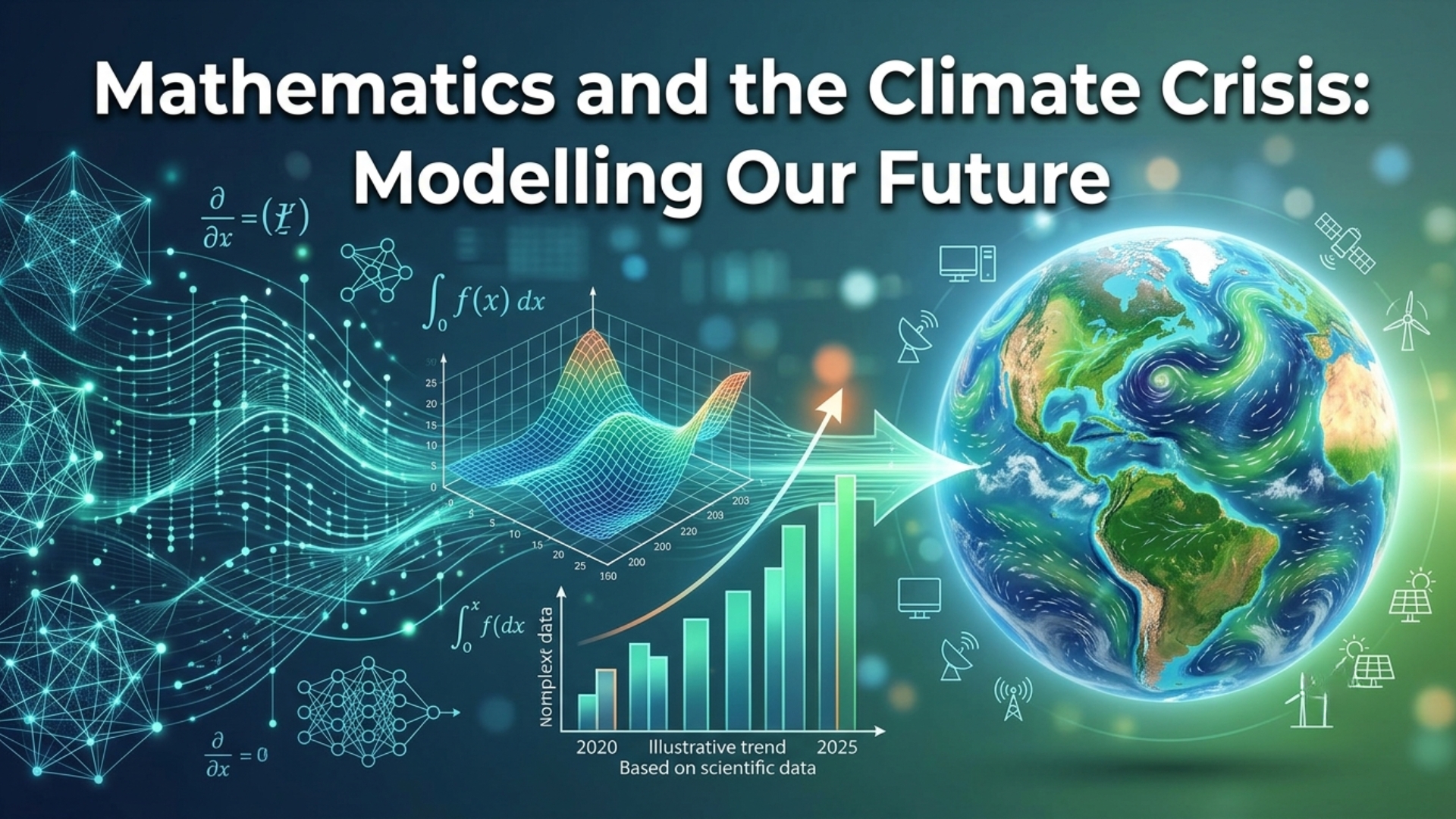
The rapid growth in mathematical modelling applied to climate science, 2020–2025 (illustrative trend based on IPCC and journal data).

When scientists want to know what Earth’s climate will look like in 2100, they do not simply observe and guess. They build mathematical models — vast systems of partial differential equations that encode the physics of the atmosphere, oceans, ice sheets, and biosphere. These models run on the world’s most powerful supercomputers, and their outputs inform government policy, infrastructure planning, and international treaty negotiations. Mathematics, quiet and unglamorous, is doing some of the most consequential work of our era.

The Navier-Stokes equations, which describe fluid motion, form the backbone of atmospheric and ocean models. These are the same equations that the 2025 Hilbert Sixth Problem breakthrough helped to place on firmer mathematical ground. The global climate system is, in essence, a coupled fluid dynamics problem of extraordinary complexity — and every mathematical insight into fluid behaviour translates, ultimately, into better predictions about hurricanes, droughts, and sea level rise.

AI-assisted mathematical modelling

In 2025 and 2026, a new generation of hybrid models began to emerge — systems that combine traditional mathematical physics with machine learning. Rather than replacing differential equations with neural networks, researchers are using AI to learn the residuals: the gaps between what physics-based models predict and what observations show. This “physics-informed machine learning” approach allows models to improve with data while remaining grounded in mathematical principles that ensure physical plausibility.

Separately, neuromorphic computing — processors modelled on the human brain — demonstrated in early 2026 that they can solve the complex equations behind physics simulations at a fraction of the energy cost of traditional supercomputers. This could dramatically reduce the computational cost of running climate models, enabling higher-resolution simulations that capture regional climate dynamics with far greater precision.

“Mathematics is the language in which the climate crisis is both written and, perhaps, solved.” — Open University Mathematics Education Blog, 2026

Data literacy as a civic necessity

Beyond the research frontier, applied mathematics is reshaping how citizens and policymakers engage with climate data. England’s forthcoming curriculum refresh (expected 2027) emphasises data literacy as a core mathematical skill — understanding graphs, interpreting uncertainty, and evaluating statistical claims. At a moment when climate projections, risk assessments, and emissions targets are contested in public debate, mathematical literacy is not merely an academic virtue. It is a prerequisite for democratic participation in civilisation’s most urgent conversation.

Sources & Further Reading

Science Daily (2026). Neuromorphic computers solve complex physics equations with low energy. sciencedaily.com, February 2026.

Open University Mathematics Education Blog (2026). England’s Curriculum Refresh and Data Education. open.ac.uk/blogs/MathEd

IPCC (2023). Sixth Assessment Report: Mathematical foundations of climate modelling. ipcc.ch

HMH Education (2026). 10 Top Trends in Education to Watch in 2026. hmhco.com

Quanta Magazine (2025). Year in Review: Applied Mathematics. quantamagazine.org
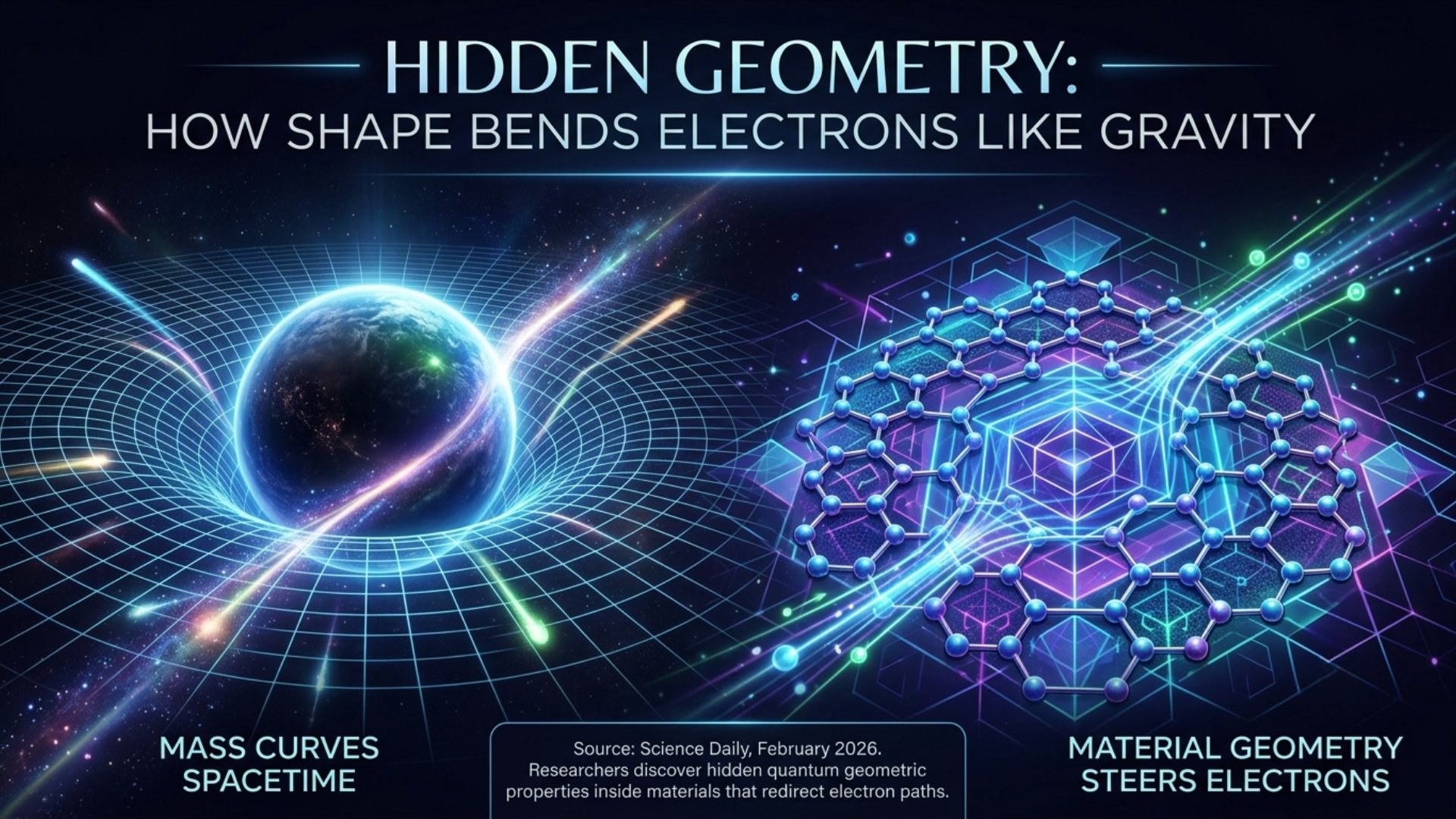


Hidden Geometry: How Shape Bends Electrons Like Gravity

Scientists discover that materials harbour an invisible quantum geometry that steers electrons — echoing how mass curves spacetime.

Hexagonal quantum lattice structures. Researchers found that hidden geometric properties inside materials subtly redirect electron paths. (Science Daily, February 2026)

One of Einstein’s most profound insights was that gravity is not a force at all in the traditional sense, but rather the curvature of spacetime — mass bends the fabric of the universe, and objects simply follow the straightest possible path through that curved space. Light, following these geodesics, appears to bend around massive objects. In February 2026, a team of physicists and mathematicians announced a discovery that carries an extraordinary echo of this idea — not in outer space, but inside the quantum materials that make up modern electronics.

Researchers discovered that materials harbour a hidden quantum geometry — mathematical structure built into the quantum mechanical wavefunctions of electrons — that subtly steers how electrons move through a material. Just as gravity curves spacetime and redirects light, this quantum geometry curves the electron’s “quantum space,” redirecting its path in ways that are not predicted by classical models. The discovery was published in Science Daily and has immediate implications for understanding exotic phenomena including superconductivity, topological insulators, and the anomalous Hall effect.

The mathematics of quantum geometry

At the heart of this discovery is a mathematical object called the quantum metric tensor — a quantity that measures distances in the abstract space of quantum states. Until recently, physicists focused almost exclusively on a related object called the Berry curvature when studying the geometry of quantum bands. The new research reveals that the quantum metric tensor plays an equally important role, and that ignoring it has led to incomplete models of electron transport.

“Researchers discovered a hidden quantum geometry inside materials that subtly steers electrons, echoing how gravity warps light in space.” — Science Daily, February 2026

From abstract to applicable

This is not merely a philosophical revelation. The quantum metric tensor is now being integrated into models of superconductors — materials that conduct electricity with zero resistance at low temperatures. Understanding the geometry of electron wavefunctions more completely may explain why some materials superconduct at higher temperatures than theory currently predicts, a problem that has profound implications for energy transmission and quantum computing. Mathematics, once again, provides the language in which nature’s deepest mechanisms are written.

Sources & Further Reading

Science Daily (2026). Scientists Discover Hidden Geometry That Bends Electrons Like Gravity. sciencedaily.com, February 2026.

Science Daily (2026). Neuromorphic computers modelled after the human brain solve complex equations. sciencedaily.com, February 2026.

Quanta Magazine (2025). Year in Review: Mathematics and Physics Intersect. quantamagazine.org

Scientific American (2025). The Top 10 Math Discoveries of 2025. scientificamerican.com


Triangle to Square: A 1907 Puzzle Finally Solved

The minimum number of pieces needed to dissect a triangle into a square has been proven — after more than a century of trying.

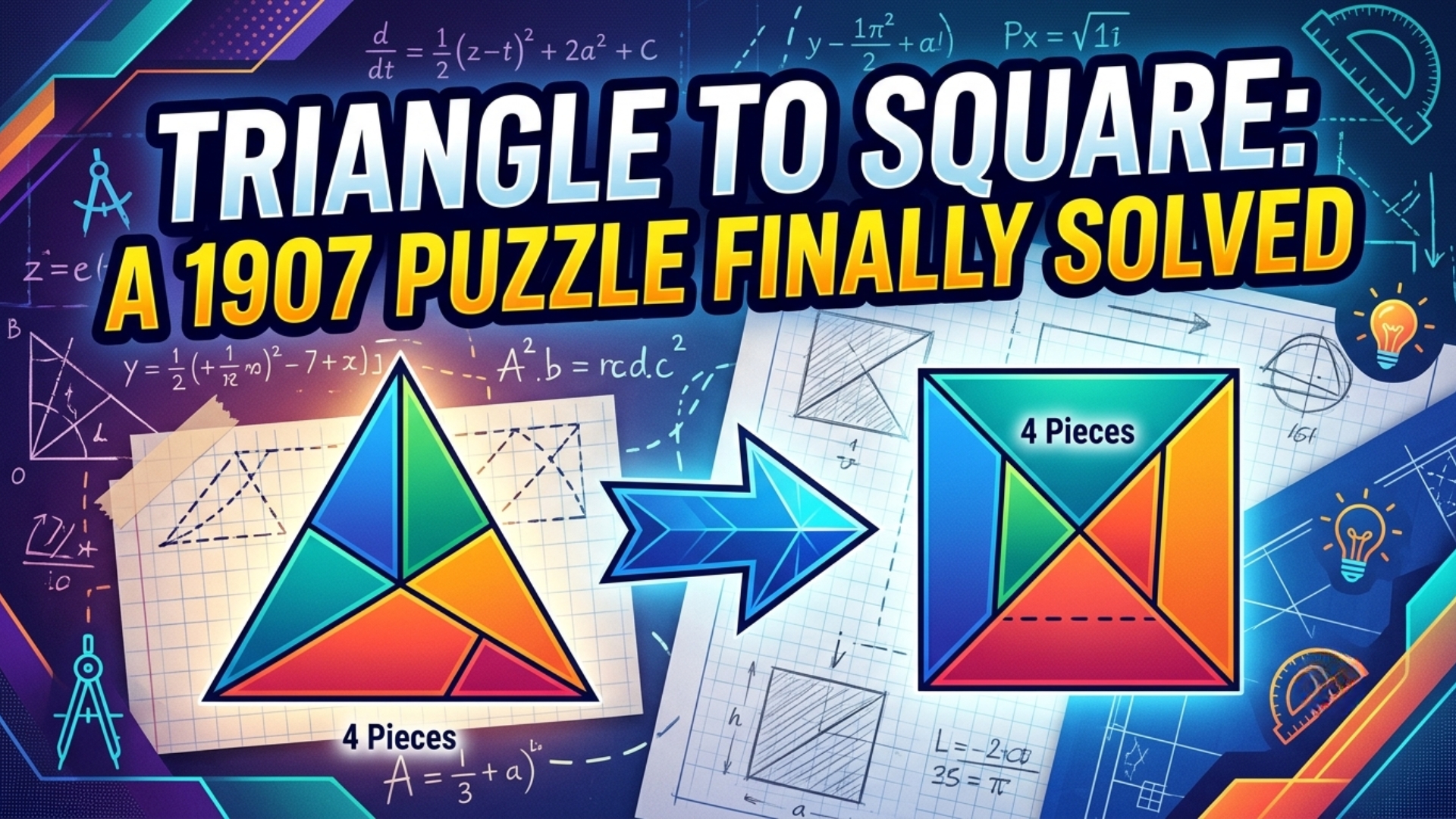
The classic dissection problem: cutting a triangle into the fewest pieces that can be rearranged into a square. Proven in 2025 to require at minimum 4 pieces.

In 1907, British puzzle maestro Henry Ernest Dudeney posed a question that has delighted and frustrated mathematicians for over a century: what is the minimum number of pieces needed to cut an equilateral triangle, and rearrange the pieces — without any folding or overlap — into a perfect square of the same area? Dudeney himself showed that four pieces suffice, producing a beautiful hinged dissection that can be photographed and reconstructed in minutes. But could it be done with three? Nobody knew.

For 118 years, this question remained technically open. Countless mathematicians and recreational puzzle enthusiasts attempted constructions with three pieces. All failed. But failure to find a three-piece solution is not the same as a proof that none exists — perhaps somewhere in the infinite space of possible cuts there was a shape waiting to be discovered. In 2025, that uncertainty was finally eliminated.

The proof

Researchers published a rigorous proof establishing that four pieces is the absolute minimum — no dissection of a triangle into a square can be achieved with three or fewer pieces. The proof uses a combinatorial analysis of all possible ways to cut a triangular region, leveraging matching diagrams and geometric constraints to show exhaustively that no three-piece configuration can satisfy all the requirements simultaneously.

The result confirms what most mathematicians had suspected for decades, but suspicion is not proof. In mathematics, intuition without demonstration is mere conjecture. The 2025 proof closes the book definitively on a problem that began as a Victorian parlour puzzle and became a genuine open question in combinatorial geometry.

“While it may be true that this started as a game, the result helps engineers who work with material transformations and manufacturing optimisation.” — Entechonline, 2026

Why puzzle problems matter

Dudeney’s triangle-to-square problem illustrates one of mathematics’ most endearing qualities: some of the hardest problems wear the simplest disguises. The question of how to cut and rearrange shapes connects directly to computational geometry, robotics motion planning, and the mathematics of efficient manufacturing. The techniques developed to solve it have applications wherever optimal partitioning of shapes is required — from laser cutting to circuit board design.

Sources & Further Reading

Scientific American (2025). The Top 10 Math Discoveries of 2025. scientificamerican.com

Entechonline (2026). Top 10 Mathematics Discoveries in 2025. entechonline.com

Medium (2025). Mathematics in 2025: Breakthroughs That Redefined the Field. medium.com

Dudeney, H.E. (1907). Amusements in Mathematics. Original puzzle formulation (historical reference).


Prime Numbers: Finding Patterns in the Infinite Chaos

Mathematicians discover fractal-like probabilistic structures governing the distribution of prime numbers — a breakthrough 2,000 years in the making.

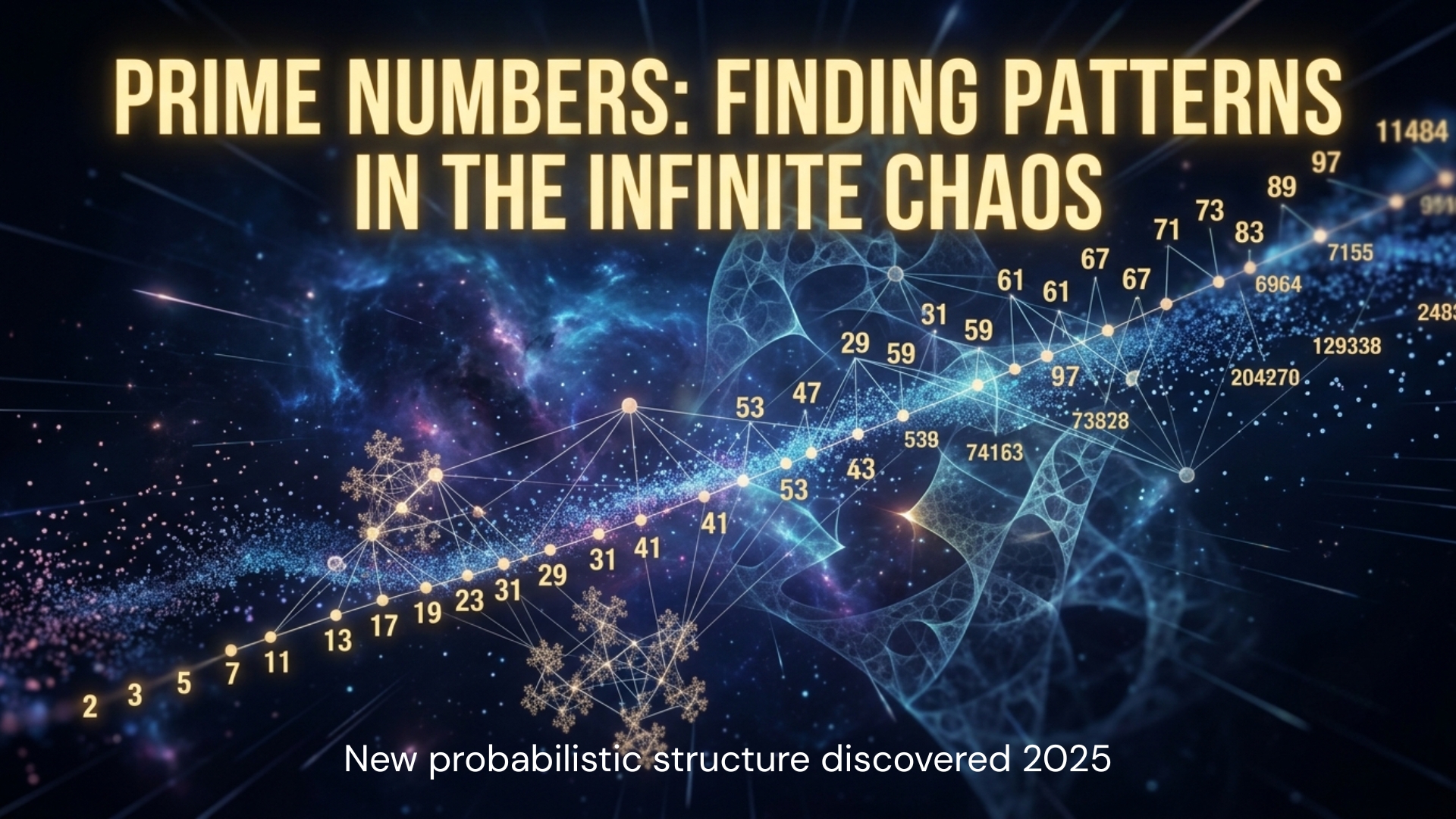
The distribution of prime numbers follows newly discovered probabilistic patterns, combining chaos theory and fractal geometry. (Scientific American, 2025)

Prime numbers are the atoms of arithmetic — the indivisible building blocks from which every whole number is constructed through multiplication. They begin simply enough: 2, 3, 5, 7, 11, 13… But their distribution along the number line has baffled mathematicians for millennia. They seem to appear randomly, with no obvious pattern, yet they are entirely determined by logic. How can something so orderly feel so chaotic?

This tension between determinism and apparent randomness has driven some of the deepest mathematics ever created, from Euler’s product formula in the 18th century to Riemann’s hypothesis in 1859 — a conjecture about the zeros of the Riemann zeta function that remains unproven and carries a $1 million prize for its resolution. In 2025, a new layer was peeled back: mathematicians discovered a set of probabilistic patterns governing how primes are distributed, patterns that involve both random chaotic behaviour and fractal geometry.

Fractals in the number line

The key discovery, highlighted by Scientific American in its year-end review of the top ten mathematical breakthroughs of 2025, is that the gaps and clustering of prime numbers — when viewed at large scales — follow statistical laws that resemble fractal structures. That is, the patterns are self-similar: zoom in or zoom out, and the same types of distributions appear. This is not the same as claiming primes are fractal (they are discrete and deterministic), but rather that their statistical fingerprint has fractal characteristics.

“Discovering new primes is difficult as you get to larger numbers. But in 2025, mathematicians found probabilistic patterns governing how primes are distributed — patterns involving fractals.” — Scientific American, 2025

A refined prime-counting method

Separately, a new and more precise technique for estimating the prime-counting function pi(x) — the number of primes up to a given value x — was developed in 2025. The method combines sieve-based elimination (filtering out composite numbers) with improved error corrections that reduce the gap between the estimate and the true count. While the method does not solve the Riemann Hypothesis, it narrows the uncertainty in prime counting to a degree that was previously out of reach, with practical applications in cryptography, where the distribution of large primes determines the security of encryption systems.

Sources & Further Reading

Scientific American (2025). The Top 10 Math Discoveries of 2025. scientificamerican.com

Quanta Magazine (2025). Year in Review: Mathematics. quantamagazine.org

Medium / Wahlastore15 (2025). Mathematics in 2025: Breakthroughs That Redefined the Field. medium.com

Entechonline (2026). Top 10 Mathematics Discoveries in 2025. entechonline.com