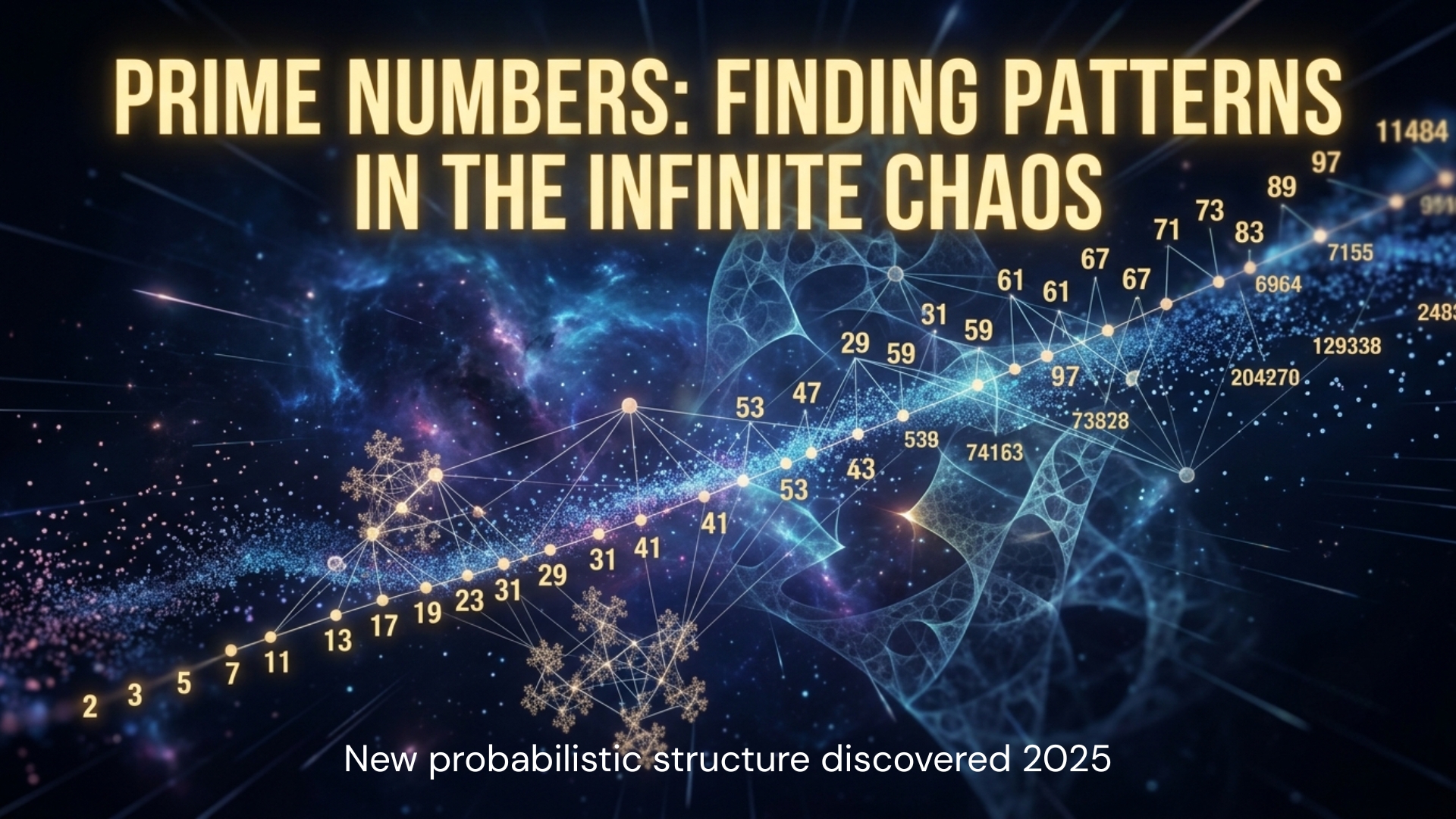
Mathematicians discover fractal-like probabilistic structures governing the distribution of prime numbers — a breakthrough 2,000 years in the making.
The distribution of prime numbers follows newly discovered probabilistic patterns, combining chaos theory and fractal geometry. (Scientific American, 2025)
Prime numbers are the atoms of arithmetic — the indivisible building blocks from which every whole number is constructed through multiplication. They begin simply enough: 2, 3, 5, 7, 11, 13… But their distribution along the number line has baffled mathematicians for millennia. They seem to appear randomly, with no obvious pattern, yet they are entirely determined by logic. How can something so orderly feel so chaotic?
This tension between determinism and apparent randomness has driven some of the deepest mathematics ever created, from Euler’s product formula in the 18th century to Riemann’s hypothesis in 1859 — a conjecture about the zeros of the Riemann zeta function that remains unproven and carries a $1 million prize for its resolution. In 2025, a new layer was peeled back: mathematicians discovered a set of probabilistic patterns governing how primes are distributed, patterns that involve both random chaotic behaviour and fractal geometry.
Fractals in the number line
The key discovery, highlighted by Scientific American in its year-end review of the top ten mathematical breakthroughs of 2025, is that the gaps and clustering of prime numbers — when viewed at large scales — follow statistical laws that resemble fractal structures. That is, the patterns are self-similar: zoom in or zoom out, and the same types of distributions appear. This is not the same as claiming primes are fractal (they are discrete and deterministic), but rather that their statistical fingerprint has fractal characteristics.
“Discovering new primes is difficult as you get to larger numbers. But in 2025, mathematicians found probabilistic patterns governing how primes are distributed — patterns involving fractals.” — Scientific American, 2025
A refined prime-counting method
Separately, a new and more precise technique for estimating the prime-counting function pi(x) — the number of primes up to a given value x — was developed in 2025. The method combines sieve-based elimination (filtering out composite numbers) with improved error corrections that reduce the gap between the estimate and the true count. While the method does not solve the Riemann Hypothesis, it narrows the uncertainty in prime counting to a degree that was previously out of reach, with practical applications in cryptography, where the distribution of large primes determines the security of encryption systems.
Sources & Further Reading
Scientific American (2025). The Top 10 Math Discoveries of 2025. scientificamerican.com
Quanta Magazine (2025). Year in Review: Mathematics. quantamagazine.org
Medium / Wahlastore15 (2025). Mathematics in 2025: Breakthroughs That Redefined the Field. medium.com
Entechonline (2026). Top 10 Mathematics Discoveries in 2025. entechonline.com