
The minimum number of pieces needed to dissect a triangle into a square has been proven — after more than a century of trying.
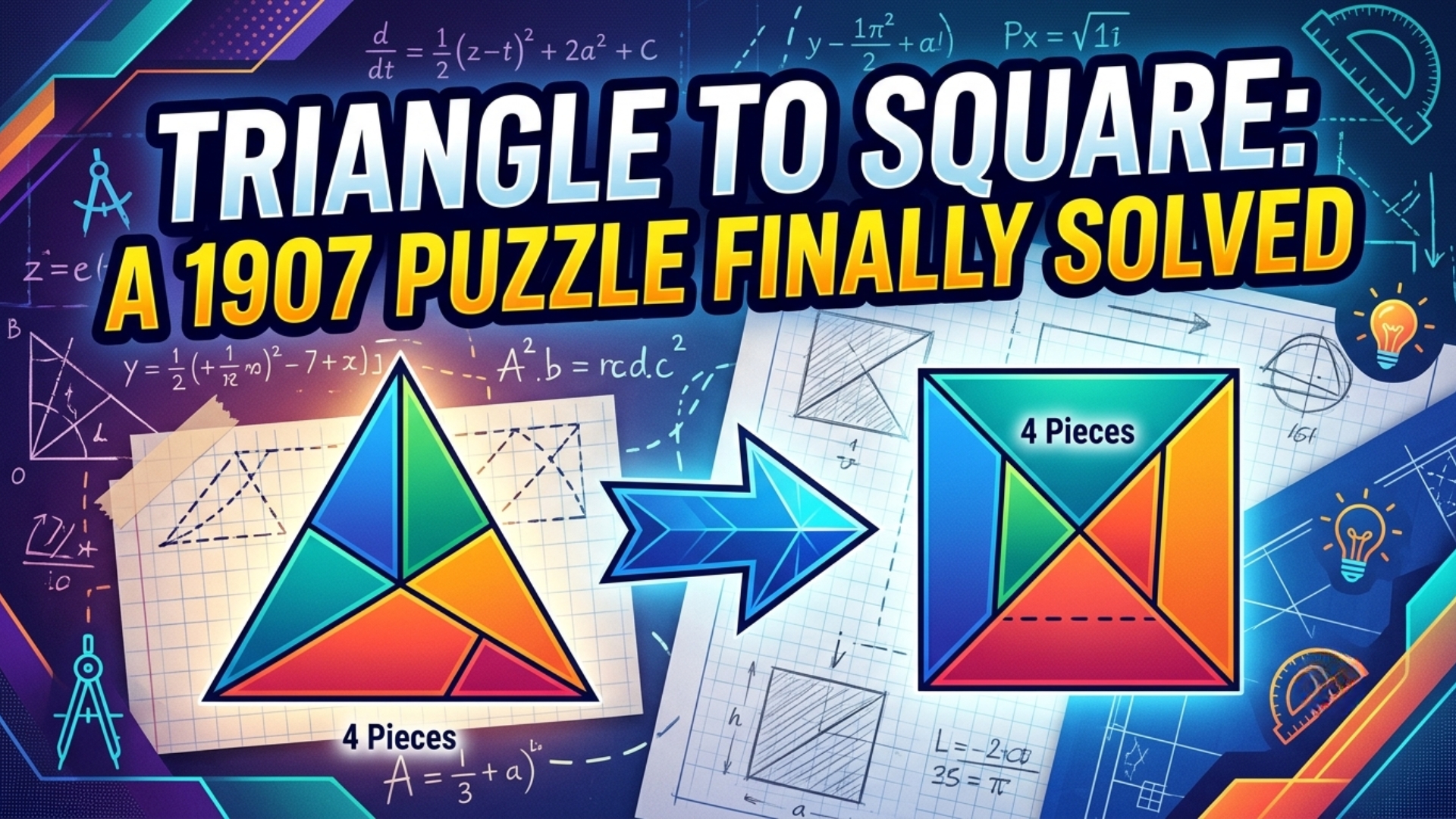
The classic dissection problem: cutting a triangle into the fewest pieces that can be rearranged into a square. Proven in 2025 to require at minimum 4 pieces.
In 1907, British puzzle maestro Henry Ernest Dudeney posed a question that has delighted and frustrated mathematicians for over a century: what is the minimum number of pieces needed to cut an equilateral triangle, and rearrange the pieces — without any folding or overlap — into a perfect square of the same area? Dudeney himself showed that four pieces suffice, producing a beautiful hinged dissection that can be photographed and reconstructed in minutes. But could it be done with three? Nobody knew.
For 118 years, this question remained technically open. Countless mathematicians and recreational puzzle enthusiasts attempted constructions with three pieces. All failed. But failure to find a three-piece solution is not the same as a proof that none exists — perhaps somewhere in the infinite space of possible cuts there was a shape waiting to be discovered. In 2025, that uncertainty was finally eliminated.
The proof
Researchers published a rigorous proof establishing that four pieces is the absolute minimum — no dissection of a triangle into a square can be achieved with three or fewer pieces. The proof uses a combinatorial analysis of all possible ways to cut a triangular region, leveraging matching diagrams and geometric constraints to show exhaustively that no three-piece configuration can satisfy all the requirements simultaneously.
The result confirms what most mathematicians had suspected for decades, but suspicion is not proof. In mathematics, intuition without demonstration is mere conjecture. The 2025 proof closes the book definitively on a problem that began as a Victorian parlour puzzle and became a genuine open question in combinatorial geometry.
“While it may be true that this started as a game, the result helps engineers who work with material transformations and manufacturing optimisation.” — Entechonline, 2026
Why puzzle problems matter
Dudeney’s triangle-to-square problem illustrates one of mathematics’ most endearing qualities: some of the hardest problems wear the simplest disguises. The question of how to cut and rearrange shapes connects directly to computational geometry, robotics motion planning, and the mathematics of efficient manufacturing. The techniques developed to solve it have applications wherever optimal partitioning of shapes is required — from laser cutting to circuit board design.
Sources & Further Reading
Scientific American (2025). The Top 10 Math Discoveries of 2025. scientificamerican.com
Entechonline (2026). Top 10 Mathematics Discoveries in 2025. entechonline.com
Medium (2025). Mathematics in 2025: Breakthroughs That Redefined the Field. medium.com
Dudeney, H.E. (1907). Amusements in Mathematics. Original puzzle formulation (historical reference).