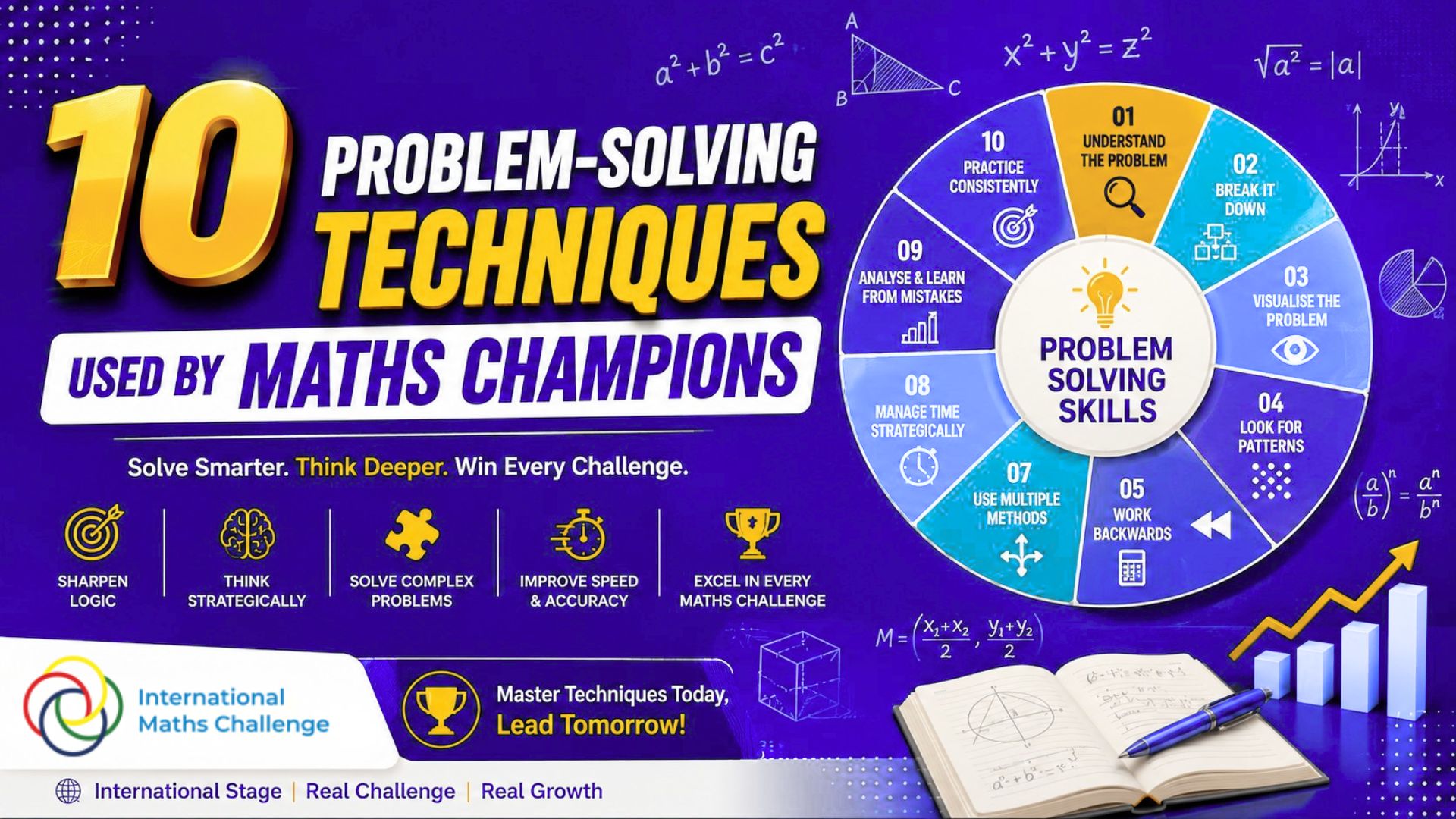
10 Problem-Solving Techniques Used by Maths Champions

Winning a Maths Challenge is not just about solving hundreds of questions, it’s about solving them smartly. The best-performing students in every Maths competition have one thing in common: they follow structured problem-solving techniques instead of relying on guesswork or memorization.

Whether you’re preparing for your school Olympiad or an International Maths Challenge, mastering these strategies can significantly improve your speed, accuracy, and confidence.

In this guide, we’ll explore the 10 problem-solving techniques used by maths champions and how you can apply them in your own maths preparation.

1. Understand the Problem Before Solving

One of the biggest mistakes students make is rushing into calculations without fully understanding the question.

Maths champions always spend a few seconds identifying:

  • What is being asked?
  • What information is already given?
  • Are there any hidden conditions?
  • Which concepts are involved?

Reading carefully often prevents simple mistakes that cost valuable marks during a Maths competition.

Pro Tip: Underline important numbers and keywords before solving.

2. Break Complex Problems into Smaller Steps

Large problems often look intimidating because students try solving everything at once.

Instead, top performers divide the problem into manageable parts.

For example:

  • Find intermediate values.
  • Solve one condition at a time.
  • Combine the results.

This approach makes difficult questions much easier and reduces calculation errors.

3. Visualise the Question

Many maths champions convert words into visual representations.

They use:

  • Diagrams
  • Tables
  • Number lines
  • Graphs
  • Shapes

Visual thinking is especially useful for:

  • Geometry
  • Ratios
  • Fractions
  • Probability
  • Logical reasoning

Drawing a simple sketch can reveal relationships that aren’t obvious in text.

4. Look for Patterns

Pattern recognition is one of the strongest skills developed through regular maths preparation.

Whenever students encounter:

  • Number sequences
  • Algebraic expressions
  • Geometric arrangements
  • Logical puzzles

they actively search for recurring relationships.

Recognising patterns often leads to quicker solutions with fewer calculations.

5. Work Backwards

Some questions become much easier when solved from the final answer instead of the beginning.

This technique is especially useful for:

  • Age problems
  • Number puzzles
  • Reverse operations
  • Logic-based questions

Working backwards allows students to eliminate unnecessary steps and verify their reasoning.

6. Estimate Before Calculating

Maths champions rarely jump straight into detailed calculations.

They first estimate the expected answer.

This helps them:

  • Detect calculation mistakes
  • Eliminate incorrect options
  • Improve accuracy
  • Save time

Estimation is particularly valuable in multiple-choice Maths Challenge exams.

7. Learn Multiple Solution Methods

Top competitors know that every problem can often be solved in more than one way.

For example:

  • Algebraic method
  • Logical reasoning
  • Elimination
  • Mental maths
  • Visual approach

Having multiple strategies allows students to choose the quickest method during a timed Maths competition.

Flexibility is one of the biggest advantages of experienced problem solvers.

8. Manage Time Strategically

Successful students understand that time is as important as accuracy.

Their strategy usually includes:

  • Solving easy questions first
  • Skipping lengthy questions initially
  • Returning later with fresh thinking
  • Keeping enough time for revision

Effective time management often improves scores without increasing mathematical ability.

9. Analyse Mistakes After Practice

The best maths champions don’t simply count how many questions they solved—they analyse every mistake.

After each practice session, ask:

  • Why was the answer wrong?
  • Was it a concept error?
  • Was it a calculation mistake?
  • Was the question misunderstood?
  • Was time management the issue?

Maintaining an error notebook helps prevent repeating the same mistakes.

This habit is one of the fastest ways to improve maths preparation.

10. Practice Consistently with Challenging Questions

Consistency always beats last-minute studying.

Instead of solving only easy textbook exercises, maths champions regularly attempt:

  • Higher-order reasoning problems
  • Previous competition papers
  • Timed mock tests
  • Mixed-topic quizzes

Exposure to different question types builds confidence and improves adaptability.

Participating in an International Maths Challenge also provides valuable experience by exposing students to questions that test conceptual understanding, logical reasoning, and creative problem-solving under exam conditions.

How the International Maths Challenge Helps Students Develop Problem-Solving Skills

The International Maths Challenge is designed to encourage students to think beyond routine classroom mathematics. Rather than focusing only on calculations, it emphasizes reasoning, analytical thinking, and practical application of mathematical concepts.

Students benefit from:

  • Exposure to internationally benchmarked questions
  • Stronger logical reasoning skills
  • Improved speed and accuracy
  • Greater confidence in tackling unfamiliar problems
  • Better preparation for future Maths competitions

Regular participation also helps students become comfortable with competitive exam environments while developing lifelong mathematical thinking skills.

Tips for Effective Maths Preparation

To maximise your performance in any Maths Challenge, follow these habits:

  • Practice mathematics every day.
  • Focus on understanding concepts instead of memorising formulas.
  • Solve questions from different topics regularly.
  • Attempt timed mock tests.
  • Review mistakes after every practice session.
  • Challenge yourself with higher-level problems.
  • Stay calm and think logically during the exam.

Small improvements every day lead to significant long-term success.

Final Thoughts

Every maths champion starts as a learner. What separates top performers is not extraordinary talent but the consistent use of smart problem-solving strategies.

By applying these 10 problem-solving techniques, students can approach every Maths Challenge with greater confidence, solve questions more efficiently, and continuously improve their performance in every Maths competition.

Remember, excellent maths preparation isn’t about studying harder, it’s about studying smarter. Participating in platforms like the International Maths Challenge gives students the opportunity to apply these techniques in a competitive environment while sharpening the analytical skills that extend far beyond mathematics.
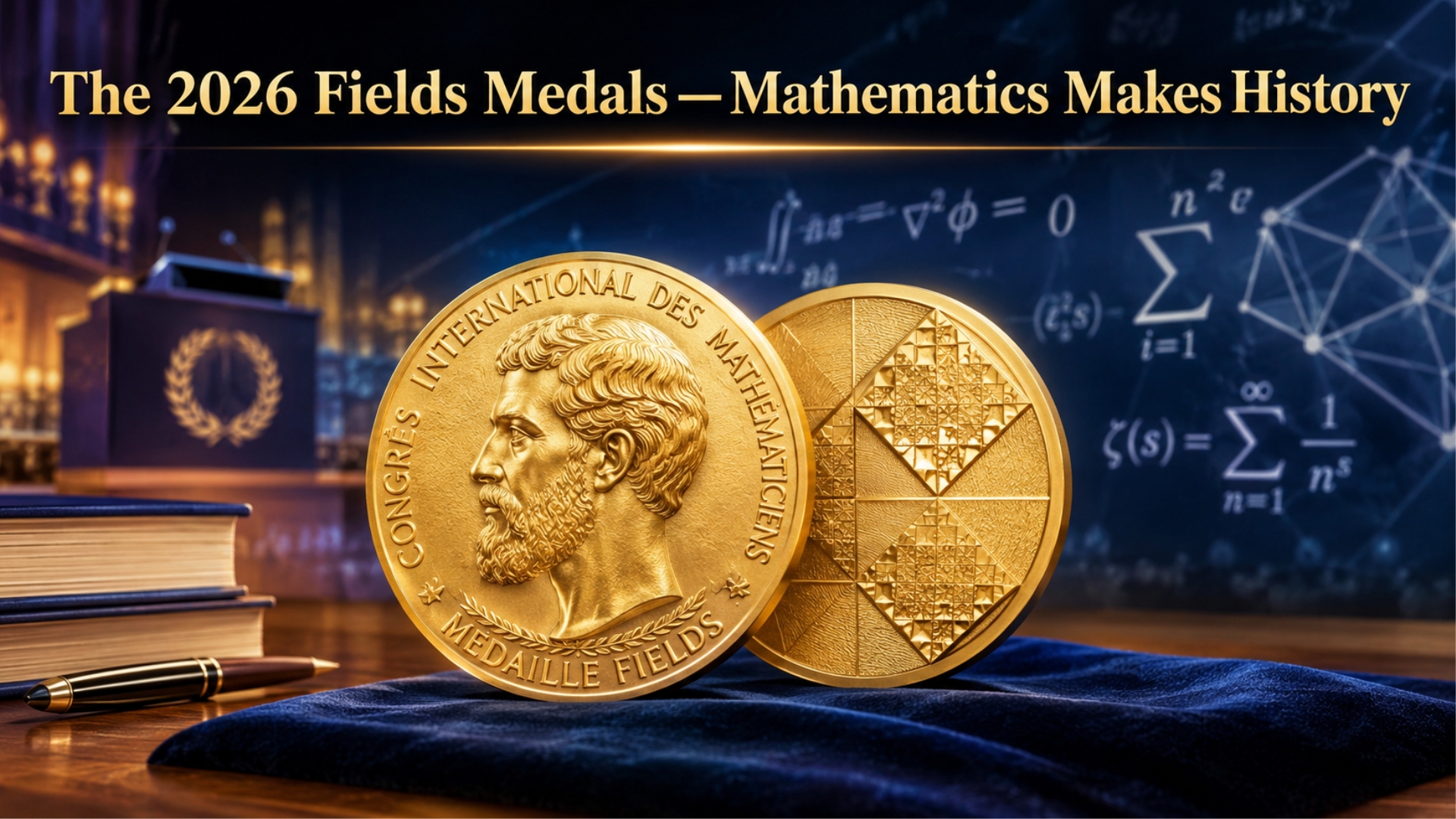
The 2026 Fields Medals — Mathematics Makes History

Every four years, the mathematics world holds its breath. The International Congress of Mathematicians gathers the brightest minds on the planet, and the International Mathematical Union announces the awards that define a generation of mathematical achievement. On 23 July 2026, at the ICM in Philadelphia — the first held in the United States since 1986 — four remarkable individuals were awarded the Fields Medal, widely described as the Nobel Prize of mathematics.

The Fields Medal has a history as rich as the mathematics it celebrates. First awarded in 1936, it was the vision of John Charles Fields, a Canadian mathematician who wanted to create an award that would both recognise outstanding work already done and encourage future achievement. Unlike the Nobel Prize, which can be awarded to scientists of any age, the Fields Medal comes with a strict upper age limit of 40. This is deliberate. The award is designed not just to honour what has been accomplished but to signal what is still to come — to tell the world that this person is worth watching.

Each winner receives CAD 15,000 and a gold medal bearing the image of the Greek mathematician Archimedes. The prize money is modest by the standards of other major awards. What the medal confers is something far more valuable than money — it is the recognition of peers, the weight of history and membership in one of the smallest and most distinguished clubs in human intellectual life.

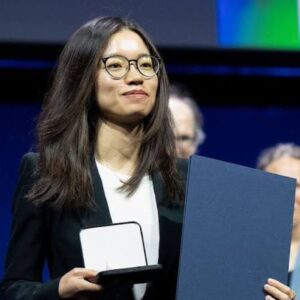
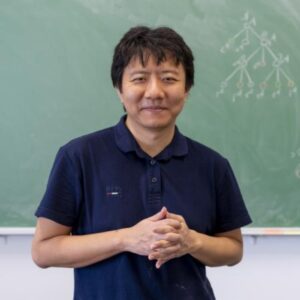
This year’s prizes went to four of the world’s top mathematicians: Yu Deng of the University of Chicago, John Pardon of Stony Brook University in New York, Jacob Tsimerman of the University of Toronto, and Hong Wang of New York University and France’s Institut des Hautes Études Scientifiques. The IMU president Hiraku Nakajima praised their depth, originality and vitality in contemporary mathematics.

Hong Wang — The History Maker

Of the four winners, it is Hong Wang whose story has captured the world’s imagination most powerfully. Wang is the third woman ever to win the Fields Medal in the 90 years since the award was established. The first was Iranian mathematician Maryam Mirzakhani in 2014, followed by Ukrainian mathematician Maryna Viazovska in 2022. No woman received the award at all in the nearly 80 years before Mirzakhani’s win. That statistic alone tells a story about the historical barriers women have faced in mathematics — and Wang’s win is another step, however overdue, toward dismantling them.

Wang, 35, was born in Guilin, China, and is now a professor at New York University as well as a researcher at the Institut des Hautes Études Scientifiques in France. Her award was for work on the Kakeya conjecture, a deceptively simple-sounding problem that had defeated mathematicians for roughly 50 years. The conjecture asks how little space is needed to rotate a needle in three-dimensional space so that it points in every possible direction. It sounds almost like a puzzle from a school textbook — and yet the mathematics required to answer it reaches into some of the deepest and most sophisticated corners of geometry and analysis.

In February 2025, Wang and her collaborator Joshua Zahl presented a 127-page proof of the long-standing conjecture. The duo had been checking their work for months and had sent it to select colleagues for review before finally mustering the courage to post it publicly. Wang worried less that the arguments were flawed than that they might be imperfectly expressed and therefore unclear.

That attention to clarity and precision is characteristic of Wang’s approach to mathematics. She has spoken openly about working harder than she feels she needs to, about the self-doubt that accompanies even the most celebrated careers in mathematics, and about the satisfaction of solving problems that others have given up on. Her story is a reminder that mathematical genius is not a thunderbolt — it is the product of sustained effort, intellectual courage and an unwillingness to accept that something cannot be done.

Yu Deng — Bridging the Microscopic and the Macroscopic

Yu Deng, a professor at the University of Chicago, received his medal for work that sits at the boundary between mathematics and physics. Specifically he was recognised for connecting microscopic and macroscopic descriptions of gases — for building mathematical bridges between the behaviour of individual molecules and the large-scale behaviour of fluids and gases that we observe in the physical world.

Yu Deng and Hong Wang are only the second and third Chinese nationals to have earned a Fields Medal, after Shing-Tung Yau who won his in 1982. That two Chinese-born mathematicians won in the same year, after a gap of more than four decades, is a remarkable moment. It reflects both the extraordinary depth of mathematical talent emerging from China and the increasingly global character of the discipline.

Deng’s work helped resolve a longstanding conceptual puzzle in physics. Microscopic physics — the behaviour of individual particles — works just as well when time is reversed. If you filmed two molecules bouncing off each other and played it backwards you would not be able to tell the difference. But when many molecules form a fluid, they behave in a clearly irreversible way — heat flows from hot to cold, never the reverse, without any external interference. Deng’s mathematics helps explain how irreversibility emerges from a world of reversible interactions. It is the kind of question that sits at the deepest level of our understanding of the physical universe.

John Pardon — Solving Topology’s Hardest Problems

John Pardon of Stony Brook University in New York was honoured for work in topology and geometry — two of the oldest and richest branches of mathematics. Topology is concerned with properties of shapes that remain unchanged when those shapes are continuously stretched, bent or deformed without tearing. In topology, a coffee cup and a donut are mathematically identical because one can be smoothly transformed into the other. It is a field that sounds abstract but underpins significant parts of modern physics, robotics and data science.

Pardon has spent his career tackling problems in topology and geometry that had resisted solution despite decades of effort by the best minds in the field. His methods are characterised by a willingness to combine ideas from different areas of mathematics in unexpected ways — a quality he shares with several of this year’s other honourees. His work has not only solved specific problems but opened up new lines of inquiry that will keep mathematicians busy for years.

Jacob Tsimerman — New Tools for Ancient Puzzles

Jacob Tsimerman of the University of Toronto works at the intersection of number theory and algebraic geometry — two fields that have been in increasingly deep conversation over the last century. Number theory is among the oldest branches of mathematics, concerned with the properties of whole numbers and the patterns hidden within them. Algebraic geometry translates geometric questions into algebraic language and vice versa, creating a powerful two-way dictionary between shape and equation.

Tsimerman’s contribution has been to develop new technical tools in this space that have allowed mathematicians to make progress on problems that had previously seemed completely out of reach. His methods combine deep ideas from several different areas of mathematics in ways that were not obvious to anyone before him. In the world of mathematics, this kind of bridge-building is often the most valuable contribution of all — not just solving one problem but creating the machinery that allows many others to be solved.

The Bigger Picture

The 2026 Fields Medal class is striking not just for the brilliance of the individual mathematics but for what it represents collectively. A Chinese-born woman solving a 50-year-old geometry problem. Two Chinese-born winners for the first time in four decades. An American solving topology’s hardest problems. A Canadian building new roads through algebraic geometry. Four people from four different corners of the mathematical world, united by the same relentless curiosity and the same willingness to spend years on problems that might defeat them.

Mathematics has always been one of the few truly universal languages. This year’s medalists are a powerful reminder of why. The discipline does not care about borders, backgrounds or biography. It cares only about ideas — and whether they are true.

The 2026 Abacus Medal and the full ICM prize ceremony — coming soon.

For more blog updates, keep following International Maths Challenge.


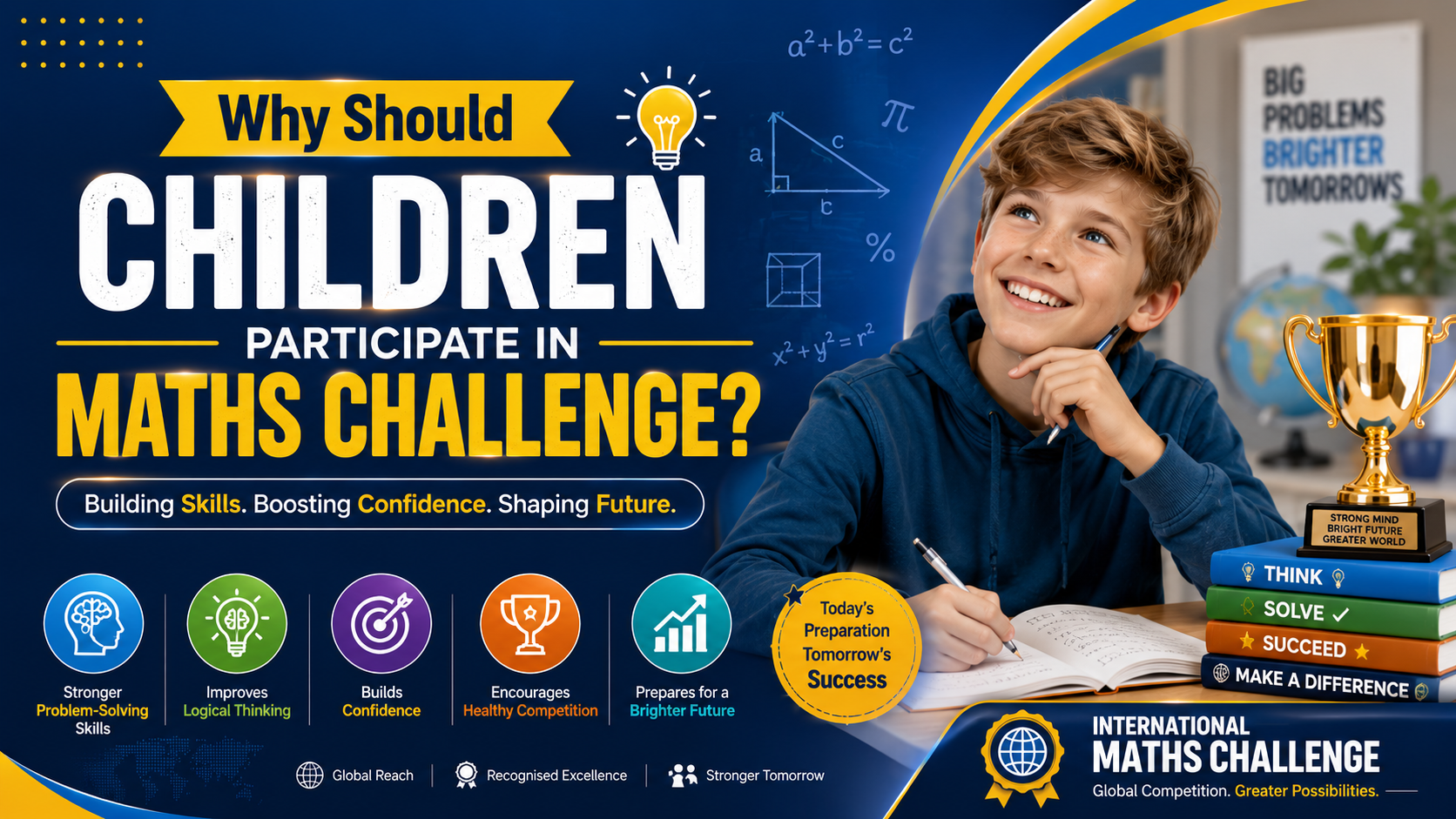
Why Should Children Participate in Maths Challenge? A Complete Guide for Parents

Every parent wants their child to become confident, analytical, and capable of solving real-life problems. While school mathematics builds the foundation, participating in a Maths Challenge takes learning a step further by encouraging students to think logically, solve unfamiliar problems, and develop a genuine love for mathematics.

Whether your child is already good at maths or simply wants to improve, a Maths Competition can be one of the most rewarding learning experiences. In this article, we’ll explore why every student should consider participating in an International Maths Challenge and how proper maths preparation can shape their academic journey.

What is a Maths Challenge?

A Maths Challenge is a competitive assessment designed to test more than just textbook knowledge. Instead of asking students to repeat formulas, it evaluates their ability to apply mathematical concepts, identify patterns, think critically, and solve problems creatively.

Unlike regular school exams, these challenges encourage deeper understanding and analytical thinking, skills that are valuable in academics and everyday life.

Why Should Children Participate in a Maths Challenge?

  1. Builds Strong Problem-Solving Skills

One of the biggest advantages of participating in a Maths Challenge is the development of problem-solving abilities.

Students encounter questions that require logical reasoning rather than memorization. As they practice solving different types of problems, they become more confident in approaching difficult questions both inside and outside the classroom.

  1. Improves Logical and Critical Thinking

Mathematics is not just about numbers, it’s about thinking.

A well-designed Maths Competition encourages students to:

  • Identify patterns
  • Analyze information
  • Think strategically
  • Evaluate multiple solutions

These thinking skills benefit students in science, technology, coding, engineering, and even daily decision-making.

  1. Makes Maths More Interesting

Many children consider mathematics difficult because classroom learning often focuses on routine exercises.

A Maths Challenge introduces puzzles, logical questions, and real-world applications that make learning enjoyable. Students begin seeing mathematics as an exciting subject instead of just another school requirement.

  1. Boosts Confidence

Successfully solving challenging mathematical problems gives students a strong sense of achievement.

Even if they don’t win a medal, participating in a Maths Competition helps children:

  • Overcome fear of difficult questions
  • Improve self-confidence
  • Develop a positive attitude toward learning
  • Become more willing to take on academic challenges

Confidence gained through competitions often reflects in school performance as well.

  1. Encourages Healthy Competition

Healthy competition motivates students to perform better while learning from others.

The International Maths Challenge allows students to compare their skills with participants from different schools, cities, and countries. This broader exposure inspires continuous improvement and helps children understand global academic standards.

  1. Strengthens School Performance

Students preparing for a Maths Challenge revise mathematical concepts more thoroughly than they typically would for regular school exams.

Regular practice improves:

  • Calculation speed
  • Concept clarity
  • Accuracy
  • Time management

As a result, many students notice better performance in classroom tests and annual examinations.

  1. Develops Discipline and Consistency

Preparing for a Maths Competition teaches students valuable habits such as:

  • Daily practice
  • Goal setting
  • Time management
  • Self-evaluation

These habits contribute not only to mathematics but to overall academic success.

Why Choose International Maths Challenge?

International Maths Challenge offers students an opportunity to compete beyond their local environment.

Benefits include:

  • Exposure to international-level questions
  • Benchmarking against global participants
  • Recognition through certificates, medals, and awards
  • Increased motivation to excel in mathematics
  • Preparation for higher-level competitive examinations

Such experiences broaden students’ perspectives and inspire them to aim higher in their academic careers.

How to Prepare for a Maths Challenge?

Proper maths preparation plays an important role in achieving success.

Here are some effective preparation strategies:

Master Basic Concepts

A strong understanding of school mathematics forms the foundation for solving advanced problems.

Practice Daily

Even 20–30 minutes of focused practice each day can significantly improve mathematical ability over time.

Improve Speed and Accuracy

Timed practice sessions help students balance speed with accuracy, an essential skill in any Maths Competition.

Focus on Logical Reasoning

Many challenge questions require logical thinking rather than lengthy calculations. Encourage students to solve puzzles and reasoning exercises regularly.

Review Mistakes

Instead of simply checking answers, students should understand why mistakes occurred. Learning from errors is one of the fastest ways to improve.

Skills Children Gain Beyond Mathematics

Participating in a Maths Challenge develops several lifelong skills:

  • Critical thinking
  • Logical reasoning
  • Analytical ability
  • Decision-making
  • Concentration
  • Patience
  • Confidence
  • Perseverance
  • Time management

These skills are valuable regardless of the career path a child chooses.

Common Myths About Maths Competitions

“Only brilliant students can participate.”

False.

Most Maths Competitions welcome students of varying skill levels. Participation itself provides valuable learning opportunities.

“Winning is everything.”

Not at all.

The real success lies in developing stronger mathematical thinking, improving confidence, and enjoying the learning process.

“Competitions create unnecessary pressure.”

When approached positively, competitions motivate students to improve without focusing solely on rankings.

Why Parents Should Encourage Participation

Parents play an important role in building a child’s confidence.

Instead of emphasizing scores, celebrate effort, consistency, and improvement. Encourage curiosity, support regular maths preparation, and view competitions as learning experiences rather than pressure-filled events.

Children who receive positive encouragement are more likely to enjoy mathematics and continue challenging themselves academically.

Final Thoughts

Participating in a Maths Challenge is about much more than winning medals. It develops logical thinking, strengthens problem-solving skills, builds confidence, and prepares students for future academic success.

The International Maths Challenge provides an excellent platform for students to test their abilities, learn from new experiences, and compete with peers from around the world. With consistent maths preparation, every child can improve their mathematical skills and develop a lifelong appreciation for learning.

Whether your child is just beginning their mathematical journey or already enjoys solving challenging problems, joining a Maths Competition can be a valuable step toward academic growth and personal development.


When Mathematicians Said Enough: The Leiden Declaration and the Battle for the Soul of Mathematics

In May 2026, OpenAI made an announcement that sent ripples through the global mathematics community. A generative AI model had produced a refutation of the unit distance problem, an 80-year-old conjecture by the legendary mathematician Paul Erdős in combinatorial geometry. For some it was a moment of wonder. For others it was a warning. And for a group of mathematicians who had spent the previous nine months drafting a document in careful, measured language, it was confirmation that the moment they had been preparing for had arrived.

On 2 June 2026, the Leiden Declaration on Artificial Intelligence and Mathematics went public. Within 24 hours, more than 1,000 people had signed it. The International Mathematical Union announced its endorsement and published a thoughtful editorial on the declaration. An editorial in Nature also endorsed both the process and its conclusions. What had begun as a workshop conversation had become one of the most significant statements the mathematics community has made in a generation.

Where It Began

The declaration originated at a September 2025 workshop at the Lorentz Center at Leiden University, where sixty researchers and policymakers gathered to consider the effect of technology on mathematics, given the increase in proofs being written in part or whole by AI.

The Lorentz Center, named after the Dutch physicist Hendrik Lorentz, is known for convening focused workshops at the frontier of science. This one brought together mathematicians, computer scientists, philosophers and historians — people with very different relationships to artificial intelligence and very different views on what it means for their field. What emerged from those conversations was not a ban, not a manifesto against technology, but something more nuanced and ultimately more powerful: a shared articulation of values.

The declaration was issued by 16 researchers from 15 universities and is endorsed by the International Mathematical Union. By the time of publication it had drawn more than 130 signatories. That number would grow dramatically in the days that followed.

What the Declaration Actually Says

It is important to be clear about what the Leiden Declaration is and is not. The declaration does not call for an outright ban on AI in mathematics. It is not a Luddite document. It does not say that artificial intelligence has no place in mathematical research. What it does is something more sophisticated and more lasting — it articulates the values that mathematics depends on and asks the community, funders, journals, institutions and technology companies to take those values seriously in an age when they are under genuine threat.

The declaration defends five core commitments: proof, attribution, shared standards of evaluation, and the autonomy of the field — and warns that current AI use threatens each.

Its core concerns are the reliability of automatically generated results, attribution of work that uses proprietary models, and effects on publication and peer review. It sets out recommendations for individual researchers, professional bodies, funders and policymakers, including disclosing AI use and preserving rigorous review.

The Problem of the Unreliable Proof

At the heart of the declaration is a concern about mathematical proof itself — the thing that makes mathematics different from every other discipline. In science you run experiments and look at evidence. In mathematics you prove things. A proof is not a very good argument or a highly convincing demonstration. It is a logically airtight chain of reasoning that shows something must be true. Once something is proved it is proved forever. The permanence of mathematical truth is one of the most remarkable features of the discipline.

AI threatens this in a specific way. As Leslie Ann Goldberg, head of computer science at the University of Oxford, put it: “Inaccurate AI-generated drafts are cheap to produce, and there is a risk of cluttering the literature with claimed results that are simply wrong.”

The danger is not that AI will produce proofs that are obviously wrong — those would be caught. The danger is that AI will produce proofs that look right, that pass superficial review, that get published, that get cited, and that turn out on careful inspection to be subtly flawed. Mathematics builds on itself. A wrong result that enters the literature does not just mislead — it can corrupt entire branches of subsequent work that rely on it as a foundation.

What currently makes mathematics attractive for general-purpose AI development is that the correctness of formalized proofs can be checked automatically, without the need for human oversight. This makes it possible to generate and check vast numbers of problems to produce an effectively unlimited source of feedback for training AI models. But automated checking of formal proofs is not the same as human mathematical understanding. A proof can be formally verified and still be mathematically meaningless or deeply misleading.

The Problem of Attribution

The second major concern is attribution — the system by which mathematics gives credit for ideas. In most fields credit goes to the person who publishes a result first. In mathematics credit goes deeper than that. It goes to the person who had the idea, who found the connection, who saw what no one else had seen. The history of mathematics is a history of ideas, and that history depends on knowing who had which idea and when.

When OpenAI announced its resolution of the unit distance problem, some mathematicians were amazed while others expressed concern. One noted that OpenAI had not appropriately cited a history of closely related ideas in the literature. This is not a minor complaint. When a proprietary AI model produces a mathematical result by processing vast quantities of human mathematical work, who gets the credit? The mathematicians whose ideas trained the model? The engineers who built it? The company that owns it?

The declaration insists that mathematical attribution must remain tied to human intellectual effort, and that the use of AI tools must be disclosed so that readers can assess what kind of intellectual contribution is actually being claimed.

The Problem of Commercial Capture

Perhaps the most striking part of the declaration is its willingness to name something that makes many in the academic world uncomfortable: the growing power of technology companies over the direction of mathematical research.

The declaration warns that some of the general-purpose AI models being developed using mathematical theorem proving are being commercialised for applications that raise grave ethical concerns, including warfare, oppression, mass surveillance and the undermining of democracy.

The declaration asks whether the direction of mathematical research will be dictated by the commercial goals of AI labs rather than by mathematicians themselves. This is a profound question. Mathematics has always been driven by curiosity — by mathematicians following problems that interest them, regardless of whether those problems have immediate practical applications. Some of the most important mathematics in history was done for its own sake, centuries before anyone found a use for it. The worry is that when commercial AI labs set the agenda — training on problems that are useful for their systems, publishing results that serve their interests — the long-term independence and health of mathematics as a discipline is at risk.

What the Declaration Asks For

The declaration calls on mathematicians to be clear about how tools are used, and to remain responsible for correctness. It calls on journals and funders to develop policies that are usable, not just symbolic. It calls on governments to protect the rights of human authors and to take seriously the regulation of an AI industry whose systems may be used far beyond mathematics. And it calls on technology companies to recognise that mathematical results and proof tasks should not be treated simply as evidence for the broader reasoning capacities of commercial AI systems.

It encourages mathematicians to take their role in the public debate, to stay informed about the emerging technologies, to carefully consider which tools to use, to evaluate the ethical consequences of their activities and if necessary to withdraw from harmful work.

Why This Matters Beyond Mathematics

The Leiden Declaration is a document about mathematics. But its implications reach far beyond equations and proofs. Every discipline that depends on verified knowledge — medicine, law, engineering, climate science — faces versions of the same challenge. What happens when AI generates results that look authoritative but may be wrong? What happens when credit for ideas becomes untraceable? What happens when the agenda of research is set by commercial interests rather than by the communities of scholars who have developed the knowledge in the first place?

Mathematics is confronting these questions first and most sharply because AI has made such rapid and visible progress in mathematical reasoning. But the questions themselves belong to everyone.

The declaration is not a regulation. It is a voluntary code that individuals can sign and that professional bodies are invited to endorse and adapt. Its force is reputational and normative rather than legal — but that is exactly how many enforceable standards begin.

A Word for Young Mathematicians

For students encountering mathematics through competitions, classroom problems or personal curiosity, the Leiden Declaration carries a particular message worth hearing. The reason mathematics matters — the reason it has mattered for thousands of years — is that it is true. Not approximately true, not probably true, not true according to our best current model. True. A proved theorem is proved. That permanence is precious, and it is fragile in ways that are easy to underestimate.

AI can be a powerful tool for mathematical exploration. It can suggest directions, check calculations, find patterns and inspire new questions. But the declaration reminds us that the understanding — the genuine human insight into why something is true — is not replaceable. It is the whole point.