Success in any Maths Challenge isn’t just about knowing formulas or solving difficult problems, it’s also about using your time wisely. Many students lose valuable marks not because they lack knowledge, but because they spend too much time on one question or rush through the easier ones. Effective time management is one of the biggest advantages top performers have in any Maths competition.
Whether you’re preparing for your school Olympiad or an international-level event like the International Maths Challenge, learning how to manage your time can significantly improve your score and confidence.
Why Time Management Matters in a Maths Competition
Every Maths competition has one common challenge: limited time. Students are expected to solve a variety of questions ranging from straightforward calculations to complex logical problems within a fixed duration.
Good time management helps you:
- Attempt more questions accurately.
- Reduce exam stress.
- Avoid spending excessive time on difficult problems.
- Improve decision-making during the test.
- Maximize your final score.
Remember, solving 18 questions correctly is always better than attempting 30 with careless mistakes.
1. Practice with a Timer
One of the most effective ways to improve your maths preparation is by practicing under real exam conditions.
Instead of solving worksheets casually, use a stopwatch or timer. Allocate yourself the exact duration that the actual competition provides.
This helps you:
- Build speed naturally.
- Become comfortable working under pressure.
- Understand your average solving time per question.
Over time, you’ll notice significant improvement in both speed and accuracy.
2. Know the Exam Pattern Beforehand
Before participating in any Maths Challenge, understand:
- Total number of questions
- Exam duration
- Marks per question
- Negative marking (if applicable)
- Question difficulty distribution
When you know what to expect, you can create a better strategy rather than making decisions during the exam.
Students participating in the International Maths Challenge should always review the competition guidelines and sample papers before exam day.
3. Divide Your Time into Sections
Don’t spend the entire exam solving questions randomly.
A smart strategy is to divide your available time.
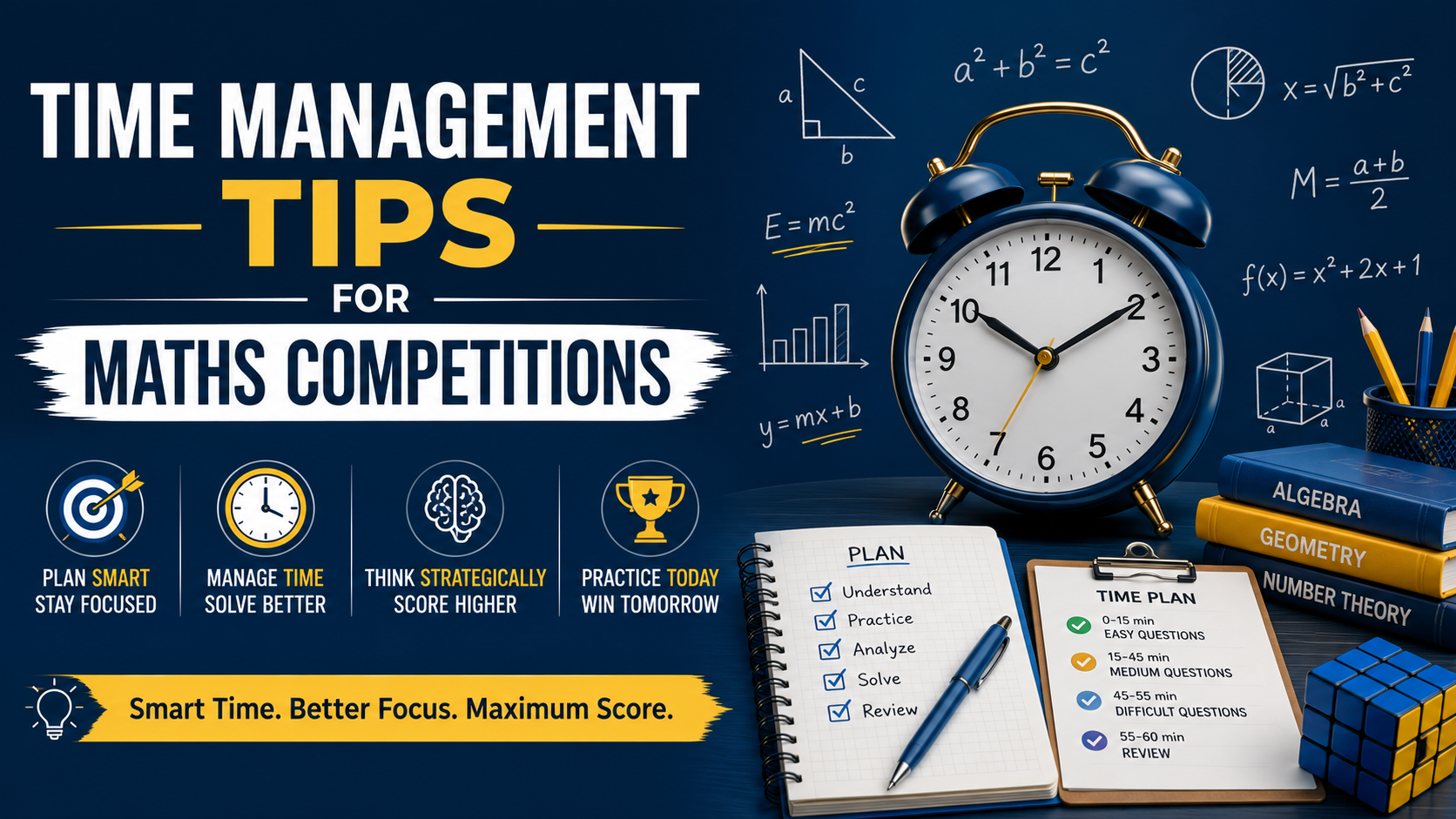
For example, in a 60-minute paper:
- First 15 minutes: Solve the easiest questions.
- Next 30 minutes: Attempt medium-level problems.
- Final 15 minutes: Solve difficult questions and review answers.
This ensures you collect maximum marks before tackling time-consuming problems.
4. Never Get Stuck on One Question
This is one of the biggest mistakes students make during a Maths competition.
If a question takes more than two or three minutes without progress:
- Mark it.
- Skip it.
- Return later.
Every difficult question costs time that could have been used to solve two or three easier ones.
Top performers know when to move on.
5. Attempt Easy Questions First
Confidence builds momentum.
Start with questions you immediately understand.
Benefits include:
- Quick marks
- Improved confidence
- Reduced anxiety
- Better rhythm throughout the exam
Once you’ve secured the easier marks, you’ll approach tougher questions with a calmer mind.
6. Improve Mental Calculation Speed
Students often waste precious seconds on basic arithmetic.
Practice:
- Multiplication tables
- Squares and cubes
- Fractions
- Percentage calculations
- Division shortcuts
Strong mental maths skills make your maths preparation far more effective and leave more time for higher-order thinking.
7. Use Rough Work Efficiently
Organized rough work saves time.
Instead of writing calculations everywhere:
- Number your rough work.
- Keep calculations neat.
- Avoid repeating the same steps.
This makes it easier to revisit questions if needed.
8. Practice Previous Competition Papers
Nothing prepares you better than solving real competition questions.
Previous papers help you:
- Understand common question types.
- Improve speed.
- Learn difficulty progression.
- Develop time management strategies.
Students preparing for the International Maths Challenge should regularly practice competition-style questions to become familiar with the exam format.
9. Learn to Estimate
Not every calculation needs complete working.
Sometimes estimation quickly eliminates incorrect options.
For example:
- Approximate large calculations.
- Compare answer choices.
- Check if your answer is reasonable.
This technique saves valuable time, especially in multiple-choice Maths Challenge exams.
10. Review Your Answers
Always reserve the final few minutes for checking your work.
Look for:
- Calculation mistakes
- Skipped questions
- Incorrect markings
- Missing units
- Unanswered problems
Many students recover valuable marks during this final review.
Sample Time Allocation Strategy
| Exam Duration | Recommended Strategy |
| First 20% | Solve easiest questions |
| Next 50% | Medium difficulty questions |
| Next 20% | Difficult problems |
| Final 10% | Review and corrections |
This balanced approach helps maximize both speed and accuracy.
Common Time Management Mistakes to Avoid
Even well-prepared students can lose marks due to poor time management. Avoid these common mistakes:
- Spending too long on one question.
- Ignoring easy questions.
- Rushing through calculations.
- Not practicing with a timer.
- Leaving no time for review.
- Panicking when encountering difficult problems.
Recognizing these habits early can make a significant difference in your competition performance.
How the International Maths Challenge Helps Students Build Time Management Skills
The International Maths Challenge is designed to help students develop not only mathematical ability but also strategic thinking and effective exam management.
By participating regularly, students learn to:
- Solve problems more efficiently.
- Improve speed and accuracy.
- Build confidence under timed conditions.
- Develop logical thinking.
- Prepare for higher-level Maths competitions.
Consistent participation, combined with focused maths preparation, helps students become stronger problem solvers while mastering the art of time management.
Final Thoughts
Excellent mathematical knowledge alone isn’t enough to succeed in a Maths competition. Students who combine strong concepts with smart time management consistently achieve better results. Learning when to move on, practicing under timed conditions, and following a clear strategy can transform your performance.
If you’re aiming to excel in your next Maths Challenge, make time management a key part of your maths preparation. Competitions like the International Maths Challenge provide the perfect platform to sharpen these skills while building confidence, accuracy, and a competitive mindset for future academic success.