The Kakeya Conjecture: Zero Area, Infinite Depth

How mathematicians proved that a needle rotated through every direction in 3D space can do so in a set of zero volume.

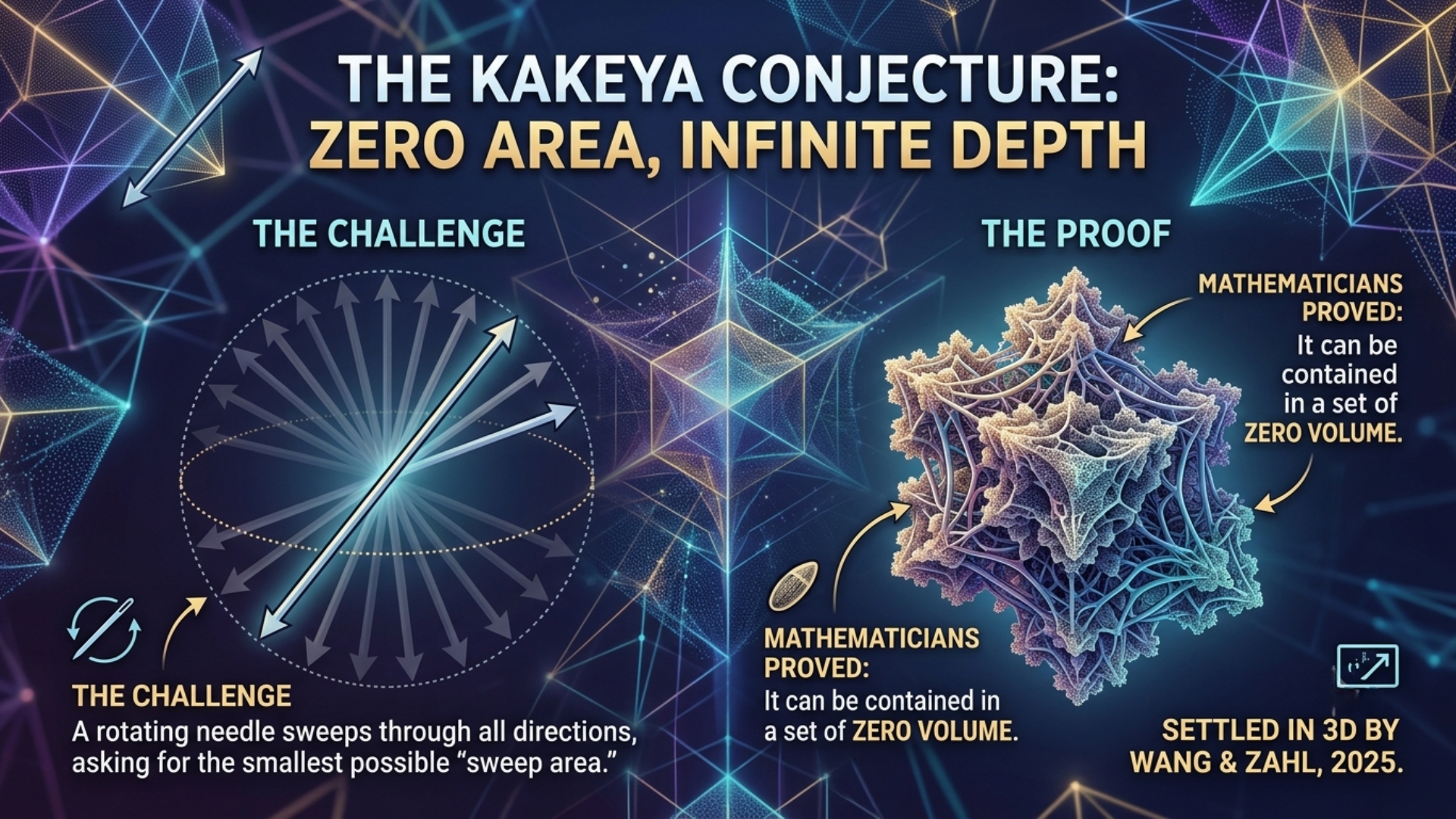
A rotating needle sweeps through all directions — the Kakeya set question asks for the smallest possible “sweep area.” Settled in 3D by Wang & Zahl, 2025.

Imagine a needle — a thin line segment of length one — lying flat on a table. You want to rotate it through every possible direction in the plane, completing a full 360-degree turn. The region swept out by the needle must have some area. But how small can that area be? Intuitively, you might think it must be at least something reasonably large. Remarkably, in two dimensions, mathematicians proved in the 1920s that you can rotate a needle through every direction in a region of arbitrarily small area. These minimal regions are called Kakeya sets.

The Kakeya conjecture asks a harder question in higher dimensions: in n-dimensional space, what is the fractal dimension of a Kakeya set — a set that contains a unit line segment in every possible direction? In two dimensions, the answer is known: 2. The three-dimensional case, however, resisted proof for nearly a century. Until 2025.

Wang and Zahl settle 3D Kakeya

In early 2025, Hong Wang (New York University) and Joshua Zahl (University of British Columbia) published a proof of the three-dimensional Kakeya conjecture. Their result establishes that a Kakeya set in three-dimensional space must have Hausdorff dimension 3 — that is, it must be “full-dimensional” even if it has zero volume. The proof runs to over 100 pages and draws on sophisticated techniques from harmonic analysis and additive combinatorics.

“The three-dimensional Kakeya problem sat unsolved for nearly a century, and its resolution is one of the landmark achievements of 2025.” — Quanta Magazine

Beyond the abstract

The Kakeya problem might sound purely theoretical, but it has deep connections to some of the most important unsolved problems in mathematics, including the Riemann Hypothesis and the behaviour of the Fourier transform in higher dimensions. Progress on Kakeya-type problems has historically driven breakthroughs in signal processing and the mathematics of waves — areas that underpin everything from medical imaging to wireless communication. Wang and Zahl’s result is not merely an isolated geometric curiosity; it opens new avenues of attack on problems that have blocked progress in analysis for decades.

Sources & Further Reading

Wang, H. & Zahl, J. (2025). Three-dimensional Kakeya conjecture: proof. Annals of Mathematics (preprint).

Quanta Magazine (2025). The Biggest Breakthroughs in Mathematics: 2025. quantamagazine.org

Scientific American (2025). The Top 10 Math Discoveries of 2025. scientificamerican.com

Medium (2025). Mathematics in 2025: Breakthroughs That Redefined the Field. medium.com
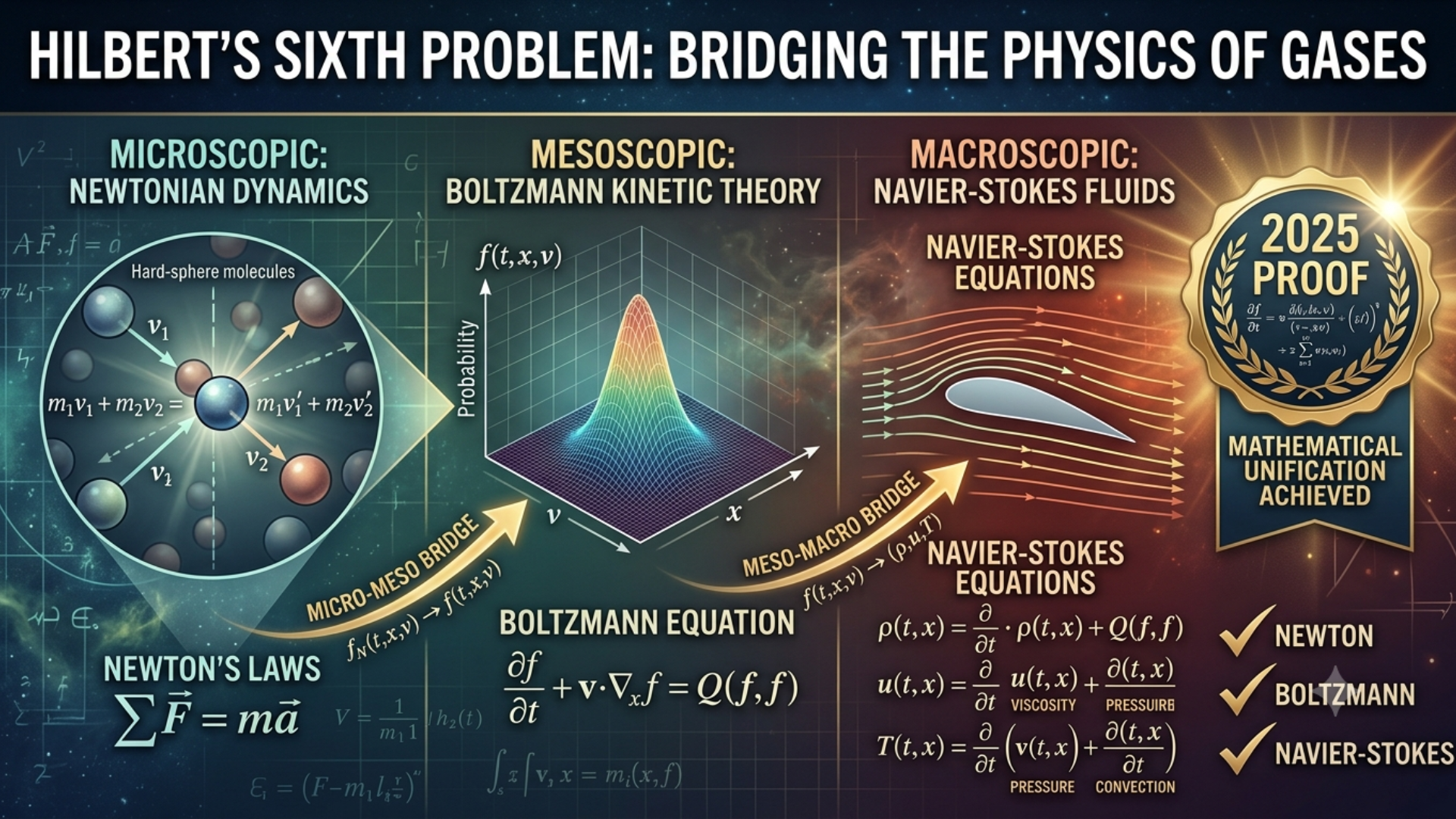

Hilbert’s Sixth Problem: Bridging the Physics of Gases

A 125-year-old challenge by David Hilbert — to mathematically unify the laws of physics — just got a major breakthrough.

Three levels of gas physics — Newton (microscopic), Boltzmann (mesoscopic), and Navier-Stokes (macroscopic) — bridged in a 2025 proof.

In 1900, the German mathematician David Hilbert set mathematics a challenge that has defined a century of research. He published a list of 23 unsolved problems — a kind of to-do list for the twentieth century and beyond. His sixth problem was among the boldest: can the laws of physics, which physicists derive from observation and intuition, be derived from pure mathematical axioms, the way theorems are proved from first principles?

One specific version of this challenge concerns the behaviour of gases. Physicists describe gas at three different scales: at the microscopic level, they use Newton’s laws of motion to track individual molecules; at the mesoscopic level (vast numbers of molecules but not yet a bulk fluid), they use the Boltzmann equation; and at the macroscopic level (a room full of air), they use the Navier-Stokes equations of fluid dynamics. All three describe the same physical reality, but they are not mathematically unified. Nobody had been able to rigorously derive one from another, from first principles, without patching in extra assumptions.

The 2025 breakthrough

In 2025, a trio of mathematicians — Yu Deng (University of Chicago), Zaher Hani (University of Michigan), and Xiao Ma — published a landmark proof connecting these three levels of description. Their work shows, rigorously and for the first time, how the microscopic Newtonian world of individual gas molecules transitions continuously into the Boltzmann equation and then into the macroscopic Navier-Stokes equations. No extra assumptions. No mathematical hand-waving.

“It reshapes our understanding of the natural world — not just solving a century-old problem, but providing a new mathematical foundation for the physics of fluids.” — Quanta Magazine, 2025

The proof is a tour de force of modern analysis, drawing on techniques from probability theory, kinetic theory, and partial differential equations. Quanta Magazine named it one of the top three mathematical breakthroughs of 2025, alongside the Kakeya conjecture and new results on hyperbolic surfaces.

Why it matters

The practical implications are significant. The Navier-Stokes equations underpin everything from weather forecasting and aircraft design to the modelling of ocean currents. Having a mathematically rigorous derivation of these equations from first principles does not change the equations themselves — but it gives physicists and mathematicians a far deeper understanding of when and why these equations can be trusted, and where their limits lie. It is the difference between knowing a recipe works and understanding the chemistry behind why it works.

Sources & Further Reading

Deng, Y., Hani, Z. & Ma, X. (2025). Full derivation of the Euler and Navier-Stokes equations from classical mechanics. Preprint.

Quanta Magazine (2025). The Biggest Breakthroughs in Mathematics: 2025. quantamagazine.org

GIGAZINE (2025). What are the three biggest breakthroughs in mathematics in 2025? gigazine.net

Scientific American (2025). The Top 10 Math Discoveries of 2025. scientificamerican.com


The Sofa Problem: 60 Years, 119 Pages, One Answer

How a Korean mathematician solved the problem of moving furniture around a corner — a question that stumped the world since 1966.

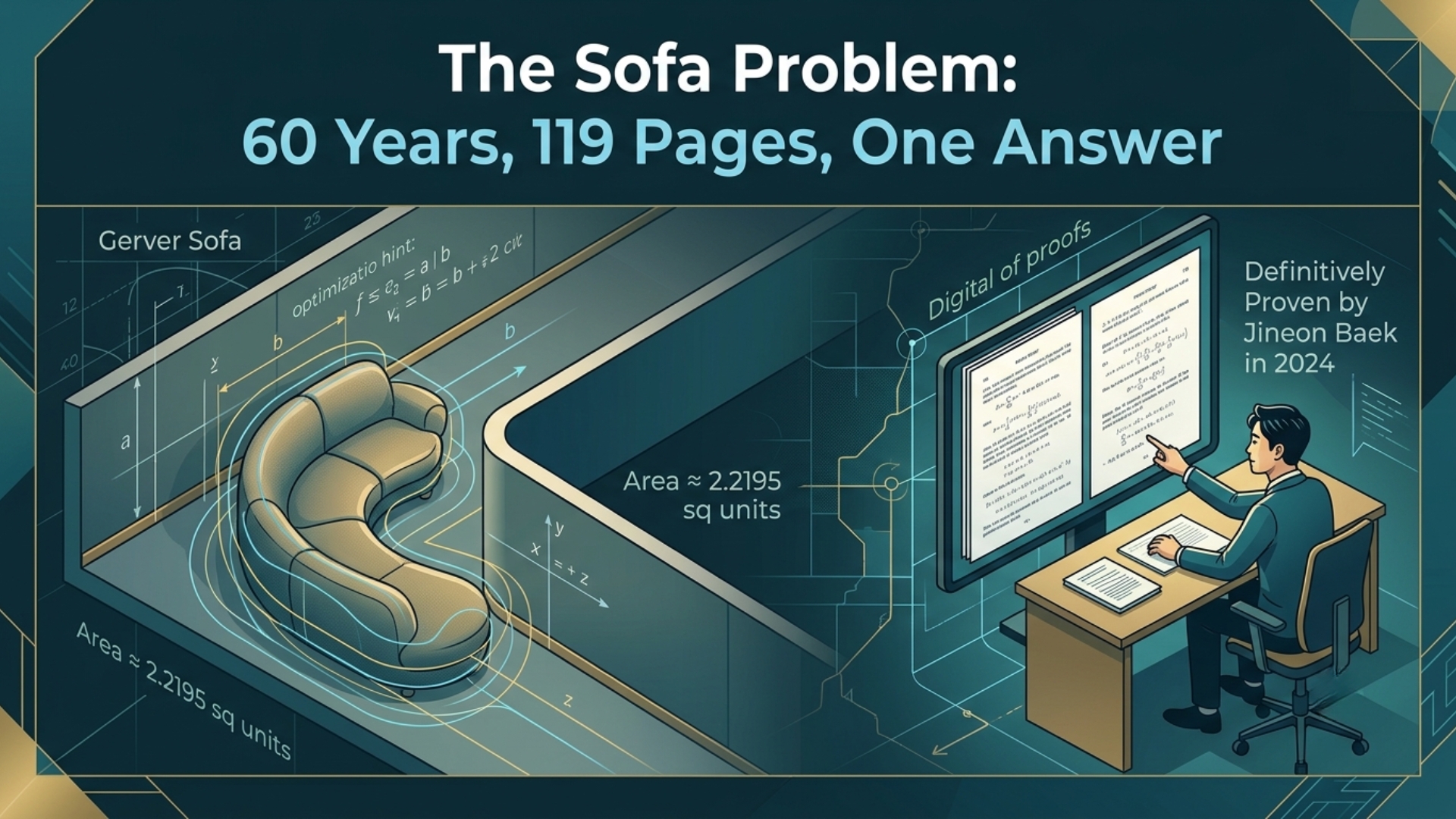
The optimal “Gerver sofa” shape, with area 2.2195 square units — proven definitively by Jineon Baek in 2024 (arXiv:2411.19826)

Anyone who has ever wrestled a sofa around a tight corner knows the frustration. Mathematicians, it turns out, have been equally frustrated by the theoretical version of this problem since 1966, when Canadian mathematician Leo Moser posed it formally: what is the largest two-dimensional shape that can be manoeuvred around a right-angled corner in a hallway of unit width?

The question is deceptively simple. A plain square can make it around the corner, as can a semicircle. But what is the absolute maximum area any shape could have while still fitting through? For nearly six decades, mathematicians circled this problem (sometimes literally), proposing shapes and proving partial results, but never settling on a definitive answer.

Gerver’s candidate — and the missing proof

In 1992, mathematician Joseph Gerver proposed a beautiful, 18-curve shape that looked somewhat like the handset of a landline telephone. It had an area of approximately 2.2195 square units — an improvement on all previous candidates. But Gerver could not prove that nothing larger was possible. His shape sat as the best known answer for more than three decades: a champion with no certificate of victory.

“You keep holding on to hope, then breaking it, and moving forward by picking up ideas from the ashes.” — Jineon Baek

Baek’s 119-page proof

In late November 2024, Jineon Baek — a postdoctoral researcher at Yonsei University in Seoul — posted a 119-page paper to the preprint server arXiv that claimed to settle the matter. After seven years of work, Baek proved that no shape with an area larger than Gerver’s sofa can exist. The maximum sofa constant is 2.2195 square units, and that is final.

What is especially striking about Baek’s proof is that it relies entirely on logical reasoning — no large-scale computer simulations, no numerical approximations. Scientific American called it “surprising” that the final solution avoids computers altogether. The proof has been submitted to the prestigious Annals of Mathematics and is under peer review; early responses from leading geometers have been optimistic.

The moving sofa problem has a cultural footprint as well. The US sitcom Friends features a famous scene in which characters struggle to manoeuvre a sofa up a staircase while Ross Geller shouts “Pivot!” Scientific American noted, tongue in cheek, that “explaining the pivot required a 119-page paper.”

Sources & Further Reading

Baek, J. (2024). Optimality of Gerver’s Sofa. arXiv:2411.19826. arxiv.org

Scientific American (2025). Mathematicians Solve Infamous Moving Sofa Problem. scientificamerican.com

Phys.org (2024). Mathematician solves the moving sofa problem. phys.org

Korea Herald (2026). Six-decade math puzzle solved by Korean mathematician. koreaherald.com

Quanta Magazine (2025). The Largest Sofa You Can Move Around a Corner. quantamagazine.org


When AI Earned a Silver Medal in Mathematics

Google DeepMind’s AlphaProof reaches Olympiad level — and what it means for the future of mathematical proof.

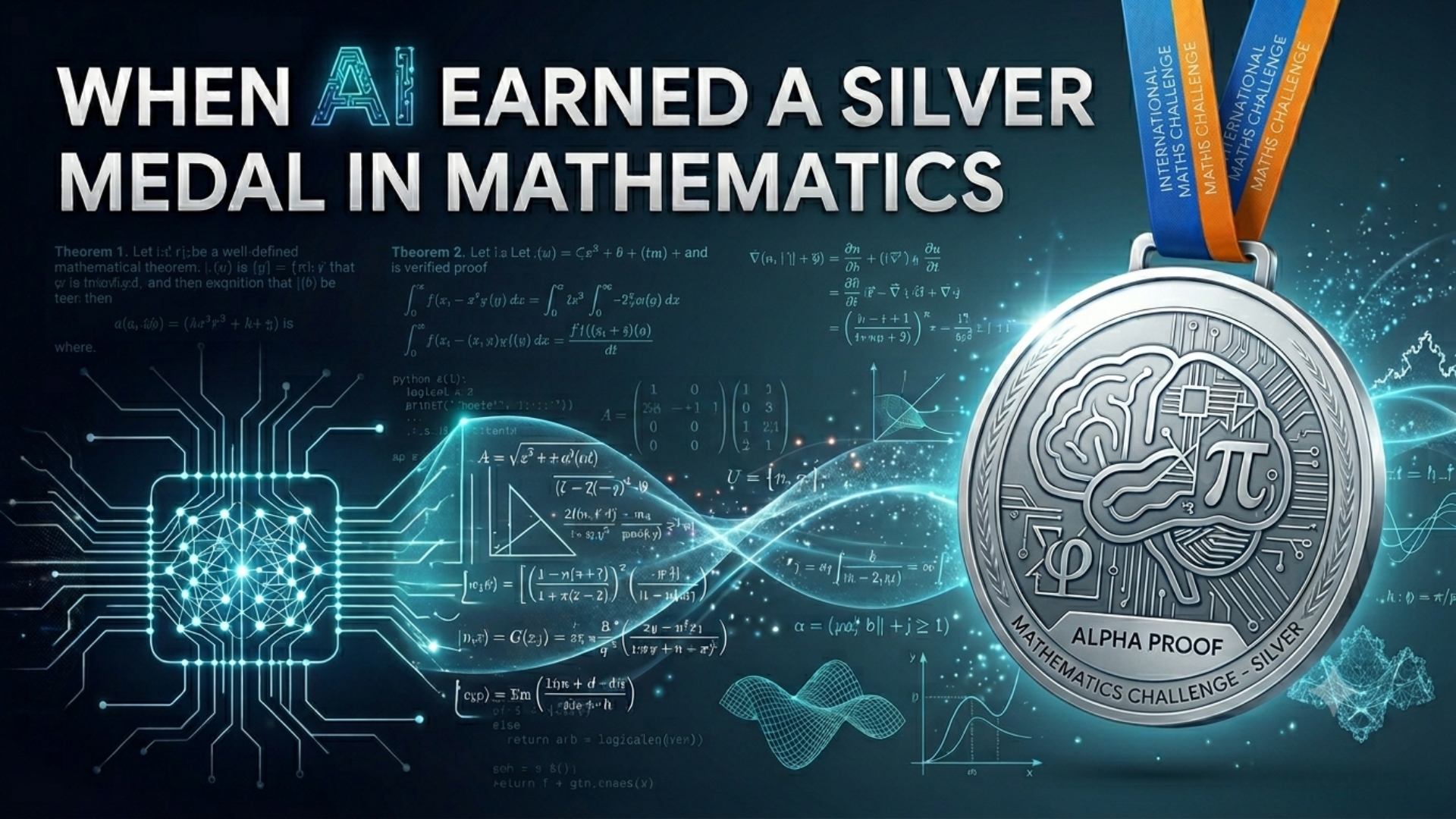
AlphaProof’s performance at the 2024 International Mathematical Olympiad, Nature (2025)

Every summer, the most gifted young mathematicians in the world converge to compete in the International Mathematical Olympiad (IMO) — six problems, nine hours across two days, and a level of difficulty that humbles even exceptional minds. In 2024, an uninvited but remarkable competitor quietly entered the fray: Google DeepMind’s AlphaProof. It scored 28 out of a possible 42 points, placing it squarely in the silver-medal category and just one point short of gold.

What makes this achievement genuinely historic is not that a computer solved hard maths problems — machines have done arithmetic faster than humans for decades. What is new is that AlphaProof proved its answers with 100% verified correctness, step by logical step, using the formal proof assistant Lean. No guessing. No hallucinating a plausible-sounding answer. Every claim in every solution was machine-verified to be logically airtight.

How AlphaProof works

AlphaProof is a neuro-symbolic hybrid — it combines the intuitive pattern-matching of a large language model (based on Google’s Gemini architecture) with the rigorous verification engine of Lean, a formal mathematics software environment. The system was trained in three stages: first absorbing 300 billion tokens of mathematical text and code; then learning from 300,000 expert-written formal proofs; and finally, tackling 80 million formal mathematics problems through reinforcement learning — rewarded for every successful proof it constructed.

At the IMO, AlphaProof solved three non-geometry problems, including what IMO judges considered the hardest problem in the entire competition — a problem solved by only five human contestants. AlphaGeometry 2, a companion system, solved the geometry problem independently.

“AlphaProof is designed to prove mathematical statements — and it guarantees 100% correct solutions by verifying every logical step.” — Nature, 2025

Gold in 2025

The progression was swift. By 2025, an advanced version of Gemini equipped with “Deep Think” reasoning achieved the full gold-medal standard at IMO 2025 — solving all six problems within the time allowed. Unlike the 2024 effort, which required human experts to manually translate problems into formal language, the 2025 system could read and interpret problems in natural language directly. What previously demanded two to three days of computation was achieved within the competition’s standard timeframe.

This is not merely a parlour trick. Mathematicians across fields are beginning to ask: if AI can verify proofs and explore mathematical territories at machine speed, could it help crack problems that have resisted human effort for centuries — the Riemann Hypothesis, the Birch and Swinnerton-Dyer conjecture, P versus NP? AlphaProof does not answer these questions, but it brings them closer to the horizon than at any point in history.

Sources & Further Reading

Hubert, T. et al. (2025). Olympiad-level formal mathematical reasoning with reinforcement learning. Nature. DOI: 10.1038/s41586-025-09833-y

Google DeepMind (2025). AI achieves silver-medal standard solving International Mathematical Olympiad problems. deepmind.google

Google DeepMind (2026). Advanced version of Gemini with Deep Think officially achieves gold-medal standard at the IMO. deepmind.google

Phys.org (2025). AI math genius delivers 100% accurate results. phys.org/news/2025-11-ai-math-genius-accurate-results.html