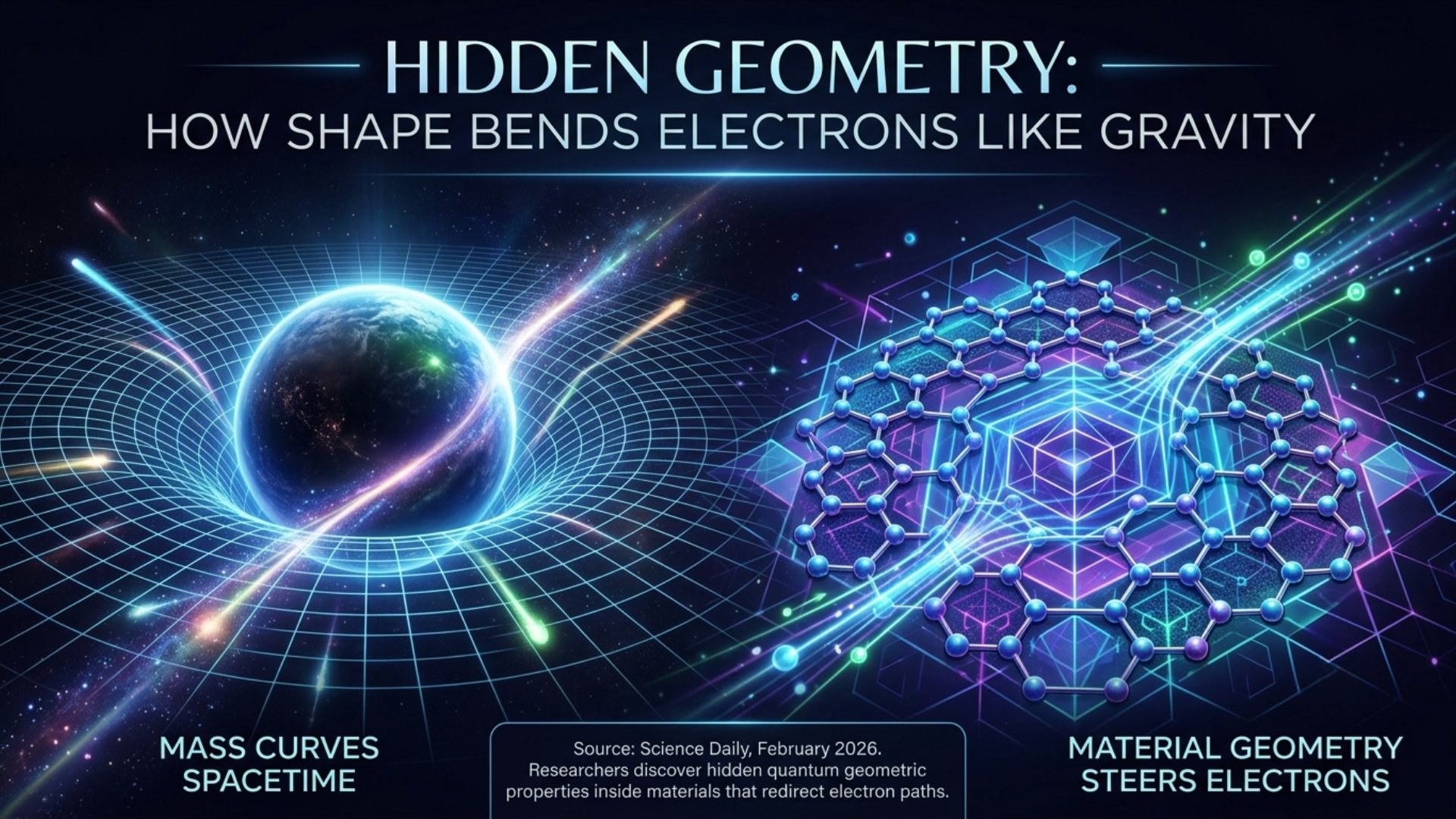
Scientists discover that materials harbour an invisible quantum geometry that steers electrons — echoing how mass curves spacetime.
Hexagonal quantum lattice structures. Researchers found that hidden geometric properties inside materials subtly redirect electron paths. (Science Daily, February 2026)
One of Einstein’s most profound insights was that gravity is not a force at all in the traditional sense, but rather the curvature of spacetime — mass bends the fabric of the universe, and objects simply follow the straightest possible path through that curved space. Light, following these geodesics, appears to bend around massive objects. In February 2026, a team of physicists and mathematicians announced a discovery that carries an extraordinary echo of this idea — not in outer space, but inside the quantum materials that make up modern electronics.
Researchers discovered that materials harbour a hidden quantum geometry — mathematical structure built into the quantum mechanical wavefunctions of electrons — that subtly steers how electrons move through a material. Just as gravity curves spacetime and redirects light, this quantum geometry curves the electron’s “quantum space,” redirecting its path in ways that are not predicted by classical models. The discovery was published in Science Daily and has immediate implications for understanding exotic phenomena including superconductivity, topological insulators, and the anomalous Hall effect.
The mathematics of quantum geometry
At the heart of this discovery is a mathematical object called the quantum metric tensor — a quantity that measures distances in the abstract space of quantum states. Until recently, physicists focused almost exclusively on a related object called the Berry curvature when studying the geometry of quantum bands. The new research reveals that the quantum metric tensor plays an equally important role, and that ignoring it has led to incomplete models of electron transport.
“Researchers discovered a hidden quantum geometry inside materials that subtly steers electrons, echoing how gravity warps light in space.” — Science Daily, February 2026
From abstract to applicable
This is not merely a philosophical revelation. The quantum metric tensor is now being integrated into models of superconductors — materials that conduct electricity with zero resistance at low temperatures. Understanding the geometry of electron wavefunctions more completely may explain why some materials superconduct at higher temperatures than theory currently predicts, a problem that has profound implications for energy transmission and quantum computing. Mathematics, once again, provides the language in which nature’s deepest mechanisms are written.
Sources & Further Reading
Science Daily (2026). Scientists Discover Hidden Geometry That Bends Electrons Like Gravity. sciencedaily.com, February 2026.
Science Daily (2026). Neuromorphic computers modelled after the human brain solve complex equations. sciencedaily.com, February 2026.
Quanta Magazine (2025). Year in Review: Mathematics and Physics Intersect. quantamagazine.org
Scientific American (2025). The Top 10 Math Discoveries of 2025. scientificamerican.com