Winning a Maths Challenge is not just about solving hundreds of questions, it’s about solving them smartly. The best-performing students in every Maths competition have one thing in common: they follow structured problem-solving techniques instead of relying on guesswork or memorization.
Whether you’re preparing for your school Olympiad or an International Maths Challenge, mastering these strategies can significantly improve your speed, accuracy, and confidence.
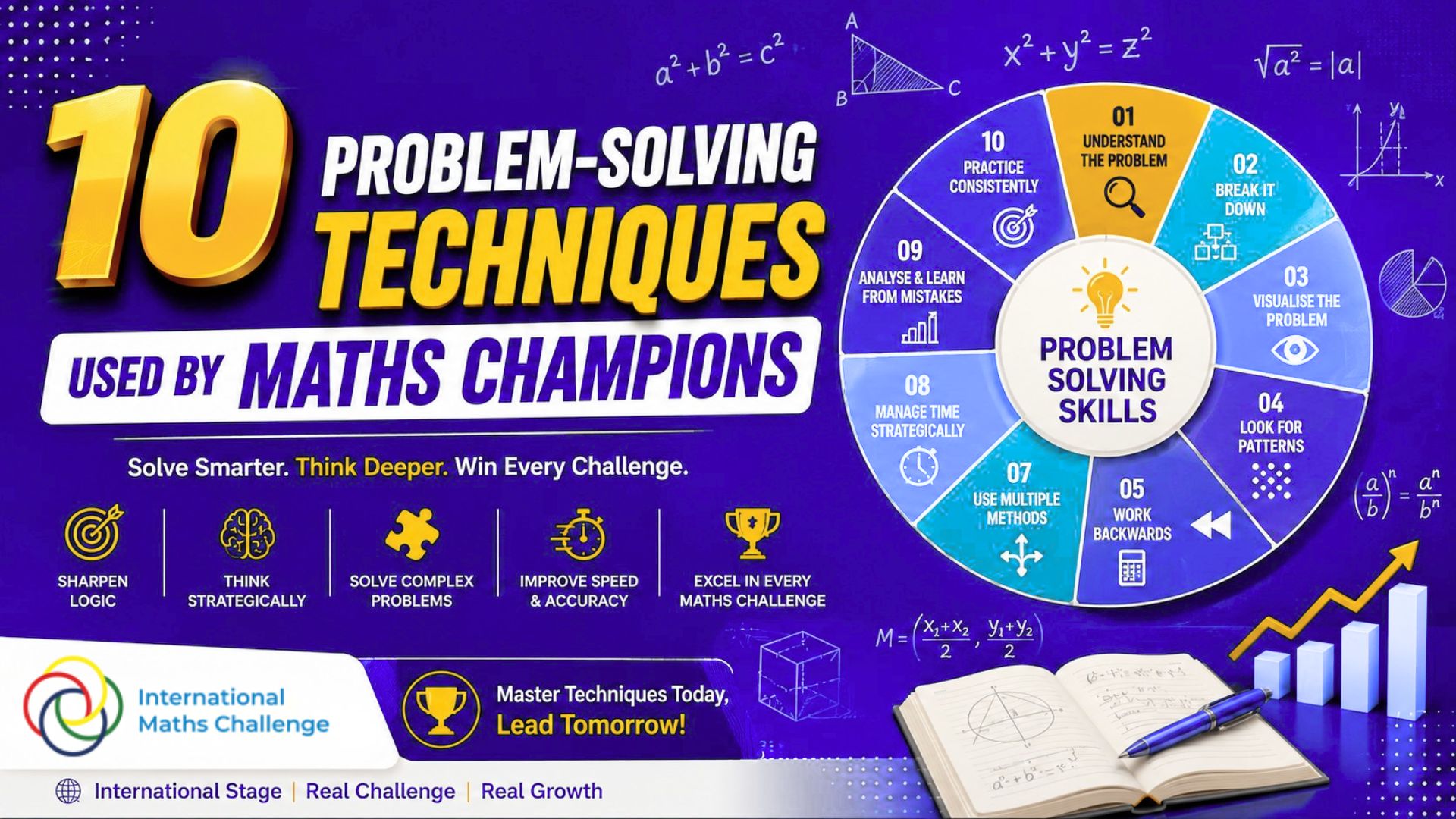
In this guide, we’ll explore the 10 problem-solving techniques used by maths champions and how you can apply them in your own maths preparation.
1. Understand the Problem Before Solving
One of the biggest mistakes students make is rushing into calculations without fully understanding the question.
Maths champions always spend a few seconds identifying:
- What is being asked?
- What information is already given?
- Are there any hidden conditions?
- Which concepts are involved?
Reading carefully often prevents simple mistakes that cost valuable marks during a Maths competition.
Pro Tip: Underline important numbers and keywords before solving.
2. Break Complex Problems into Smaller Steps
Large problems often look intimidating because students try solving everything at once.
Instead, top performers divide the problem into manageable parts.
For example:
- Find intermediate values.
- Solve one condition at a time.
- Combine the results.
This approach makes difficult questions much easier and reduces calculation errors.
3. Visualise the Question
Many maths champions convert words into visual representations.
They use:
- Diagrams
- Tables
- Number lines
- Graphs
- Shapes
Visual thinking is especially useful for:
- Geometry
- Ratios
- Fractions
- Probability
- Logical reasoning
Drawing a simple sketch can reveal relationships that aren’t obvious in text.
4. Look for Patterns
Pattern recognition is one of the strongest skills developed through regular maths preparation.
Whenever students encounter:
- Number sequences
- Algebraic expressions
- Geometric arrangements
- Logical puzzles
they actively search for recurring relationships.
Recognising patterns often leads to quicker solutions with fewer calculations.
5. Work Backwards
Some questions become much easier when solved from the final answer instead of the beginning.
This technique is especially useful for:
- Age problems
- Number puzzles
- Reverse operations
- Logic-based questions
Working backwards allows students to eliminate unnecessary steps and verify their reasoning.
6. Estimate Before Calculating
Maths champions rarely jump straight into detailed calculations.
They first estimate the expected answer.
This helps them:
- Detect calculation mistakes
- Eliminate incorrect options
- Improve accuracy
- Save time
Estimation is particularly valuable in multiple-choice Maths Challenge exams.
7. Learn Multiple Solution Methods
Top competitors know that every problem can often be solved in more than one way.
For example:
- Algebraic method
- Logical reasoning
- Elimination
- Mental maths
- Visual approach
Having multiple strategies allows students to choose the quickest method during a timed Maths competition.
Flexibility is one of the biggest advantages of experienced problem solvers.
8. Manage Time Strategically
Successful students understand that time is as important as accuracy.
Their strategy usually includes:
- Solving easy questions first
- Skipping lengthy questions initially
- Returning later with fresh thinking
- Keeping enough time for revision
Effective time management often improves scores without increasing mathematical ability.
9. Analyse Mistakes After Practice
The best maths champions don’t simply count how many questions they solved—they analyse every mistake.
After each practice session, ask:
- Why was the answer wrong?
- Was it a concept error?
- Was it a calculation mistake?
- Was the question misunderstood?
- Was time management the issue?
Maintaining an error notebook helps prevent repeating the same mistakes.
This habit is one of the fastest ways to improve maths preparation.
10. Practice Consistently with Challenging Questions
Consistency always beats last-minute studying.
Instead of solving only easy textbook exercises, maths champions regularly attempt:
- Higher-order reasoning problems
- Previous competition papers
- Timed mock tests
- Mixed-topic quizzes
Exposure to different question types builds confidence and improves adaptability.
Participating in an International Maths Challenge also provides valuable experience by exposing students to questions that test conceptual understanding, logical reasoning, and creative problem-solving under exam conditions.
How the International Maths Challenge Helps Students Develop Problem-Solving Skills
The International Maths Challenge is designed to encourage students to think beyond routine classroom mathematics. Rather than focusing only on calculations, it emphasizes reasoning, analytical thinking, and practical application of mathematical concepts.
Students benefit from:
- Exposure to internationally benchmarked questions
- Stronger logical reasoning skills
- Improved speed and accuracy
- Greater confidence in tackling unfamiliar problems
- Better preparation for future Maths competitions
Regular participation also helps students become comfortable with competitive exam environments while developing lifelong mathematical thinking skills.
Tips for Effective Maths Preparation
To maximise your performance in any Maths Challenge, follow these habits:
- Practice mathematics every day.
- Focus on understanding concepts instead of memorising formulas.
- Solve questions from different topics regularly.
- Attempt timed mock tests.
- Review mistakes after every practice session.
- Challenge yourself with higher-level problems.
- Stay calm and think logically during the exam.
Small improvements every day lead to significant long-term success.
Final Thoughts
Every maths champion starts as a learner. What separates top performers is not extraordinary talent but the consistent use of smart problem-solving strategies.
By applying these 10 problem-solving techniques, students can approach every Maths Challenge with greater confidence, solve questions more efficiently, and continuously improve their performance in every Maths competition.
Remember, excellent maths preparation isn’t about studying harder, it’s about studying smarter. Participating in platforms like the International Maths Challenge gives students the opportunity to apply these techniques in a competitive environment while sharpening the analytical skills that extend far beyond mathematics.