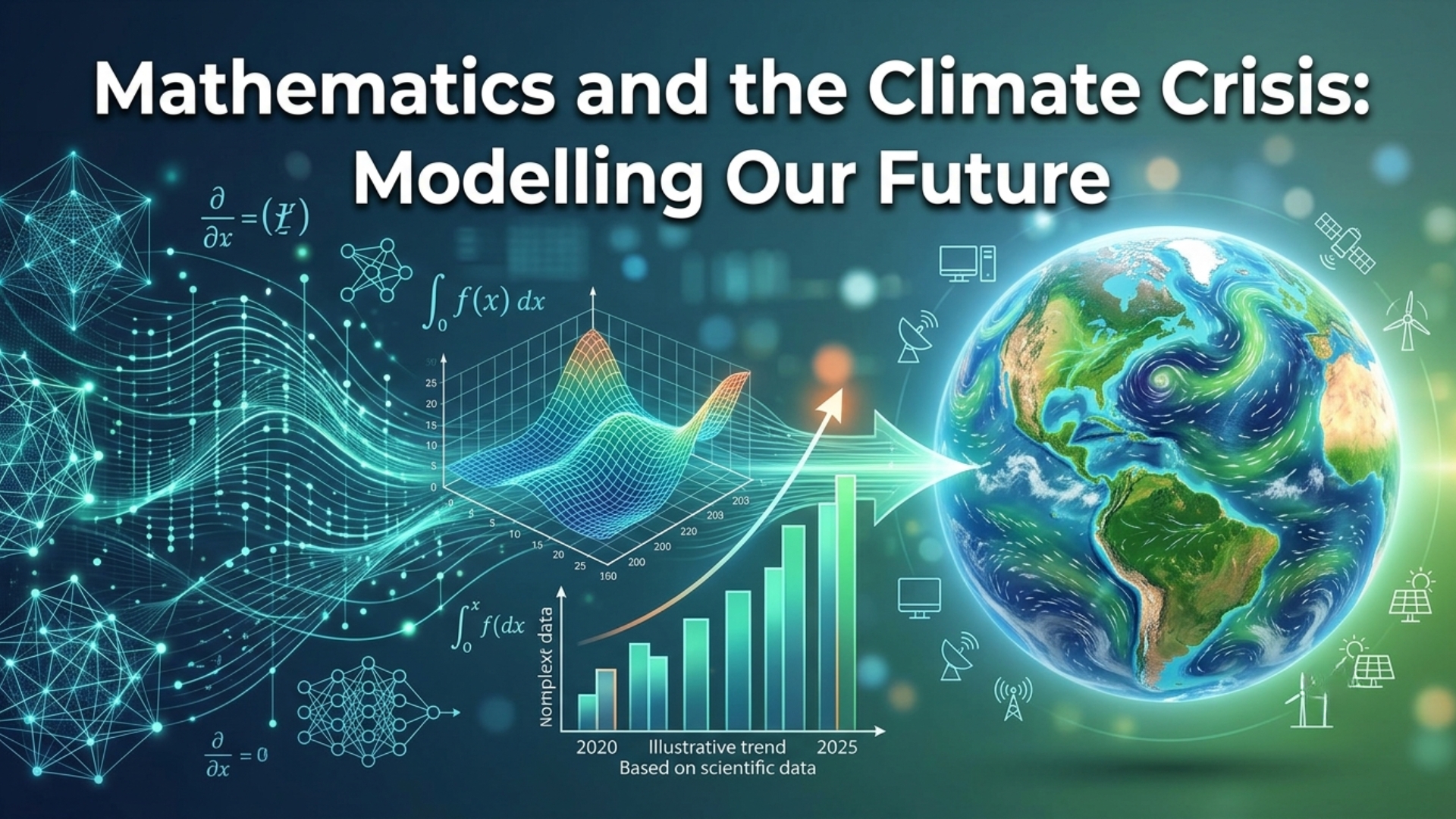
From differential equations to machine learning hybrids — how mathematics has become the most powerful tool in climate science.
The rapid growth in mathematical modelling applied to climate science, 2020–2025 (illustrative trend based on IPCC and journal data).
When scientists want to know what Earth’s climate will look like in 2100, they do not simply observe and guess. They build mathematical models — vast systems of partial differential equations that encode the physics of the atmosphere, oceans, ice sheets, and biosphere. These models run on the world’s most powerful supercomputers, and their outputs inform government policy, infrastructure planning, and international treaty negotiations. Mathematics, quiet and unglamorous, is doing some of the most consequential work of our era.
The Navier-Stokes equations, which describe fluid motion, form the backbone of atmospheric and ocean models. These are the same equations that the 2025 Hilbert Sixth Problem breakthrough helped to place on firmer mathematical ground. The global climate system is, in essence, a coupled fluid dynamics problem of extraordinary complexity — and every mathematical insight into fluid behaviour translates, ultimately, into better predictions about hurricanes, droughts, and sea level rise.
AI-assisted mathematical modelling
In 2025 and 2026, a new generation of hybrid models began to emerge — systems that combine traditional mathematical physics with machine learning. Rather than replacing differential equations with neural networks, researchers are using AI to learn the residuals: the gaps between what physics-based models predict and what observations show. This “physics-informed machine learning” approach allows models to improve with data while remaining grounded in mathematical principles that ensure physical plausibility.
Separately, neuromorphic computing — processors modelled on the human brain — demonstrated in early 2026 that they can solve the complex equations behind physics simulations at a fraction of the energy cost of traditional supercomputers. This could dramatically reduce the computational cost of running climate models, enabling higher-resolution simulations that capture regional climate dynamics with far greater precision.
“Mathematics is the language in which the climate crisis is both written and, perhaps, solved.” — Open University Mathematics Education Blog, 2026
Data literacy as a civic necessity
Beyond the research frontier, applied mathematics is reshaping how citizens and policymakers engage with climate data. England’s forthcoming curriculum refresh (expected 2027) emphasises data literacy as a core mathematical skill — understanding graphs, interpreting uncertainty, and evaluating statistical claims. At a moment when climate projections, risk assessments, and emissions targets are contested in public debate, mathematical literacy is not merely an academic virtue. It is a prerequisite for democratic participation in civilisation’s most urgent conversation.
Sources & Further Reading
Science Daily (2026). Neuromorphic computers solve complex physics equations with low energy. sciencedaily.com, February 2026.
Open University Mathematics Education Blog (2026). England’s Curriculum Refresh and Data Education. open.ac.uk/blogs/MathEd
IPCC (2023). Sixth Assessment Report: Mathematical foundations of climate modelling. ipcc.ch
HMH Education (2026). 10 Top Trends in Education to Watch in 2026. hmhco.com
Quanta Magazine (2025). Year in Review: Applied Mathematics. quantamagazine.org