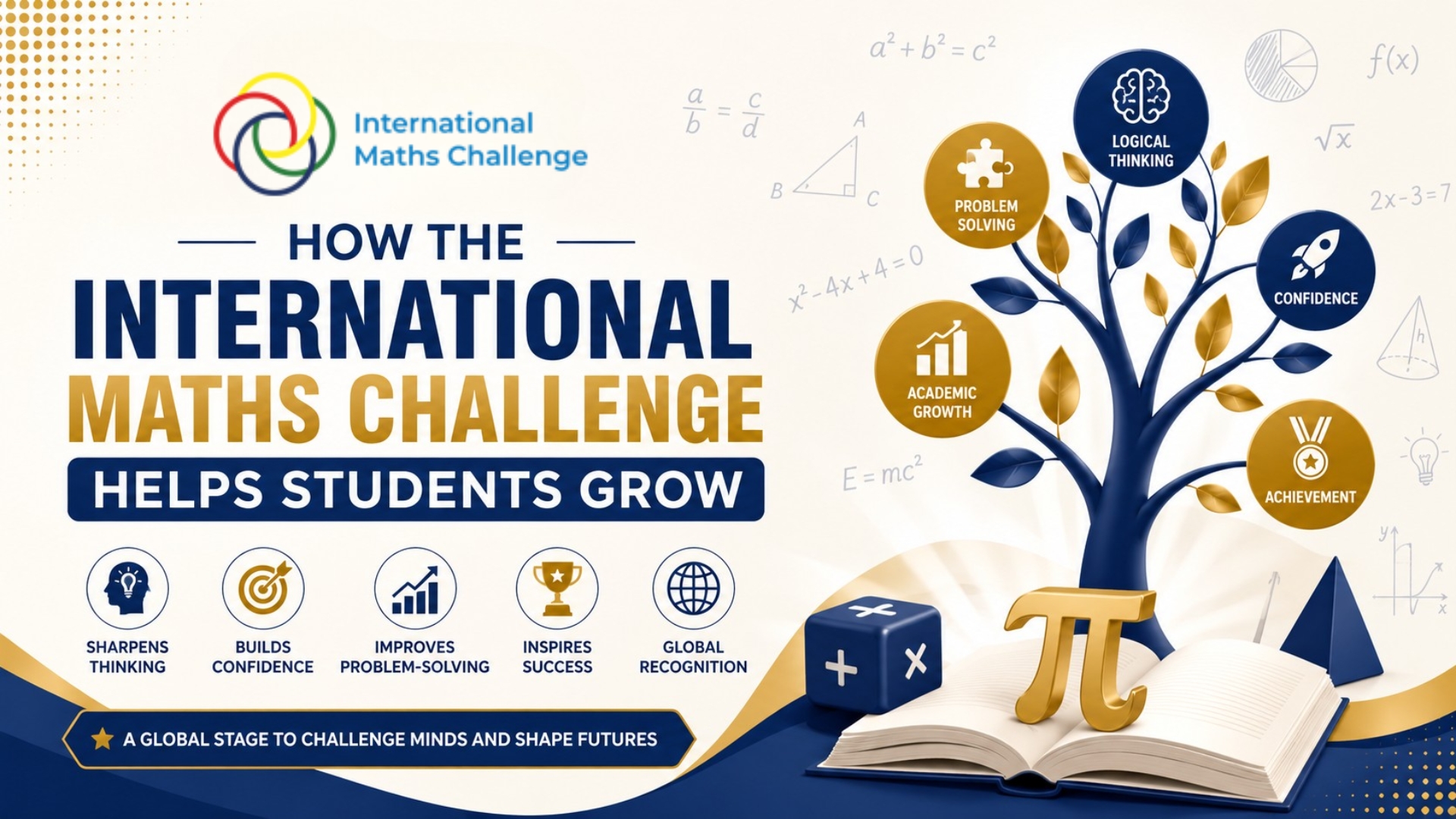
How the International Maths Challenge Helps Students Grow

Mathematics is much more than numbers and formulas. When students develop strong mathematical reasoning, they become better problem-solvers, critical thinkers, and confident learners. One of the best ways to nurture these skills is by participating in a well-structured Maths Challenge.

The International Maths Challenge is designed to inspire students to enjoy mathematics while competing with peers from different schools and countries. Unlike traditional exams that focus on memorization, the International Maths Challenge encourages logical thinking, creativity, and analytical reasoning.

Whether a student is already excelling in mathematics or looking to improve, participating in this prestigious Maths competition can be a transformative learning experience.

Why Maths Competitions Matter

Classroom learning builds the foundation, but competitions encourage students to apply their knowledge in new and challenging ways.

A Maths competition teaches students how to:

  • Think critically under pressure
  • Solve unfamiliar problems
  • Develop multiple approaches to one question
  • Improve speed and accuracy
  • Build resilience after making mistakes

These skills extend far beyond mathematics and benefit students throughout their academic journey.

  1. Develops Strong Problem-Solving Skills

One of the biggest strengths of the International Maths Challenge is its focus on problem-solving rather than rote learning.

Students encounter questions that require them to:

  • Analyze patterns
  • Apply mathematical concepts creatively
  • Think logically
  • Eliminate incorrect possibilities
  • Make informed decisions

Regular exposure to these challenges strengthens analytical thinking, making students better equipped for both academics and real-life situations.

  1. Builds Confidence in Mathematics

Many students feel nervous about mathematics because they fear making mistakes.

Participating in the International Maths Challenge helps students gradually overcome this fear.

As they solve increasingly challenging questions and see their progress, they begin to realize that success comes through practice and logical thinking, not simply memorizing formulas.

This confidence often translates into improved classroom performance and a more positive attitude toward mathematics.

  1. Encourages Healthy Academic Competition

Competition, when approached positively, motivates students to perform at their best.

The International Maths Challenge creates an environment where students strive for excellence while learning alongside talented peers from around the world.

Healthy competition teaches students:

  • Goal setting
  • Self-improvement
  • Discipline
  • Perseverance
  • Sportsmanship

Rather than comparing themselves to others, students learn to compete with their own previous performance.

  1. Strengthens Logical and Analytical Thinking

Mathematics is fundamentally about logic.

The carefully designed questions in the International Maths Challenge encourage students to think step by step before reaching conclusions.

This improves:

  • Logical reasoning
  • Pattern recognition
  • Deductive thinking
  • Decision-making abilities
  • Analytical skills

These abilities benefit subjects like science, computer programming, engineering, economics, and even everyday decision-making.

  1. Makes Maths Preparation More Effective

Preparing for a Maths competition naturally improves overall academic performance.

Effective maths preparation includes:

  • Practicing challenging questions
  • Understanding concepts deeply
  • Managing time efficiently
  • Identifying weak areas
  • Reviewing mistakes regularly

Students who prepare consistently often find that school mathematics becomes easier because they have developed a stronger conceptual understanding.

  1. Improves Speed and Accuracy

Success in any Maths competition requires balancing speed with accuracy.

The International Maths Challenge encourages students to:

  • Solve problems efficiently
  • Avoid careless mistakes
  • Prioritize questions wisely
  • Improve calculation speed
  • Develop effective time management

These skills are valuable for school examinations and future competitive tests.

  1. Encourages Independent Learning

Students preparing for the IMC become active learners.

Instead of waiting for classroom instruction, they begin exploring:

  • New problem-solving techniques
  • Advanced mathematical concepts
  • Practice papers
  • Logical reasoning puzzles
  • Different solution methods

This habit of independent learning helps students become lifelong learners.

  1. Develops Persistence and Resilience

Every difficult question teaches an important lesson.

Students participating in the International Maths Challenge quickly understand that not every problem has an immediate solution.

Instead of giving up, they learn to:

  • Stay patient
  • Try different strategies
  • Learn from mistakes
  • Keep improving through practice

These qualities are essential not only in mathematics but also in academics, careers, and life.

  1. Inspires a Love for Mathematics

Many students discover that mathematics becomes enjoyable once they start solving interesting puzzles rather than repetitive textbook exercises.

The International Maths Challenge transforms mathematics into an engaging intellectual activity that rewards curiosity and creativity.

Students begin viewing maths as a subject to explore rather than one to fear.

  1. Provides International Recognition

One unique advantage is the opportunity to compete on a global platform.

Students gain:

  • International exposure
  • Recognition for their achievements
  • Certificates and awards
  • Motivation to pursue higher goals
  • A stronger academic profile

Such accomplishments can enhance students’ confidence and encourage continued participation in academic competitions.

How Parents Benefit

The International Maths Challenge is equally valuable for parents.

It helps parents:

  • Understand their child’s mathematical strengths
  • Identify areas needing improvement
  • Encourage productive learning habits
  • Motivate consistent practice
  • Celebrate academic achievements

Rather than focusing solely on marks, parents can appreciate the development of valuable thinking skills.

Tips for Effective Maths Preparation

Students preparing for Maths Challenge can improve their performance by following these practical strategies:

  • Practice mathematics every day.
  • Focus on understanding concepts instead of memorizing formulas.
  • Solve previous competition-style questions.
  • Work on logical reasoning and mental calculations.
  • Learn multiple methods for solving problems.
  • Review mistakes carefully.
  • Practice under timed conditions.
  • Stay consistent with revision.

Remember, successful maths preparation is about building understanding gradually through regular practice.

Why Choose the International Maths Challenge?

The International Maths Challenge is more than just another Maths competition.

It is an opportunity for students to:

  • Improve mathematical confidence
  • Develop advanced problem-solving abilities
  • Learn logical reasoning
  • Compete internationally
  • Strengthen academic foundations
  • Build discipline and perseverance
  • Prepare for future competitive examinations
  • Discover the joy of mathematics

Every challenge solved becomes a step toward becoming a stronger thinker and a more confident learner.

Final Thoughts

The journey of learning mathematics is not measured solely by classroom grades but by the ability to think, reason, and solve problems confidently. The International Maths Challenge provides students with the perfect platform to develop these lifelong skills while enjoying the excitement of a global Maths competition.

With consistent maths preparation, determination, and a willingness to learn from every challenge, students gain much more than certificates, they develop confidence, resilience, and a genuine appreciation for mathematics.

Whether your child is taking their first step into competitive mathematics or aiming to sharpen advanced skills, the International Maths Challenge offers an inspiring path toward academic and personal growth.
The Genius of Randomness: How a Graduate Student Just Upgraded One of Mathematics’ Most Powerful Tools

There is a peculiar kind of proof in mathematics that tells you something exists without telling you what it looks like, where to find it, or how to build it. It simply shows you, with iron-clad logic, that it must be out there somewhere. This type of proof strikes many people as almost philosophically unsatisfying, how can you prove something exists without actually producing it? And yet it is one of the most powerful ideas in all of modern mathematics.

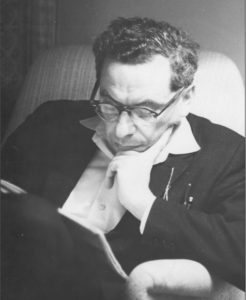
That idea has a name: the probabilistic method. It was invented in 1947 by Paul Erdős, the legendary itinerant Hungarian mathematician who spent his life wandering from university to university, collaborating with hundreds of mathematicians across the world, and leaving behind a trail of problems, conjectures and breakthroughs that kept the mathematics community busy for generations. The probabilistic method was perhaps his greatest gift to the field. And for nearly 80 years, no one had found a way to significantly improve on it for the class of problems Erdős originally cared about most.

Until a graduate student at Tsinghua University decided to try.

The Problem: Colouring Connections

To understand what makes this story remarkable you first need to understand the problem Erdős was trying to solve. Imagine a network of nodes – points – where every pair of nodes is connected by a line. Now colour each line either red or blue. Your challenge is to avoid creating large clusters where every member is connected to every other member by lines of the same colour. These forbidden clusters are called monochromatic cliques.

It sounds like a puzzle. And in a sense it is. But as the network gets bigger, the puzzle becomes impossible. At some point, no matter how cleverly you colour the lines, a monochromatic clique of a certain size will inevitably appear somewhere in the network. The question mathematicians call a Ramsey number asks: how big can the network get before a monochromatic clique of a given size is unavoidable?

The Ramsey number for a clique of size three, for instance, is six. If you have six nodes all connected to each other, you cannot colour the lines red and blue without creating a triangle of the same colour somewhere. Five nodes you can manage. Six you cannot.

As the clique size grows the problem becomes extraordinarily difficult. Mathematicians have been able to calculate only a handful of the smallest Ramsey numbers. As Paul Horn of the University of Denver put it: “It’s very hard to create something that has no structure. Maybe it’s because we’re human and we’re subject to our biases.”

Erdős and the Power of Randomness

This is where Erdős made his revolution. Rather than trying to build a clique-free network by hand which is fiendishly difficult, he asked a different question. What if you consider every possible way to colour the network and choose one at random? He then showed that the probability of getting a clique-free colouring is greater than zero. Which means such a colouring must exist, even if you have no idea what it looks like.

Before the development of the probabilistic method, “if I’m telling you that certain objects exist, you would tell me, ‘Show me,'” said Benny Sudakov, a mathematician at the Swiss Federal Institute of Technology Zurich. “But certain objects are so unusual that it’s hard for us to grasp that they exist at all.”

The proof was just a few lines long. But its impact was enormous. At first, mathematicians were loath to follow Erdős’ lead. They wanted concrete examples. “For many years, Erdős was like a voice in the wilderness,” said Joel Spencer of New York University. “He was getting these amazing results using randomness, and people had never done that before.”

But soon the method proved its worth beyond doubt. Today it is used across mathematics and computer science, to test whether a number is prime, to design better circuits, to clean up data without introducing biases. As Spencer put it: “Now, that’s the baseline.”

Yet for all its power, the probabilistic method had a stubborn limitation. For the specific class of Ramsey numbers Erdős originally cared about, what mathematicians call near-diagonal Ramsey numbers, where the forbidden red and blue cliques are similar in size, progress had essentially frozen. Erdős showed in 1947 that the Ramsey number for same-size cliques of size k must be bigger than roughly the square root of 2 raised to the power k. Over the following eight decades, the entire combined effort of the global mathematics community managed to nudge that bound from 2 to the power of 500 all the way to 2 to the power of 501. For half a century on the near-diagonal problem, the needle barely moved.

Enter a Graduate Student With an Unusual Idea

Wujie Shen had spent his first few semesters at Tsinghua University focused mainly on geometry and topology. But in the spring of 2024, he came across a paper on Ramsey numbers that captivated him.

Shen understood how Erdős’ method worked. You flip a coin to decide the colour of each connection in the network, heads for red, tails for blue. You then calculate the probability that this random colouring will be clique-free. But this calculation becomes extraordinarily difficult for large networks. Shen wondered whether there was a smarter way to introduce randomness, a model that could produce clique-free colourings more efficiently than Erdős’ simple coin flip.

Given his background in geometry, the model he came up with was unexpected. He wanted to use the geometry of high-dimensional spheres.

The Strange World of High-Dimensional Spheres

A sphere, in everyday life, is something you can hold in your hand, a round shape, every point on its surface equidistant from the centre. But mathematicians can define spheres in any number of dimensions, and the higher the dimension the stranger the behaviour. These spheres “mess with all our intuitions completely,” said David Conlon of the California Institute of Technology. Many of our assumptions about what a sphere looks like are no longer true in high dimensions: a high-dimensional sphere has a tiny volume and massive surface area, and most of its points lie on the equator. It’s “pretty complicated to work with,” Sudakov said.

Shen, working with his colleague Jie Ma and Ma’s graduate student Shengjie Xie, proposed a new colouring method. First, place all the nodes of your network randomly on the surface of a high-dimensional sphere. Then colour each connection based on the distance between the two nodes it connects, if the nodes are far apart, colour the connection red; if they are close together, colour it blue.

The insight behind this approach is elegant. To form a large red clique, you need many nodes that are all far from each other. But on the surface of a sphere, with only so much space available, many nodes being simultaneously far from each other is geometrically constrained. The geometry works against the formation of large red cliques in a way that Erdős’ coin flip method does not exploit.

There was a catch, however. By the same logic, the method also produced more blue cliques than Erdős’ approach. “There’s a trade-off that looks like it really helps in one colour, but it doesn’t help at all in the other colour,” Conlon said. “Why bother?”

But Ma, Shen and Xie persisted. They tested their approach on smaller networks and found that even among the many bad colourings their method produced, there was still a nonzero chance of getting a good clique-free colouring. The benefits, they believed, could outweigh the costs even for much larger networks.

The Proof and Its Breakthrough

The key to unlocking the geometry turned out to lie in a peculiar property of high-dimensional spheres. When you randomly place many nodes on the surface of such a sphere and draw lines from each node to the centre, those lines are almost always perpendicular to each other. This is not true in two or three dimensions, it is a feature that only emerges in very high dimensions. And this near-universal perpendicularity restricts how far apart the nodes can be from each other, which in turn limits their chances of forming a large monochromatic clique.

After a year and 40 pages of dense computations, the trio published their paper in July 2025. The result was the first improvement for near-diagonal Ramsey numbers in 50 years. The change in the growth rate was tiny, they managed to nudge Erdős’ growth rate up by a factor of 10 to the power of minus 21, but the significance is enormous. A 50-year frozen problem had moved.

“It’s lucky, and we feel like all our efforts are rewarded,” Ma said. “But it was tough for a long time.”

“It’s a bit shocking that a familiar thing works for a familiar problem,” said Julian Sahasrabudhe of the University of Cambridge. Their technique, he said, “was hidden in plain view.”

What Happened Next

Mathematics rarely stands still after a breakthrough like this. In December 2025, Sudakov and two of his graduate students drastically simplified the team’s colouring model, improving their new bounds even further. Others have since used the model to estimate Ramsey numbers that involve three colours, not two.

This ripple effect is characteristic of the probabilistic method’s entire history. For 80 years mathematicians have been tinkering with Erdős’ randomness-based technique, finding new ways to mix in additional structure to boost its power. Each improvement has then proved useful far beyond the original problem.

Why This Story Matters

For students who encounter mathematics through school, competitions or casual curiosity, this story carries several lessons worth holding onto.

The first is about the power of an unexpected idea. Erdős’ insight, that you could prove something exists by showing it cannot be impossible, was so strange when he proposed it that the mathematical community took years to accept it. Today it underpins huge swathes of modern mathematics and computer science.

The second is about the value of crossing boundaries. Wujie Shen was a graduate student trained in geometry who wandered into a problem in graph theory. His outsider perspective was precisely what unlocked a method that specialists had been staring at for decades. As Sahasrabudhe noted, the technique was hidden in plain view. Sometimes the person who sees it is the one who was not looking in the expected direction.

The third is about the nature of progress in mathematics. The improvement Ma, Shen and Xie achieved was tiny in numerical terms. A change of 10 to the power of minus 21 sounds almost negligible. But in mathematics what matters is not the size of the step — it is whether the barrier has been crossed. For 50 years the near-diagonal Ramsey problem had not moved at all. Now it has. And once a barrier moves, it tends to keep moving.

Erdős himself spent his life believing that mathematics was a vast and largely unexplored territory, full of beautiful truths waiting to be discovered. He carried almost nothing with him as he wandered the world, a single suitcase, a few changes of clothes, and an inexhaustible supply of problems. He would have been delighted to know that 80 years after his greatest invention, a graduate student on the other side of the world had found a way to make it stronger.

That, perhaps, is the most enduring lesson of all. Mathematical ideas do not expire. They wait.


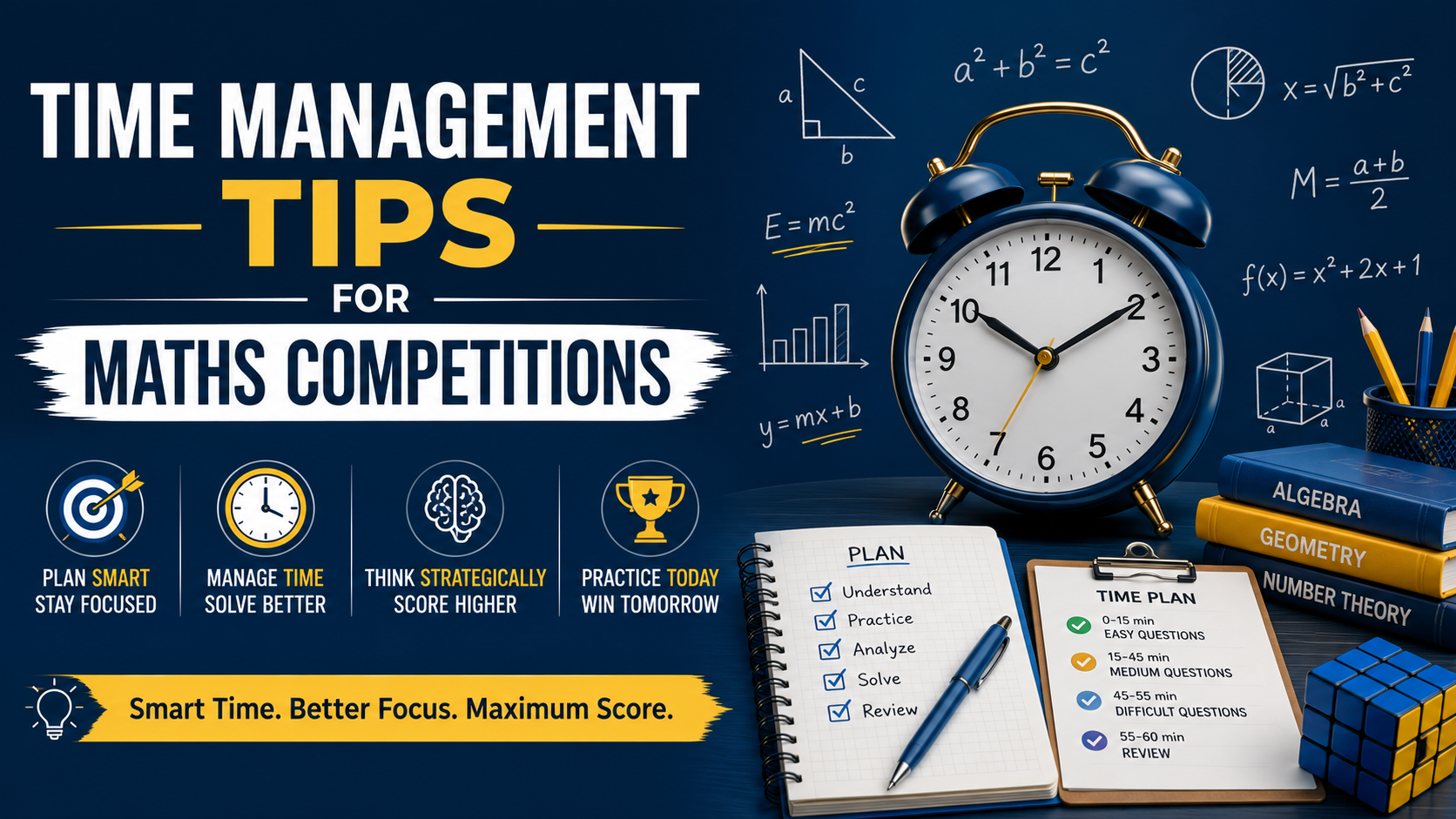
Time Management Tips for Maths Competitions

Success in any Maths Challenge isn’t just about knowing formulas or solving difficult problems, it’s also about using your time wisely. Many students lose valuable marks not because they lack knowledge, but because they spend too much time on one question or rush through the easier ones. Effective time management is one of the biggest advantages top performers have in any Maths competition.

Whether you’re preparing for your school Olympiad or an international-level event like the International Maths Challenge, learning how to manage your time can significantly improve your score and confidence.

Why Time Management Matters in a Maths Competition

Every Maths competition has one common challenge: limited time. Students are expected to solve a variety of questions ranging from straightforward calculations to complex logical problems within a fixed duration.

Good time management helps you:

  • Attempt more questions accurately.
  • Reduce exam stress.
  • Avoid spending excessive time on difficult problems.
  • Improve decision-making during the test.
  • Maximize your final score.

Remember, solving 18 questions correctly is always better than attempting 30 with careless mistakes.

1. Practice with a Timer

One of the most effective ways to improve your maths preparation is by practicing under real exam conditions.

Instead of solving worksheets casually, use a stopwatch or timer. Allocate yourself the exact duration that the actual competition provides.

This helps you:

  • Build speed naturally.
  • Become comfortable working under pressure.
  • Understand your average solving time per question.

Over time, you’ll notice significant improvement in both speed and accuracy.

2. Know the Exam Pattern Beforehand

Before participating in any Maths Challenge, understand:

  • Total number of questions
  • Exam duration
  • Marks per question
  • Negative marking (if applicable)
  • Question difficulty distribution

When you know what to expect, you can create a better strategy rather than making decisions during the exam.

Students participating in the International Maths Challenge should always review the competition guidelines and sample papers before exam day.

3. Divide Your Time into Sections

Don’t spend the entire exam solving questions randomly.

A smart strategy is to divide your available time.

For example, in a 60-minute paper:

  • First 15 minutes: Solve the easiest questions.
  • Next 30 minutes: Attempt medium-level problems.
  • Final 15 minutes: Solve difficult questions and review answers.

This ensures you collect maximum marks before tackling time-consuming problems.

4. Never Get Stuck on One Question

This is one of the biggest mistakes students make during a Maths competition.

If a question takes more than two or three minutes without progress:

  • Mark it.
  • Skip it.
  • Return later.

Every difficult question costs time that could have been used to solve two or three easier ones.

Top performers know when to move on.

5. Attempt Easy Questions First

Confidence builds momentum.

Start with questions you immediately understand.

Benefits include:

  • Quick marks
  • Improved confidence
  • Reduced anxiety
  • Better rhythm throughout the exam

Once you’ve secured the easier marks, you’ll approach tougher questions with a calmer mind.

6. Improve Mental Calculation Speed

Students often waste precious seconds on basic arithmetic.

Practice:

  • Multiplication tables
  • Squares and cubes
  • Fractions
  • Percentage calculations
  • Division shortcuts

Strong mental maths skills make your maths preparation far more effective and leave more time for higher-order thinking.

7. Use Rough Work Efficiently

Organized rough work saves time.

Instead of writing calculations everywhere:

  • Number your rough work.
  • Keep calculations neat.
  • Avoid repeating the same steps.

This makes it easier to revisit questions if needed.

8. Practice Previous Competition Papers

Nothing prepares you better than solving real competition questions.

Previous papers help you:

  • Understand common question types.
  • Improve speed.
  • Learn difficulty progression.
  • Develop time management strategies.

Students preparing for the International Maths Challenge should regularly practice competition-style questions to become familiar with the exam format.

9. Learn to Estimate

Not every calculation needs complete working.

Sometimes estimation quickly eliminates incorrect options.

For example:

  • Approximate large calculations.
  • Compare answer choices.
  • Check if your answer is reasonable.

This technique saves valuable time, especially in multiple-choice Maths Challenge exams.

10. Review Your Answers

Always reserve the final few minutes for checking your work.

Look for:

  • Calculation mistakes
  • Skipped questions
  • Incorrect markings
  • Missing units
  • Unanswered problems

Many students recover valuable marks during this final review.

Sample Time Allocation Strategy

Exam Duration Recommended Strategy
First 20% Solve easiest questions
Next 50% Medium difficulty questions
Next 20% Difficult problems
Final 10% Review and corrections

This balanced approach helps maximize both speed and accuracy.

Common Time Management Mistakes to Avoid

Even well-prepared students can lose marks due to poor time management. Avoid these common mistakes:

  • Spending too long on one question.
  • Ignoring easy questions.
  • Rushing through calculations.
  • Not practicing with a timer.
  • Leaving no time for review.
  • Panicking when encountering difficult problems.

Recognizing these habits early can make a significant difference in your competition performance.

How the International Maths Challenge Helps Students Build Time Management Skills

The International Maths Challenge is designed to help students develop not only mathematical ability but also strategic thinking and effective exam management.

By participating regularly, students learn to:

  • Solve problems more efficiently.
  • Improve speed and accuracy.
  • Build confidence under timed conditions.
  • Develop logical thinking.
  • Prepare for higher-level Maths competitions.

Consistent participation, combined with focused maths preparation, helps students become stronger problem solvers while mastering the art of time management.

Final Thoughts

Excellent mathematical knowledge alone isn’t enough to succeed in a Maths competition. Students who combine strong concepts with smart time management consistently achieve better results. Learning when to move on, practicing under timed conditions, and following a clear strategy can transform your performance.

If you’re aiming to excel in your next Maths Challenge, make time management a key part of your maths preparation. Competitions like the International Maths Challenge provide the perfect platform to sharpen these skills while building confidence, accuracy, and a competitive mindset for future academic success.


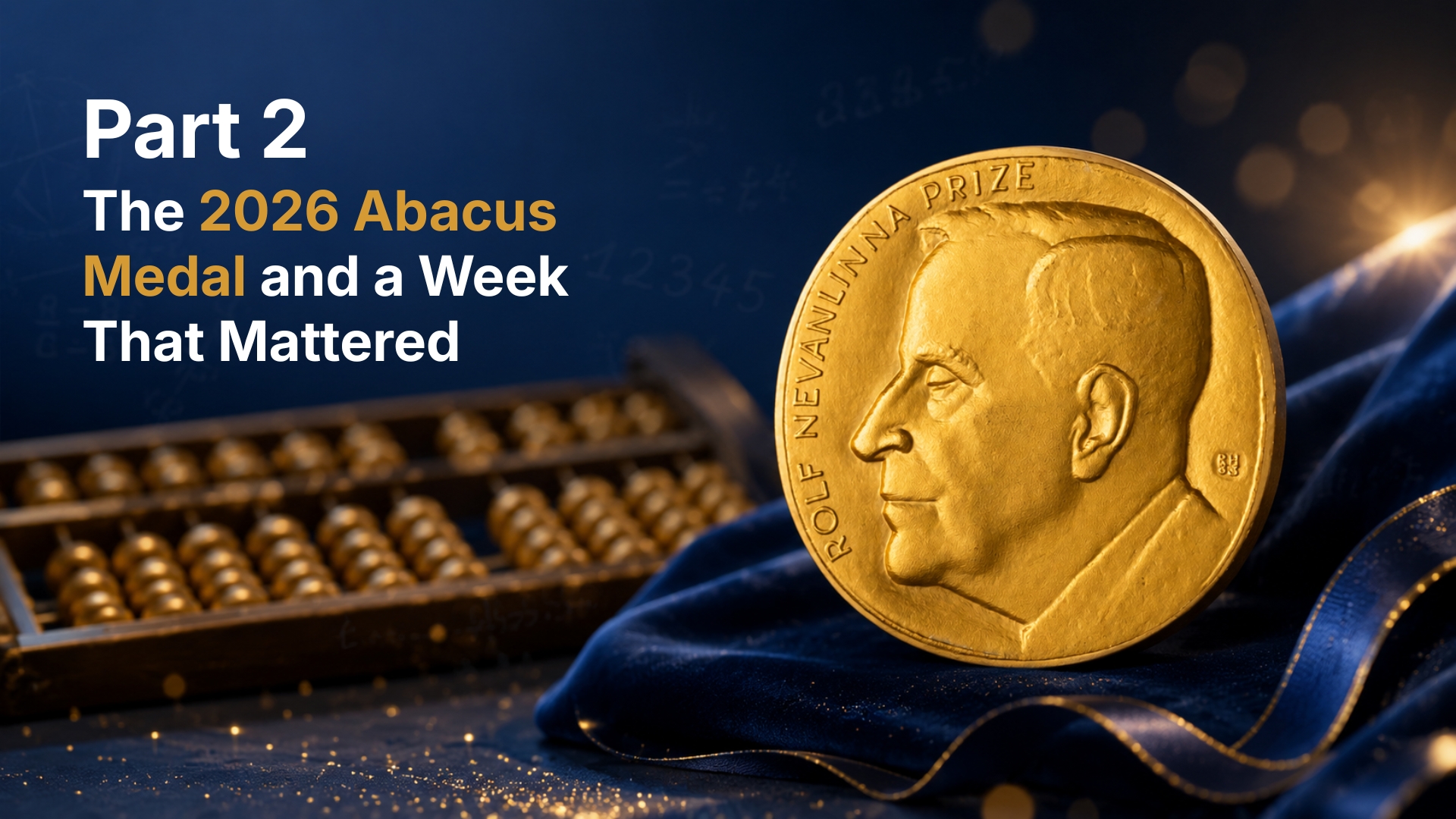
Part 2: The 2026 Abacus Medal and a Week That Mattered

While the Fields Medal captured global headlines, the International Congress of Mathematicians in Philadelphia on 23 July 2026 was about far more than four prizes. It was a week-long celebration of mathematics in all its forms, pure and applied, theoretical and computational, ancient and brand new. Alongside the Fields Medals, the IMU announced several other major awards, each recognising a different dimension of mathematical achievement. At the centre of the non-Fields story was the IMU Abacus Medal.

What Is the Abacus Medal?

The IMU Abacus Medal is the highest honour in theoretical computer science awarded for outstanding contributions in the mathematical aspects of information sciences to a researcher under the age of 40. It was known until 2022 as the Rolf Nevanlinna Prize, having been awarded under that name since 1982. The renaming to the Abacus Medal reflected a desire to give the award its own distinct identity, separate from the personal associations of the original name.

The medal sits alongside the Fields Medal at the ICM ceremony and carries enormous prestige in the world of algorithms, computational complexity and the mathematics that underpins modern computing. In an age when the digital world touches virtually every aspect of human life, the mathematics behind how computers think and solve problems has never mattered more. The Abacus Medal exists to recognise the people pushing those boundaries.

Shayan Oveis Gharan – The Algorithm Alchemist

Shayan Oveis Gharan is awarded the IMU Abacus Medal 2026 for his landmark contributions to the theory of algorithms, taking the analysis of algorithms beyond combinatorics and probabilistic analysis into the theory of the geometry of polynomials and related topics.

Gharan is a computer scientist at the University of Washington in Seattle, born in Iran and trained across some of the world’s leading institutions. His career is defined by an unusual intellectual restlessness, a refusal to stay within the boundaries of his own field when the tools he needs might be found somewhere else entirely.

His most celebrated work is on the travelling salesperson problem, one of the most famous and stubbornly difficult problems in all of computer science. The problem sounds deceptively simple: given a list of cities and the distances between them, find the shortest possible route that visits every city exactly once and returns to the starting point. In practice the problem is extraordinarily hard, the number of possible routes grows so rapidly with the number of cities that brute force calculation becomes impossible even for computers of enormous power.

For decades mathematicians and computer scientists have sought algorithms that can find good approximate solutions routes that may not be perfectly optimal but are guaranteed to be close. Gharan made a breakthrough by importing tools from the geometry of polynomials, a corner of mathematics that at first glance has nothing to do with travelling salespeople or routing problems. By finding unexpected connections between these fields he was able to improve on approximation bounds that had stood for nearly 40 years. It was exactly the kind of cross-disciplinary thinking that the Abacus Medal was created to reward.

His other major area of work involves a concept called negative dependence in probability theory specifically the mathematics of choosing randomly from a large collection of objects in a way that spreads the choices out rather than clustering them. This too has deep connections to polynomial geometry, and Gharan’s contributions here have had ripple effects across theoretical computer science and beyond.

What makes Gharan’s story particularly compelling is that his path to the Abacus Medal was not linear. He has spoken about the importance of pursuing problems that genuinely excite him rather than problems that seem tractable or fashionable. He follows his curiosity even when it leads him far from his own expertise. In this he is a model not just for computer scientists but for anyone who has ever wondered whether it is worth pursuing a problem that seems too hard.

The Rest of the 2026 ICM Awards

The full ceremony in Philadelphia included several other major prizes that deserve recognition.

The Chern Medal for outstanding lifetime achievement in mathematics went to Graeme Segal of the University of Oxford. The Chern Medal has no age restriction. It is awarded to a mathematician whose body of work across an entire career has been of the highest order. Segal’s contributions span topology, geometry and mathematical physics, and his influence on generations of younger mathematicians has been immense.

The Carl Friedrich Gauss Prize was awarded to Yurii Nesterov of Belgium’s University of Louvain for mathematical contributions with significant applications outside mathematics. Nesterov’s work in mathematical optimisation, the mathematics of finding the best solution to a problem subject to constraints, has had profound practical impact, providing theoretical and algorithmic foundations for modern computational optimisation that underpins everything from machine learning to logistics planning.

The Leelavati Prize, awarded for outstanding public outreach in mathematics and sponsored by Infosys, went to Hannah Fry of the University of Cambridge. Fry is one of the world’s most beloved communicators of mathematics, her books, documentaries, podcasts and public lectures have introduced mathematical thinking to millions of people who would never otherwise have encountered it. Recognising public outreach alongside pure research sends a message that the mathematics community takes seriously its responsibility to share what it knows with the world.

Why This Week Matters for Young Mathematicians

Taken together, the 2026 ICM prize winners paint a picture of a discipline that is global, diverse, rigorous and very much alive. A Chinese-born woman solving a 50-year-old geometry problem. An Iranian-born computer scientist reimagining how algorithms work. A lifetime achievement award for a British mathematician at Oxford. A Gaussian prize for practical optimisation that powers modern AI. A prize for making maths joyful and accessible to the world.

For young students sitting a maths challenge this November, whether through the IMC or any other competition, these names and stories are worth knowing. Every one of the 2026 medalists was once a student sitting in a classroom, wrestling with a problem that seemed impossible, wondering whether mathematics was something they could really do. The distance between that moment and a gold medal is long. But it begins with exactly the kind of curiosity, persistence and willingness to try hard problems that competitions like the OSMC are designed to nurture.

Mathematics does not belong to any one country, age group or background. Philadelphia 2026 proved it once again and in the most spectacular way imaginable.