
Teaching maths in the garden: a guide for parents

Keeping children engaged with maths over the summer doesn’t have to be complicated. Grow their maths skills alongside your very own garden with these tips.

As some children continue to learn from home, maintaining their mathematical skills can be a challenge. Parents and caregivers may feel nervous about teaching maths to their children, and even hold onto some maths anxiety themselves.

It’s okay to take a simple approach to maths teaching using objects and environments at home. Have you considered that gardening can be an easy and effective way to help your child connect with mathematical concepts in a concrete and lasting way?

Here are four ways you can support teaching maths in the garden.

1. Invite your child to help with garden planning

Maths is everywhere! And your garden is no exception. Creating gardening maths activities can be as simple as taking notice of what you’re already doing.

Ready to plan your garden? Start by breaking down the information you need. The planning stage of gardening is full of rich mathematical calculations like:

How much space do we have to plant?

How much soil will we need?

How much will it cost?

How far apart will we need to plant the different varieties of flowers or vegetables?

How many rows do we have space to plant? How many columns?

How much sunlight does this spot get? How much sun will our plants need?

To an expert gardener, these may seem like simple things you think about in passing. But they can easily become mathematical tasks you could get your child to help you with.

2. Ask your child to help you find the answers

You need information to get your garden going, and you have a helper ready to get it for you. Ask your child questions that will help you prepare for planting:

Can they measure the length and width of your garden?

Can they find the area?

If it’s a raised garden bed, can they find the height and the volume?

If they know the volume in cubic metres or centimetres, can they express it in litres?

If a standard bag of soil is 50 l and costs £12, can they tell you how many bags you’ll need to fill the garden bed?

Can they tell you how much the soil will cost overall?

Posing mathematical questions that are rooted in reality gives your child and opportunity to use their knowledge. When your child can see why they’re doing something, they develop a deeper conceptual understanding.

3. Challenge your child to find multiple solutions

If you think your child could go a bit further, ask them to plot out where to plant different varieties in your garden. Say you want to plant lettuce, beetroot and carrots — and they all need to be planted the following distances away from other plants:

Lettuce should be planted at least 30 cm away from other plants

Beetroot should be planted at least 10 cm away from other plants

Carrots should be planted at least 5 cm away from other plants

With available garden space in mind, you can ask guiding questions like:

How many configurations could you have?

Could you plant 5 lettuce, 10 beetroot and 20 carrots?

Or could you plant more lettuce and fewer beetroot and carrots?


Ask your child to map it out, and come up with a few different answers. Finding more than one way to solve a problem will boost your child’s reasoning skills, allow them to explore maths for themselves and encourage creativity!

4. Continue learning by encouraging maths journaling

Keeping a garden is a great opportunity for your child to reflect on what they learned in an ongoing maths journal. For example, when your child thinks back on what they did to measure and plan the garden, you could ask:

Why did we need that information?

What did it help us do next?

When planting, they can keep a record of what, where, when and how many seeds were planted. Have them make estimations like:

How many plants do you think will grow?

What do you think the yield will be?

When harvesting, encourage them to refer back to their planting journal and compare.

Can they compare their estimations to the actual yield?

Can they compare the actual yield to the data they recorded when planting?

Can they tell you what percentage of seeds grew into plants?

How could they use their findings in the future?

Reflecting on their learning and answering open questions will help your child master mathematical concepts in depth. Explaining their thinking, getting creative and making connections to what they learned and why, all help to solidify mathematical understanding.

In short, learning maths at home doesn’t need to be complicated. Teaching mathematics can also be a part of teaching your child life lessons and skills, like how to plant a garden.

Learning maths in real-life contexts helps children form a connection with new information, and better understand how to apply it. So they won’t just understand what to do, they’ll understand why they’re doing it.

For more such insights, log into www.international-maths-challenge.com.

*Credit for article given to Lisa Champagne*


Probability underlies much of the modern world – an engineering professor explains how it actually works

Probability can explain why a coin flip has a 50/50 chance of landing heads versus tails, but it also can be used for more powerful applications. Monty Rakusen/DigitalVision via Getty Images

Probability underpins AI, cryptography and statistics. However, as the philosopher Bertrand Russell said, “Probability is the most important concept in modern science, especially as nobody has the slightest notion what it means.”

I teach statistics to engineers, so I know that while probability is important, it is counterintuitive.

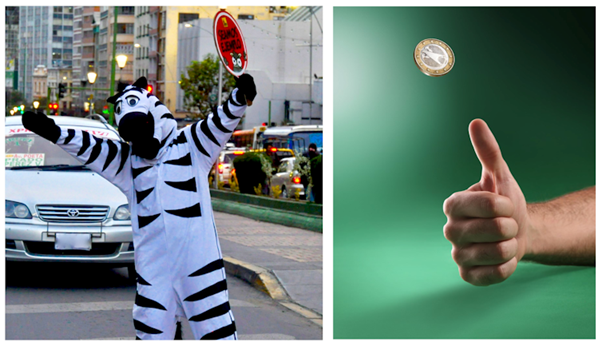
Probability is a branch of mathematics that describes randomness. When scientists describe randomness, they’re describing chance events – like a coin flip – not strange occurrences, like a person dressed as a zebra. While scientists do not have a way to predict strange occurrences, probability does predict long-run behavior – that is, the trends that emerge from many repeated events.

We may say ‘random’ to describe strange occurrences (person dressed as zebra), but probability describes chance events (a coin flip). Zebras in La Paz, Bolivia by EEJCC, Own Work CC A-SA 4.0; https://commons.wikimedia.org/wiki/File:Zebra_La_Paz.jpg _ , CC BY-SA

Modeling with probability

Since probability is about events, a scientist must choose which events to study. This choice defines the sample space. When flipping a coin, for example, you might define your event as the way it lands.

Coins almost always land on heads or tails. However, it’s possible – if very unlikely – for a coin to land on its side. So to create a sample space, you’d have two choices: heads and tails, or heads, tails and side. For now, ignore the side landings and use heads and tails as our sample space.

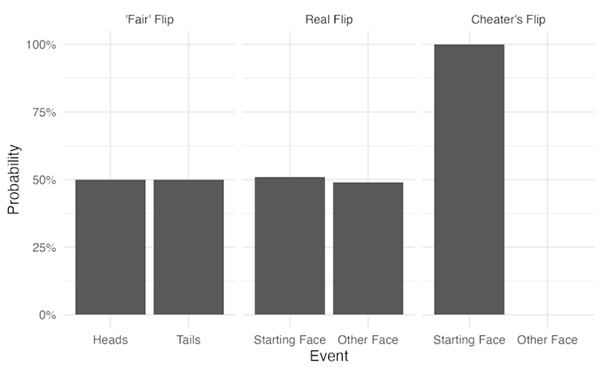
Next, you would assign probabilities to the events. Probability describes the rate of occurrence of an event and takes values between 0% and 100%. For example, a fair flip will tend to land 50% heads up and 50% tails up.

To assign probabilities, however, you need to think carefully about the scenario. What if the person flipping the coin is a cheater? There’s a sneaky technique to “wobble” the coin without flipping, controlling the outcome. Even if you can prevent cheating, real coin flips are slightly more probable to land on their starting face – so if you start the flip with the coin heads up, it’s very slightly more likely to land heads up.

In both the cheating and real flip cases, you need an appropriate sample space: starting face and other face. To have a fair flip in the real world, you’d need an additional step where you randomly – with equal probability – choose the starting face, then flip the coin.

The probabilities for different coin-flipping scenarios. Zachary del Rosario, CC BY-SA

These assumptions add up quickly. To have a fair flip, you had to ignore side landings, assume no one is cheating, and assume the starting face is evenly random. Together, these assumptions constitute a model for the coin flip with random outcomes. Probability tells us about the long-run behavior of a random model. In the case of the coin model, probability describes how many coins land on heads out of many flips.

But instead of using a random model, why not just solve the coin toss using physics? Actually, scientists have done just that, and the physics shows that slight changes in the speed of the flip determine whether it comes up heads or tails. This sensitivity makes a coin flip unpredictable, so a random model is a good one.

Frequency vs. probability

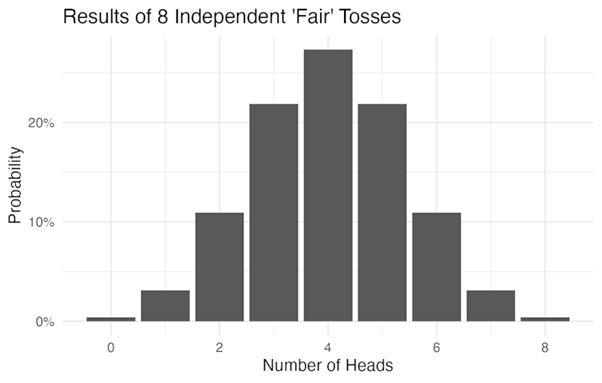
Probability differs from frequency, which is the rate of events in a sequence. For example, if you flip a coin eight times and get two heads, that’s a frequency of 25%. Even if the probability of flipping a coin and seeing heads is 50% over the long run, each short sequence of flips will come out different. Four heads and four tails is the most probable outcome from eight flips, but other events can – and will – happen.

Frequency and probability are the same in one special setting: when the number of data points goes to infinity. In this sense, probability tells us about long-run behavior.

Probabilities for all possible outcomes of eight ‘fair’ coin flips. Zachary del Rosario, CC BY-SA

Applications to AI, cryptography and statistics

Probability isn’t just useful for predicting coin flips. It underlies many modern technological systems.

For example, AI systems such as large language models, or LLMs, are based on next-word prediction. Essentially, they compute a probability for the words that follow your prompt. For example, with the prompt “New York” you might get “City” or “State” as the predicted next word, because in the training data those are the words that most frequently follow.

But since probability describes randomness, the outputs of a LLM are random. Just like a sequence of coin flips is not guaranteed to come out the same way every time, if you ask an LLM the same question again, you will tend to get a different response. Effectively, each next word is treated like a new coin flip.

Randomness is also key to cryptography: the science of securing information. Cryptographic communication uses a shared secret, such as a password, to secure information. However, surprising randomness isn’t good enough for security, which is why picking a surprising word is a bad choice of password. A shared secret is only secure if it’s hard to guess. Even if a word is surprising, real words are easier to guess than flipping a “coin” for each letter.

You can make a much stronger password by using probability to choose characters at random on your keyboard – or better yet, use a password manager.

Finally, randomness is key in statistics. Statisticians are responsible for designing and analyzing studies to make use of limited data. This practice is especially important when studying medical treatments, because every data point represents a person’s life.

The gold standard is a randomized controlled trial. Participants are assigned to receive the new treatment or the current standard of care based on a fair coin flip. It may seem strange to do this assignment randomly – using coin flips to make decisions about lives. However, the unpredictability serves an important role, as it ensures that nothing about the person affects their chance to get the treatment: not age, gender, race, income or any other factor. The unpredictability helps scientists ensure that only the treatment causes the observed result and not any other factor.

So what does probability mean? Like any kind of math, it’s only a model, meaning it can’t perfectly describe the world. In the examples discussed, probability is useful for describing long-term behaviors and using unpredictability to solve practical problems.

For more such insights, log into www.international-maths-challenge.com.

*Credit for article given to Zachary del Rosario*


Teaching mathematical statistics: one lecturer’s way of testing what students understand

Unsplash

It’s getting tougher to assess how much university students have learnt. In his work as a Mathematical Statistics lecturer, Michael von Maltitz has tried a new way of getting students to learn, and of assessing what they’ve absorbed and retained. Students have to show and discuss how they arrived at their understanding of the subject. They can’t just rely on cramming, because he interviews them as if they were applying for a job.

What prompted you to try something new?

“We understand, but how will it be asked in the test?” This is the question that was posed to me time and again in 2019 when I started lecturing a module in mathematical statistics at second-year university level.

I knew I had to make a change. I already understood that students were stressed, prone to memorising content and cramming before tests and examinations, and using short cuts to attain a good grade, rather than to learn anything.

What did you then do differently?

The module was unfamiliar to me so I decided to allow the students to approach the course content in the same way as I was: gathering information from different sources and combining and collating it digitally, reflecting on how it helped to meet certain objectives or learning outcomes.

These portfolios of learning evidence would contain course and outcome information, content knowledge (including theorems and proofs), examples with solutions, showpiece assignments, links to and discussions on online tutorials or videos, and paragraphs of self-reflection. Readers might see these portfolios as “study notes on steroids”.

Assessing the portfolio would be an exercise in evaluating the learning process, rather than a memorised product.

The process was challenging but offered a reward for me and my students – that of discovery. Students seemed to be genuinely learning.

Besides checking their portfolios, I needed a way to assess progress that didn’t fall into the old habits of memorisation and “teaching to the test”. I needed to ensure that a student had created their own portfolio and could defend the content in it. And I needed an assessment method that would not take more time and effort than coming up with a unique written test or examination, formulating a typeset memorandum, and marking more than 100 answer scripts, giving feedback that the students might never look at.

I decided to test this form of deep learning using a workplace method – the interview. In a 30-minute online interview with each student, I asked questions about their understanding of the module content, as well as questions concerning their own portfolios. Each student had to defend the information collected and reflected upon.

The interview worked perfectly when paired with the portfolio. I assessed a set of portfolios in an evening, gave typed feedback, and then interviewed those portfolios’ creators the next day. Feedback was immediate, and the interview assessment became a learning experience, for me and the student.

They were able to defend their portfolios if I made any errors on the portfolio assessment, and I could give the correct answer immediately to any interview question they were stumped by.

Afterwards, the recording of the interview could be given to the student, and if they felt I was being unfair at all, they could compare their interview with another student’s. In doing so, the students themselves could moderate my assessment practice.

What results did you observe?

After a year or two of teaching and assessing like this, I noticed my students seemed to understand more of the content. They retained more into their final year, they were fluent in “statistics” communication and they had better time management and self-reflection skills.

Students told me that they were asked the same questions in their first job interviews as I had asked in my modules, and that they felt much more at ease in those first few job interviews.

How did you confirm these results?

To formally test the developments I had noticed in my students, I conducted research on the class in 2022, which was published in conference proceedings and an article.

This study showed that students experienced significant learning in every facet of an educational framework known as Fink’s taxonomy:

  • foundational knowledge
  • application and communication
  • integration of content into other areas
  • self-reflection
  • interest
  • learning how to learn.

Thus, the method of learning and assessment could formally be called a success within Statistics.

Can this approach be used in other courses?

Yes. One might argue that if this method can be employed for a mathematical module, it can be utilised anywhere. Mathematical modules contain theorems, proofs, definitions, theoretical and practical problem solving – items that might seem difficult to assess through verbal communication. But it is the understanding of the ideas behind the theorems, the stories of and the tricks used within the proofs, the application of the theoretical problems, that are so important in an age where your favourite AI can provide content knowledge.

Mathematical proofs and worked calculations, both of which take time in practice, can be assessed by looking at a portfolio containing these items with the student’s annotations and reflections. The understandings of these concepts are assessed in the interview.

Likewise, in other subjects, a portfolio could be used for assessing knowledge-based content, while the interview could be used to gauge a student’s understanding of what was put into the portfolio, why they chose that content, why the content is important, and how that content is used in practice.

For more such insights, log into www.international-maths-challenge.com.

*Credit for article given to Michael Johan von Maltitz*


Why you can’t tie knots in four dimensions

John M Lund Photography Inc / Getty Images

We all know we live in three-dimensional space. But what does it mean when people talk about four dimensions?

Is it just a bigger kind of space? Is it “space-time”, the popular idea which emerged from Einstein’s theory of relativity?

If you have wondered what four dimensions really look like, you may have come across drawings of a “four-dimensional cube”. But our brains are wired to interpret drawings on flat paper as two- or at most three-dimensional, not four-dimensional.

The almost insurmountable difficulty of visualising the fourth dimension has inspired mathematicians, physicists, writers and even some artists for centuries. But even if we can’t quite imagine it, we can understand it.

What is dimension?

The dimension of a space captures the number of independent directions in it.

A line is one-dimensional. We can move along it forwards and backwards, but these are opposite, not independent, directions. You can also think of a string or piece of rope as practically one-dimensional, as the thickness is negligible compared with the length.

You can move forwards along a rope, or backwards – but not side to side. Zsuzsanna Dancso, CC BY

A surface, such as a soccer field or the skin of a balloon, is two-dimensional. There are independent directions forwards and sideways.

You can move diagonally on a surface, but this is not an independent direction because you can get to the same place by moving forwards, then sideways. The space we live in is three-dimensional: in addition to moving forwards and sideways, we can also jump up and down.

Four-dimensional space has yet another independent direction. This is why space-time is considered four-dimensional: you have the three dimensions of space, but moving forward or backward in time counts as a new direction.

One way to imagine four-dimensional space is as an immersive three-dimensional movie, where each “frame” is three-dimensional and you can also fast-forward and rewind in time.

Consider the cube

A powerful tool for understanding higher dimensions is through analogies in lower dimensions. An example of this technique is drawing cubes in more dimensions.

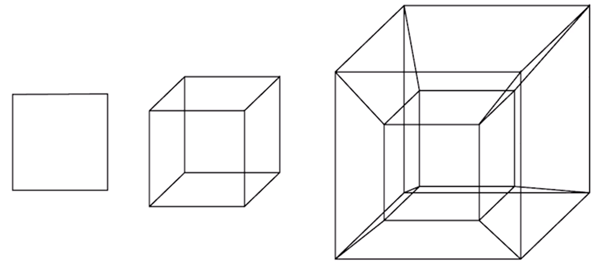
A “two-dimensional cube” is just a square. To draw a three-dimensional cube, we draw two squares, then connect them corner to corner to make a cube.

So, to draw a four-dimensional cube, start by drawing two three-dimensional cubes, then connect them corner to corner. You can even continue doing this to draw cubes in five or more dimensions. (You will need a large piece of paper and need to keep your lines neat!)

A two-dimensional, a three-dimensional and a four-dimensional cube. Zsuzsanna Dancso, CC BY

This experiment can help accurately determine how many corners and edges a higher-dimensional cube has. But for most of us, it will not help us “see” one. Our brains will only interpret the images as complex webs of lines in two or at most three dimensions.

Knots

We can tie knots in three dimensions because one-dimensional ropes “catch on each other”. This is why a long rope wound around itself, if done right, won’t come apart. We trust knots with our lives when we’re sailing or climbing.

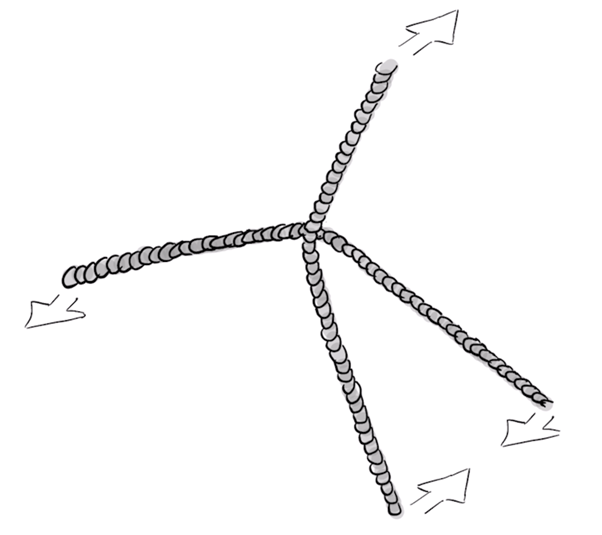
Two ropes catch on each other if pulled in opposite directions. This is what makes knotting possible. Zsuzsanna Dancso, CC BY

But in four dimensions, knots would instantly come apart. We can understand why by using an example in fewer dimensions, like we did with cubes.

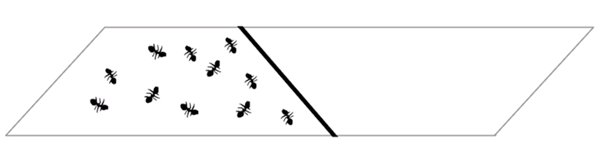
Imagine a colony of two-dimensional ants living on a flat surface divided by a line. The ants can’t cross the line: it’s an impassable barrier for them, and they don’t even know the other side of the line exists.

A colony of flat ants in a two-dimensional world don’t even know that a world on the other side of the line exists. Zsuzsanna Dancso, CC BY

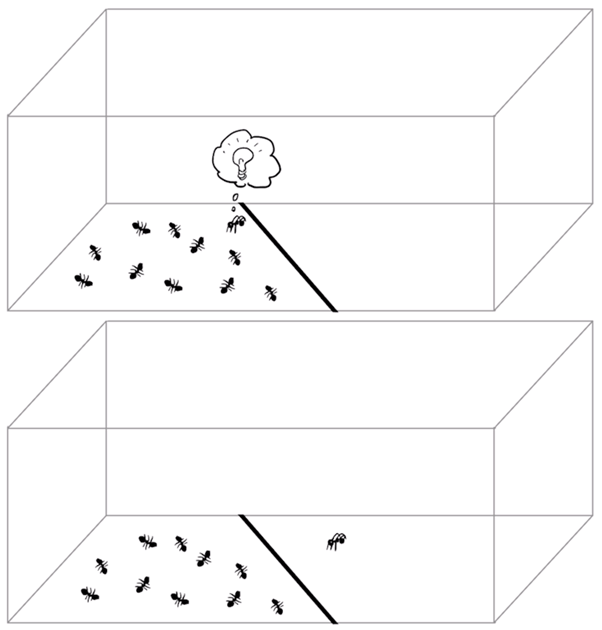
But if one day an ant, and its world, becomes three-dimensional, that ant will step over the line with ease. To step over, it needs to move just a tiny bit in the new, vertical direction.

If one ant becomes three-dimensional, it can see across the line and step over it with ease. Zsuzsanna Dancso, CC BY

Now, instead of an ant and a line on a flat surface, imagine a horizontal and a vertical piece of rope in three dimensions. These will catch on each other if pulled in opposite directions.

But if the space became four-dimensional, it would be enough for the horizontal piece of rope to move just a little bit in the new, fourth direction, to avoid the other entirely.

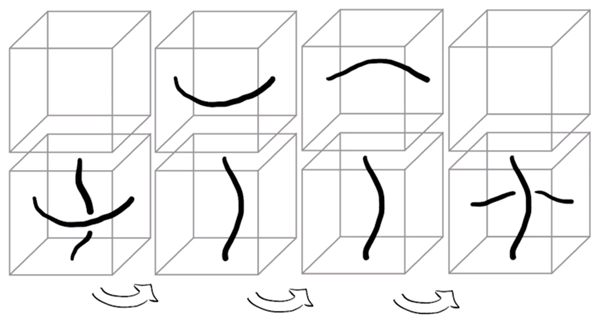
Thinking of four dimensions as a movie, the pieces of rope live in a single, three-dimensional frame. If the horizontal piece of rope shifts just slightly into a future frame, in that frame there is no vertical piece, so it can easily move to the other side of the vertical piece before shifting back.

Imagine four-dimensional space as a movie of three-dimensional frames. The bottom left cube shows a horizontal piece of rope in front of a vertical piece, both in the ‘present’ frame. The horizontal piece can move into the future frame (second column), where it is able to slide towards the back (third column), then move back into the present frame, now behind the vertical piece. Zsuzsanna Dancso, CC BY

From our three-dimensional perspective, the ropes would appear to slide through each other like ghosts.

Knots in more dimensions

Is it impossible, then, to knot a rope in higher dimensions? Yes: any knot tied on a rope will come apart.

But not all is lost: in four-dimensional space you can knot two-dimensional surfaces, such as balloons, large picnic blankets or long tubes.

There is a mathematical formula that determines when knots can stay knotted: take the dimension of the object you want to knot, double it, and add one. According to the formula, this is the maximum dimension of a space where knotting is possible.

The formula implies, for example, that a rope (one-dimensional) can be knotted in at most three dimensions. A (two-dimensional) balloon surface can be knotted in at most five dimensions.

Studying knotted surfaces in four-dimensional space is a vibrant topic of research, which provides mathematical insight into the the still poorly understood mysteries into the intricacies of four-dimensional space.

For more such insights, log into www.international-maths-challenge.com.

*Credit for article given to Zsuzsanna Dancso*