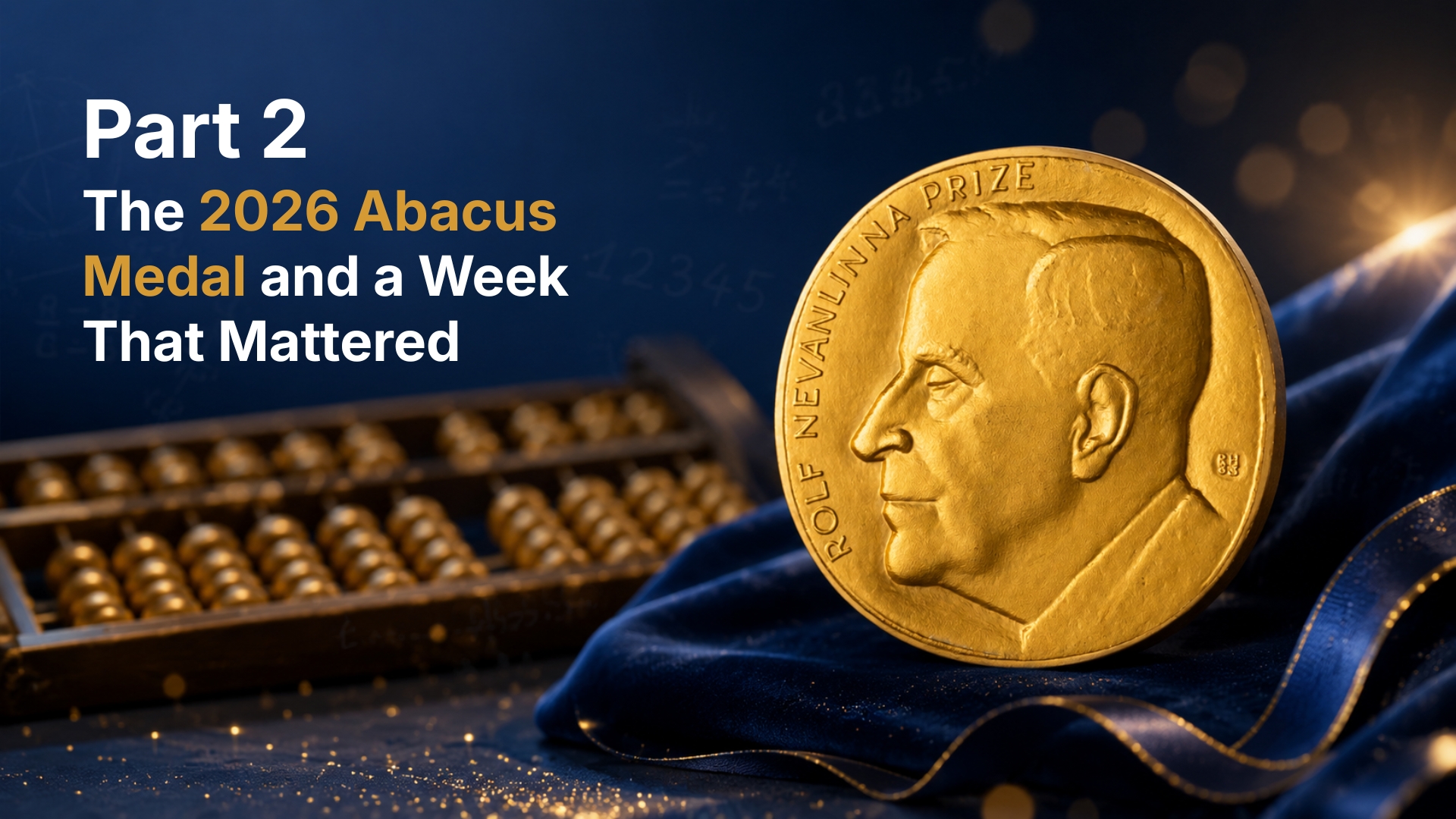
While the Fields Medal captured global headlines, the International Congress of Mathematicians in Philadelphia on 23 July 2026 was about far more than four prizes. It was a week-long celebration of mathematics in all its forms, pure and applied, theoretical and computational, ancient and brand new. Alongside the Fields Medals, the IMU announced several other major awards, each recognising a different dimension of mathematical achievement. At the centre of the non-Fields story was the IMU Abacus Medal.
What Is the Abacus Medal?
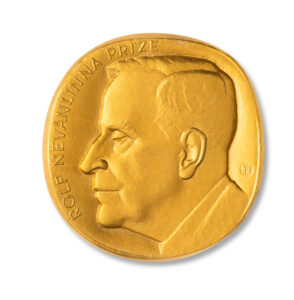
The IMU Abacus Medal is the highest honour in theoretical computer science awarded for outstanding contributions in the mathematical aspects of information sciences to a researcher under the age of 40. It was known until 2022 as the Rolf Nevanlinna Prize, having been awarded under that name since 1982. The renaming to the Abacus Medal reflected a desire to give the award its own distinct identity, separate from the personal associations of the original name.
The medal sits alongside the Fields Medal at the ICM ceremony and carries enormous prestige in the world of algorithms, computational complexity and the mathematics that underpins modern computing. In an age when the digital world touches virtually every aspect of human life, the mathematics behind how computers think and solve problems has never mattered more. The Abacus Medal exists to recognise the people pushing those boundaries.
Shayan Oveis Gharan – The Algorithm Alchemist
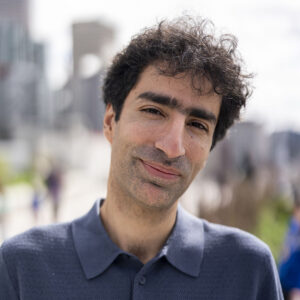
Shayan Oveis Gharan is awarded the IMU Abacus Medal 2026 for his landmark contributions to the theory of algorithms, taking the analysis of algorithms beyond combinatorics and probabilistic analysis into the theory of the geometry of polynomials and related topics.
Gharan is a computer scientist at the University of Washington in Seattle, born in Iran and trained across some of the world’s leading institutions. His career is defined by an unusual intellectual restlessness, a refusal to stay within the boundaries of his own field when the tools he needs might be found somewhere else entirely.
His most celebrated work is on the travelling salesperson problem, one of the most famous and stubbornly difficult problems in all of computer science. The problem sounds deceptively simple: given a list of cities and the distances between them, find the shortest possible route that visits every city exactly once and returns to the starting point. In practice the problem is extraordinarily hard, the number of possible routes grows so rapidly with the number of cities that brute force calculation becomes impossible even for computers of enormous power.
For decades mathematicians and computer scientists have sought algorithms that can find good approximate solutions routes that may not be perfectly optimal but are guaranteed to be close. Gharan made a breakthrough by importing tools from the geometry of polynomials, a corner of mathematics that at first glance has nothing to do with travelling salespeople or routing problems. By finding unexpected connections between these fields he was able to improve on approximation bounds that had stood for nearly 40 years. It was exactly the kind of cross-disciplinary thinking that the Abacus Medal was created to reward.
His other major area of work involves a concept called negative dependence in probability theory specifically the mathematics of choosing randomly from a large collection of objects in a way that spreads the choices out rather than clustering them. This too has deep connections to polynomial geometry, and Gharan’s contributions here have had ripple effects across theoretical computer science and beyond.
What makes Gharan’s story particularly compelling is that his path to the Abacus Medal was not linear. He has spoken about the importance of pursuing problems that genuinely excite him rather than problems that seem tractable or fashionable. He follows his curiosity even when it leads him far from his own expertise. In this he is a model not just for computer scientists but for anyone who has ever wondered whether it is worth pursuing a problem that seems too hard.
The Rest of the 2026 ICM Awards
The full ceremony in Philadelphia included several other major prizes that deserve recognition.
The Chern Medal for outstanding lifetime achievement in mathematics went to Graeme Segal of the University of Oxford. The Chern Medal has no age restriction. It is awarded to a mathematician whose body of work across an entire career has been of the highest order. Segal’s contributions span topology, geometry and mathematical physics, and his influence on generations of younger mathematicians has been immense.
The Carl Friedrich Gauss Prize was awarded to Yurii Nesterov of Belgium’s University of Louvain for mathematical contributions with significant applications outside mathematics. Nesterov’s work in mathematical optimisation, the mathematics of finding the best solution to a problem subject to constraints, has had profound practical impact, providing theoretical and algorithmic foundations for modern computational optimisation that underpins everything from machine learning to logistics planning.
The Leelavati Prize, awarded for outstanding public outreach in mathematics and sponsored by Infosys, went to Hannah Fry of the University of Cambridge. Fry is one of the world’s most beloved communicators of mathematics, her books, documentaries, podcasts and public lectures have introduced mathematical thinking to millions of people who would never otherwise have encountered it. Recognising public outreach alongside pure research sends a message that the mathematics community takes seriously its responsibility to share what it knows with the world.
Why This Week Matters for Young Mathematicians
Taken together, the 2026 ICM prize winners paint a picture of a discipline that is global, diverse, rigorous and very much alive. A Chinese-born woman solving a 50-year-old geometry problem. An Iranian-born computer scientist reimagining how algorithms work. A lifetime achievement award for a British mathematician at Oxford. A Gaussian prize for practical optimisation that powers modern AI. A prize for making maths joyful and accessible to the world.
For young students sitting a maths challenge this November, whether through the IMC or any other competition, these names and stories are worth knowing. Every one of the 2026 medalists was once a student sitting in a classroom, wrestling with a problem that seemed impossible, wondering whether mathematics was something they could really do. The distance between that moment and a gold medal is long. But it begins with exactly the kind of curiosity, persistence and willingness to try hard problems that competitions like the OSMC are designed to nurture.
Mathematics does not belong to any one country, age group or background. Philadelphia 2026 proved it once again and in the most spectacular way imaginable.