
What is the chance of a message in a bottle being found?

Jenny Sturm/Shutterstock

Recently, a cheerful 100-year-old message in a bottle was found on the south-west coast of Australia. In it, a world war one soldier proclaimed to be “as happy as Larry”.

If you’re a betting person, you probably wouldn’t expect great odds of this happening. A bottle cast into the ocean could end up absolutely anywhere.

If it floats to a remote location, there is little chance of somebody stumbling upon it. And if it lands somewhere more favourable where people could potentially find it, there are other issues. The message itself will deteriorate over time as light degrades it. If the bottle fills with water, it will sink and almost certainly never be found.

So, what are the chances of a message in a bottle being found and it being over 100? And what are your chances of finding this bottle?

Despite these many possibilities during a bottle’s lifetime, the probability we are after is a straightforward calculation. Just count up the number of bottles with messages that have been found and are over 100 years old, and divide by the number of messages that have been sent this way (assuming we know how many are sent):

Probability calculation.

Our diagram below shows a hypothetical situation where 20 bottles are sent in total, of which six are found (indicated in gold) and one of these is over 100 years old (indicated by the “100” stamp). So, one in 20 bottles are found and over 100 years old. (Note: This is only a hypothetical calculation, not the real data.)
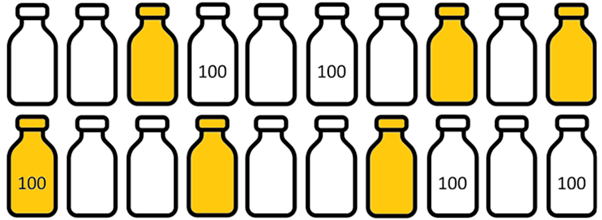
Hypothetical bottle data. Bottle image from https://www.flaticon.com/free-icons/bottle.

Instead of calculating the probability directly, another way to do it is by breaking the problem into two parts: (A) a bottle with a message is found, and (B) the found bottle is over 100. These two probabilities can be calculated separately and multiplied together to get what we want:

Multiplication rule of probability.

This is known as the “multiplication rule” of probability, and we confirm from our hypothetical numbers that (6/20)×(1/6) = 1/20, as before.

Both approaches to calculating this probability are simple. However, the direct calculation requires knowing the total number of bottles sent out, which is very difficult to know in the real world.

The multiplication rule has the advantage that it breaks the calculation into two parts. We can tackle each separately, then bring the two results together to get the probability we want. This is useful in the real-world situation where we can draw information from different sources.

First, we’ll deal with the probability that a bottle with a message is found, irrespective of its age.

Experts from the Federal Maritime and Hydrographic Agency of Germany suggest a one in ten chance that a message in a bottle will be found. This aligns broadly with various historical “drift bottle” experiments, where oceanographers released large numbers of bottles to understand ocean currents.

For example, studies from the 1960s and ’70s in the North Atlantic Ocean led to recovery rates of 14% from the Gulf of Mexico, 8% from the Caribbean Sea and 7% from the northern Brazilian coast. A more recent and more northerly study (between Canada and Greenland) from the 2000s led to a 5% recovery rate.

We would expect the results to vary naturally from different experiments in different parts of the world. But to keep things simple, we will stick with 1/10 as the probability that a bottle with a message is found.

Now for the second piece of the calculation: of the bottles that are found, what proportion are over 100 years old?

The table below summarises data from news articles collected on Wikipedia about very old bottles with messages that have been found. However, only data on bottles over 25 years old has been collected, presumably because older bottles are more newsworthy.

Data on the age distribution of bottles found, where the asterisk * indicates an estimated number.

So, we needed to estimate the number of 0- to 25-year-old bottles with messages ourselves – here’s how we did this.

The table shows that fewer bottles with messages are found as they get older. Messages in bottles degrade over time, which means the bottles have an increased chance of breaking and sinking, or just getting covered in layers of sediment. Plotting this data in the graph below helped us see the trend in the ages of found bottles more clearly.
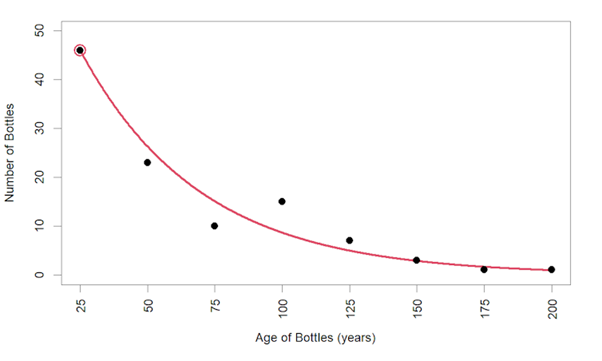
Trend in the ages of bottles found.

We drew a line to match this observed trend in the ages of found bottles. This red line in the graph corresponds to the equation:

This equation provides an estimate of how many bottles have been found for any specific age range (where 25 = 0-to-25, 50 = 25-to-50 and so on). We are interested in the the 0- to 25-year-old bottles, so the equation suggests 46 bottles have been found in this range.

Adding up this and all of the numbers in the table gives a total of 106 bottles found, of which 12 are over 100 years old, and 12/106 is about one in ten.

Recapping the above, we have that: (A) one in ten bottles with messages are found, of which (B) one in ten are over 100 years old. Bringing these results together using the multiplication rule, we estimate the chance of a message in a bottle being found and it being over 100 years old to be (1/10)×(1/10) = 1/100.

So, if there are 100,000 bottles with messages floating around the oceans waiting to be found, we’d expect 1,000 of these to be found and be 100 or more years old. Assuming anybody in the world is equally likely to find one of these, with 8 billion people currently, that’s about a one in 8 million chance of you finding one – pretty unlikely.

However, some people are more persistent at message-in-a-bottle hunting than others. Following the paths of ocean currents (known as gyres) could provide clues on where to look.

Specifically, peninsulas or islands intersecting with these gyres could be good spots. For this reason, it has been suggested the Caribbean islands are ideally placed for finding bottles as they lie on the path of the North Atlantic Gyre. Which seems like a great reason to travel to the Carribean!

But let’s also spare a thought for the poor soul stranded on their desert island, who surely won’t appreciate the low odds of their SOS being found.

For more such insights, log into www.international-maths-challenge.com.

*Credit for article given to Kevin Burke & David O’Sullivan*

Finding Square Roots Without Estimating

Typical algorithms for doing square roots by hand require estimation. I have taught a different algorithm that does not rely on estimation but instead uses subtraction of successive odd integers. First, I offer examples that illustrate two situations that may arise. Then I present a third situation (as well as how to deal with the square roots of non-perfect squares).

This approach is based on the fact that the nth perfect square is the sum of the first n odd integers. This fact can be used to subtract successive odd integers from a given number for which one wishes to find the square root. If the number isn’t a perfect square, this method can be extended by adding pairs of zeroes to the original number and continuing the process for each additional decimal place one wishes find.

FIRST RULE

It helps to look at a couple of examples to illustrate two “special cases” that arise with some numbers, requiring one or two additional “rules” or steps.

Using the example of 54,756:

Start by marking pairs of digits from the right-most digit: 5 | 47 | 56

Then subtract 1 from the leftmost digit or pair: 5 – 1 = 4.
Continue with the next odd integer: 4 – 3 = 1.

We can’t subtract 5 from 1, so we count how many odd integers we’ve subtracted thus far (2) and mark that above the 5.

Bring down the next pair of digits and append it to the 1 yielding 147.

To get the next odd integer to subtract, multiply the last odd integer subtracted by 10 and add 11 (this is Rule #1) to the product. Here, we have 10 x 3 + 11 = 41. Proceed as previously, subtracting 41 from 147 = 106.
Subtract the next odd integer, 43 from 106 = 63.
Subtract the next odd integer, 45 from 63 = 18.

Again, we can’t subtract 47 from 18; counting, we have done 3 subtractions and place 3 above the pair 47. Multiply 45 x 10 and add 11 = 461.

Bring down the next pair of digits, 56, and append them to the 18, yielding 1856.

Subtract 461 from 1856 = 1395.
Subtract the next odd integer, 463 from 1395 = 932.
Subtract the next odd integer, 465 from 932 = 467.
Subtract the next odd integer, 467 from 467 = 0.
Stop.

Counting how many subtractions, we see it is 4 and we write 4 above the 56.

Our answer is that 234 is the square root of 54,756. Alternately, instead of keeping a running total of the subtractions and placing the digits above successive pairs of digits from the left, take the last number subtracted, 467, add 1, and divide the result by 2 = 234, same as what we determined the other way.

SECOND RULE

A second example introduces another rule not previously required: find the square root of 4,121,062,016 using the subtraction of successive odd integers.

Begin as above by making pairs of digits from the right-most digit: 4 | 12 | 10 | 62 | 40 | 16

Subtract 1 from 4 = 3.

Subtract 3 from 3 = 0.
Write down 2 for the two subtractions above the 4.
Bring down the next pair of digits, 12.
Multiply 3 x 10 and add 11 = 41.
Note that 41 is too big to subtract from 12.
Write 0 above the 12, since we did 0 subtractions.

Bring down the next pair of digits, 10, and append to the 12 => 1210.

Insert a 0 to the left of the last digit in 41 => 401. (This is Rule #2)
Subtract 401 from 1210 = 809.
Subtract the next odd integer, 403, from 809 = 406.
Subtract the next odd integer, 405 from 406 = 1.

For the three subtractions, write 3 above the 10.

Bring down the next pair of integers, 62 and append to the 1 => 162
Multiply 405 by 10 and add 11 = 4061.
We need to apply Rule #2 again. Write 0 above the 62, bring down the next pair of digits, 40, and append to the 162 => 16240.
Insert 0 to the left of the last digit of 4061 => 40601.

Note that this is still too big to subtract from 16240.
Apply Rule #2 again (and it may have to be applied more than twice in particular cases).
Write 0 above the 40, bring down the 16 and append to the 16240 => 1624016.
Insert a 0 to the left of the last digit of 40601 => 406001.

Subtract 406001 from 1624016 = 1218015.
Subtract the next odd integer , 406003 from 1218015 = 812012.
Subtract the next odd integer, 406005 from 812012 = 406007.
Subtract the next odd integer, 406007 from 406007 = 0.
Write a 4 above the last pair of digits, 16.

The square root of 41210624016 = 203,004.

Again, alternately, the answer = (406007+1) / 2 = 203,004.

THIRD RULE

There is a group of numbers for which the process previously described won’t work. For example, try to use it to find the square root of 100.

Grouping as before: 1 | 00

Subtracting 1 from 1 = 0.

Write 1 above the 1, bring down the next pair of digits, 00, and append to the 0.

Multiply 1 x 10 and add 11 = 21.

Can’t subtract 21 from 0. Hmm. Although we know the answer is 10, to make things work, we can note the following, which is Rule #3:

If you want the square root of a whole number that ends in two or more zeros, write the number as a product of a number and an even power of ten.

So 100 = 1 x 10^2.

We get that the square root of 1 = 1, append one zero for every pair of zeroes in the original number, and Bob’s your uncle. (Or something like that).

For example, to find the square root of 3,610,000, remove two pairs of zeroes from the original number, then apply the original procedure:

Group: 3 | 61.

Subtract 1 from 3 = 2

Can’t subtract 3 from 2, so write 1 above the 3, bring down the next pair of digits and append them to the 2 => 261.

Multiply 1 x 10 and add 11 = 21.

Subtract 21 from 261 = 240.
Subtract 23 from 240 = 217
Subtract 25 from 217 = 192
Subtract 27 from 192 = 165
Subtract 29 from 165 = 136
Subtract 31 from 136 = 105
Subtract 33 from 105 = 72
Subtract 35 from 72 = 37
Subtract 37 from 37 = 0

So write a 9 above the 61. Append two zeroes to the 19, one for each pair removed.
Then the square root of 3,610,000 = 1900.

DEALING WITH NON-PERFECT SQUARES

Finally, this process works for whole numbers that aren’t perfect squares and for decimals. It just won’t terminate in those cases (except arbitrarily). For a decimal, also break the number into pairs of digits to the right of the decimal point.

For example, finding the square root of 3 to 3 decimal places.

Append pairs of zeroes for each decimal place you want in the answer, plus two more to be able to round to the given place.

So write 3 as 3 | 00 | 00 | 00 | 00

Subtract 1 from 3 = 2.

Write 1 above the 3. Bring down a pair of zeroes, append to the 2 => 200.

Multiply 1 x 10 and add 11 = 21.

Subtract 21 from 200 = 179
Subtract 23 from 179 = 156
Subtract 25 from 156 = 131
Subtract 27 from 131 = 104
Subtract 29 from 104 = 75
Subtract 31 from 75 = 44
Subtract 33 from 44 = 11.

Write 7 above the first pair of zeroes.

Bring down the next pair of zeroes and append to the 11 => 1100.

Multiply 33 x 10 and add 11 = 341.

Subtract 341 from 1100 = 759.
Subtract 343 from 759 = 416.
Subtract 345 from 416 = 71.

Write 3 above the second pair of zeroes.

Append the next pair of zeroes to the 71 => 7100.

Multiply 345 x 10 and add 11 = 3461.

Subtract 3461 from 7100 = 3639.
Subtract 3463 from 3639 = 176.

Write 2 above the third pair of zeroes.

Append the last pair of zeroes to the 176 => 17600

Multiply 3463 x 10 and add 11 = 346241.

We could continue, but it suffices to realize that the next digit will be 0 and so our answer is that the square root of 3 is 1.732 rounded to three decimal places.

For more such insights, log into www.international-maths-challenge.com.

*Credit for article given to Michael Goldenberg*


What is a Ruler and Compass Construction?

I’d never heard of this thing until grad school. And even then, I never asked what it was. Over the course of time I eventually figured it out, but never really got an opportunity to do much with it. Nor have I had a chance to teach it.

A teacher interview question from Oleg Gleizer’s book inspired me to think about, and learn, this nifty skill.

So what is it?

Here’s the definition (mostly from Wikipedia):

A ruler-and-compass construction is the construction of lengths, angles, and geometric figures using only a ruler and compass.

This means that you can take one of those “pointer and pencil circle making things” and anything really straight (the side of your new iPhone, the edge of a file folder, etc.) and make pretty much create anything in geometry.

Pretty cool, huh?

I gave it a shot!

I used Oleg’s teacher interview question:

Given a straight line and a point away from it, how would you draw another straight line passing through the point and perpendicular to the original line, using a compass and straightedge as tools?

Can I do it? Of course!

Well… I thought about it and it seemed like I could. So I went out and got a compass, and used a fingernail file as a straight edge. Here’s how I did it:

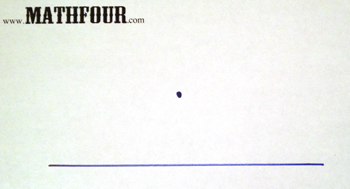
Here’s the line and the point. Easy peasy.

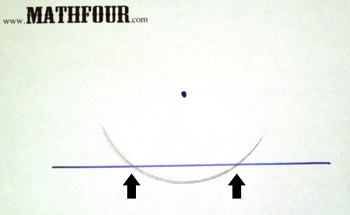
I made an arc from the point through the line, so I would have two spots on the line (where the circle piece went through):

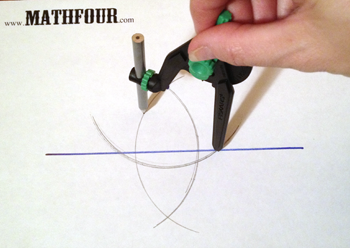
From those two places, I made two more arcs through the point above and long enough to run into each other below:

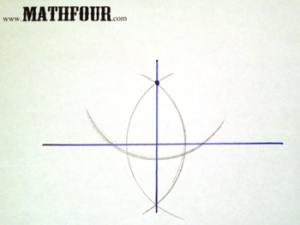
I connected the point with the intersection of the arcs at the bottom and VOILA: perpendicular line to the other line!

Join me in the journey!

This is the first in my ruler and compass journey. They’re kind of fun, and I want to do more. So I will house them here, for future reference.

Here are the first 10 on my list.

  1. Line perpendicular to given line through given point not on given line. (this one)
  2. Perpendicular bisector of given segment.
  3. Right angle at given point on given line.
  4. Square with given segment as side.
  5. Equilateral triangle with given segment as side.
  6. Hexagon with given segment as side.
  7. Copy a given angle to a given segment.
  8. Line parallel to given line through point not on given line.
  9. Dividing given segment into N equal parts.
  10. Bisecting a given angle.

Grab a straightedge and compass for each member of your family – let me know you’re on board in the comments.

For more such insights, log into www.international-maths-challenge.com.

*Credit for article given to Bon Crowder*


The mathematical crimes of the Young Sherlock Holmes series

Dan Smith

Warning this article contains spoilers about the new Amazon Prime series Young Sherlock.

I’ve read the whole Sherlock Holmes canon multiple times over. I love how Holmes uses analytical reasoning to unravel problems that look mysterious, but ultimately prove to have simple explanations. So I was excited when I saw Guy Ritchie’s Young Sherlock appear on Amazon Prime. My excitement was quickly tempered when I started watching, though.

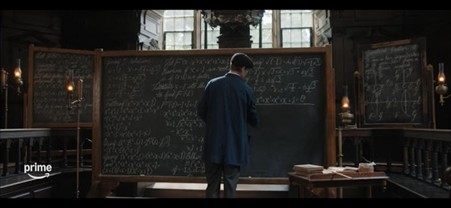
A key part of the plot relies on mathematics. Holmes first meets his sidekick Moriarty (yes, he is working together with his future adversary) at the blackboard after a maths lecture at Oxford. Despite some mistakes in the dialogue, the maths on the blackboard is interesting enough. It is finding the solutions to the equation x5 + x4 + x3 + x2 + x + 1 = 0.

In the maths many of us will have learned at school, we are taught that a positive times a positive makes a positive and that a negative times a negative also makes a positive. For example, 3 times 3 equals 9, but -3 times -3 also equals 9. Squaring a number (when you multiply a number by itself) should always give a positive result. The reverse operation – finding the number(s) you multiply together to give a positive number – is called taking the square root. The two square roots of 9 are 3 and -3, since when you square either of these numbers you get the answer 9.

If we want to take the square root of -1, say, then we need to venture into the realm of imaginary numbers. Imaginary numbers are the square roots of negative numbers. Mathematicians defined the imaginary number i to be the square root of -1 (technically -1 has two square roots i and -i). The square roots of other negative numbers are multiples of i. The square roots of -9, for example are 3i and -3i. Some of the solutions from the equation on the blackboard involve imaginary numbers (this will turn out to be an important plot point).

Mathematical blunders

It’s plausible that the equation on the blackboard might appear in an early first year undergraduate tutorial. Something approaching a passable solution is given, but in excruciating detail (the sort of detail you wouldn’t use at school, let alone in a maths degree at Oxford). And there are mistakes in the maths.

Young Sherlock Holmes contemplates the incorrect solutions on the blackboard. Amazon Prime screenshot

Towards the end of the lecture, the professor sets the students homework to find all the solutions to the equation, even though they are already written on the board (although incorrectly). Despite this, the end of the scene sees Sherlock spending some time trying to think of the solutions before Moriarty comes up and shows him two of the five solutions (as if they were the only ones). Moriarty too writes these down incorrectly, but in a different way to the incorrectness already on the board.

As Moriarty writes down the complex solution (complex means the answer contains both real and imaginary numbers) he says “These solutions, they’re not real. They’re imaginary.” which we can allow (although technically he means complex).

What we can’t forgive is Moriarty going on to say, “That means even if you can’t see the target, you can still shoot for it.” Which is nonsense, even as a metaphor. Complex numbers aren’t targets you can’t see, but well-defined, mainstream (even in the 1870s) mathematical quantities and there’s no sense in which you “aim at” a complex solution to an equation.

Death by numbers

In the last episode, Holmes and his team are battling to halt the distribution of a deadly chemical weapon known as the “creeping death”. They find a scrap of paper in a secret room which they say is the “equation for creating the creeping death.”

I was expecting to see some complex chemical reaction formulae sketched on the page, but when it’s held up to the camera, we see instead a mathematical equation: z3 + 4 z2 – 10 z + 12 = 0.

What does this have to do with the chemical process for creating the deadly nerve agent?

Nothing, it turns out. Or at least nothing I can imagine. In fact it’s a device to allow Holmes and Moriarty to hark back to that moment in the lecture theatre when they first met. What follows goes beyond artistic license into the realm of gibberish.

“If we have the positive equation”, they say, “then we can come up with the negative. And thus create a compound to neutralise the threat of creeping death.” Perhaps they meant “positive solution”, because equations themselves aren’t positive or negative. Either way, the idea that this simple mathematical equation or its solutions are the secret formula for making a weapon of mass destruction doesn’t make sense. There’s no context, no sense in which this equation could be the secret recipe for creating the nerve agent.

Moriarty points out that they have a problem. “This equation is not finished.” By this I think he means that the three solutions to the equation are not written out explicitly.

One solution, z = – 6 is given. And it’s correct. The rest of the scrap of paper contains a reformulation of the equation (a factorisation), which shows that the remaining solutions can be found by solving a quadratic equation: z2 – 2 z + 2 = 0.

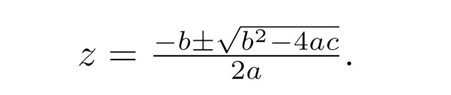
A quadratic equation is just an equation built around a squared term (in this case z2 ), which has two solutions. The formula for the solutions may be familiar to GCSE students (normally aged 15 to 17 years old). For a general quadratic equation: a z2 + b z + c = 0, the two solutions are given below.

Yet, we are supposed to believe that, despite having supposedly solved a far more complicated equation than this in the first episode, Moriarty can’t find the solution to this much simpler equation. So stumped is Moriarty – the future maths professor – that he spends precious time, as a bomb is about to detonate, searching for a piece of paper with this missing solution. He almost loses his life when he could have just used a GCSE-level formula.

The piece of paper he eventually finds contains an incorrect statement of the quadratic formula alongside some nonsensical text, although the solutions are at least correct: z = 1 + i and z = 1 – i (where i, remember, is the imaginary number).

I appreciate my dissection of the maths is high-grade nerdery. Most people will have watched the series without pausing it like I did to look at the maths and probably won’t have noticed. But, if maths is going to be a pivotal plot point in your blockbuster series, then you’ll probably want to make sure you get it right.

For more such insights, log into www.international-maths-challenge.com.

*Credit for article given to Kit Yates*