
Millennium Prize: the Birch and Swinnerton-Dyer Conjecture

Elliptic curves have a long and distinguished history that can be traced back to antiquity. They are prevalent in many branches of modern mathematics, foremost of which is number theory.

In simplest terms, one can describe these curves by using a cubic equation of the form

where A and B are fixed rational numbers (to ensure the curve E is nice and smooth everywhere, one also needs to assume that its discriminant 4A3 + 27B2 is non-zero).

To illustrate, let’s consider an example: choosing A=-1 and B=0, we obtain the following picture:

At this point it becomes clear that, despite their name, elliptic curves have nothing whatsoever to do with ellipses! The reason for this historical confusion is that these curves have a strong connection to elliptic integrals, which arise when describing the motion of planetary bodies in space.

The ancient Greek mathematician Diophantus is considered by many to be the father of algebra. His major mathematical work was written up in the tome Arithmetica which was essentially a school textbook for geniuses. Within it, he outlined many tools for studying solutions to polynomial equations with several variables, termed Diophantine Equations in his honour.

One of the main problems Diophantus considered was to find all solutions to a particular polynomial equation that lie in the field of rational numbers Q. For equations of “degree two” (circles, ellipses, parabolas, hyperbolas) we now have a complete answer to this problem. This answer is thanks to the late German mathematician Helmut Hasse, and allows one to find all such points, should they exist at all.

Returning to our elliptic curve E, the analogous problem is to find all the rational solutions (x,y) which satisfy the equation defining E. If we call this set of points E(Q), then we are asking if there exists an algorithm that allows us to obtain all points (x,y) belonging to E(Q).

At this juncture we need to introduce a group law on E, which gives an eccentric way of fusing together two points (p₁ and p₂) on the curve, to obtain a brand new point (p₄). This mimics the addition law for numbers we learn from childhood (i.e. the sum or difference of any two numbers is still a number). There’s an illustration of this rule below:

Under this geometric model, the point p₄ is defined to be the sum of p₁ and p₂ (it’s easy to see that the addition law does not depend on the order of the points p₁, p₂). Moreover the set of rational points is preserved by this notion of addition; in other words, the sum of two rational points is again a rational point.

Louis Mordell, who was Sadleirian Professor of Pure Mathematics at Cambridge University from 1945 to 1953, was the first to determine the structure of this group of rational points. In 1922 he proved

where the number of copies of the integers Z above is called the “rank r(E) of the elliptic curve E”. The finite group ΤE(Q) on the end is uninteresting, as it never has more than 16 elements.

For more such insights, log into www.international-maths-challenge.com.

*Credit for article given to Daniel Delbourgo*


Millennium Prize: The Poincaré Conjecture

The problem’s been solved … but the sweet treats were declined. Back to the Cutting Board

In 1904, French mathematician Henri Poincaré asked a key question about three-dimensional spaces (“manifolds”).

Imagine a piece of rope, so that firstly a knot is tied in the rope and then the ends are glued together. This is what mathematicians call a knot. A link is a collection of knots that are tangled together.

It has been observed that DNA, which is coiled up within cells, occurs in closed knotted form.

Complex molecules such as polymers are tangled in knotted forms. There are deep connections between knot theory and ideas in mathematical physics. The outsides of a knot or link in space give important examples of three-dimensional spaces.

Torus. Fropuff

Back to Poincaré and his conjecture. He asked if the 3-sphere (which can be formed by either adding a point at infinity to ordinary three-dimensional Euclidean space or by gluing two solid three-dimensional balls together along their boundary 2-spheres) was the only three-dimensional space in which every loop can be continuously shrunk to a point.

Poincaré had introduced important ideas in the structure and classification of surfaces and their higher dimensional analogues (“manifolds”), arising from his work on dynamical systems.

Donuts to go, please

A good way to visualise Poincaré’s conjecture is to examine the boundary of a ball (a two-dimensional sphere) and the boundary of a donut (called a torus). Any loop of string on a 2-sphere can be shrunk to a point while keeping it on the sphere, whereas if a loop goes around the hole in the donut, it cannot be shrunk without leaving the surface of the donut.

Many attempts were made on the Poincaré conjecture, until in 2003 a wonderful solution was announced by a young Russian mathematician, Grigori “Grisha” Perelman.

This is a brief account of the ideas used by Perelman, which built on work of two other outstanding mathematicians, Bill Thurston and Richard Hamilton.

3D spaces

Thurston made enormous strides in our understanding of three-dimensional spaces in the late 1970s. In particular, he realised that essentially all the work that had been done since Poincaré fitted into a single theme.

He observed that known three-dimensional spaces could be divided into pieces in a natural way, so that each piece had a uniform geometry, similar to the flat plane and the round sphere. (To see this geometry on a torus, one must embed it into four-dimensional space!).

Thurston made a bold “geometrisation conjecture” that this should be true for all three-dimensional spaces. He had many brilliant students who further developed his theories, not least by producing powerful computer programs that could test any given space to try to find its geometric structure.

Thurston made spectacular progress on the geometrisation conjecture, which includes the Poincaré conjecture as a special case. The geometrisation conjecture predicts that any three-dimensional space in which every loop shrinks to a point should have a round metric – it would be a 3-sphere and Poincaré’s conjecture would follow.

In 1982, Richard Hamilton published a beautiful paper introducing a new technique in geometric analysis which he called Ricci flow. Hamilton had been looking for analogues of a flow of functions, so that the energy of the function decreases until it reaches a minimum. This type of flow is closely related to the way heat spreads in a material.

Hamilton reasoned that there should be a similar flow for the geometric shape of a space, rather than a function between spaces. He used the Ricci tensor, a key feature of Einstein’s field equations for general relativity, as the driving force for his flow.

He showed that, for three-dimensional spaces where the Ricci curvature is positive, the flow gradually changes the shape until the metric satisfies Thurston’s geometrisation conjecture.

Hamilton attracted many outstanding young mathematicians to work in this area. Ricci flow and other similar flows have become a huge area of research with applications in areas such as moving interfaces, fluid mechanics and computer graphics.

Ricci flow. CBN

He outlined a marvellous program to use Ricci flow to attack Thurston’s geometrisation conjecture. The idea was to keep evolving the shape of a space under Ricci flow.

Hamilton and his collaborators found the space might form a singularity, where a narrow neck became thinner and thinner until the space splits into two smaller spaces.

Hamilton worked hard to try to fully understand this phenomenon and to allow the pieces to keep evolving under Ricci flow until the geometric structure predicted by Thurston could be found.

Perelman

This is when Perelman burst on to the scene. He had produced some brilliant results at a very young age and was a researcher at the famous Steklov Institute in St Petersburg. Perelman got a Miller fellowship to visit UC Berkeley for three years in the early 1990s.

I met him there around 1992. He then “disappeared” from the mathematical scene for nearly ten years and re-emerged to announce that he had completed Hamilton’s Ricci flow program, in a series of papers he posted on the electronic repository called ArXiv.

His papers created enormous excitement and within several months a number of groups had started to work through Perelman’s strategy.

Eventually everyone was convinced that Perelman had indeed succeeded and both the geometrisation and Poincaré conjecture had been solved.

Perelman was awarded both a Fields medal (the mathematical equivalent of a Nobel prize) and also offered a million dollars for solving one of the Millenium prizes from the Clay Institute.

He turned down both these awards, preferring to live a quiet life in St Petersburg. Mathematicians are still finding new ways to use the solution to the geometrisation conjecture, which is one of the outstanding mathematical results of this era.

For more such insights, log into www.international-maths-challenge.com.

*Credit for article given to Hyam Rubinstein*


Statistically significant

When the statistician for UC Irvine’s innovative Down syndrome program retired last year, its researchers were left in a bind. The group is studying ways to prevent or delay the onset of Alzheimer’s-type dementia in people with Down syndrome, including examining possible links between seizures and cognitive decline.

“We were mid-study when we found ourselves with no statistician and little budget with which to pay one,” explains program manager Eric Doran.

Statistical analysis for the project was critical and especially difficult. Some of the subjects’ dementia had progressed to the point that they could no longer be tested on performance-based cognitive measures. They couldn’t respond to questions, making it hard for clinicians to evaluate them. But that resulted in missing data. How, then, could the team accurately quantify change over time and see whether seizures might play a role?

Enter Vinh Nguyen, then a doctoral student in statistics at the Donald Bren School of Information & Computer Sciences and now the new head of the UCI Center for Statistical Consulting, which aims to help researchers across campus and Orange County with such challenges. He proposed a model to gauge how quickly people were becoming untestable, instead of how fast they declined. Rather than including test scores – which would have been zero for those who couldn’t be quizzed – Nguyen designed a variable to show when they became unable to respond.

“My part of it was to help them find a way to look at patients with and without seizures, to see if those with seizures might have a shorter time before they became untestable,” he says. “That’s what we found.”Although the findings are preliminary, without his involvement they wouldn’t have been possible. The work resulted in a paper that has been accepted for publication in the Journal of Alzheimer’s Disease. Nguyen, as of October an assistant professor-in-residence of statistics, is a co-author.

“We’re very fortunate to have Vinh’s assistance,” Doran says. “Quite frankly, some of the statistical analysis he’s doing goes well beyond the skill level of even the most seasoned investigators. Vinh was able to pick up where our previous statistician left off, and he was pretty ingenious. His creative look at the data enabled us to complete our analysis.”

Nguyen was glad to help: “I’m excited to be involved in studies that not only advance science but also make a meaningful impact in people’s lives.”

He looks forward to doing more such work through the center, providing state-of-the-art statistical expertise in grant preparation, the design of studies and experiments, and data analysis. The center this spring will offer free statistical consulting for campus researchers via a course taught by Dr. Nguyen. Graduate students in the class will be assigned to projects based on their interests and skills.

“It’s a huge benefit to the university because it’s free, and it’s a huge benefit to the statistics graduate program because it gives our master’s and Ph.D. students a chance to exercise their knowledge and training in real-world applications,” Nguyen says. “Learning how to communicate, how to collaborate with folks outside your field – you can’t just lecture about that. It’s got to be a hands-on experience.”

Colleagues say Nguyen, 26 – whose research interests include survival analysis, robust statistical methods, sequential clinical trials and prediction – was the right choice to run the center.

“It’s a big set of responsibilities for someone so young, but he’s got the ability and maturity level to succeed,” says associate professor of statistics Dan Gillen, who directs statistics research at the Institute for Memory Impairments & Neurological Disorders. It was Gillen who introduced Nguyen, whom he was advising on his doctoral thesis, to the Down syndrome team. “Vinh understands the role of statistics across multiple branches of science, and he’s extremely good at translating a seemingly vague hypothesis into a precise statistical framework.”

A native of Vietnam, Nguyen immigrated to the United States at age 5 and grew up in Garden Grove. A true-blue Anteater, he earned all his degrees at UCI, graduating magna cum laude with a B.S. in mathematics and a B.A. in economics, then obtaining an M.S. and a Ph.D. in statistics. In 2010, he received an Achievement Rewards for College Scientists scholar award, which recognizes UCI’s academically superior doctoral students who exhibit outstanding promise as scientists, researchers and public leaders.

“I feel very fortunate to be here,” Nguyen says. “I’m honoured to be given this opportunity to lead the center and help it grow, and to work in a field and a setting that allow me to apply my knowledge.”

For more such insights, log into our website https://international-maths-challenge.com

Credit of the article given to Rizza Barnes, University of California, Irvine


Millennium Prize: P vs NP

Deciding whether a statement is true is a computational head-scratcher.

In the 1930s, Alan Turing showed there are basic tasks that are impossible to achieve by algorithmic means. In modern lingo, what he showed was that there can be no general computer program that answers yes or no to the question of whether another computer program will eventually stop when it is run.

The amazing unsolvability of this Halting Problem contains a further perplexing subtlety. While we have no way of finding in advance if a program will halt, there is an obvious way, in principle, to demonstrate that it halts if it is a halting program: run it, wait, and witness it halting!

In other words, Turing showed that, at the broadest level, deciding whether a statement is true is computationally harder than demonstrating that it’s true when it is.

A question of efficiency

Turing’s work was a pivotal moment in the history of computing. Some 80 years later, computing devices have pervaded almost every facet of society. Turing’s original “what is computable?” question has been mostly replaced by the more pertinent, “what is efficiently computable?”

But while Turing’s Halting Problem can be proved impossible in a few magical lines, the boundary between “efficient” and “inefficient” seems far more elusive. P versus NP is the most famous of a huge swathe of unresolved questions to have emerged from this modern take on Turing’s question.

So what is this NP thing?

Roughly speaking, P (standing for “polynomial time”), corresponds to the collection of computational problems that have an efficient solution. It’s only an abstract formulation of “efficient”, but it works fairly well in practice.

The class NP corresponds to the problems for which, when the answer is “yes”, there is an efficient demonstration that the answer is yes (the “N” stands for “nondeterministic”, but the description taken here is more intuitive). P versus NP simply asks if these two classes of computational problems are the same.

It’s just the “deciding versus demonstrating” issue in Turing’s original Halting Problem, but with the added condition of efficiency.

A puzzler

P certainly doesn’t look to be the same as NP. Puzzles are good examples of the general intuition here. Crossword puzzles are popular because it’s a challenge to find the solution, and humans like challenge. But no-one spends their lunchtime checking already completed crosswords: checking someone else’s solution offers nowhere near the same challenge.

Even clearer is Sudoku: again it is a genuine challenge to solve, but checking an existing solution for correctness is so routine it is devoid of entertainment value.

The P=NP possibility is like discovering that the “finding” part of these puzzles is only of the same difficulty to the “checking” part. That seems hard to believe, but the truth is we do not know for sure.

This same intuition pervades an enormous array of important computational tasks for which we don’t currently have efficient algorithms. One particularly tantalising feature is that, more often than not, these problems can be shown to be maximally hard among NP problems.

These so-called “NP-complete” problems are test cases for P versus NP: if any one of them has an efficient algorithmic solution then they all do (and efficient checking is no harder than efficient finding).

But if even just one single one can be shown to have no efficient solution, then P does not equal NP (and efficient finding really is, in general, harder than efficient checking).

Here are some classic examples of NP-complete problems.

  • Partition (the dilemma of the alien pick-pockets). On an alien planet, two pick-pockets steal a wallet. To share the proceeds, they must evenly divide the money: can they do it? Standard Earth currencies evolved to have coin values designed to make this task easy, but in general this task is NP-complete. It’s in NP because, if there is an equal division of the coins, this can be easily demonstrated by simply showing the division. (Finding it is the hard part!)
  • Timetabling. Finding if a clash-free timetable exists is NP-complete. The problem is in NP because we can efficiently check a correct, clash-free timetable to be clash-free.
  • Travelling Salesman. A travelling salesman must visit each of some number of cities. To save costs, the salesman wants to find the shortest route that passes through all of the cities. For some given target distance “n”, is there a route of length at most “n”?
  • Short proofs. Is there a short proof for your favourite mathematical statement (a Millennium Prize problem perhaps)? With a suitable formulation of “short”, this is NP-complete. It is in NP because checking formal proofs can be done efficiently: the hard part is finding them (at least, we think that’s the hard part!).

In every case, we know of no efficient exact algorithm, and the nonexistence of such an algorithm is equivalent to proving P not equal to NP.

So are we close to a solution? It seems the best we know is that we don’t know much! Arguably, the most substantial advances in the P versus NP saga are curiously negative: they mostly show we cannot possibly hope to resolve P as different to NP by familiar techniques.

We know Turing’s approach cannot work. In 2007, Alexander Razborov and Steven Rudich were awarded the Gödel Prize (often touted as the Nobel Prize of Computer Science) for their work showing that no “natural proof” can prove P unequal to NP.

Of course, we’ll keep looking!

For more such insights, log into www.international-maths-challenge.com.

*Credit for article given to Marcel Jackson*


Millennium Prize: The Hodge Conjecture

If one grossly divides mathematics into two parts they would be: tools for measuring and tools for recognition.

To use an analogy, tools for measuring are the technologies for collecting data about an object, the process of “taking a blurry photograph”. Tools for recognition deal with the following: if you are given a pile of data or a blurry photograph, how can the object that it came from be recognised from the data?

The Hodge Conjecture – a major unsolved problem in algebraic geometry – deals with recognition.

William Vallance Douglas Hodge was a professor at Cambridge who, in the 1940s, worked on developing a refined version of cohomology – tools for measuring flow and flux across boundaries of surfaces (for example, fluid flow across membranes).

The classical versions of cohomology are used for the understanding of the flow and dispersion of electricity and magnetism (for example, Maxwell’s equations, which describe how electric charges and currents act as origins for electric and magnetic fields). These were refined by Hodge in what is now called the “Hodge decomposition of cohomology”.

Hodge recognised that the actual measurements of flow across regions always contribute to a particular part of the Hodge decomposition, known as the (p,p) part. He conjectured that any time the data displays a contribution to the (p,p) part of the Hodge decomposition, the measurements could have come from a realistic scenario of a system of flux and change across a region.

Or, to put this as an analogy, one could say Hodge found a criterion to test for fraudulent data.

If Hodge’s test comes back positive, you can be sure the data is fraudulent. The question in the Hodge conjecture is whether there is any fraudulent data which Hodge’s test will not detect. So far, Hodge’s test seems to work.

But we haven’t understood well enough why it works, and so the possibility is open that there could be a way to circumvent Hodge’s security scheme.

Hodge made his conjecture in 1950, and many of the leaders in the development of geometry have worked on this basic recognition problem. The problem itself has stimulated many other refined techniques for measuring flow, flux and dispersion.

Tate’s 1963 conjecture is another similar recognition question coming out of another measurement technique, the l-adic cohomology developed by Alexander Grothendieck.

The strongest evidence in favour of the Hodge conjecture is a 1995 result of Cattani, Deligne & Kaplan which studies how the Hodge decomposition behaves as a region mutates.

Classical cohomology measurements are not affected by small mutations, but the Hodge decomposition does register mutations. The study of the Hodge decomposition across mutations provides great insight into the patterns in data that must occur in true measurements.

In the 1960s, Grothendieck initiated a powerful theory generalising the usual concept of “region” to include “virtual regions” (the theory of motives on which one could measure “virtual temperatures” and “virtual magnetic fields”.

In a vague sense, the theory of motives is trying to attack the problem by trying to think like a hacker. The “Standard Conjectures” of Grothendieck are far-reaching generalisations of the Hodge conjecture, which try to explain which virtual regions are indistinguishable from realistic scenarios.

The question in the Hodge conjecture has stimulated the development of revolutionary tools and techniques for measurement and analysis of data across regions. These tools have been, and continue to be, fundamental for modern development.

Imagine trying to building a mobile phone without an understanding of how to measure, analyse and control electricity and magnetism. Alternatively, imagine trying to sustain an environment without a way to measure, analyse and detect the spread of toxins across regions and in waterways.

Of course, the tantalising intrigue around recognition and detection problems makes them thrilling. Great minds are drawn in and produce great advances in an effort to understand what makes it all work.

One might, very reasonably, claim that the longer the Hodge conjecture remains an unsolved problem the more good it will do for humanity, driving more and more refined techniques for measurement and analysis and stimulating the development of better and better methods for recognition of objects from the data.

The Clay Mathematics Institute was wise in pinpointing the Hodge conjecture as a problem that has the capacity to stimulate extensive development of new methods and technologies and including it as one of the Millennium problems.

For more such insights, log into www.international-maths-challenge.com.

*Credit for article given to Arun Ram*


Millennium Prize: the Navier–Stokes existence and uniqueness problem

Among the seven problems in mathematics put forward by the Clay Mathematics Institute in 2000 is one that relates in a fundamental way to our understanding of the physical world we live in.

It’s the Navier-Stokes existence and uniqueness problem, based on equations written down in the 19th century.

The solution of this prize problem would have a profound impact on our understanding of the behaviour of fluids which, of course, are ubiquitous in nature. Air and water are the most recognisable fluids; how they move and behave has fascinated scientists and mathematicians since the birth of science.

But what are the so-called Navier-Stokes equations? What do they describe?

The equations

In order to understand the Navier-Stokes equations and their derivation we need considerable mathematical training and also a sound understanding of basic physics.

Without that, we must draw upon some very simple basics and talk in terms of broad generalities – but that should be sufficient to give the reader a sense of how we arrive at these fundamental equations, and the importance of the questions.

From this point, I’ll refer to the Navier-Stokes equations as “the equations”.

The equations governing the motion of a fluid are most simply described as a statement of Newton’s Second Law of Motion as it applies to the movement of a mass of fluid (whether that be air, water or a more exotic fluid). Newton’s second law states that:

Mass x Acceleration = Force acting on a body

For a fluid the “mass” is the mass of the fluid body; the “acceleration” is the acceleration of a particular fluid particle; the “forces acting on the body” are the total forces acting on our fluid.

Without going into full details, it’s possible to state here that Newton’s Second Law produces a system of differential equations relating rates of change of fluid velocity to the forces acting on the fluid. We require one other physical constraint to be applied on our fluid, which can be most simply stated as:

Mass is conserved! – i.e. fluid neither appears nor disappears from our system.

The solution

Having a sense of what the Navier-Stokes equations are allows us to discuss why the Millennium Prize solution is so important. The prize problem can be broken into two parts. The first focuses on the existence of solutions to the equations. The second focuses on whether these solutions are bounded (remain finite).

It’s not possible to give a precise mathematical description of these two components so I’ll try to place the two parts of the problem in a physical context.

1) For a mathematical model, however complicated, to represent the physical world we are trying to understand, the model must first have solutions.

At first glance, this seems a slightly strange statement – why study equations if we are not sure they have solutions? In practice we know many solutions that provide excellent agreement with many physically relevant and important fluid flows.

But these solutions are approximations to the solutions of the full Navier-Stokes equations (the approximation comes about because there is, usually, no simple mathematical formulae available – we must resort to solving the equations on a computer using numerical approximations).

Although we are very confident that our (approximate) solutions are correct, a formal mathematical proof of the existence of solutions is lacking. That provides the first part of the Millennium Prize challenge.

2) The second part asks whether the solutions of the Navier-Stokes equations can become singular (or grow without limit).

Again, a lot of mathematics is required to explain this. But we can examine why this is an important question.

There is an old saying that “nature abhors a vacuum”. This has a modern parallel in the assertion by physicist Stephen Hawking, while referring to black holes, that “nature abhors a naked singularity”. Singularity, in this case, refers to the point at which the gravitational forces – pulling objects towards a black hole – appear (according to our current theories) to become infinite.

In the context of the Navier-Stokes equations, and our belief that they describe the movement of fluids under a wide range of conditions, a singularity would indicate we might have missed some important, as yet unknown, physics. Why? Because mathematics doesn’t deal in infinites.

The history of fluid mechanics is peppered with solutions of simplified versions of the Navier-Stokes equations that yield singular solutions. In such cases, the singular solutions have often hinted at some new physics previously not considered in the simplified models.

Identifying this new physics has allowed researchers to further refine their mathematical models and so improve the agreement between model and reality.

If, as many believe, the Navier-Stokes equations do posses singular solutions then perhaps the next Millennium Prize will go to the person that discovers just what new physics is required to remove the singularity.

Then nature can, as all fluid mechanists already do, come to delight in the equations handed down to us by Claude-Louis Navier and George Gabriel Stokes.

For more such insights, log into our website https://international-maths-challenge.com

Credit of the article given to Jim Denier, University of Adelaide


Millennium Prize: The Navier–Stokes Existence And Uniqueness Problem

How fluids move has fascinated researchers since the birth of science.

Among the seven problems in mathematics put forward by the Clay Mathematics Institute in 2000 is one that relates in a fundamental way to our understanding of the physical world we live in.

It’s the Navier-Stokes existence and uniqueness problem, based on equations written down in the 19th century.

The solution of this prize problem would have a profound impact on our understanding of the behaviour of fluids which, of course, are ubiquitous in nature. Air and water are the most recognisable fluids; how they move and behave has fascinated scientists and mathematicians since the birth of science.

But what are the so-called Navier-Stokes equations? What do they describe?

The equations

In order to understand the Navier-Stokes equations and their derivation we need considerable mathematical training and also a sound understanding of basic physics.

Without that, we must draw upon some very simple basics and talk in terms of broad generalities – but that should be sufficient to give the reader a sense of how we arrive at these fundamental equations, and the importance of the questions.

From this point, I’ll refer to the Navier-Stokes equations as “the equations”.

The equations governing the motion of a fluid are most simply described as a statement of Newton’s Second Law of Motion as it applies to the movement of a mass of fluid (whether that be air, water or a more exotic fluid). Newton’s second law states that:

Mass x Acceleration = Force acting on a body

For a fluid the “mass” is the mass of the fluid body; the “acceleration” is the acceleration of a particular fluid particle; the “forces acting on the body” are the total forces acting on our fluid.

Without going into full details, it’s possible to state here that Newton’s Second Law produces a system of differential equations relating rates of change of fluid velocity to the forces acting on the fluid. We require one other physical constraint to be applied on our fluid, which can be most simply stated as:

Mass is conserved! – i.e. fluid neither appears nor disappears from our system.

The solution

Having a sense of what the Navier-Stokes equations are allows us to discuss why the Millennium Prize solution is so important. The prize problem can be broken into two parts. The first focuses on the existence of solutions to the equations. The second focuses on whether these solutions are bounded (remain finite).

It’s not possible to give a precise mathematical description of these two components so I’ll try to place the two parts of the problem in a physical context.

1) For a mathematical model, however complicated, to represent the physical world we are trying to understand, the model must first have solutions.

At first glance, this seems a slightly strange statement – why study equations if we are not sure they have solutions? In practice we know many solutions that provide excellent agreement with many physically relevant and important fluid flows.

But these solutions are approximations to the solutions of the full Navier-Stokes equations (the approximation comes about because there is, usually, no simple mathematical formulae available – we must resort to solving the equations on a computer using numerical approximations).

Although we are very confident that our (approximate) solutions are correct, a formal mathematical proof of the existence of solutions is lacking. That provides the first part of the Millennium Prize challenge.

2) The second part asks whether the solutions of the Navier-Stokes equations can become singular (or grow without limit).

Again, a lot of mathematics is required to explain this. But we can examine why this is an important question.

There is an old saying that “nature abhors a vacuum”. This has a modern parallel in the assertion by physicist Stephen Hawking, while referring to black holes, that “nature abhors a naked singularity”. Singularity, in this case, refers to the point at which the gravitational forces – pulling objects towards a black hole – appear (according to our current theories) to become infinite.

In the context of the Navier-Stokes equations, and our belief that they describe the movement of fluids under a wide range of conditions, a singularity would indicate we might have missed some important, as yet unknown, physics. Why? Because mathematics doesn’t deal in infinites.

The history of fluid mechanics is peppered with solutions of simplified versions of the Navier-Stokes equations that yield singular solutions. In such cases, the singular solutions have often hinted at some new physics previously not considered in the simplified models.

Identifying this new physics has allowed researchers to further refine their mathematical models and so improve the agreement between model and reality.

If, as many believe, the Navier-Stokes equations do posses singular solutions then perhaps the next Millennium Prize will go to the person that discovers just what new physics is required to remove the singularity.

Then nature can, as all fluid mechanists already do, come to delight in the equations handed down to us by Claude-Louis Navier and George Gabriel Stokes.

For more such insights, log into www.international-maths-challenge.com.

*Credit for article given to Jim Denier*


Millennium Prize: the Riemann Hypothesis

What will be the next number in this sequence?

“At school I was never really good at maths” is an all too common reaction when mathematicians name their profession.

In view of most people’s perceived lack of mathematical talent, it may come as somewhat of a surprise that a recent study carried out at John Hopkins University has shown that six-month-old babies already have a clear sense of numbers. They can count, or at least approximate, the number of happy faces shown on a computer screen.

By the time they start school, at around the age of five, most children are true masters of counting, and many will proudly announce when for the first time they have counted up to 100 or 1000. Children also intuitively understand the regular nature of counting; by adding sufficiently many ones to a starting value of one they know they will eventually reach their own age, that of their parents, grandparents, 2011, and so on.

Counting is child’s play. Photography By Shaeree

From counting to more general addition of whole numbers is only a small step—again within children’s almost-immediate grasp. After all, counting is the art of adding one, and once that is mastered it takes relatively little effort to work out that 3 + 4 = 7. Indeed, the first few times children attempt addition they usually receive help from their fingers or toes, effectively reducing the problem to that of counting:

3 + 4 = (1 + 1 + 1) + (1 + 1 + 1 + 1) = 7.

For most children, the sense of joy and achievement quickly ends when multiplication enters the picture. In theory it too can be understood through counting: 3 x 6 is three lots of six apples, which can be counted on fingers and toes to give 18 apples.

In practice, however, we master it through long hours spent rote-learning multiplication tables—perhaps not among our favourite primary school memories.

But at this point, we ask the reader to consider the possibility—in fact, the certainty—that multiplication is far from boring and uninspiring, but that it is intrinsically linked with some of mathematics’ deepest, most enduring and beautiful mysteries. And while a great many people may claim to be “not very good at maths” they are, in fact, equipped to understand some very difficult mathematical questions.

Primes

Let’s move towards these questions by going back to addition and those dreaded multiplication tables. Just like the earlier example of 7, we know that every whole number can be constructed by adding together sufficiently many ones. Multiplication, on the other hand, is not so well-behaved.

The number 12, for example, can be broken up into smaller pieces, or factors, while the number 11 cannot. More precisely, 12 can be written as the product of two whole numbers in multiple ways: 1 x 12, 2 x 6 and 3 x 4, but 11 can only ever be written as the product 1 x 11. Numbers such as 12 are called composite, while those that refuse to be factored are known as prime numbers or simply primes. For reasons that will soon become clear, 1 is not considered a prime, so that the first five prime numbers are 2, 3, 5, 7 and 11.

Just as the number 1 is the atomic unit of whole-number addition, prime numbers are the atoms of multiplication. According to the Fundamental Theorem of Arithmetic, any whole number greater than 1 can be written as a product of primes in exactly one way. For example: 4 = 2 x 2, 12 = 2 x 2 x 3, 2011 = 2011 and

13079109366950 = 2 x 5 x 5 x 11 x 11 x 11 x 37 x 223 x 23819,

where we always write the factors from smallest to largest. If, rather foolishly, we were to add 1 to the list of prime numbers, this would cause the downfall of the Fundamental Theorem of Arithmetic:

4 = 2 x 2 = 1 x 2 x 2 = 1 x 1 x 2 x 2 = …

In the above examples we have already seen several prime numbers, and a natural question is to ask for the total number of primes. From what we have learnt about addition with its single atom of 1, it is not unreasonable to expect there are only finitely many prime numbers, so that, just maybe, the 2649th prime number, 23819, could be the largest. Euclid of Alexandria, who lived around 300BC and who also gave us Euclidean Geometry, in fact showed that there are infinitely many primes.

Euclid’s reasoning can be captured in just a single sentence: if the list of primes were finite, then by multiplying them together and adding 1 we would get a new number which is not divisible by any prime on our list—a contradiction.

A few years after Euclid, his compatriot Eratosthenes of Cyrene found a clever way, now known as the Sieve of Eratosthenes, to obtain all primes less than a given number.

For instance, to find all primes less than 100, Eratosthenes would write down a list of all numbers from 2 to 99, cross out all multiples of 2 (but not 2 itself), then all multiples of 3 (but not 3 itself), then all multiples of 5, and so on. After only four steps(!) this would reveal to him the 25 primes

2, 3, 5, 7, 11, 13, 17, 19, 23, 29, 31, 37, 41, 43, 47, 53, 59, 61, 67, 71, 73, 79, 83, 89 and 97.

While this might seem very quick, much more sophisticated methods, combined with very powerful computers, are needed to find really large prime numbers. The current world record, established 2008, is the truly monstrous 243112609 – 1, a prime number of approximately 13 million digits.

The quest to tame the primes did not end with the ancient Greeks, and many great mathematicians, such as Pierre de Fermat, Leonhard Euler and Carl Friedrich Gauss studied prime numbers extensively. Despite their best efforts, and those of many mathematicians up to the present day, there are many more questions than answers concerning the primes.

One famous example of an unsolved problem is Goldbach’s Conjecture. In 1742, Christian Goldbach remarked in a letter to Euler that it appeared that every even number greater than 2 could be written as the sum of two primes.

For example, 2012 = 991 + 1021. While computers have confirmed the conjecture holds well beyond the first quintillion (1018) numbers, there is little hope of a proof of Goldbach’s Conjecture in the foreseeable future.

Another intractable problem is that of breaking very large numbers into their prime factors. If a number is known to be the product of two primes, each about 200 digits long, current supercomputers would take more than the lifetime of the universe to actually find these two prime factors. This time round our inability to do better is in fact a blessing: most secure encryption methods rely heavily on our failure to carry out prime factorisation quickly. The moment someone discovers a fast algorithm to factor large numbers, the world’s financial system will collapse, making the GFC look like child’s play.

To the dismay of many security agencies, mathematicians have also failed to show that fast algorithms are impossible—the possibility of an imminent collapse of world order cannot be entirely ruled out!

Margins of error

For mathematicians, the main prime number challenge is to understand their distribution. Quoting Don Zagier, nobody can predict where the next prime will sprout; they grow like weeds among the whole numbers, seemingly obeying no other law than that of chance. At the same time the prime numbers exhibit stunning regularity: there are laws governing their behaviour, obeyed with almost military precision.

The Prime Number Theorem describes the average distribution of the primes; it was first conjectured by both Gauss and Adrien-Marie Legendre, and then rigorously established independently by Jacques Hadamard and Charles Jean de la Vallée Poussin, a hundred years later in 1896.

The Prime Number Theorem states that the number of primes less than an arbitrarily chosen number n is approximately n divided by ln(n), where ln(n) is the natural logarithm of n. The relative error in this approximation becomes arbitrarily small as n becomes larger and larger.

For example, there are 25 primes less than 100, and 100/ln(100) = 21.7…, which is around 13% short. When n is a million we are up to 78498 primes and since 106/ln(106) = 72382.4…, we are only only 8% short.

The Riemann Hypothesis

The Prime Number Theorem does an incredible job describing the distribution of primes, but mathematicians would love to have a better understanding of the relative errors. This leads us to arguably the most famous open problem in mathematics: the Riemann Hypothesis.

Posed by Bernhard Riemann in 1859 in his paper “Ueber die Anzahl der Primzahlen unter einer gegebenen Grösse” (On the number of primes less than a given magnitude), the Riemann Hypothesis tells us how to tighten the Prime Number Theorem, giving us a control of the errors, like the 13% or 8% computed above.

The Riemann Hypothesis does not just “do better” than the Prime Number Theorem—it is generally believed to be “as good as it gets”. That is, we, or far-superior extraterrestrial civilisations, will never be able to predict the distribution of the primes any better than the Riemann Hypothesis does. One can compare it to, say, the ultimate 100 metres world record—a record that, once set, is impossible to ever break.

Finding a proof of the Riemann Hypothesis, and thus becoming record holder for all eternity, is the holy grail of pure mathematics. While the motivation for the Riemann Hypothesis is to understand the behaviour of the primes, the atoms of multiplication, its actual formulation requires higher-level mathematics and is beyond the scope of this article.

In 1900, David Hilbert, the most influential mathematician of his time, posed a now famous list of 23 problems that he hoped would shape the future of mathematics in the 20th century. Very few of Hilbert’s problems other than the Riemann Hypothesis remain open.

Inspired by Hilbert, in 2000 the Clay Mathematics Institute announced a list of seven of the most important open problems in mathematics. For the successful solver of any one of these there awaits not only lasting fame, but also one million US dollars in prize money. Needless to say, the Riemann Hypothesis is one of the “Millennium Prize Problems”.

Hilbert himself remarked: “If I were awoken after having slept for a thousand years, my first question would be: has the Riemann Hypothesis been proven?” Judging by the current rate of progress, Hilbert may well have to sleep a little while longer.

For more such insights, log into www.international-maths-challenge.com.

*Credit for article given to Ole Warnaar*


How far away is everybody? Climbing the cosmic distance ladder

Let’s talk numbers for a moment.

The moon is approximately 384,000 kilometres away, and the sun is approximately 150 million kilometres away. The mean distance between Earth and the sun is known as the “astronomical unit” (AU). Neptune, the most distant planet, then, is 30 AU from the sun.

The nearest stars to Earth are 1,000 times more distant, roughly 4.3 light-years away (one light-year being the distance that light travels in 365.25 days – just under 10 trillion kilometres).

The Milky Way galaxy consists of some 300 billion stars in a spiral-shaped disk roughly 100,000 light-years across.

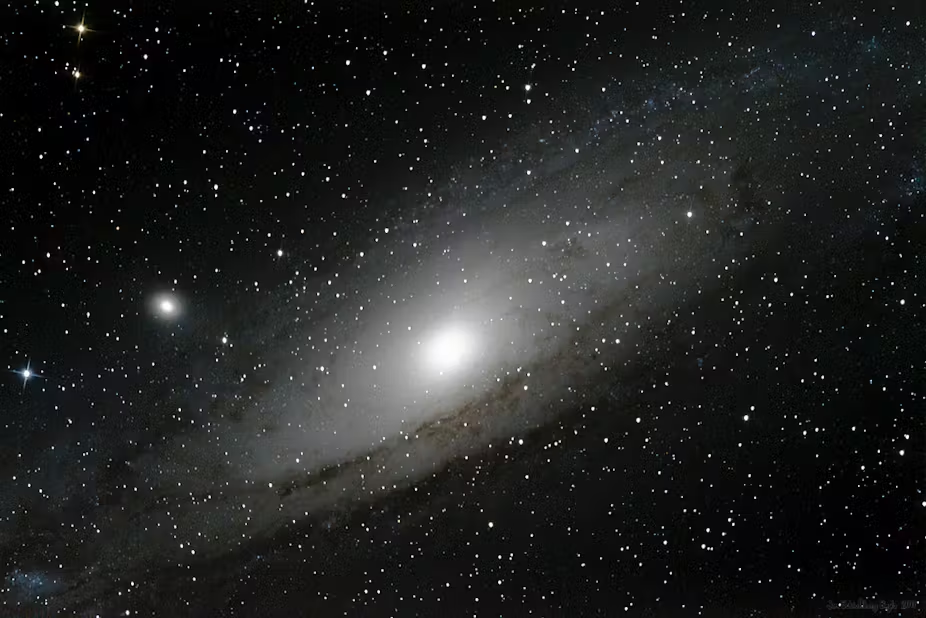
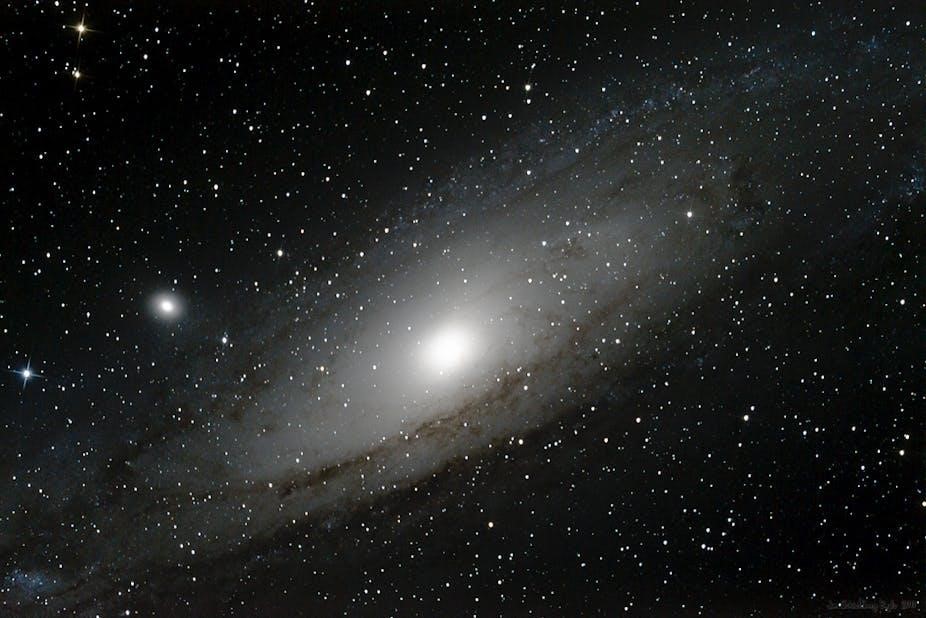
The Andromeda Galaxy, which can be seen with many home telescopes, is 2.54 million light years away. There are hundreds of billions of galaxies in the observable universe.

At present, the most distant observed galaxy is some 13.2 billion light-years away, formed not long after the Big Bang, 13.75 billion years ago (plus or minus 0.011 billion years).

The scope of the universe was illustrated by the astrophysicist Geraint Lewis in a recent Conversation article.

He noted that, if the entire Milky Way galaxy was represented by a small coin one centimetre across, the Andromeda Galaxy would be another small coin 25 centimetres away.

Going by this scale, the observable universe would extend for 5 kilometres in every direction, encompassing some 300 billion galaxies.

But how can scientists possibly calculate these enormous distances with any confidence?

Parallax

One technique is known as parallax. If you cover one eye and note the position of a nearby object, compared with more distant objects, the nearby object “moves” when you view it with the other eye. This is parallax (see below).

The same principle is used in astronomy. As Earth travels around the sun, relatively close stars are observed to move slightly, with respect to other fixed stars that are more distant.

Distance measurements can be made in this way for stars up to about 1,000 light-years away.

Standard candles

For more distant objects such as galaxies, astronomers rely on “standard candles” – bright objects that are known to have a fixed absolute luminosity (brightness).

Since light flux falls off as the square of the distance, by measuring the actual brightness observed on Earth astronomers can calculate the distance.

One type of standard candle, which has been used since the 1920s, is Cepheid variable stars.

Distances determined using this scheme are believed accurate to within about 7% for more nearby galaxies, and 15-20% for the most distant galaxies.

Type Ia supernovas

In recent years scientists have used Type Ia supernovae. These occur in a binary star system when a white dwarf star starts to attract matter from a larger red dwarf star.

As the white dwarf gains more and more matter, it eventually undergoes a runaway nuclear explosion that may briefly outshine an entire galaxy.

Because this process can occur only within a very narrow range of total mass, the absolute luminosity of Type Ia supernovas is very predictable. The uncertainty in these measurements is typically 5%.

In August, worldwide attention was focused on a Type Ia supernova that exploded in the Pinwheel Galaxy (known as M101), a beautiful spiral galaxy located just above the handle of the Big Dipper in the Northern Hemisphere. This is the closest supernova to the earth since the 1987 supernova, which was visible in the Southern Hemisphere.

These and other techniques for astronomical measurements, collectively known as the “cosmic distance ladder”, are described in an excellent Wikipedia article. Such multiple schemes lend an additional measure of reliability to these measurements.

In short, distances to astronomical objects have been measured with a high degree of reliability, using calculations that mostly employ only high-school mathematics.

Thus the overall conclusion of a universe consisting of billions of galaxies, most of them many millions or even billions of light-years away, is now considered beyond reasonable doubt.

Right tools for the job

The kind of distances we’re dealing with above do cause consternation for some since, as we peer millions of light-years into space, we are also peering millions of years into the past.

Some creationists, for instance, have theorised that, in about 4,000 BCE, a Creator placed quadrillions of photons in space en route to Earth, with patterns suggestive of supernova explosions and other events millions of years ago.

Needless to say, most observers reject this notion. Kenneth Miller of Brown University commented, “Their [Creationists’] version of God is one who has filled the universe with so much bogus evidence that the tools of science can give us nothing more than a phony version of reality.”

There are plenty of things in the universe to marvel at, and plenty of tools to help us understand them. That should be enough to keep us engaged for now.

For more such insights, log into our website https://international-maths-challenge.com

Credit of the article given to Jonathan Borwein (Jon), University of Newcastle and David H. Bailey, University of California, Davis


A revolution in knot theory

This knot has Gauss code O1U2O3U1O2U3. Credit: Graphic by Sam Nelson.

In the 19th century, Lord Kelvin made the inspired guess that elements are knots in the “ether”. Hydrogen would be one kind of knot, oxygen a different kind of knot—and so forth throughout the periodic table of elements. This idea led Peter Guthrie Tait to prepare meticulous and quite beautiful tables of knots, in an effort to elucidate when two knots are truly different. From the point of view of physics, Kelvin and Tait were on the wrong track: the atomic viewpoint soon made the theory of ether obsolete. But from the mathematical viewpoint, a gold mine had been discovered: The branch of mathematics now known as “knot theory” has been burgeoning ever since.

In his article “The Combinatorial Revolution in Knot Theory”, to appear in the December 2011 issue of the Notices of the AMS, Sam Nelson describes a novel approach to knot theory that has gained currency in the past several years and the mysterious new knot-like objects discovered in the process.

As sailors have long known, many different kinds of knots are possible; in fact, the variety is infinite. A *mathematical* knot can be imagined as a knotted circle: Think of a pretzel, which is a knotted circle of dough, or a rubber band, which is the “un-knot” because it is not knotted. Mathematicians study the patterns, symmetries, and asymmetries in knots and develop methods for distinguishing when two knots are truly different.

Mathematically, one thinks of the string out of which a knot is formed as being a one-dimensional object, and the knot itself lives in three-dimensional space. Drawings of knots, like the ones done by Tait, are projections of the knot onto a two-dimensional plane. In such drawings, it is customary to draw over-and-under crossings of the string as broken and unbroken lines. If three or more strands of the knot are on top of each other at single point, we can move the strands slightly without changing the knot so that every point on the plane sits below at most two strands of the knot. A planar knot diagram is a picture of a knot, drawn in a two-dimensional plane, in which every point of the diagram represents at most two points in the knot. Planar knot diagrams have long been used in mathematics as a way to represent and study knots.

As Nelson reports in his article, mathematicians have devised various ways to represent the information contained in knot diagrams. One example is the Gauss code, which is a sequence of letters and numbers wherein each crossing in the knot is assigned a number and the letter O or U, depending on whether the crossing goes over or under. The Gauss code for a simple knot might look like this: O1U2O3U1O2U3.

In the mid-1990s, mathematicians discovered something strange. There are Gauss codes for which it is impossible to draw planar knot diagrams but which nevertheless behave like knots in certain ways. In particular, those codes, which Nelson calls *nonplanar Gauss codes*, work perfectly well in certain formulas that are used to investigate properties of knots. Nelson writes: “A planar Gauss code always describes a [knot] in three-space; what kind of thing could a nonplanar Gauss code be describing?” As it turns out, there are “virtual knots” that have legitimate Gauss codes but do not correspond to knots in three-dimensional space. These virtual knots can be investigated by applying combinatorial techniques to knot diagrams.

Just as new horizons opened when people dared to consider what would happen if -1 had a square root—and thereby discovered complex numbers, which have since been thoroughly explored by mathematicians and have become ubiquitous in physics and engineering—mathematicians are finding that the equations they used to investigate regular knots give rise to a whole universe of “generalized knots” that have their own peculiar qualities. Although they seem esoteric at first, these generalized knots turn out to have interpretations as familiar objects in mathematics. “Moreover,” Nelson writes, “classical knot theory emerges as a special case of the new generalized knot theory.”

For more such insights, log into our website https://international-maths-challenge.com

Credit of the article given to American Mathematical Society