Explainer: Evolutionary Algorithms

My intention with this article is to give an intuitive and non-technical introduction to the field of evolutionary algorithms, particularly with regards to optimisation.

If I get you interested, I think you’re ready to go down the rabbit hole and simulate evolution on your own computer. If not … well, I’m sure we can still be friends.

Survival of the fittest

According to Charles Darwin, the great evolutionary biologist, the human race owes its existence to the phenomenon of survival of the fittest. And being the fittest doesn’t necessarily mean the biggest physical presence.

Once in high school, my lunchbox was targeted by swooping eagles, and I was reduced to a hapless onlooker. The eagle, though smaller in form, was fitter than me because it could take my lunch and fly away – it knew I couldn’t chase it.

As harsh as it sounds, look around you and you will see many examples of the rule of the jungle – the fitter survive while the rest gradually vanish.

The research area, now broadly referred to as Evolutionary Algorithms, simulates this behaviour on a computer to find the fittest solutions to a number of different classes of problems in science, engineering and economics.

The area in which this area is perhaps most widely used is known as “optimisation”.

Optimisation is everywhere

Your high school maths teacher probably told you the shortest way to go from point A to point B was along the straight line joining A and B. Your mum told you that you should always get the right amount of sleep.

And, if you have lived on your own for any length of time, you’ll be familiar with the ever-increasing cost of living versus the constant income – you always strive to minimise the expenditures, while ensuring you are not malnourished.

Whenever you undertake an activity that seeks to minimise or maximise a well-defined quantity such as distance or the vague notion of the right amount of sleep, you are optimising.

Look around you right now and you’ll see optimisation in play – your Coke can is shaped like that for a reason, a water droplet is spherical for a reason, you wash all your dishes together in the dishwasher for a reason.

Each of these strives to save on something: volume of material of the Coke can, and energy and water, respectively, in the above cases.

So we can safely say optimisation is the act of minimising or maximising a quantity. But that definition misses an important detail: there is always a notion of subject to, or satisfying some conditions.

You must get the right amount of sleep, but you also must do your studies and go for your music lessons. Such conditions, which you also have to adhere to, are known as “constraints”. Optimisation with constraints is then collectively termed “constrained optimisation”.

After constraints comes the notion of “multi-objective optimisation”. You’ll usually have more than one thing to worry about (you must keep your supervisor happy with your work and keep yourself happy and also ensure that you are working on your other projects). In many cases these multiple objectives can be in conflict.

Evolutionary algorithms and optimisation

Imagine your local walking group has arranged a weekend trip for its members and one of the activities is a hill climbing exercise. The problem assigned to your group leader is to identify who among you will reach the hill in the shortest time.

There are two approaches he or she could take to complete this task: ask only one of you to climb up the hill at a time and measure the time needed, or ask all of you to run all at once and see who reaches first.

That second method is known as the “population approach” of solving optimisation problems – and that’s how evolutionary algorithms work. The “population” of solutions are evolved over a number of iterations, with only the fittest solutions making it to the next.

This is analogous to the champion girl from your school making to the next round which was contested among champions from other schools in your state, then your country, and finally winning among all the countries.

Or, in our above scenario, finding who in the walking group reaches the hill top fastest, who would then be denoted as the fittest.

In engineering, optimisation needs are faced at almost every step, so it’s not surprising evolutionary algorithms have been successful in that domain.

Design optimisation of scramjets

At the Multi-disciplinary Design Optimisation Group at the University of New South Wales, my colleagues and I are involved in the design optimisation of scramjets, as part of the SCRAMSPACE program. In this, we’re working with colleagues from the University of Queensland.

Our evolutionary algorithms-based optimisation procedures have been successfully used to obtain the optimal configuration of various components of a scramjet.

Some of these have quite technical names, that in themselves would require quite a bit of explanation but, if you want, you can get a feel for the kind of work we do, and its applications for scramjets, by clicking here.

There are, at the risk of sounding over-zealous, no limits to the application of evolutionary algorithms.

Has this whetted your appetite? Have you learnt something new today?

If so, I’m glad. May the force be with you!

For more such insights, log into www.international-maths-challenge.com.

*Credit for article given to Amit Saha*


How Far Away is Everybody? Climbing The Cosmic Distance Ladder

We know the universe is vast, but how do we measure the distances between things? Dave Scrimshaw.

Let’s talk numbers for a moment.

The moon is approximately 384,000 kilometres away, and the sun is approximately 150 million kilometres away. The mean distance between Earth and the sun is known as the “astronomical unit” (AU). Neptune, the most distant planet, then, is 30 AU from the sun.

The nearest stars to Earth are 1,000 times more distant, roughly 4.3 light-years away (one light-year being the distance that light travels in 365.25 days – just under 10 trillion kilometres).

The Milky Way galaxy consists of some 300 billion stars in a spiral-shaped disk roughly 100,000 light-years across.

The Andromeda Galaxy, which can be seen with many home telescopes, is 2.54 million light years away. There are hundreds of billions of galaxies in the observable universe.

At present, the most distant observed galaxy is some 13.2 billion light-years away, formed not long after the Big Bang, 13.75 billion years ago (plus or minus 0.011 billion years).

The scope of the universe was illustrated by the astrophysicist Geraint Lewis in a recent Conversation article.

He noted that, if the entire Milky Way galaxy was represented by a small coin one centimetre across, the Andromeda Galaxy would be another small coin 25 centimetres away.

Going by this scale, the observable universe would extend for 5 kilometres in every direction, encompassing some 300 billion galaxies.

But how can scientists possibly calculate these enormous distances with any confidence?

Parallax

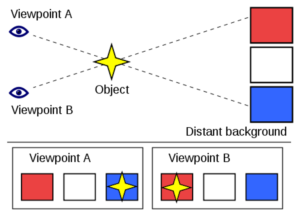
One technique is known as parallax. If you cover one eye and note the position of a nearby object, compared with more distant objects, the nearby object “moves” when you view it with the other eye. This is parallax (see below).

Booyabazooka

The same principle is used in astronomy. As Earth travels around the sun, relatively close stars are observed to move slightly, with respect to other fixed stars that are more distant.

Distance measurements can be made in this way for stars up to about 1,000 light-years away.

Standard candles

For more distant objects such as galaxies, astronomers rely on “standard candles” – bright objects that are known to have a fixed absolute luminosity (brightness).

Since light flux falls off as the square of the distance, by measuring the actual brightness observed on Earth astronomers can calculate the distance.

One type of standard candle, which has been used since the 1920s, is Cepheid variable stars.

Distances determined using this scheme are believed accurate to within about 7% for more nearby galaxies, and 15-20% for the most distant galaxies.

Type Ia supernovas

In recent years scientists have used Type Ia supernovae. These occur in a binary star system when a white dwarf star starts to attract matter from a larger red dwarf star.

As the white dwarf gains more and more matter, it eventually undergoes a runaway nuclear explosion that may briefly outshine an entire galaxy.

Because this process can occur only within a very narrow range of total mass, the absolute luminosity of Type Ia supernovas is very predictable. The uncertainty in these measurements is typically 5%.

In August, worldwide attention was focused on a Type Ia supernova that exploded in the Pinwheel Galaxy (known as M101), a beautiful spiral galaxy located just above the handle of the Big Dipper in the Northern Hemisphere. This is the closest supernova to the earth since the 1987 supernova, which was visible in the Southern Hemisphere.

These and other techniques for astronomical measurements, collectively known as the “cosmic distance ladder”, are described in an excellent Wikipedia article. Such multiple schemes lend an additional measure of reliability to these measurements.

In short, distances to astronomical objects have been measured with a high degree of reliability, using calculations that mostly employ only high-school mathematics.

Thus the overall conclusion of a universe consisting of billions of galaxies, most of them many millions or even billions of light-years away, is now considered beyond reasonable doubt.

Right tools for the job

The kind of distances we’re dealing with above do cause consternation for some since, as we peer millions of light-years into space, we are also peering millions of years into the past.

Some creationists, for instance, have theorised that, in about 4,000 BCE, a Creator placed quadrillions of photons in space en route to Earth, with patterns suggestive of supernova explosions and other events millions of years ago.

Needless to say, most observers reject this notion. Kenneth Miller of Brown University commented, “Their [Creationists’] version of God is one who has filled the universe with so much bogus evidence that the tools of science can give us nothing more than a phony version of reality.”

There are plenty of things in the universe to marvel at, and plenty of tools to help us understand them. That should be enough to keep us engaged for now.

For more such insights, log into www.international-maths-challenge.com.

*Credit for article given to Jonathan Borwein (Jon)*


Science, maths and the future of Australia

Australia faces many big challenges – in the economy, health, energy, water, climate change, infrastructure, sustainable agriculture and the preservation of our precious biodiversity.

To meet these, we need creative scientists and engineers drawn from many disciplines, and a technologically skilled workforce.

The many world-changing advances and achievements of Australian research and development (R&D) are encouraging. Indeed, the Australian Academy of Science, of which I’m president, believes our country’s scientific potential has never been greater.

But our ability to improve this performance in the future, or even maintain it, is not assured.

Four things threaten our ongoing R&D performance and, as a consequence, our economic security and prosperity, and I’ll address each of these in turn.

1) The level of investment in R&D

Over the past decade, successive Australian governments have recognised the need to properly invest in research and innovation.

Total investment by the current government has increased by almost 43% and is projected to amount to $9.4 billion dollars over the current financial year. This is very commendable.

It’s heartening to see Australia’s business sector is also increasing its investment – although admittedly this boost is coming off a low base compared to many other OECD nations. (Australia ranks 14th for business expenditure on R&D as a percentage of GDP).

But to remain competitive internationally we need even greater investment.

Australia spends around 2.2% of its GDP (around AU$900 per person per year) on research and development.

Iceland, the next best-ranked country, devotes 2.6% cent of GDP. Top of the list is Israel, with 4.6%, followed by Finland and Sweden, each of which spend 3.6%.

We have around 92,000 full-time equivalent researchers which, again, is only middle order. According to the OECD, in 2008 the proportion of R&D personnel in our total labour force puts Australia 16th, well short of Canada, which ranks ninth.

China has more than 1.6 million people working on research and development, a number that’s increasing rapidly. (China is ranked 33rd, with 2.5 R&D personnel per thousand in the workforce, from a total population of 1.3 billion)

Worryingly, Australia sits well within the bottom half of OECD countries (ranked 20th of 30) when it comes to the number of university graduates emerging with a science or engineering degree per capita.

These are sobering statistics.

The Australian Academy of Science therefore calls on the government to create a Sovereign Fund for Science, to secure the future prosperity of the nation.

The goal should be to increase Australia’s research and development expenditure to at least 3% of GDP by 2020.

2) International collaboration

By its very nature, science is a collaborative enterprise. It transcends generations, individual scientific disciplines and, increasingly, national boundaries. To paraphrase Sir Isaac Newton, we see further by standing on the shoulders of giants.

Australia produces only 2% of the world’s knowledge. To gain access to the other 98%, we must ensure our scientists are well-connected internationally.

Getting involved with major international projects at inception allows Australia to stay abreast of new scientific developments, to have a say in their direction, to take the knowledge further, and to apply it.

International collaborations also attract scientists from overseas to spend time in Australia, bringing us new skills and knowledge. Importantly, many return and become part of our scientific workforce.

Work arising from such collaborations often attracts great attention and gets cited more frequently. Take the recently announced kangaroo genome sequence, which garnered international media attention.

This work was done by a consortium of more than 100 researchers from Australia, the US, the UK, Germany and Japan, headed by my friend and Academy colleague Professor Marilyn Renfree. The “kangaroo” was in fact the Tammar wallaby.

Its genome is yielding many unexpected insights that may have significance for humans as well as for wallabies – for example the genes that make antibiotics in the mother’s milk to protect the tiny newborns from harmful bacteria.

There are many such examples.

We hope to bring international astronomers to Australia by winning the bid to build a giant collection of radio telescopes in the Western Australian desert. Known as the Square Kilometre Array, or SKA, this international project – which could go to either South Africa or Australia – will give astronomers huge insights into the formation and evolution of the first stars and galaxies after the Big Bang.

Barriers that have impeded the use of Australian research grants for international collaborations are being dismantled.

Today many grants and fellowships provided by the Australian Research Council, National Health and Medical Research Council and CSIRO support projects that include international partners.

Many of these linkages were initially catalysed by the federal government’s International Science Linkages (or ISL) program.

With funding of about $10 million per year, the ISL program has supported bilateral and multilateral relations with many other countries.

Regrettably, the ten-year program ended in June this year as funding was not renewed in the 2011-2012 Budget.

Put simply, it would be a grave blow if our ability to compete on the international stage were to be diminished.

I strongly urge the Federal Government to fund in its next Budget a new program to provide strategic support for Australia’s International Science Linkages.

3) Science capability in the workforce

We are a lucky nation: we have access to immense mineral wealth. But resources are finite. Even the minerals sector acknowledges that we cannot ride the current boom indefinitely.

Further, the Minerals Council of Australia warns skills shortages and structural weaknesses in the Australian economy have been masked by the boom.

And so, when the end of the mining boom comes, where will Australia be?

There is broad consensus among minds more economically astute than mine that our future prosperity will depend upon:

  • a skilled workforce
  • innovation
  • entrepreneurship
  • high productivity
  • the creation of the kind of knowledge-intensive goods and services that can only result from robust research and development.

Certain skills are already in short supply in Australia.

In fact, the No More Excuses report issued by the Industry Skills Council earlier this year points to an alarming deficit in even basic skills.

According to that report, “millions of Australians have insufficient language, literacy and numeracy skills to benefit fully from training or to participate effectively at work”.

A recent project looking at the maths skills of bricklaying apprentices at a regional TAFE showed:

  • 75% could not do basic arithmetic.
  • 80% could not calculate the area of a rectangle, or the pay owed for working four-and-a-half hours.

Such figures are particularly worrying at a time when the demand for higher-level skills is increasing.

It’s essential we act now to ease the bottleneck and put in place measures that will create the technologically competent workforce we need for the future.

We can, and should, be “the clever country”. But this will only happen if we place appropriate emphasis on properly educating our young people.

4) Science and maths education

Without a robust and inspiring science and maths education system, it’s impossible to create an internationally competitive workforce.

Myriad jobs – apart from the obvious research, engineering and technology careers – require a basic understanding of science and maths.

And, as a parent, a mentor of young scientists and a passionate advocate for quality education, I know that all children are natural born scientists.

“Why?”, “How?”, and “What happens if …?” are questions asked frequently by young children, whose natural spirit of inquiry is crucial to understanding the big, exciting world around them.

We need to harness this natural curiosity and nurture it with inspiring education.

Australian public expenditure on education as a percentage of GDP is just 4.2% – significantly below the OECD average of 5.4%.

A decade ago, a review of Australian science education, revealed many students were disappointed with their high school science.

Today, this disenchantment continues, as evidenced by the declining number of students choosing to study science in senior secondary school. Consider the following:

  • In 1991, more than a third of Year 12 students chose to study biology. That now sits at less than a quarter.
  • 23% of Year 12 students studied chemistry ten years ago, compared with 18% now.
  • In the same period, physics has fallen from 21% to 14%.

While Australian students have been losing interest in science, their international peers have been taking it up with great enthusiasm.

The OECD Program for International Student Assessment (PISA) examines the scientific literacy of teenagers in 57 different countries.

In 2000, the only nations that performed better than Australia were Korea and Japan. In 2009 – the most recent figures available – Australia ranked behind Shanghai, Finland, Hong Kong, Singapore, Japan and Korea.

What happened? The Assessment indicated that the performance of other countries has improved while Australia’s has remained stationary.

Maths

Australia’s early secondary mathematical literacy scores have significantly declined over the last decade. Our Year 4 and Year 8 students ranked 14th internationally in the most recent Trends International Mathematics and Science Study, conducted in 2007.

The decline in Australia’s mathematical literacy is of grave concern because mathematics is an enabling science, without which it’s not possible to make use of other sciences – either in the lab or in the workforce.

A recent survey conducted by Science and Technology Australia and the Academy of Science showed Australians clearly value science – 80% of respondents acknowledged science education is absolutely essential or very important to the national economy.

But it also revealed some alarming holes in the basic science understanding of the average Australian.

  • Three in ten believe humans were around at the time of dinosaurs.
  • More than a fifth of our university graduates think that it takes just one day for the Earth to travel around the sun.
  • Almost a third of Australians do not think evolution is currently occurring.
  • About a quarter say human activity is not influencing the evolution of other species: a worrying statistic given the impact that human activity is having on the environment.

In other words, many of us do not understand even the most basic science.

How can we halt this slide in science and maths in our schools and attain an internationally enviable position?

Thankfully, our government is already investing significantly in school infrastructure and in rolling out a national high-speed internet network.

Last December, education ministers approved the content for new national curricula in English, history, maths and science. In coming months, they’ll be asked to sign off on the standards for these curricula. This is an important initiative, and the Academy of Science applauds it.

But we also need investment in teachers, and in inspiring curriculum programs.

This is a responsibility for both the Commonwealth and the States, who must work together rather than reverting to the blame game.

Inspired (and inspiring) teachers will be the most important agents for improving educational outcomes.

We must place a much higher societal value on teachers and do everything we can to recruit some of our brightest and best into teaching.

We must support these educators with the best tools and resources available and provide them with stimulating opportunities for ongoing training.

I agree with the prime minister that we live in a crucial time for science in Australia and around the world.

In fact, I could not agree more.

For more such insights, log into our website https://international-maths-challenge.com

Credit of the article given to Suzanne Cory, WEHI (Walter and Eliza Hall Institute of Medical Research)


Where is Everybody? Doing the Maths on Extraterrestrial Life

Are we getting closer to solving one of life’s greatest mysteries?

During a lunch in the summer of 1950, physicists Enrico Fermi, Edward Teller and Herbert York were chatting about a recent New Yorker cartoon depicting aliens abducting trash cans in flying saucers. Suddenly, Fermi blurted out, “Where is everybody?”

He reasoned: “Since there are likely many other technological civilisations in the Milky Way galaxy, and since in a few tens of thousands of years at most they could have explored or even colonised many distant planets, why don’t we see any evidence of even a single extraterrestrial civilisation?”

This has come to be known as Fermi’s Paradox.

Clearly the question of whether other civilisations exist is one of the most important questions of modern science. Any discovery of a distant civilisation – say by analysis of microwave data – would rank as among the most far-reaching of all scientific discoveries.

Drake equation

At a 1960 conference regarding extraterrestrial intelligence, Frank Drake (1930 —) sketched out what is now the Drake equation, estimating the number of civilisations in the Milky Way with which we could potentially communicate:

where

N = number of civilisations in our galaxy that can communicate.

R* = average rate of star formation per year in galaxy.

fp = fraction of those stars that have planets.

ne = average number of planets that can support life, per star that has planets.

fl = fraction of the above that eventually develop life.

fi = fraction of the above that eventually develop intelligent life.

fc = fraction of civilisations that develop technology that signals existence into space.

L = length of time such civilisations release detectable signals into space.

The result? Drake estimated ten such civilisations were out there somewhere in the Milky Way.

This analysis, led to the Search for Extraterrestrial Intelligence (SETI) project, looking for radio transmissions in a region of the electromagnetic spectrum thought best suited for interstellar communication.

But after 50 years of searching, using increasingly powerful equipment, nothing has been found.

So where is everybody?

Proposed solutions to Fermi’s paradox

Numerous scientists have examined Fermi’s paradox and proposed solutions. The following is a list of some of the proposed solutions, and common rejoinders:

  • Such civilisations are here, or are observing us, but are under orders not to disclose their existence.

Common rejoinder: This explanation (known as the “zookeeper’s theory”) is preferred by some scientists including, for instance, the late Carl Sagan. But it falls prey to the fact that it would take just one member of an extraterrestrial society to break the pact of silence – and this would seem inevitable.

  • Such civilisations have been here and planted seeds of life, or perhaps left messages in DNA.

Common rejoinder: The notion that life began on Earth from bacterial spores or the like that originated elsewhere, known as the “panspermia theory”, only pushes the origin of life problem to some other star system – scientists see no evidence in DNA sequences of anything artificial.

  • Such civilisations exist, but are too far away.

Common rejoinder: A sufficiently advanced civilisation could send probes to distant stars, which could scout out suitable planets, land and construct copies of themselves, using the latest software beamed from home.

So the entire Milky Way galaxy could be explored within, at most, a few million years.

  • Such civilisations exist, but have lost interest in interstellar engagement.

Common rejoinder: As with the zookeeper theory, this would require each civilisation to forever lack interest in communication and transportation – and someone would most likely break the pact of silence.

  • Such civilisations are calling, but we don’t recognise the signal.

Common rejoinder: This explanation doesn’t apply to signals sent with the direct purpose of communicating to nascent technological societies. Again, it is hard to see how a galactic society could enforce a global ban.

  • Civilisations invariably self-destruct.

Common rejoinder: This contingency is already figured into the Drake equation (the L term, above). In any event, we have survived at least 100 years of technological adolescence, and have managed (until now) not to destroy ourselves in a nuclear or biological apocalypse.

Relatively soon we will colonise the moon and Mars, and our long-term survival will no longer rely on Earth.

  • Earth is a unique planet in fostering long-lived ecosystems resulting in intelligent life.

Common rejoinder: Perhaps, but the latest studies, in particular the detections of extrasolar planets point in the opposite direction. Environments like ours appear quite common.

  • We are alone in the Milky Way galaxy. Some scientists further conclude we are alone in the entire observable universe.

Common rejoinder: This conclusion flies in the face of the “principle of mediocrity,” namely the presumption, popular since the time of Copernicus, that there’s nothing special about human society or environment.

Numerous other proposed solutions and rejoinders are given in by Stephen Webb in his 2002 book, If the Universe Is Teeming with Aliens … Where is Everybody?.

Two of Drake’s key terms – fp (the fraction of stars that have planets) and ne (the average number of planets that can support life, per star that has planets) are subject to measurement.

Scientists once thought stable planetary systems and Earth-like planets were a rarity. But recent evidence suggests otherwise.

Thanks to Kepler and other projects, these two terms have been found to have reasonable values, although not quite as optimistic as Drake and his colleagues first estimated.

With every new research finding in the area of extrasolar planets and possible extraterrestrial living organisms, the mystery of Fermi’s paradox deepens.

“Where is everybody?” is a question that now carries even greater resonance.

For more such insights, log into www.international-maths-challenge.com.

*Credit for article given to Jonathan Borwein (Jon)*


Science, Maths and The Future of Australia

Australia faces many big challenges – in the economy, health, energy, water, climate change, infrastructure, sustainable agriculture and the preservation of our precious biodiversity.

To meet these, we need creative scientists and engineers drawn from many disciplines, and a technologically-skilled workforce.

The many world-changing advances and achievements of Australian research and development (R&D) are encouraging. Indeed, the Australian Academy of Science, of which I’m president, believes our country’s scientific potential has never been greater.

But our ability to improve this performance in the future, or even maintain it, is not assured.

Four things threaten our ongoing R&D performance and, as a consequence, our economic security and prosperity, and I’ll address each of these in turn.

1) The level of investment in R&D

Over the past decade, successive Australian governments have recognised the need to properly invest in research and innovation.

Total investment by the current government has increased by almost 43%, and is projected to amount to $9.4 billion dollars over the current financial year. This is very commendable.

It’s heartening to see Australia’s business sector is also increasing its investment – although admittedly this boost is coming off a low base compared to many other OECD nations. (Australia ranks 14th for business expenditure on R&D as a percentage of GDP).

But to remain competitive internationally we need even greater investment.

Australia spends around 2.2% of its GDP (around AU$900 per person per year) on research and development.

Iceland, the next best-ranked country, devotes 2.6% cent of GDP. Top of the list is Israel, with 4.6%, followed by Finland and Sweden, each of which spend 3.6%.

We have around 92,000 full-time equivalent researchers which, again, is only middle order. According to the OECD, in 2008 the proportion of R&D personnel in our total labour force puts Australia 16th, well short of Canada, which ranks ninth.

China has more than 1.6 million people working on research and development, a number that’s increasing rapidly. (China is ranked 33rd, with 2.5 R&D personnel per thousand in the workforce, from a total population of 1.3 billion)

Worryingly, Australia sits well within the bottom half of OECD countries (ranked 20th of 30) when it comes to the number of university graduates emerging with a science or engineering degree per capita.

These are sobering statistics.

The Australian Academy of Science therefore calls on the government to create a Sovereign Fund for Science, to secure the future prosperity of the nation.

The goal should be to increase Australia’s research and development expenditure to at least 3% of GDP by 2020.

2) International collaboration

By its very nature, science is a collaborative enterprise. It transcends generations, individual scientific disciplines and, increasingly, national boundaries. To paraphrase Sir Isaac Newton, we see further by standing on the shoulders of giants.

Australia produces only 2% of the world’s knowledge. To gain access to the other 98%, we must ensure our scientists are well-connected internationally.

Getting involved with major international projects at inception allows Australia to stay abreast of new scientific developments, to have a say in their direction, to take the knowledge further, and to apply it.

International collaborations also attract scientists from overseas to spend time in Australia, bringing us new skills and knowledge. Importantly, many return and become part of our scientific workforce.

Work arising from such collaborations often attracts great attention and gets cited more frequently. Take the recently announced kangaroo genome sequence, which garnered international media attention.

This work was done by a consortium of more than 100 researchers from Australia, the US, the UK, Germany and Japan, headed by my friend and Academy colleague Professor Marilyn Renfree. The “kangaroo” was in fact the Tammar wallaby.

Its genome is yielding many unexpected insights that may have significance for humans as well as for wallabies – for example the genes that make antibiotics in the mother’s milk to protect the tiny newborns from harmful bacteria.

There are many such examples.

We hope to bring international astronomers to Australia by winning the bid to build a giant collection of radio telescopes in the Western Australian desert. Known as the Square Kilometre Array, or SKA, this international project – which could go to either South Africa or Australia – will give astronomers huge insights into the formation and evolution of the first stars and galaxies after the Big Bang.

Barriers that have impeded the use of Australian research grants for international collaborations are being dismantled.

Today many grants and fellowships provided by the Australian Research Council, National Health and Medical Research Council and CSIRO support projects that include international partners.

Many of these linkages were initially catalysed by the federal government’s International Science Linkages (or ISL) program.

With funding of about $10 million per year, the ISL program has supported bilateral and multilateral relations with many other countries.

Regrettably, the ten-year program ended in June this year as funding was not renewed in the 2011-2012 Budget.

Put simply, it would be a grave blow if our ability to compete on the international stage were to be diminished.

I strongly urge the Federal Government to fund in its next Budget a new program to provide strategic support for Australia’s International Science Linkages.

3) Science capability in the workforce

We are a lucky nation: we have access to immense mineral wealth. But resources are finite. Even the minerals sector acknowledges that we cannot ride the current boom indefinitely.

Further, the Minerals Council of Australia warns skills shortages and structural weaknesses in the Australian economy have been masked by the boom.

And so, when the end of the mining boom comes, where will Australia be?

There is broad consensus among minds more economically astute than mine that our future prosperity will depend upon:

  • a skilled workforce
  • innovation
  • entrepreneurship
  • high productivity
  • the creation of the kind of knowledge-intensive goods and services that can only result from robust research and development.

Certain skills are already in short supply in Australia.

In fact, the No More Excuses report issued by the Industry Skills Council earlier this year points to an alarming deficit in even basic skills.

According to that report, “millions of Australians have insufficient language, literacy and numeracy skills to benefit fully from training or to participate effectively at work”.

A recent project looking at the maths skills of bricklaying apprentices at a regional TAFE showed:

  • 75% could not do basic arithmetic.
  • 80% could not calculate the area of a rectangle, or the pay owed for working four-and-a-half hours.

Such figures are particularly worrying at a time when the demand for higher-level skills is increasing.

It’s essential we act now to ease the bottleneck and put in place measures that will create the technologically-competent workforce we need for the future.

We can, and should, be “the clever country”. But this will only happen if we place appropriate emphasis on properly educating our young people.

4) Science and maths education

Without a robust and inspiring science and maths education system, it’s impossible to create an internationally-competitive workforce.

Myriad jobs – apart from the obvious research, engineering and technology careers – require a basic understanding of science and maths.

And, as a parent, a mentor of young scientists and a passionate advocate for quality education, I know that all children are natural born scientists.

“Why?”, “How?”, and “What happens if …?” are questions asked frequently by young children, whose natural spirit of inquiry is crucial to understanding the big exciting world around them.

We need to harness this natural curiosity and nurture it with inspiring education.

Australian public expenditure on education as a percentage of GDP is just 4.2% – significantly below the OECD average of 5.4%.

A decade ago, a review of Australian science education, revealed many students were disappointed with their high school science.

Today, this disenchantment continues, as evidenced by the declining number of students choosing to study science in senior secondary school. Consider the following:

  • In 1991, more than a third of Year 12 students chose to study biology. That now sits at less than a quarter.
  • 23% of Year 12 students studied chemistry ten years ago, compared with 18% now.
  • In the same period, physics has fallen from 21% to 14%.

While Australian students have been losing interest in science, their international peers have been taking it up with great enthusiasm.

The OECD Program for International Student Assessment (PISA) examines the scientific literacy of teenagers in 57 different countries.

In 2000, the only nations that performed better than Australia were Korea and Japan. In 2009 – the most recent figures available – Australia ranked behind Shanghai, Finland, Hong Kong, Singapore, Japan and Korea.

What happened? The Assessment indicated that the performance of other countries has improved while Australia’s has remained stationary.

Maths

Australia’s early secondary mathematical literacy scores have significantly declined over the last decade. Our Year 4 and Year 8 students ranked 14th internationally in the most recent Trends International Mathematics and Science Study, conducted in 2007.

The decline in Australia’s mathematical literacy is of grave concern because mathematics is an enabling science, without which it’s not possible to make use of other sciences – either in the lab or in the workforce.

A recent survey conducted by Science and Technology Australia and the Academy of Science showed Australians clearly value science – 80% of respondents acknowledged science education is absolutely essential or very important to the national economy.

But it also revealed some alarming holes in the basic science understanding of the average Australian.

  • Three in ten believe humans were around at the time of dinosaurs.
  • More than a fifth of our university graduates think that it takes just one day for the Earth to travel around the sun.
  • Almost a third of Australians do not think evolution is currently occurring.
  • About a quarter say human activity is not influencing the evolution of other species: a worrying statistic given the impact that human activity is having on the environment.

In other words, many of us do not understand even the most basic science.

How can we halt this slide in science and maths in our schools and attain an internationally enviable position?

Thankfully, our government is already investing significantly in school infrastructure and in rolling out a national high-speed internet network.

Last December, education ministers approved the content for new national curricula in English, history, maths and science. In coming months, they’ll be asked to sign off on the standards for these curricula. This is an important initiative and the Academy of Science applauds it.

But we also need investment in teachers, and in inspiring curriculum programs.

This is a responsibility for both the Commonwealth and the States, who must work together rather than reverting to the blame game.

Inspired (and inspiring) teachers will be the most important agents for improving educational outcomes.

We must place a much higher societal value on teachers and do everything we can to recruit some of our brightest and best into teaching.

We must support these educators with the best tools and resources available and provide them with stimulating opportunities for ongoing training.

I agree with Prime Minister Julia Gillard that science is one of the fundamental platforms upon which our conception of a modern advanced society is based.

I agree with the prime minister that we live in a crucial time for science in Australia and around the world.

In fact, I could not agree more.

For more such insights, log into www.international-maths-challenge.com.

*Credit for article given to Suzanne Coryter *


Where is everybody? Doing the maths on extraterrestrial life

During a lunch in the summer of 1950, physicists Enrico Fermi, Edward Teller and Herbert York were chatting about a recent New Yorker cartoon depicting aliens abducting trash cans in flying saucers. Suddenly, Fermi blurted out, “Where is everybody?”

He reasoned: “Since there are likely many other technological civilisations in the Milky Way galaxy, and since in a few tens of thousands of years at most they could have explored or even colonised many distant planets, why don’t we see any evidence of even a single extraterrestrial civilisation?”

This has come to be known as Fermi’s Paradox.

Clearly the question of whether other civilisations exist is one of the most important questions of modern science. Any discovery of a distant civilisation – say by analysis of microwave data – would rank as among the most far-reaching of all scientific discoveries.

Drake equation

At a 1960 conference regarding extraterrestrial intelligence, Frank Drake (1930 —) sketched out what is now the Drake equation, estimating the number of civilisations in the Milky Way with which we could potentially communicate:

where

N = number of civilisations in our galaxy that can communicate.

R* = average rate of star formation per year in galaxy.

fp = fraction of those stars that have planets.

ne = average number of planets that can support life, per star that has planets.

fl = fraction of the above that eventually develop life.

fi = fraction of the above that eventually develop intelligent life.

fc = fraction of civilisations that develop technology that signals existence into space.

L = length of time such civilisations release detectable signals into space.

The result? Drake estimated ten such civilisations were out there somewhere in the Milky Way.

This analysis, led to the Search for Extraterrestrial Intelligence (SETI) project, looking for radio transmissions in a region of the electromagnetic spectrum thought best suited for interstellar communication.

But after 50 years of searching, using increasingly powerful equipment, nothing has been found.

So where is everybody?

Proposed solutions to Fermi’s paradox

Numerous scientists have examined Fermi’s paradox and proposed solutions. The following is a list of some of the proposed solutions, and common rejoinders:

  • Such civilisations are here, or are observing us, but are under orders not to disclose their existence.

Common rejoinder: This explanation (known as the “zookeeper’s theory”) is preferred by some scientists including, for instance, the late Carl Sagan. But it falls prey to the fact that it would take just one member of an extraterrestrial society to break the pact of silence – and this would seem inevitable.

  • Such civilisations have been here and planted seeds of life, or perhaps left messages in DNA.

Common rejoinder: The notion that life began on Earth from bacterial spores or the like that originated elsewhere, known as the “panspermia theory”, only pushes the origin of life problem to some other star system – scientists see no evidence in DNA sequences of anything artificial.

  • Such civilisations exist but are too far away.

Common rejoinder: A sufficiently advanced civilisation could send probes to distant stars, which could scout out suitable planets, land and construct copies of themselves, using the latest software beamed from home.

So, the entire Milky Way galaxy could be explored within, at most, a few million years.

  • Such civilisations exist but have lost interest in interstellar engagement.

Common rejoinder: As with the zookeeper theory, this would require each civilisation to forever lack interest in communication and transportation – and someone would most likely break the pact of silence.

  • Such civilisations are calling, but we don’t recognise the signal.

Common rejoinder: This explanation doesn’t apply to signals sent with the direct purpose of communicating to nascent technological societies. Again, it is hard to see how a galactic society could enforce a global ban.

  • Civilisations invariably self-destruct.

Common rejoinder: This contingency is already figured into the Drake equation (the L term, above). In any event, we have survived at least 100 years of technological adolescence, and have managed (until now) not to destroy ourselves in a nuclear or biological apocalypse.

Relatively soon we will colonise the moon and Mars, and our long-term survival will no longer rely on Earth.

  • Earth is a unique planet in fostering long-lived ecosystems resulting in intelligent life.

Common rejoinder: Perhaps, but the latest studies, in particular the detections of extrasolar planets point in the opposite direction. Environments like ours appear quite common.

  • We are alone in the Milky Way galaxy. Some scientists further conclude we are alone in the entire observable universe.

Common rejoinder: This conclusion flies in the face of the “principle of mediocrity,” namely the presumption, popular since the time of Copernicus, that there’s nothing special about human society or environment.

Stephen Webb’s 2002 book If the Universe Is Teeming with Aliens … Where is Everybody, provides numerous other proposed solutions and rejoinders.

Two of Drake’s key terms – fp (the fraction of stars that have planets) and ne (the average number of planets that can support life, per star that has planets) are subject to measurement.

Scientists once thought stable planetary systems and Earth-like planets were a rarity. But recent evidence suggests otherwise.

Thanks to Kepler and other projects, these two terms have been found to have reasonable values, although not quite as optimistic as Drake and his colleagues first estimated.

With every new research finding in the area of extrasolar planets and possible extraterrestrial living organisms, the mystery of Fermi’s paradox deepens.

“Where is everybody?” is a question that now carries even greater resonance.

For more such insights, log into our website https://international-maths-challenge.com

Credit of the article given to Jonathan Borwein (Jon), University of Newcastle and David H. Bailey, University of California, Davis.


Peer Review: The Fallacy of Fine-Tuning

We are a product of evolution, and are not surprised that our bodies seem to be well-suited to the environment.

Our leg bones are strong enough to allow for Earth’s gravitational pull – not too weak to shatter, not so massively over-engineered as to be wasteful.

But it could also be claimed we are special and the environment was formed and shaped for us.

This, as we know, is the basis of many religious ideas.

In recent years, such ideas have been expanded beyond Earth to look at the entire universe and our place within it.

The so-called Fine-Tuning Argument – that the laws of physics have been specially-tuned, potentially by some Supreme Being, to allow human life to arise – is the focus of Victor J. Stenger’s book.

Stenger presents the mathematics underpinning cosmic evolution, the lifetime of stars, the quantum nature of atoms and so on. His central is that “fine-tuning” claims are fatally flawed.

He points out that some key areas of physics – such as the equality of the charges on the electron and proton – are set by conservation laws determined by symmetries in the universe, and so are not free to play with.

Some flaws in the theory, he argues, run deeper.

A key component of the fine-tuning argument is that there are many parameters governing our universe, and that changing any one of these would likely produce a sterile universe unlike our own.

But think of baking a cake. Arbitrarily doubling only the flour, or sugar or vanilla essence may end in a cooking disaster, but doubling all the ingredients results in a perfectly tasty cake.

The interrelationships between the laws of physics are somewhat more complicated, but the idea is the same.

A hypothetical universe in which gravity was stronger, the masses of the fundamental particles smaller and electomagnetic force weaker may well result in the following: a universe that appears a little different to our own, but is still capable of producing long-lived stars and heavy chemical elements, the basic requirements for complex life.

Stenger backs up such points with his own research, and provides access to a web-based program he wrote called MonkeyGod.

The program allows you to conjure up universes with differing underlying physics. And, as Stenger shows, randomly plucking universe parameters from thin air can still produce universes quite capable of harbouring life.

This book is a good read for those wanting to understand the fine-tuning issues in cosmology, and it’s clear Stenger really understands the science.

But while many of the discussions are robust, I felt that in places some elements of the fine-tuning argument were brushed aside with little real justification.

As a case in point, Stenger falls back on multiverse theory and the anthropic principle, whereby we occupy but one of an almost infinite sea of different universes, each with a different law of physics.

In multiverse theory, most universes would be sterile (though we should not be surprised to find ourselves in a habitable universe).

While such a multiverse – the staple of superstring and brane ideas of the cosmos – is often sold as science fact, it actually lies much closer to the world of science speculation (or, to many, fiction).

We are not out of the fine-tuning waters yet, but Stenger’s book is a good place to start getting to grips with the issues.

For more such insights, log into www.international-maths-challenge.com.

*Credit for article given to Geraint Lewis*


Cutting Cake (And Eating it Too) – The Sticky Maths of Fair Division

I work on the mathematics of sharing resources, which has led me to consider emotions such as envy, behaviour such as risk-taking and the best way to cut a cake.

Like, I suspect, many women, my wife enjoys eating dessert but not ordering it. I therefore dutifully order what I think she’ll like, cut it in half and invite her to choose a piece.

This is a sure-fire recipe for marital accord. Indeed, many mathematicians, economists, political scientists and others have studied this protocol and would agree. The protocol is known as the “cut-and-choose” procedure. I cut. You choose.

Cut-and-choose

Cut-and-choose is not limited to the dining table – it dates back to antiquity. It appears nearly 3,000 years ago in Hesiod’s poem Theogeny where Prometheus divides a cow and Zeus selects the part he prefers.

In more recent times, cut-and-choose has been enshrined in the UN’s 1982 Convention of the Law of the Sea where it was proposed as a mechanism to resolve disputes when dividing the seabed for mining.

To study the division of cake, cows and the seabed in a more formal way, various mathematical models have been developed. As with all models, these need to make a number of simplifying assumptions.

One typical assumption is that the people employing the cut-and-choose method are risk-averse. They won’t adopt a risky strategy that may give them less cake than a more conservative strategy.

With such assumptions in place, we can then prove what properties cake cutting procedures have and don’t have. For instance, cut-and-choose is envy free.

You won’t envy the cake I have, otherwise you would have taken this piece. And I won’t envy the piece you have, as the only risk-averse strategy is for me to cut the cake into two parts that I value equally.

On the other hand, the cutting of the cake is not totally equitable since the player who chooses can get cake that has more than half the total value for them.

With two players, it’s hard to do better than cut-and-choose. But I should record that my wife argues with me about this.

She believes it favours the second player since the first player inevitably can’t divide the cake perfectly and the second player can capitalise on this. This is the sort of assumption ignored in our mathematical models.

My wife might prefer the moving-knife procedure which doesn’t favour either player. A knife is moved over the cake, and either player calls “cut” when they are happy with the slice.

Again, this will divide the cake in such a way that neither player will envy the other (else they would have called “cut” themselves).

Three’s a crowd

Unfortunately, moving beyond two players increases the complexity of cutting cake significantly.

With two players, we needed just one cut to get to an envy free state. With three players, a complex series of five cuts of the cake might be needed. Of course, only two cuts are needed to get three slices.

The other three cuts are needed to remove any envy. And with four players, the problem explodes in our face.

An infinite number of cuts may be required to get to a situation where no one envies another’s cake. I’m sure there’s some moral here about too many cake cutters spoiling the dessert.

There are many interesting extensions of the problem. One such extension is to indivisible goods.

Suppose you have a bag of toys to divide between two children. How do you divide them fairly? As a twin myself, I know that the best solution is to ensure you buy two of everything.

It’s much more difficult when your great aunt gives you one Zhu Zhu pet, one Bratz doll and three Silly Bandz bracelets to share.

Online

More recently, I have been studying a version of the problem applicable to online settings. In such problems, not all players may be available all of the time. Consider, for instance, allocating time on a large telescope.

Astronomers will have different preferences for when to use the telescope depending on what objects are visible, the position of the sun, etcetera. How do we design a web-based reservation system so that astronomers can choose observation times that is fair to all?

We don’t want to insist all astronomers log in at the same time to decide an allocation. And we might have to start allocating time on the telescope now, before everyone has expressed their preferences. We can view this as a cake-cutting problem where the cake is made up of the time slots for observations.

The online nature of such cake-cutting problems poses some interesting new challenges.

How can we ensure that late-arriving players don’t envy cake already given to earlier players? The bad news is that we cannot now achieve even a simple property like envy freeness.

No procedure can guarantee situations where players don’t envy one another. But more relaxed properties are possible, such as not envying cake allocated whilst you are participating in the cutting of the cake.

Ham sandwich

There’s a brilliantly named piece of mathematics due to Arthur H. Stone and [John Tukey](http://www.morris.umn.edu/~sungurea/introstat/history/w98/Tukey.html, the Ham Sandwich Theorem which proves we can always cut a three-layered cake perfectly with a single cut.

Suppose we have three objects. Let’s call them “the top slice of bread”, “the ham filling” and “the bottom slice of bread”. Or if you prefer “the top layer” of the cake, “the middle layer” and “the bottom layer”.

The ham sandwich theorem proves a single slice can always perfectly bisect the three objects. Actually, the ham sandwich theorem works in any number of dimensions: any n objects in n-dimensional space can be simultaneously bisected by a single (n − 1) dimensional hyperplane.

So, in the case of the three-layered cake, n = 3, and the three-layered cake can be bisected (or cut) using a single, two-dimensional “hyperplane”. Such as, say, a knife.

Who would have thought that cutting cake would lead to higher dimensions of mathematics by way of a ham sandwich?

For more such insights, log into www.international-maths-challenge.com.

*Credit for article given to Toby Walsh*


Cutting cake (and eating it too) – the sticky maths of fair division

I work on the mathematics of sharing resources, which has led me to consider emotions such as envy, behaviour such as risk-taking and the best way to cut a cake.

Like, I suspect, many women, my wife enjoys eating dessert but not ordering it. I therefore dutifully order what I think she’ll like, cut it in half and invite her to choose a piece.

This is a sure-fire recipe for marital accord. Indeed, many mathematicians, economists, political scientists and others have studied this protocol and would agree. The protocol is known as the “cut-and-choose” procedure. I cut. You choose.

Cut-and-choose

Cut-and-choose is not limited to the dining table – it dates back to antiquity. It appears nearly 3,000 years ago in Hesiod’s poem Theogeny where Prometheus divides a cow and Zeus selects the part he prefers.

In more recent times, cut-and-choose has been enshrined in the UN’s 1982 Convention of the Law of the Sea where it was proposed as a mechanism to resolve disputes when dividing the seabed for mining.

To study the division of cake, cows and the seabed in a more formal way, various mathematical models have been developed. As with all models, these need to make a number of simplifying assumptions.

One typical assumption is that the people employing the cut-and-choose method are risk-averse. They won’t adopt a risky strategy that may give them less cake than a more conservative strategy.

With such assumptions in place, we can then prove what properties cake cutting procedures have and don’t have. For instance, cut-and-choose is envy free.

You won’t envy the cake I have, otherwise you would have taken this piece. And I won’t envy the piece you have, as the only risk-averse strategy is for me to cut the cake into two parts that I value equally.

On the other hand, the cutting of the cake is not totally equitable since the player who chooses can get cake that has more than half the total value for them.

With two players, it’s hard to do better than cut-and-choose. But I should record that my wife argues with me about this.

She believes it favours the second player since the first player inevitably can’t divide the cake perfectly and the second player can capitalise on this. This is the sort of assumption ignored in our mathematical models.

My wife might prefer the moving-knife procedure which doesn’t favour either player. A knife is moved over the cake, and either player calls “cut” when they are happy with the slice.

Again, this will divide the cake in such a way that neither player will envy the other (else they would have called “cut” themselves).

Three’s a crowd

Unfortunately, moving beyond two players increases the complexity of cutting cake significantly.

With two players, we needed just one cut to get to an envy free state. With three players, a complex series of five cuts of the cake might be needed. Of course, only two cuts are needed to get three slices.

The other three cuts are needed to remove any envy. And with four players, the problem explodes in our face.

An infinite number of cuts may be required to get to a situation where no one envies another’s cake. I’m sure there’s some moral here about too many cake cutters spoiling the dessert.

There are many interesting extensions of the problem. One such extension is to indivisible goods.

Suppose you have a bag of toys to divide between two children. How do you divide them fairly? As a twin myself, I know that the best solution is to ensure you buy two of everything.

It’s much more difficult when your great aunt gives you one Zhu Zhu pet, one Bratz doll and three Silly Bandz bracelets to share.

Online

More recently, I have been studying a version of the problem applicable to online settings. In such problems, not all players may be available all of the time. Consider, for instance, allocating time on a large telescope.

Astronomers will have different preferences for when to use the telescope depending on what objects are visible, the position of the sun, etcetera. How do we design a web-based reservation system so that astronomers can choose observation times that is fair to all?

We don’t want to insist all astronomers log in at the same time to decide an allocation. And we might have to start allocating time on the telescope now, before everyone has expressed their preferences. We can view this as a cake-cutting problem where the cake is made up of the time slots for observations.

The online nature of such cake-cutting problems poses some interesting new challenges.

How can we ensure that late-arriving players don’t envy cake already given to earlier players? The bad news is that we cannot now achieve even a simple property like envy freeness.

No procedure can guarantee situations where players don’t envy one another. But more relaxed properties are possible, such as not envying cake allocated whilst you are participating in the cutting of the cake.

Ham sandwich

There’s a brilliantly named piece of mathematics due to Arthur H. Stone and John Tukey. The Ham Sandwich Theorem which proves we can always cut a three-layered cake perfectly with a single cut.

Suppose we have three objects. Let’s call them “the top slice of bread”, “the ham filling” and “the bottom slice of bread”. Or if you prefer “the top layer” of the cake, “the middle layer” and “the bottom layer”.

The ham sandwich theorem proves a single slice can always perfectly bisect the three objects. Actually, the ham sandwich theorem works in any number of dimensions: any n objects in n-dimensional space can be simultaneously bisected by a single (n − 1) dimensional hyperplane.

So, in the case of the three-layered cake, n = 3, and the three-layered cake can be bisected (or cut) using a single, two-dimensional “hyperplane”. Such as, say, a knife.

Who would have thought that cutting cake would lead to higher dimensions of mathematics by way of a ham sandwich?

For more such insights, log into our website https://international-maths-challenge.com

Credit of the article given to Toby Walsh


Factor Lattices

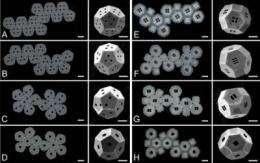
The objects pictured above are interesting structures – they are derived from the prime factorization of a given number n. They can be described in a number of ways – for example, as directed graphs. Because they are nicely structured, they actually form something more special – a lattice. Accordingly, these structures are called factor lattices.
It’s easy to start drawing these by hand following the instructions below.

1. The first node is 1
2. Draw arrows out of this node for each of the prime factors of n.
3. The arrows that you just drew should connect to nodes labled with the prime factors of n.

Now, for each of the new nodes that you drew do the following:

4. Start from a node x that is not equal to n.
5. Draw arrows out of this node for each of the prime factors of n/x.
6. The arrows that you just drew (one for each p = n/x) should connect to nodes labled with the numbers p*x.

7. Now repeat 4,5, and 6 for each new node that you have drawn that is not equal to n.

This process is recursive, and ends when you have the complete lattice. The process is well suited for implementation as a computer program – the images above were created using SAGE using output from a Java program based on the algorithm above.

Manually trying out the steps out for a number like n = 24 goes something like this: First write out the prime factorization of 24, 24=(2*2*2)*3 = (2^3)*3. Starting with 1, draw arrows out to 2 and 3. Now looking at each node and following the algorithm, from the 2 you will get arrows out to 4 and 6. From the 3 you will get an arrow out to 6 as well. From 4 you will get arrows out to 8 or 12. From 6 you will get an arrow out to 12 as well. From 8 and from 12 you get arrows out to 24, and you are done.

In general, the algorithm produces a lattice that can be described as follows. Each node is a factor of the given number n. Two nodes are connected by an edge if their prime factorization differs by a single prime number. In other words, if a and b are nodes, and p = b/a, then there is an arrow p:a–>b.

It’s a good exercise to make the connections between the lattice structure and the prime factorization of a number n.

1. What does the factor lattice of a prime number look like?
2. If a number is just a power of a prime, what does its lattice look like?
3. If you know the factorization, can you find the number of nodes without drawing the lattice.

The answer to the last question (3) can be expressed as:

For example, if n = 24= 2^3*3, then the number of nodes will be (3+1)(1+1) = 8

That these structures can be thought of as “lattices”comes from the fact that you can think of the arrows as an ordering of the nodes, ab. The number 1 is always the least node in the factor lattice for n, while n itself is the greatest node. The property that actually makes these structures a “lattice” is that for any two nodes there is always a lower-bound for any pair of nodes in the lattice, and always an upper-bound for the pair (these are often referred to as meets and joins).

The Wolfram Demonstrations Project has a nice factor lattice demo that will draw factor lattices for a large number of integers for you. There is also a good Wikipedia entry for lattices in general.

For more such insights, log into www.international-maths-challenge.com.

*Credit for article given to dan.mackinnon*