How Math Helped Me Learn Early Music

Abstract algebra class gave me the kick in the rear I needed to focus on the relationships between notes

During my senior year of college, I decided I wanted to expand my musical horizons, so I joined the early music ensemble. I had entered college with a viola scholarship, so I had played in the orchestra throughout my time there as well as doing chamber music and working on solo viola pieces, but I had always enjoyed early music and wanted to try something new. In the ensemble, I played Baroque violin, and a lot of my technique as a modern violist translated well. I held the instrument and bow a little differently, but on the whole, I was able to pick it up quickly. Reading the music was another story.

Many people are exposed to treble and bass clefs in music classes. I was very young when my mom started to teach me how to read music, but I still remember the feeling of accomplishment I had when I mastered the idea that the position of a spot on an array of lines and spaces corresponded to a particular key on a piano or a particular pitch I could sing. The treble clef is based on the G above middle C. The bass clef uses the F below middle C.

A C major scale written across bass (bottom) and treble (top) clefs. The two dots on the bass clef indicate the F below middle C, and the treble clef circles the G above middle C. Credit: Martin Marte-Singer Wikimedia (CC BY-SA 4.0)

Many instruments’ ranges fit comfortably onto either the treble or bass clef, perhaps adjusted by an octave when necessary. Piano music, of course, uses both clefs. But the viola is a little too low to use treble clef all the time and a little too high to use bass clef all the time. When I started to play viola, I learned to read alto clef, which has middle C smack dab in the middle of the staff, and eventually I was the music-reading equivalent of trilingual.

A C major scale written in alto clef, starting on middle C. Credit: Hyacinth Wikimedia

My multilingualism had its limits, though. I could read all three clefs, but if I wanted to play music originally written for cello an octave higher or music originally written for flute or violin an octave lower—tasks that would have been trivial on a piano—I would struggle to read bass clef up an octave or treble clef down an octave, respectively. Tenor clef, which is like alto clef but with the C one line higher, flummoxed me entirely. I wasn’t as fluent as I wanted to be.

Early music ensemble pushed my limits. Music from the Baroque era and before was not always notated using the small number of clefs we tend to use now. I was reading music in French violin clef (ooh-la-la, this one looks like treble clef but has the G on the bottom line instead of the line above the bottom), soprano clef (a C clef like alto and tenor clefs with the C on the bottom line), and other currently unusual clefs. It was overwhelming. I made a lot of mistakes in rehearsal, despite the many note names I had to write in my music.

The same semester I started playing with the early music ensemble, I took an abstract algebra class. Abstract algebra looks at structures of sets of numbers and symmetries. It encourages people to see connections between sometimes very different mathematical objects and transformations and to view the relationships between objects as fundamental to understanding those objects.

At some point in the semester, a switch flipped in my brain, and my early music clef struggles virtually disappeared. At the beginning of a piece, I would look at the clef to get my bearings, and I could see the rest of the notes as representing relationships between one pitch and the next. I read intervals, not pitches. I was not perfect, but I felt like almost overnight I had unlocked a new music-reading level.

I have always felt like my journey into more abstract algebra and my new clef fluency were related, but I have struggled to put that connection into words. I feel like the structural and relational aspects of abstract algebra helped me to see clefs as descriptions of relationships between notes rather than as absolute pitches, but I can’t point to a particular theorem or insight in abstract algebra that would apply explicitly.

Last year, I learned about the Yoneda lemma, an important theorem in the mathematical field of category theory. (According to our My Favorite Theorem guest Emily Riehl, it’s every category theorist’s favorite theorem.) I am no category theorist, but I found Tai-Danae Bradley’s description of the Yoneda lemma helpful, particularly the big idea she shared in this post on the Yoneda perspective. She writes that the punchline of the Yoneda lemma, or at least two of its corollaries, is “mathematical objects are completely determined by their relationships to other objects.”

It has taken me a while to make the connection explicitly, but I think the “Yoneda perspective” describes the mental shift I made in early music ensemble. It’s not the exact notes that matter when you’re reading music written in an unfamiliar clef but the relationships between them. Since having this shift in perspective, it’s been easier for me to transpose music into different keys and read treble and bass clefs in whatever octaves I need to.

Some organists and pianists can transpose music seemingly effortlessly to accommodate the needs of their church choirs or musical theater performers, and I think it’s because they’ve already shifted to the Yoneda perspective, even if that’s not how they would describe it. They didn’t necessarily get there via advanced mathematics classes, but for me, I think abstract algebra class gave me the kick in the rear I needed not to be tied to any one set of exact pitches but to focus on the relationships between them. I won’t claim that studying abstract algebra or category theory will improve your music-reading skills—making music, not studying a math book, is usually the best way to get better at making music—but pondering these connections enriches my experience of both math and music, and I hope it can do the same for you.

For more insights like this, visit our website at www.international-maths-challenge.com.

Credit of the article given to Evelyn Lamb


A Hippocratic Oath for data science? We’ll settle for a little more data literacy

Bias in, bias out: many algorithms have inherent design problems. Vintage Tone/Shutterstock

Could this be the first line of a “Hippocratic Oath” for mathematicians and data scientists? Hannah Fry, Associate Professor in the mathematics of cities at University College London, argues that mathematicians and data scientists need such an oath, just like medical doctors who swear to act only in their patients’ best interests.

“In medicine, you learn about ethics from day one. In mathematics, it’s a bolt-on at best. It has to be there from day one and at the forefront of your mind in every step you take,” Fry argued.

But is a tech version of the Hippocratic Oath really required? In medicine, these oaths vary between institutions, and have evolved greatly in the nearly 2,500 years of their history. Indeed, there is some debate around whether the oath remains relevant to practising doctors, particularly as it is the law, rather than a set of ancient Greek principles, by which they must ultimately abide.

How has data science reached the point at which an ethical pledge is deemed necessary? There are certainly numerous examples of algorithms doing harm – criminal sentencing algorithms, for instance, have been shown to disproportionately recommend that low-income and minority people are sent to jail.

Similar crises have led to proposals for ethical pledges before. In the aftermath of the 2008 global financial crisis, a manifesto by financial engineers Emanuel Derman and Paul Wilmott beseeched economic modellers to swear not to “give the people who use my model false comfort about its accuracy. Instead, I will make explicit its assumptions and oversights.”

Just as prejudices can be learned as a child, the biases of these algorithms are a result of their training. A common feature of these algorithms is the use of black-box (often proprietary) algorithms, many of which are trained using statistically biased data.

In the case of criminal justice, the algorithm’s unjust outcome stems from the fact that historically, minorities are overrepresented in prison populations (most likely as a result of long-held human biases). This bias is therefore replicated and likely exacerbated by the algorithm.

Machine learning algorithms are trained on data, and can only be expected to produce predictions that are limited to those data. Bias in, bias out.

Promises, promises

Would taking an ethical pledge have helped the designers of these algorithms? Perhaps, but greater awareness of statistical biases might have been enough. Issues of unbiased representation in sampling have long been a cornerstone of statistics, and training in these topics may have led the designers to step back and question the validity of their predictions.

Fry herself has commented on this issue in the past, saying it’s necessary for people to be “paying attention to how biases you have in data can end up feeding through to the analyses you’re doing”.

But while issues of unbiased representation are not new in statistics, the growing use of high-powered algorithms in contentious areas make “data literacy” more relevant than ever.

Part of the issue is the ease with which machine learning algorithms can be applied, making data literacy no longer particular to mathematical and computer scientists, but to the public at large. Widespread basic statistical and data literacy would aid awareness of the issues with statistical biases, and are a first step towards guarding against inappropriate use of algorithms.

Nobody is perfect, and while improved data literacy will help, unintended biases can still be overlooked. Algorithms might also have errors. One easy (to describe) way to guard against such issues is to make them publicly available. Such open source code can allow joint responsibility for bias and error checking.

Efforts of this sort are beginning to emerge, for example the Web Transparency and Accountability Project at Princeton University. Of course, many proprietary algorithms are commercial in confidence, which makes transparency difficult. Regulatory frameworks are hence likely to become important and necessary in this area. But a precondition is for practitioners, politicians, lawyers, and others to understand the issues around the widespread applicability of models, and their inherent statistical biases.

Ethics is undoubtedly important, and in a perfect world would form part of any education. But university degrees are finite. We argue that data and statistical literacy is an even more pressing concern, and could help guard against the appearance of more “unethical algorithms” in the future.

For more insights like this, visit our website at www.international-maths-challenge.com.
Credit of the article given to Lewis Mitchell, Joshua Ross


How Does a Mathematician’s Brain Differ from That of a Mere Mortal?

Credit: Getty Images

Processing high-level math concepts uses the same neural networks as the basic math skills a child is born with

Alan Turing, Albert Einstein, Stephen Hawking, John Nash—these “beautiful” minds never fail to enchant the public, but they also remain somewhat elusive. How do some people progress from being able to perform basic arithmetic to grasping advanced mathematical concepts and thinking at levels of abstraction that baffle the rest of the population? Neuroscience has now begun to pin down whether the brain of a math wiz somehow takes conceptual thinking to another level.

Specifically, scientists have long debated whether the basis of high-level mathematical thought is tied to the brain’s language-processing centers—that thinking at such a level of abstraction requires linguistic representation and an understanding of syntax—or to independent regions associated with number and spatial reasoning. In a study published this week in Proceedings of the National Academy of Sciences, a pair of researchers at the INSERM–CEA Cognitive Neuroimaging Unit in France reported that the brain areas involved in math are different from those engaged in equally complex nonmathematical thinking.

The team used functional magnetic resonance imaging (fMRI) to scan the brains of 15 professional mathematicians and 15 nonmathematicians of the same academic standing. While in the scanner the subjects listened to a series of 72 high-level mathematical statements, divided evenly among algebra, analysis, geometry and topology, as well as 18 high-level nonmathematical (mostly historical) statements. They had four seconds to reflect on each proposition and determine whether it was true, false or meaningless.

The researchers found that in the mathematicians only, listening to math-related statements activated a network involving bilateral intraparietal, dorsal prefrontal, and inferior temporal regions of the brain. This circuitry is usually not associated with areas involved in language processing and semantics, which were activated in both mathematicians and nonmathematicians when they were presented with the nonmathematical statements. “On the contrary,” says study co-author and graduate student Marie Amalric, “our results show that high-level mathematical reflection recycles brain regions associated with an evolutionarily ancient knowledge of number and space.”

Previous research has found that these nonlinguistic areas are active when performing rudimentary arithmetic calculations and even simply seeing numbers on a page, suggesting a link between advanced and basic mathematical thinking. In fact, co-author Stanislas Dehaene, director of the Cognitive Neuroimaging Unit and experimental psychologist, has studied how humans (and even some animal species) are born with an intuitive sense of numbers—of quantity and arithmetic manipulation—closely related to spatial representation. How the connection between a hardwired “number sense” and higher-level math is formed, however, remains unknown. This work raises the intriguing question of whether an innate capability to recognize different quantities—that two pieces of fruit are greater than one—is the biological foundation on which can be built the capacity to master group theory. “It would be interesting to investigate the causal chain between lower-level and higher-level mathematical competency,” says Daniel Ansari, a cognitive neuroscientist at the University of Western Ontario who did not participate in the study. “Most of us master basic arithmetic, so we’re already recruiting these brain regions, but only a fraction of us go on to do high-level math. We don’t yet know whether becoming a mathematical expert changes the way you do arithmetic or whether learning arithmetic lays out the foundation for acquiring higher-level mathematical concepts.”

Ansari suggests that a training study, in which nonmathematicians are taught advanced mathematical concepts, could provide a better understanding of these connections and how they form. Moreover, achieving expertise in mathematics may affect neuronal circuitry in other ways. Amalric’s study found that mathematicians had reduced activity in the visual areas of the brain involved in facial processing. This could mean that the neural resources required to grasp and work with certain math concepts may undercut—or “use up”—some of the brain’s other capacities. Although additional studies are needed to determine whether mathematicians actually do process faces differently, the researchers hope to gain further insight into the effects that expertise has on how the brain is organized.

“We can start to investigate where exceptional abilities come from, and the neurobiological correlates of such high-level expertise,” Ansari says. “I just think it’s great that we now have the capability to use brain imaging to answer these deep questions about the complexity of human abilities.”

For more insights like this, visit our website at www.international-maths-challenge.com.

Credit of the article given to  Jordana Cepelewicz


What was the first computer?

The first modern electronic digital computer was called the Atanasoff–Berry computer, or ABC.

It was built by physics Professor John Vincent Atanasoff and his graduate student, Clifford Berry, in 1942 at Iowa State College, now known as Iowa State University.

That’s where I have been teaching computer engineering for over 30 years, and I’m also a collector of old computers. I got to meet Atanasoff when he visited Iowa State and got a signed copy of his book.

Before ABC, there were mechanical computing devices that could perform simple calculations. The first mechanical computer, The Babbage Difference Engine, was designed by Charles Babbage in 1822. The ABC was the basis for the modern computer we all use today.

The ABC’s drums. Courtesy of Iowa State University Library Special Collections and University Archives, CC BY-ND

The ABC weighed over 700 pounds and used vacuum tubes. It had a rotating drum, a little bigger than a paint can, that had small capacitors on it. A capacitor is device that can store an electric charge, like a battery.


The ABC was designed to solve problems with up to 29 different variables. You might be familiar with equations with one variable, like 2y = 14. Now imagine 29 different variables. These are common problems in physics and other sciences, but were difficult and time-consuming to solve by hand.

Atanasoff was credited with several breakthrough ideas that are still present in modern computers. The most important idea was using binary digits, just ones and zeroes, to represent all numbers and data. This allowed the calculations to be performed using electronics.

Another idea was the separation of the program (the computer instructions) and memory (places to store numbers).

The ABC completed one operation about every 15 seconds. Compared to the millions of operations per second of today’s computer, that probably seems very slow.

Unlike today’s computers, the ABC did not have a changeable stored program. This meant the program was fixed and designed to do a single task. This also meant that, to solve these problems, an operator had to write down the intermediate answer and then feed that back into the ABC. Atanasoff left Iowa State before he perfected a storage method that would have eliminated the need for the operator to reenter the intermediate results.

Part of the ABC. Courtesy of Iowa State University Library Special Collections and University Archives, CC BY-ND

Shortly after Atanasoff left Iowa State, the ABC was dismantled. Atanasoff never filed a patent for his invention. That means that, for a long time, many people weren’t aware of the ABC.

In 1947, the creators of the Electronic Numerical Integrator And Computer, or ENIAC, filed a patent. This allowed them to claim they were the inventors of the digital computer. For several decades, most people thought that the ENIAC was the first modern computer.

But one of the inventors of the ENIAC had visited Atanasoff in 1941. The courts later ruled that this visit influenced the design of the ENIAC. The ENIAC patent was thrown out by a judge in 1973.

The holders of the ENIAC patent argued that the ABC never really worked. Since all that remained was one of the drum memory units, it was hard to prove otherwise.

In 1997 a team of faculty, researchers and students at Iowa State University finished building a replica of the ABC. They were able to demonstrate that the ABC did function. You can see the replica today at the Computer History Museum in Mountain View, California.

For more insights like this, visit our website at www.international-maths-challenge.com.
Credit of the article given to Doug Jacobson


Fractions: Where It All Goes Wrong

Credit: Jasmina81 Getty Images

Why do Americans have such trouble with fractions—and what can be done?

Many children never master fractions. When asked whether 12/13 + 7/8 was closest to 1, 2, 19, or 21, only 24% of a nationally representative sample of more than 20,000 US 8th graders answered correctly. This test was given almost 40 years ago, which gave Hugo Lortie-Forgues and me hope that the work of innumerable teachers, mathematics coaches, researchers, and government commissions had made a positive difference. Our hopes were dashed by the data, though; we found that in all of those years, accuracy on the same problem improved only from 24% to 27% correct.

Such difficulties are not limited to fraction estimation problems nor do they end in 8th grade. On standard fraction addition, subtraction, multiplication, and division problems with equal denominators (e.g., 3/5+4/5) and unequal denominators (e.g., 3/5+2/3), 6th and 8th graders tend to answer correctly only about 50% of items. Studies of community college students have revealed similarly poor fraction arithmetic performance. Children in the US do much worse on such problems than their peers in European countries, such as Belgium and Germany, and in Asian countries such as China and Korea.

This weak knowledge is especially unfortunate because fractions are foundational to many more advanced areas of mathematics and science. Fifth graders’ fraction knowledge predicts high school students’ algebra learning and overall math achievement, even after controlling for whole number knowledge, the students’ IQ, and their families’ education and income. On the reference sheets for recent high school AP tests in chemistry and physics, fractions were part of more than half of the formulas. In a recent survey of 2300 white collar, blue collar, and service workers, more than two-thirds indicated that they used fractions in their work. Moreover, in a nationally representative sample of 1,000 Algebra 1 teachers in the US, most rated as “poor” their students’ knowledge of fractions and rated fractions as the second greatest impediment to their students mastering algebra (second only to “word problems”).

Why are fractions so difficult to understand? A major reason is that learning fractions requires overcoming two types of difficulty: inherent and culturally contingent. Inherent sources of difficulty are those that derive from the nature of fractions, ones that confront all learners in all places. One inherent difficulty is the notation used to express fractions. Understanding the relation a/b is more difficult than understanding the simple quantity a, regardless of the culture or time period in which a child lives. Another inherent difficulty involves the complex relations between fraction arithmetic and whole number arithmetic. For example, multiplying fractions involves applying the whole number operation independently to the numerator and the denominator (e.g., 3/7 * 2/7 = (3*2)/(7*7) = 6/49), but doing the same leads to wrong answers on fraction addition (e.g., 3/7 + 2/7 ≠ 5/14). A third inherent source of difficulty is complex conceptual relations among different fraction arithmetic operations, at least using standard algorithms. Why do we need equal denominators to add and subtract fractions but not to multiply and divide them? Why do we invert and multiply to solve fraction division problems, and why do we invert the fraction in the denominator rather than the one in the numerator? These inherent sources of difficulty make understanding fraction arithmetic challenging for all students.

Culturally contingent sources of difficulty, in contrast, can mitigate or exacerbate the inherent challenges of learning fractions. Teacher understanding is one culturally-contingent variable: When asked to explain the meaning of fraction division problems, few US teachers can provide any explanation, whereas the large majority of Chinese teachers provide at least one good explanation. Language is another culturally-contingent factor; East Asian languages express fractions such as 3/4 as “out of four, three,” which makes it easier to understand their meaning than relatively opaque terms such as “three fourth.” A third such variable is textbooks. Despite division being the most difficult operation to understand, US textbooks present far fewer problems with fraction division than fraction multiplication; the opposite is true in Chinese and Korean textbooks. Probably most fundamental are cultural attitudes: Math learning is viewed as crucial throughout East Asia, but US attitudes about its importance are far more variable.

Given the importance of fractions in and out of school, the extensive evidence that many children and adults do not understand them, and the inherent difficulty of the topic, what is to be done? Considering culturally contingent factors points to several potentially useful steps. Inculcating a deeper understanding of fractions among teachers will likely help them to teach more effectively. Explaining the meaning of fractions to students using clear language (for example, explaining that 3/4 means 3 of the 1/4 units), and requesting textbook writers to include more challenging problems are other promising strategies. Addressing inherent sources of difficulty in fraction arithmetic, in particular understanding of fraction magnitudes, can also make a large difference.

Fraction Face-off!, a 12-week program designed by Lynn Fuchs to help children from low-income backgrounds improve their fraction knowledge, seems especially promising. The program teaches children about fraction magnitudes through tasks such as comparing and ordering fraction magnitudes and locating fractions on number lines. After participating in Fraction Face-off!, fourth graders’ fraction addition and subtraction accuracy consistently exceeds of children receiving the standard classroom curriculum. This finding was especially striking because Fraction Face-off! devoted less time to explicit instruction in fraction arithmetic procedures than did the standard curriculum. Similarly encouraging findings have been found for other interventions that emphasize the importance of fraction magnitudes. Such programs may help children learn fraction arithmetic by encouraging them to note that answers such as 1/3+1/2 = 2/5 cannot be right, because the sum is less than one of the numbers being added, and therefore to try procedures that generate more plausible answers. These innovative curricula seem well worth testing on a wider basis.

For more insights like this, visit our website at www.international-maths-challenge.com.

Credit of the article given to Robert S. Siegler


Bees can learn higher numbers than we thought – if we train them the right way

Bees are pretty good at maths – as far as insects go, at least. We already know, for example, that they can count up to four and even understand the concept of zero.

But in a new study, published today in the Journal of Experimental Biology, we show honeybees can also understand numbers higher than four – as long as we provide feedback for both correct and incorrect responses as they learn.

Even our own brains are less adept at dealing with numbers greater than four. While we can effortlessly estimate up to four items, processing larger numbers requires more mental effort. Hence why when asked to count, a young child will sometimes answer with “1, 2, 3, 4, more”!

If you don’t believe me, try the test below. The various colour groupings representing 1-4 stars are easy to count quickly and accurately. However, if we try estimating the number of all stars at once by ignoring colours, it requires more concentration, and even then our accuracy tends to be poorer.

For numbers of elements ranging from 1-4, as represented here in different colours, we very efficiently process the exact number. However, if we try estimating the number of all stars at once by ignoring colour, it requires a lot more cognitive effort.

This effect isn’t unique to humans. Fish, for example, also show a threshold for accurate quantity discrimination at four.

One theory to explain this is that counting up to four isn’t really counting at all. It may be that many animals’ brains can innately recognise groups of up to four items, whereas proper counting (the process of sequentially counting the number of objects present) is needed for numbers beyond that.

By comparing the performance of different animal species in various number processing tasks we can better understand how differences in brain size and structure enable number processing. For example, honeybees have previously been shown to be able to count and discriminate numbers up to four, but not beyond. We wanted to know why there was a limit at four – and whether they can go further.

Best bee-haviour

Bees are surprisingly good at maths. We recently discovered that bees can learn to associate particular symbols with particular quantities, much like the way we use numerals to represent numbers.

Bees learn to do this type of difficult task if given a sugary reward for choosing the correct association, and a bitter liquid for choosing incorrectly. So if we were to push bees beyond the four threshold, we knew success would depend on us asking the right question, in the right way, and providing useful feedback to the bees.

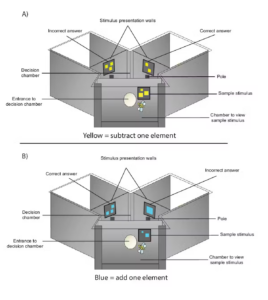
We trained two different groups of bees to perform a task in which they were presented with a choice of two different patterns, each containing a different number of shapes. They could earn a reward for choosing the group of four shapes, as opposed to other numbers up to ten.

We used two different training strategies. One group of ten bees received only a reward for a correct choice (choosing a quantity of four), and nothing for an incorrect choice. A second group of 12 bees received a sugary reward for picking four, or a bitter-tasting substance if they made a mistake.

In the test, bees flew into a Y-shaped maze to make a choice, before returning to their hive to share their collected sweet rewards.

Each experiment conducted with a single bee lasted about four hours, by which time each bee had made 50 choices.

Bees were individually trained and tested in a Y-shaped maze where a sugar reward was presented on the pole directly in front of the correct stimulus. Author provided

The group that only received sweet rewards could not successfully learn to discriminate between four and higher numbers. But the second group reliably discriminated the group of four items from other groups containing higher numbers.

Thus, bees’ ability to learn higher number discrimination depends not just on their innate abilities, but also on the risks and rewards on offer for doing so.

Bee’s-eye view of either four or five element displays that could be discriminated. Inserts show how we normally see these images.

Our results have important implications for understanding how animals’ brains may have evolved to process numbers. Despite being separated by 600 million years of evolution, invertebrates such as bees and vertebrates such as humans and fish all seem to share a common threshold for accurately and quickly processing small numbers. This suggests there may be common principles behind how our brains tackle the question of quantity.

The evidence from our new study shows bees can learn to process higher numbers if the question and training are presented in the right way. These results suggest an incredible flexibility in animal brains, of all sizes, for learning to become maths stars.

For more insights like this, visit our website at www.international-maths-challenge.com.
Credit of the article given to Adrian Dyer, Jair Garcia, Scarlett Howard


Bizarre Proof to Torment Mathematicians for Years to Come

Credit: Pavel Bolotov/Thinkstock (MARS)

A rare appearance by enigmatic Shinichi Mochizuki brings faint optimism about his famously impenetrable work

Nearly four years after Shinichi Mochizuki unveiled an imposing set of papers that could revolutionize the theory of numbers, other mathematicians have yet to understand his work or agree on its validity — although they have made modest progress.

Some four dozen mathematicians converged last week for a rare opportunity to hear Mochizuki present his own work at a conference on his home turf, Kyoto University’s Research Institute for Mathematical Sciences (RIMS).

Mochizuki is “less isolated than he was before the process got started”, says Kiran Kedlaya, a number theorist at the University of California, San Diego. Although at first Mochizuki’s papers, which stretch over more than 500 pages, seemed like an impenetrable jungle of formulae, experts have slowly discerned a strategy in the proof that the papers describe, and have been able to zero in on particular passages that seem crucial, he says.

And Jeffrey Lagarias, a number theorist at the University of Michigan in Ann Arbor, says that he got far enough to see that Mochizuki’s work is worth the effort. “It has some revolutionary new ideas,” he says.

Still, Kedlaya says that the more he delves into the proof, the longer he thinks it will take to reach a consensus on whether it is correct. He used to think that the issue would be resolved perhaps by 2017. “Now I’m thinking at least three years from now.”

Others are even less optimistic. “The constructions are generally clear, and many of the arguments could be followed to some extent, but the overarching strategy remains totally elusive for me,” says mathematician Vesselin Dimitrov of Yale University in New Haven, Connecticut. “Add to this the heavy, unprecedentedly indigestible notation: these papers are unlike anything that has ever appeared in the mathematical literature.”

The abc proof

Mochizuki’s theorem aims to prove the important abc conjecture, which dates back to 1985 and relates to prime numbers — whole numbers that cannot be evenly divided by any smaller number except by 1. The conjecture comes in a number of different forms, but explains how the primes that divide two numbers, a and b, are related to those that divide their sum, c.

If Mochizuki’s proof is correct, it would have repercussions across the entire field, says Dimitrov. “When you work in number theory, you cannot ignore the abc conjecture,” he says. “This is why all number theorists eagerly wanted to know about Mochizuki’s approach.” For example, Dimitrov showed in January how, assuming the correctness of Mochizuki’s proof, one might be able to derive many other important results, including a completely independent proof of the celebrated Fermat’s last theorem.

But the purported proof, which Mochizuki first posted on his webpage in August 2012, builds on more than a decade of previous work in which Mochizuki worked in virtual isolation and developed a novel and extremely abstract branch of mathematics.

Mochizuki in the room

The Kyoto workshop followed on the heels of one held last December in Oxford, UK. Mochizuki did not attend that first meeting, although he answered the audience’s questions over a Skype video link. This time, having him in the room — and hearing him present some of the materials himself — was helpful, says Taylor Dupuy, a mathematician at the Hebrew University of Jerusalem who participated in both workshops.

There are now around ten mathematicians who are putting substantial effort into digesting the material — up from just three before the Oxford workshop, says Ivan Fesenko, a mathematician at the University of Nottingham, UK, who co-organized both workshops. The group includes younger researchers, such as Dupuy.

In keeping with his reputation for being a very private person, Mochizuki — who is said to never eat meals in the presence of colleagues — did not take part in the customary mingling and social activities at the Kyoto meeting, according to several sources. And although he was unfailingly forthcoming in answering questions, it was unclear what he thought of the proceedings. “Mochizuki does not give a lot away,” Kedlaya says. “He’s an excellent poker player.”

Fellow mathematicians have criticized Mochizuki for his refusal to travel. After he posted his papers, he turned down multiple offers to spend time abroad and lecture on his ideas. Although he spent much of his youth in the United States, he is now said to rarely leave the Kyoto area. (Mochizuki does not respond to requests for interviews, and the workshop’s website contained the notice: “Activities aimed at interviewing or media coverage of any sort within the facilities of RIMS, Kyoto University, will not be accepted.”)

“He is very level-headed,” says another workshop participant, who did not want to be named. “The only thing that frustrates him is people making rash judgemental comments without understanding any details.”

Still, Dupuy says, “I think he does take a lot of the criticism about him really personally. I’m sure he’s sick of this whole thing, too.”

For more insights like this, visit our website at www.international-maths-challenge.com.

Credit of the article given to Davide Castelvecchi & Nature magazine


Nicolas Bourbaki: The greatest mathematician who never was

Bourbaki Congress of 1938.

By many measures, Nicolas Bourbaki ranks among the greatest mathematicians of the 20th century.

Largely unknown today, Bourbaki is likely the last mathematician to master nearly all aspects of the field. A consummate collaborator, he made fundamental contributions to important mathematical fields such as set theory and functional analysis. He also revolutionized mathematics by emphasizing rigor in place of conjecture.

There’s just one problem: Nicolas Bourbaki never existed.

Never existed?

The cover of the first volume in Bourbaki’s textbook. Maitrier/WikimediaCC BY-SA

While it is now widely accepted that there never was a Nicolas Bourbaki, there is evidence to the contrary.

For example, there are wedding announcements for his daughter Betty, a baptismal certificate in his name and an impressive family lineage extending back to an ancestor Napoleon raised as his own son.

Even the professional mathematics community was misled for a time. When Ralph Boas, an editor of the journal Mathematical Reviews, wrote that Bourbaki was a pseudonym, he was promptly refuted by none other than Bourbaki himself. Bourbaki countered with a letter stating that B.O.A.S. actually just was an acronym of the last names of the editors of the Reviews.

These cases of confused identity were not all fun and games. For example, it is alleged that, while visiting Finland at the outset of World War II, French mathematician André Weil was investigated for spying. The authorities found suspicious papers in his possession: a fake identity, a set of business cards and even invitations from the Russian Academy of Science – all in Bourbaki’s name. Supposedly, Weil was freed only after an officer recognized him as a preeminent mathematician.

Who was Bourbaki?

If Bourbaki never existed, who – or what – was he?

The name Nicolas Bourbaki first appeared in a place rocked by turmoil at a volatile time in history: Paris in 1934.

World War I had wiped out a generation of French intellectuals. As a result, the standard university-level calculus textbook had been written more than two and half decades before and was out of date.

Newly minted professors André Weil and Henri Cartan wanted a rigorous method to teach Stokes’ theorem, a key result of calculus. After realizing that others had similar concerns, Weil organized a meeting. It took place December 10, 1934 at a Parisian café called Capoulade.

The nine mathematicians in attendance agreed to write a textbook “to define for 25 years the syllabus for the certificate in differential and integral calculus by writing, collectively, a treatise on analysis,” which they hoped to complete in just six months.

Cafe Capoulade in 1943. Langhaus, German Federal Archive/WikimediaCC BY-SA


As a joke, they named themselves after an old French general who had been duped in the Franco-Prussian war.

As they proceeded, their original goal of elucidating Stokes’ theorem expanded to laying out the foundations of all mathematics. Eventually, they began to hold regular Bourbaki “conferences” three times a year to discuss new chapters for the treatise.

Individual members were encouraged to engage with all aspects of the effort, to ensure that the treatise would be accessible to nonspecialists. According to one of the founders, spectators invariably came away with the impression that they were witnessing “a gathering of madmen.” They could not imagine how people, shouting – “sometimes three or four at the same time” – could ever come up with something “intelligent.”

Top mathematicians from across Europe, intrigued by the group’s work and style, joined to augment the group’s ranks. Over time, the name Bourbaki became a collective pseudonym for dozens of influential mathematicians spanning generations, including Weil, Dieudonne, Schwartz, Borel, Grothendieck and many others.

Since then, the group which has added new members over time, has proved to have a profound impact on mathematics, certainly rivaling any of its individual contributors.

Profound impact

Mathematicians have made a plethora of important contributions under Bourbaki’s name.

To name a few, the group introduced the null set symbol; the ubiquitous terms injective, surjective, bijective; and generalizations of many important theorems, including the Bourbaki-Witt theorem, the Jacobson-Bourbaki theorem and the Bourbaki-Banach-Alaoglu theorem.

Their text, “Elements of Mathematics,” has swelled to more than 6,000 pages. It provides a “solid foundation for the whole body of modern mathematics,” according to mathematician Barbara Pieronkiewicz.

Bourbaki’s influence is still alive and well. Now in “his” 80th year of research, in 2016 “he” published the 11th volume of the “Elements of Mathematics.” The Bourbaki group, with its ever-changing cast of members, still holds regular seminars at the University of Paris.

Partly thanks to the breadth and significance of “his” mathematical contributions, and also because – ageless, unchanging and operating in multiple places at once – “he” seems to defy the very laws of physics, Bourbaki’s mathematical prowess will likely never be equaled.

For more insights like this, visit our website at www.international-maths-challenge.com.
Credit of the article given to David Gunderman


3 Revolutionary Women of Mathematics

Credit: Ada Lovelace, Julia Robinson, and Emmy Noether. IanDagnall Computing/Alamy Stock Photo (Lovelace and Noether); George M. Bergman/Wikimedia Commons (CC BY-SA 4.0) (Robinson)

Everyone knows that history’s great mathematicians were all men—but everybody is wrong

This article was published in Scientific American’s former blog network and reflects the views of the author, not necessarily those of Scientific American

From the profound revelations of the shape of space to the furthest explorations reachable by imagination and logic, the history of mathematics has always been seen as a masculine endeavor. Names like Gauss, Euler, Riemann, Poincare, Erdős, and the more modern Wiles, Tao, Perelman, and Zhang, all of them associated with the most beautiful mathematics discovered since the dawn of humanity, are all men. The book Men of Mathematics, written by E.T. Bell in 1937, is just one example of how this “fact” has been reinforced in in the public consciousness.

Even today, it is no secret that male mathematicians still dominate the field. But this should not distract us from the revolutionary contributions women have made. We have notable women to thank for modern computation, revelations on the geometry of space, cornerstones of abstract algebra, and major advances in decision theory, number theory, and celestial mechanics that continue to provide crucial breakthroughs in applied areas like cryptography, computer science, and physics.

The works of geniuses like Julia Robinson on Hilbert’s Tenth Problem in number theory, Emmy Noether in abstract algebra and physics, and Ada Lovelace in computer science, are just three examples of women whose contributions have been absolutely essential.

Julia Robinson at Berkeley, California, 1975. Credit: George M. Bergman/Wikimedia Commons (CC BY-SA 4.0)

Julia Robinson (1919-1985)

At the turn of the twentieth century the famed German mathematician David Hilbert published a set of twenty-three tantalizing problems that had evaded the most brilliant of mathematical minds. Among them was his tenth problem, which asked if a general algorithm could be constructed to determine the solvability of any Diophantine equation (those polynomial equations with only integer coefficients and integer solutions). Imagine, for any Diophantine equation of the infinite set of such equations a machine that can tell whether it can be solved. Mathematicians often deal with infinite questions of this nature that exist far beyond resolution by simple extensive observations. This particular problem drew the attention of a Berkeley mathematician named Julia Robinson. Over several decades, Robinson collaborated with colleagues including Martin Davis and Hillary Putnam that resulted in formulating a condition that would answer Hilbert’s question in the negative.

In 1970 a young Russian mathematician named Yuri Matiyasevich solved the problem using the insight provided by Robinson, Davis, and Putnam. With her brilliant contributions in number theory, Robinson was a remarkable mathematician who paved the way to answering one of the greatest pure math questions ever proposed. In a Mathematical Association of America article, “The Autobiography of Julia Robinson”, her sister and biographer Constance Read wrote, “She herself, in the normal course of events, would never have considered recounting the story of her own life. As far as she was concerned, what she had done mathematically was all that was significant.”

Portrait of the German mathematician Amalie Emmy Noether, c.1910. Credit: IanDagnall Computing/Alamy Stock Photo

Emmy Noether (1882-1935)

Sitting in an abstract math course for any length of time, one is bound to hear the name Emmy Noether. Her notable work spans subjects from physics to modern algebra, making Noether one of the most important figures in mathematical history. Her 1913 result on the calculus of variations, leading to Noether’s Theorem is considered one of the most important theorems in mathematics—and one that shaped modern physics. Noether’s theory of ideals and commutative rings forms a foundation for any researcher in the field of higher algebra.

The influence of her work continues to shine as a beacon of intuition for those who grapple with understanding physical reality more abstractly. Mathematicians and physicists alike admire her epoch contributions that provide deep insights within their respective disciplines. In 1935, Albert Einstein wrote in a letter to the New York Times, “In the judgment of the most competent living mathematicians, Fräulein Noether was the most significant creative mathematical genius thus far produced since the higher education of women began.”

Ada Lovelace, Portrait by Margaret Sarah Carpenter, oil on canvas, 1836. Credit: IanDagnall Computing/Alamy Stock Photo

Ada Lovelace (1815-1852)

In 1842, Cambridge mathematics professor Charles Babbage gave a lecture at the University of Turin on the design of his Analytical Engine (the first computer). Mathematician Luigi Menabrea later transcribed the notes of that lecture to French. The young Countess Ada Lovelace was commissioned by Charles Wheatstone (a friend of Babbage) to translate the notes of Menabrea into English. She is known as the “world’s first programmer” due to her insightful augmentation of that transcript. Published in 1843, Lovelace added her own notes including Section G, which outlined an algorithm to calculate Bernoulli numbers. In essence, she took Babbage’s theoretical engine and made it a computational reality. Lovelace provided a path for others to shed light on the mysteries of computation that continues to impact technology.

Despite their profound contributions, the discoveries made by these three women are often overshadowed by the contributions of their male counterparts. According to a 2015 United Nations estimate, the number of men and women in the world is almost equal (101.8 men for every 100 women). One could heuristically argue, therefore that we should see roughly the same number of women as men working in the field of mathematics.

One large reason that we don’t is due to our failure to recognize the historical accomplishments of female mathematicians. Given the crucial role of science and technology in the modern world, however, it is imperative as a civilization to promote and encourage more women to pursue careers in mathematics.

For more insights like this, visit our website at www.international-maths-challenge.com.

Credit of the article given to Avery Carr


Pi Day: How To Calculate Pi Using A Cardboard Tube And A Load Of Balls

Grab a few balls and get calculating pi

Pi Day, which occurs every 14 March – or 3/14, in the US date format – celebrates the world’s favourite mathematical constant. This year, why not try an experiment to calculate its value? All you will need is a cardboard tube and a series of balls, each 100 times lighter than the next. You have those lying around the house, right?

This experiment was first formulated by mathematician Gregory Galperin in 2001. It works because of a mathematical trick involving the masses of a pair of balls and the law of conservation of energy.

First, take the tube and place one end up against a wall. Place two balls of equal mass in the tube. Let’s say that the ball closer to the wall is red, and the other is blue.

Next, bounce the blue ball off the red ball. If you have rolled the blue ball hard enough, there should be three collisions: the blue ball hits the red one, the red ball hits the wall, and the red ball bounces back to hit the blue ball once more. Not-so-coincidentally, three is also the first digit of pi.

To calculate pi a little bit more precisely, replace the red ball with one that is 100 times less massive than the blue ball – a ping pong ball might work, so we will call this the white ball.

When you perform the experiment again, you will find that the blue ball hits the white ball, the white ball hits the wall and then the white ball continues to bounce back and forth between the blue ball and the wall as it slows down. If you count the bounces, you’ll find that there are 31 collisions. That gives you the first two digits of pi: 3.1.

Galperin calculated that if you continue the same way, you will keep getting more digits of pi. If you replace the white ball with another one that is 10,000 times less massive than the blue ball, you will find that there are 314 collisions, and so on. If you have enough balls, you can count as many digits of pi as you like.

For more such insights, log into www.international-maths-challenge.com.

*Credit for article given to Leah Crane*