
How The Maths Behind Honeycombs Can Help You Work A Jigsaw Puzzle

Maths tells us the best way to cover a surface with copies of a shape – even when it comes to jigsaw puzzles, says Katie Steckles.

WHAT do a bathroom wall, a honeycomb and a jigsaw puzzle have in common? Obviously, the answer is mathematics.

If you are trying to cover a surface with copies of a shape – say, for example, you are tiling a bathroom – you ideally want a shape like a square or rectangle. They will cover the whole surface with no gaps, which is why these boring shapes get used as wall tiles so often.

But if your shapes don’t fit together exactly, you can still try to get the best coverage possible by arranging them in an efficient way.

Imagine trying to cover a surface with circular coins. The roundness of the circles means there will be gaps between them. For example, we could use a square grid, placing the coins on the intersections. This will cover about 78.5 per cent of the area.

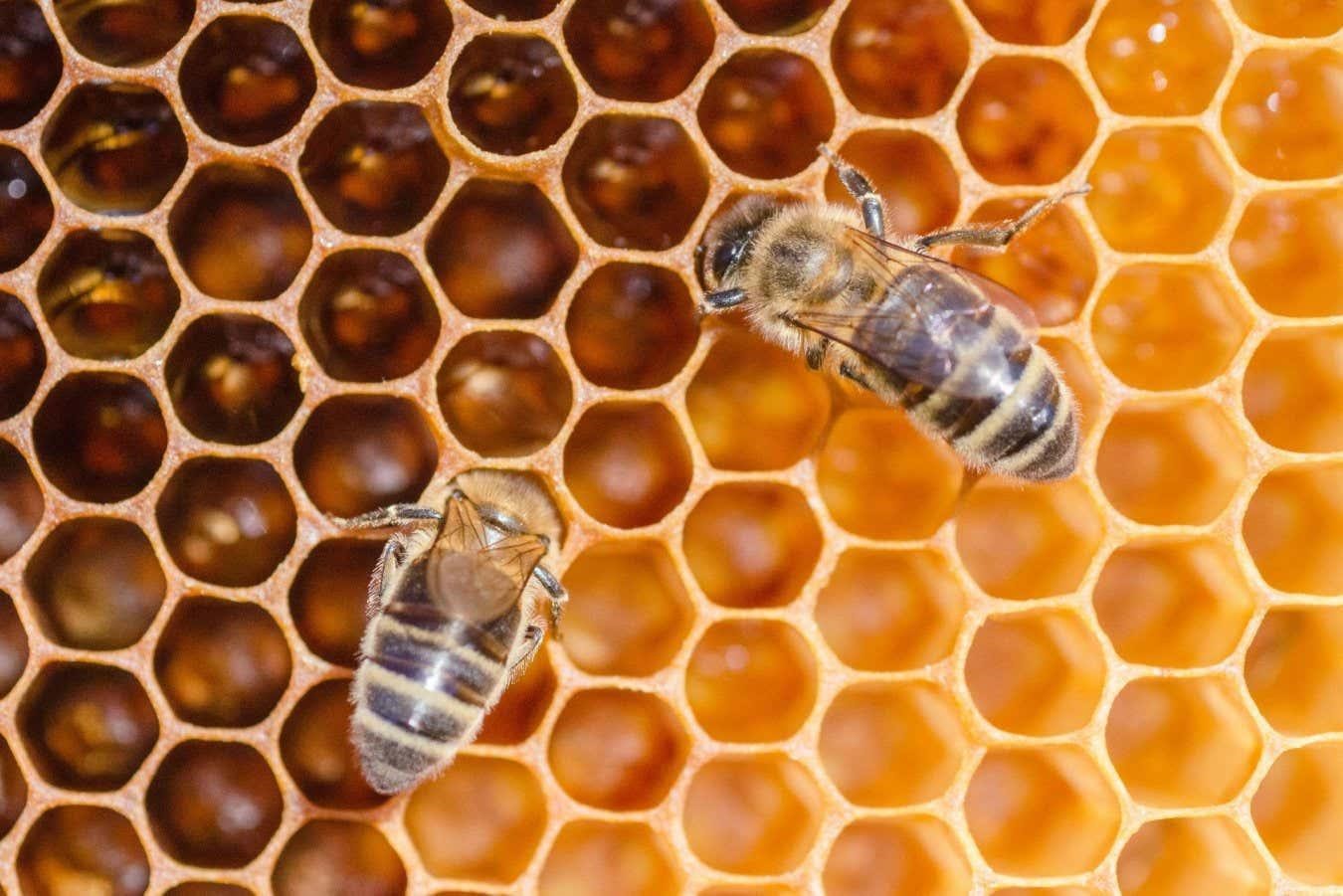
But this isn’t the most efficient way: in 1773, mathematician Joseph-Louis Lagrange showed that the optimal arrangement of circles involves a hexagonal grid, like the cells in a regular honeycomb – neat rows where each circle sits nestled between the two below it.

In this situation, the circles will cover around 90.7 per cent of the space, which is the best you can achieve with this shape. If you ever need to cover a surface with same-size circles, or pack identical round things into a tray, the hexagon arrangement is the way to go.

But this isn’t just useful knowledge if you are a bee: a recent research paper used this hexagonal arrangement to figure out the optimal size table for working a jigsaw puzzle. The researchers calculated how much space would be needed to lay out the pieces of an unsolved jigsaw puzzle, relative to the solved version. Puzzle pieces aren’t circular, but they can be in any orientation and the tabs sticking out stop them from moving closer together, so each takes up a theoretically circular space on the table.

By comparing the size of the central rectangular section of the jigsaw piece to the area it would take up in the hexagonal arrangement, the paper concluded that an unsolved puzzle takes up around 1.73 times as much space.

This is the square root of three (√3), a number with close connections to the regular hexagon – one with a side length of 1 will have a height of √3. Consequently, there is also a √3 in the formula for the hexagon’s area, which is 3/2 × √3 × s2, where s is the length of a side. This is partly why it pops out, after some fortuitous cancellation, as the answer here.

So if you know the dimensions of a completed jigsaw puzzle, you can figure out what size table you need to lay out all the pieces: multiply the width and height, then multiply that by 1.73. For this ingenious insight, we can thank the bees.

For more such insights, log into www.international-maths-challenge.com.

*Credit for article given to Katie Steckles*


Mathematicians prove Pólya’s conjecture for the eigenvalues of a disk, a 70-year-old math problem

Is it possible to deduce the shape of a drum from the sounds it makes? This is the kind of question that Iosif Polterovich, a professor in the Department of Mathematics and Statistics at Université de Montréal, likes to ask. Polterovich uses spectral geometry, a branch of mathematics, to understand physical phenomena involving wave propagation.

Last summer, Polterovich and his international collaborators—Nikolay Filonov, Michael Levitin and David Sher—proved a special case of a famous conjecture in spectral geometry formulated in 1954 by the eminent Hungarian-American mathematician George Pólya.

The conjecture bears on the estimation of the frequencies of a round drum or, in mathematical terms, the eigenvalues of a disk.

Pólya himself confirmed his conjecture in 1961 for domains that tile a plane, such as triangles and rectangles. Until last year, the conjecture was known only for these cases. The disk, despite its apparent simplicity, remained elusive.

“Imagine an infinite floor covered with tiles of the same shape that fit together to fill the space,” Polterovich said. “It can be tiled with squares or triangles, but not with disks. A disk is actually not a good shape for tiling.”

The universality of mathematics

In an article published in the mathematical journal Inventiones Mathematicae, the researchers show that Pólya’s conjecture is true for the disk, a case considered particularly challenging.

Though their result is essentially of theoretical value, their proof method has applications in computational mathematics and numerical computation. The authors are now investigating this avenue.

“While mathematics is a fundamental science, it is similar to sports and the arts in some ways,” Polterovich said.

“Trying to prove a long-standing conjecture is a sport. Finding an elegant solution is an art. And in many cases, beautiful mathematical discoveries do turn out to be useful—you just have to find the right application.”

For more such insights, log into our website https://international-maths-challenge.com

Credit of the article to be given Béatrice St-Cyr-Leroux, University of Montreal


New statistical tool to distinguish shared and unique features in data from different sources

When facing a daunting dataset, Principal Component Analysis (PCA), known as PCA, can help distill complexity by finding a few meaningful features that explain the most significant proportion of the data variance.

However, PCA comes with the underlying assumption that all data sources are homogeneous.

The growth in Internet of Things connectivity poses a challenge as the data collected by “clients,” like patients, connected vehicles, sensors, hospitals or cameras, are incredibly heterogeneous. As this increasing array of technologies from smartwatches to manufacturing tools collect monitoring data, a new analytical tool is needed to disentangle heterogeneous data and characterize what is shared and unique across increasingly complex data from multiple sources.

“Identifying meaningful commonalities among these devices poses a significant challenge. Despite extensive research, we found no existing method that can provably extract both interpretable and identifiable shared and unique features from different datasets,” said Raed Al Kontar, an assistant professor of industrial and operations engineering.

To tackle this challenge, the University of Michigan researchers Niaichen Shi and Raed Al Kontar developed a new “personalized PCA,” or PerPCA, method to decouple the shared and unique components from heterogeneous data. The results will be published in the Journal of Machine Learning Research.

“The personalized PCA method leverages low-rank representation learning techniques to accurately identify both shared and unique components with good statistical guarantees,” said Shi, first author of the paper and a doctoral student of industrial and operations engineering.

“As a simple method that can effectively identify shared and unique features, we envision personalized PCA will be helpful in fields including genetics, image signal processing, and even large language models.”

Further increasing its utility, the method can be implemented in a fully federated and distributed manner, meaning that learning can be distributed across different clients, and raw data does not need to be shared; only the shared (and not unique) features are communicated across the clients.

“This can enhance data privacy and save communication and storage costs,” said Al Kontar.

With personalized PCA, different clients can collaboratively build strong statistical models despite the considerable differences in their data. The extracted shared and unique features encode rich information for downstream analytics, including clustering, classification, or anomaly detection.

The researchers demonstrated the method’s capabilities by effectively extracting key topics from 13 different data sets of U.S. presidential debate transcriptions from 1960 to 2020. They were able to discern shared and unique debate topics and keywords.

Personalized PCA leverages linear features that are readily interpretable by practitioners, further enhancing its use in new applications.

For more such insights, log into our website https://international-maths-challenge.com

Credit of the article to be given Patricia DeLacey, University of Michigan College of Engineering


Understanding how the brain works can transform how school students learn maths

School mathematics teaching is stuck in the past. An adult revisiting the school that they attended as a child would see only superficial changes from what they experienced themselves.

Yes, in some schools they might see a room full of electronic tablets, or the teacher using a touch-sensitive, interactive whiteboard. But if we zoom in on the details – the tasks that students are actually being given to help them make sense of the subject – things have hardly changed at all.

We’ve learnt a huge amount in recent years about cognitive science – how our brains work and how people learn most effectively. This understanding has the potential to revolutionise what teachers do in classrooms. But the design of mathematics teaching materials, such as textbooks, has benefited very little from this knowledge.

Some of this knowledge is counter-intuitive, and therefore unlikely to be applied unless done so deliberately. What learners prefer to experience, and what teachers think is likely to be most effective, often isn’t what will help the most.

For example, cognitive science tells us that practising similar kinds of tasks all together generally leads to less effective learning than mixing up tasks that require different approaches.

In mathematics, practising similar tasks together could be a page of questions each of which requires addition of fractions. Mixing things up might involve bringing together fractions, probability and equations in immediate succession.

Learners make more mistakes when doing mixed exercises, and are likely to feel frustrated by this. Grouping similar tasks together is therefore likely to be much easier for the teacher to manage. But the mixed exercises give the learner important practice at deciding what method they need to use for each question. This means that more knowledge is retained afterwards, making this what is known as a “desirable difficulty”.

Cognitive science applied

We are just now beginning to apply findings like this from cognitive science to design better teaching materials and to support teachers in using them. Focusing on school mathematics makes sense because mathematics is a compulsory subject which many people find difficult to learn.

Typically, school teaching materials are chosen by gut reactions. A head of department looks at a new textbook scheme and, based on their experience, chooses whatever seems best to them. What else can they be expected to do? But even the best materials on offer are generally not designed with cognitive science principles such as “desirable difficulties” in mind.

My colleagues and I have been researching educational designthat applies principles from cognitive science to mathematics teaching, and are developing materials for schools. These materials are not designed to look easy, but to include “desirable difficulties”.

They are not divided up into individual lessons, because this pushes the teacher towards moving on when the clock says so, regardless of student needs. Being responsive to students’ developing understanding and difficulties requires materials designed according to the size of the ideas, rather than what will fit conveniently onto a double-page spread of a textbook or into a 40-minute class period.

Switching things up

Taking an approach led by cognitive science also means changing how mathematical concepts are explained. For instance, diagrams have always been a prominent feature of mathematics teaching, but often they are used haphazardly, based on the teacher’s personal preference. In textbooks they are highly restricted, due to space constraints.

Often, similar-looking diagrams are used in different topics and for very different purposes, leading to confusion. For example, three circles connected as shown below can indicate partitioning into a sum (the “part-whole model”) or a product of prime factors.

These involve two very different operations, but are frequently represented by the same diagram. Using the same kind of diagram to represent conflicting operations (addition and multiplication) leads to learners muddling them up and becoming confused.

Number diagrams showing numbers that add together to make six and numbers that multiply to make six. Colin Foster

The “coherence principle” from cognitive science means avoiding diagrams where their drawbacks outweigh their benefits, and using diagrams and animations in a purposeful, consistent way across topics.

For example, number lines can be introduced at a young age and incorporated across many topic areas to bring coherence to students’ developing understanding of number. Number lines can be used to solve equations and also to represent probabilities, for instance.

Unlike with the circle diagrams above, the uses of number lines shown below don’t conflict but reinforce each other. In each case, positions on the number line represent numbers, from zero on the left, increasing to the right.

A number line used to solve an equation. Colin Foster

A number line used to show probability. Colin Foster

There are disturbing inequalities in the learning of mathematics, with students from poorer backgrounds underachieving relative to their wealthier peers. There is also a huge gender participation gap in maths, at A-level and beyond, which is taken by far more boys than girls.

Socio-economically advantaged families have always been able to buy their children out of difficulties by using private tutors, but less privileged families cannot. Better-quality teaching materials, based on insights from cognitive science, mitigate the impact for students who have traditionally been disadvantaged by gender, race or financial background in the learning of mathematics.

For more such insights, log into our website https://international-maths-challenge.com

Credit of the article given to SrideeStudio/Shutterstock


Anyone can play Tetris, but architects, engineers and animators alike use the math concepts underlying the game

With its bright colors, easy-to-learn rules and familiar music, the video game Tetris has endured as a pop culture icon over the last 40 years. Many people, like me, have been playing the game for decades, and it has evolved to adapt to new technologies like game systems, phones and tablets. But until January 2024, nobody had ever been able to beat it.

A teen from Oklahoma holds the Tetris title after he crashed the game on Level 157 and beat the game. Beating it means the player moved the tiles too fast for the game to keep up with the score, causing the game to crash. Artificial intelligence can suggest strategies that allow players to more effectively control the game tiles and slot them into place faster—these strategies helped crown the game’s first winner.

But there’s far more to Tetris than the elusive promise of winning. As a mathematician and mathematics educator, I recognize that the game is based on a fundamental element of geometry, called dynamic spatial reasoning. The player uses these geometric skills to manipulate the game pieces, and playing can both test and improve a player’s dynamic spatial reasoning.

Playing the game

A Russian computer scientist named Alexey Pajitnov invented Tetris in 1984. The game itself is very simple: The Tetris screen is composed of a rectangular game board with dropping geometric figures. These figures are called tetrominoes, made up of four squares connected on their sides in seven different configurations.

The game pieces drop from the top, one at a time, stacking up from the bottom. The player can manipulate each one as it falls by turning or sliding it and then dropping it to the bottom. When a row completely fills up, it disappears and the player earns points.

As the game progresses, the pieces appear at the top more quickly, and the game ends when the stack reaches the top of the board.


Dynamic spatial reasoning

Manipulating the game pieces gives the player an exercise in dynamic spatial reasoning. Spatial reasoning is the ability to visualize geometric figures and how they will move in space. So, dynamic spatial reasoning is the ability to visualize actively moving figures.

The Tetris player must quickly decide where the currently dropping game piece will best fit and then move it there. This movement involves both translation, or moving a shape right and left, and rotation, or twirling the shape in increments of 90 degrees on its axis.

Spatial visualization is partly inherent ability, but partly learned expertise. Some researchers identify spatial skill as necessary for successful problem solving, and it’s often used alongside mathematics skills and verbal skills.

Spatial visualization is a key component of a mathematics discipline called transformational geometry, which is usually first taught in middle school. In a typical transformational geometry exercise, students might be asked to represent a figure by its x and y coordinates on a coordinate graph and then identify the transformations, like translation and rotation, necessary to move it from one position to another while keeping the piece the same shape and size.

Reflection and dilation are the two other basic mathematical transformations, though they’re not used in Tetris. Reflection flips the image across any line while maintaining the same size and shape, and dilation changes the size of the shape, producing a similar figure.

For many students, these exercises are tedious, as they involve plotting many points on graphs to move a figure’s position. But games like Tetris can help students grasp these concepts in a dynamic and engaging way.

Transformational geometry beyond Tetris

While it may seem simple, transformational geometry is the foundation for several advanced topics in mathematics. Architects and engineers both use transformations to draw up blueprints, which represent the real world in scale drawings.

Animators and computer graphic designers use concepts of transformations as well. Animation involves representing a figure’s coordinates in a matrix array and then creating a sequence to change its position, which moves it across the screen. While animators today use computer programs that automatically move figures around, they are all based on translation.

Calculus and differential geometry also use transformation. The concept of optimization involves representing a situation as a function and then finding the maximum or minimum value of that function. Optimization problems often involve graphic representations where the student uses transformations to manipulate one or more of the variables.

Lots of real-world applications use optimization—for example, businesses might want to find out the minimum cost of distributing a product. Another example is figuring out the size of a theoretical box with the largest possible volume.

All of these advanced topics use the same concepts as the simple moves of Tetris.

Tetris is an engaging and entertaining video game, and players with transformational geometry skills might find success playing it. Research has found that manipulating rotations and translations within the game can provide a solid conceptual foundation for advanced mathematics in numerous science fields.

Playing Tetris may lead students to a future aptitude in business analytics, engineering or computer science—and it’s fun. As a mathematics educator, I encourage students and friends to play on.

For more such insights, log into our website https://international-maths-challenge.com

Credit of the article to be given Leah McCoy, The Conversation


Pythagoras Was Wrong About The Maths Behind Pleasant Music

It is said that the ancient Greek philosopher Pythagoras came up with the idea that musical note combinations sound best in certain mathematical ratios, but that doesn’t seem to be true.

Pythagoras has influenced Western music for millennia

An ancient Greek belief about the most pleasing combinations of musical notes – often attributed to the philosopher Pythagoras – doesn’t actually reflect the way people around the world appreciate harmony, researchers have found. Instead, Pythagoras’s mathematical arguments may merely have been taken as fact and used to assert the superiority of Western culture.

According to legend, Pythagoras found that the ringing sounds of a blacksmith’s hammers sounded most pleasant, or “consonant”, when the ratio between the size of two tools involved two integers, or whole numbers, such as 3:2.

This idea has shaped how Western musicians play chords, because the philosopher’s belief that listeners prefer music played in perfect mathematical ratios was so influential. “Consonance is a really important concept in Western music, in particular for telling us how we build harmonies,” says Peter Harrison at the University of Cambridge.

But when Harrison and his colleagues surveyed 4272 people in the UK and South Korea about their perceptions of music, their findings flew in the face of this ancient idea.

In one experiment, participants were played musical chords and asked to rate how pleasant they seemed. Listeners were found to slightly prefer sounds with an imperfect ratio. Another experiment discovered little difference in appeal between the sounds made by instruments from around the world, including the bonang, an Indonesian gong chime, which produces harmonies that cannot be replicated on a Western piano.

While instruments like the bonang have traditionally been called “inharmonic” by Western music culture, study participants appreciated the sounds the instrument and others like it made. “If you use non-Western instruments, you start preferring different harmonies,” says Harrison.

“It’s fascinating that music can be so universal yet so diverse at the same time,” says Patrick Savage at the University of Auckland, New Zealand. He says that the current study also contradicts previous research he did with some of the same authors, which found that integer ratio-based rhythms are surprisingly universal.

Michelle Phillips at the Royal Northern College of Music in Manchester, UK, points out that the dominance of Pythagorean tunings, as they are known, has been in question for some time. “Research has been hinting at this for 30 to 40 years, as music psychology has grown as a discipline,” she says. “Over the last fifteenish years, people have undertaken more work on music in the whole world, and we now know much more about non-Western pitch perception, which shows us even more clearly how complex perception of harmony is.”

Harrison says the findings tell us both that Pythagoras was wrong about music – and that music and music theory have been too focused on the belief that Western views are held worldwide. “The idea that simple integer ratios are superior could be framed as an example of mathematical justification for why we’ve got it right over here,” he says. “What our studies are showing is that, actually, this is not an inviolable law. It’s something that depends very much on the way in which you’re playing music.”

For more such insights, log into www.international-maths-challenge.com.

*Credit for article given to Chris Stokel-Walker*


Smart learning software helps students study math during lockdowns and beyond

Intelligent tutoring systems for math problems helped pupils remain or even increase their performance during the pandemic. This is the conclusion of a new study led by the Martin Luther University Halle-Wittenberg (MLU) and Loughborough University in the U.K.

As part of their work, the researchers analysed data from 5 million exercises done by about 2,700 pupilsin Germany over a period of five years. The study found that particularly lower-performing children benefit if they use the software regularly. The paper was published in the journal Computers and Education Open.

Intelligent tutoring systems are digital learning platforms that children can use to complete math problems. “The advantage of those rapid learning aids is that pupils receive immediate feedback after they submit their solution. If a solution is incorrect, the system will provide further information about the pupil’s mistake.

“If certain errors are repeated, the system recognizes a deficit and provides further problem sets that address the issue,” explains Assistant Professor Dr. Markus Spitzer, a psychologist at MLU. Teachers could also use the software to discover possible knowledge gaps in their classes and adapt their lessons accordingly.

For the new study, Spitzer and his colleague Professor Korbinian Moeller from Loughborough University used data from “Bettermarks,” a large commercial provider of such tutoring systems in Germany. The team analysed the performance of pupils before, during and after the first two coronavirus lockdowns.

Their analysis included data from about 2,700 children who solved more than 5 million problems. The data was collected between January 2017 and the end of May 2021. “This longer timeframe allowed us to observe the pupils’ performance trajectories over several years and analyse them in a wider context,” says Spitzer.

The students’ performance was shown to remain constant throughout the period. “The fact that their performance didn’t drop during the lockdowns is a win in and of itself. But our analysis also shows that lower-performing children even managed to narrow the gap between themselves and higher achieving pupils,” Spitzer concludes.

According to the psychologist, intelligent tutoring systems are a useful addition to conventional math lessons. “The use of tutoring systems varies greatly from state to state. However, our study suggests that their use should be expanded across the board,” explains Spitzer. The systems could also help during future school closures, for example in the event of extreme weather conditions, transport strikes or similar events.

For more such insights, log into our website https://international-maths-challenge.com

Credit of the article to be given Tom Leonhardt, Martin Luther University Halle-Wittenberg


Pythagoras was wrong: There are no universal musical harmonies, study finds

The tone and tuning of musical instruments has the power to manipulate our appreciation of harmony, new research shows. The findings challenge centuries of Western music theory and encourage greater experimentation with instruments from different cultures.

According to the Ancient Greek philosopher Pythagoras, ‘consonance’—a pleasant-sounding combination of notes—is produced by special relationships between simple numbers such as 3 and 4. More recently, scholars have tried to find psychological explanations, but these ‘integer ratios’ are still credited with making a chord sound beautiful, and deviation from them is thought to make music ‘dissonant,’ unpleasant sounding.

But researchers from the University of Cambridge, Princeton and the Max Planck Institute for Empirical Aesthetics, have now discovered two key ways in which Pythagoras was wrong.

Their study, published in Nature Communications, shows that in normal listening contexts, we do not actually prefer chords to be perfectly in these mathematical ratios.

“We prefer slight amounts of deviation. We like a little imperfection because this gives life to the sounds, and that is attractive to us,” said co-author, Dr. Peter Harrison, from Cambridge’s Faculty of Music and Director of its Center for Music and Science.

The researchers also found that the role played by these mathematical relationships disappears when you consider certain musical instruments that are less familiar to Western musicians, audiences and scholars. These instruments tend to be bells, gongs, types of xylophones and other kinds of pitched percussion instruments. In particular, they studied the ‘bonang,’ an instrument from the Javanese gamelan built from a collection of small gongs.

“When we use instruments like the bonang, Pythagoras’s special numbers go out the window and we encounter entirely new patterns of consonance and dissonance,” Dr. Harrison said.

“The shape of some percussion instruments means that when you hit them, and they resonate, their frequency components don’t respect those traditional mathematical relationships. That’s when we find interesting things happening.”

“Western research has focused so much on familiar orchestral instruments, but other musical cultures use instruments that, because of their shape and physics, are what we would call ‘inharmonic.'”

The researchers created an online laboratory in which over 4,000 people from the US and South Korea participated in 23 behavioural experiments. Participants were played chords and invited to give each a numeric pleasantness rating or to use a slider to adjust particular notes in a chord to make it sound more pleasant. The experiments produced over 235,000 human judgments.

The experiments explored musical chords from different perspectives. Some zoomed in on particular musical intervals and asked participants to judge whether they preferred them perfectly tuned, slightly sharp or slightly flat.

The researchers were surprised to find a significant preference for slight imperfection, or ‘inharmonicity.’ Other experiments explored harmony perception with Western and non-Western musical instruments, including the bonang.

Instinctive appreciation of new kinds of harmony

The researchers found that the bonang’s consonances mapped neatly onto the particular musical scale used in the Indonesian culture from which it comes. These consonances cannot be replicated on a Western piano, for instance, because they would fall between the cracks of the scale traditionally used.

“Our findings challenge the traditional idea that harmony can only be one way, that chords have to reflect these mathematical relationships. We show that there are many more kinds of harmony out there, and that there are good reasons why other cultures developed them,” Dr. Harrison said.

Importantly, the study suggests that its participants—not trained musicians and unfamiliar with Javanese music—were able to appreciate the new consonances of the bonang’s tones instinctively.

“Music creation is all about exploring the creative possibilities of a given set of qualities, for example, finding out what kinds of melodies can you play on a flute, or what kinds of sounds can you make with your mouth,” Harrison said.

“Our findings suggest that if you use different instruments, you can unlock a whole new harmonic language that people intuitively appreciate, they don’t need to study it to appreciate it. A lot of experimental music in the last 100 years of Western classical music has been quite hard for listeners because it involves highly abstract structures that are hard to enjoy. In contrast, psychological findings like ours can help stimulate new music that listeners intuitively enjoy.”

Exciting opportunities for musicians and producers

Dr. Harrison hopes that the research will encourage musicians to try out unfamiliar instruments and see if they offer new harmonies and open up new creative possibilities.

“Quite a lot of pop music now tries to marry Western harmony with local melodies from the Middle East, India, and other parts of the world. That can be more or less successful, but one problem is that notes can sound dissonant if you play them with Western instruments.”

“Musicians and producers might be able to make that marriage work better if they took account of our findings and considered changing the ‘timbre,’ the tone quality, by using specially chosen real or synthesized instruments. Then they really might get the best of both worlds: harmony and local scale systems.”

Harrison and his collaborators are exploring different kinds of instruments and follow-up studies to test a broader range of cultures. In particular, they would like to gain insights from musicians who use ‘inharmonic’ instruments to understand whether they have internalized different concepts of harmony to the Western participants in this study.


For more such insights, log into our website https://international-maths-challenge.com

Credit of the article to be given University of Cambridge


Mathematicians discover how to stop sloshing using porous baffles

Studies by applied mathematicians at the University of Surrey are helping to identify ways of reducing how much liquids slosh around inside tanks.

Baffles slow down the movement of fluid by diverting its flow. The research found that two or three porous baffles dividing a tank calms sloshing better than a single separator, but the returns diminish as more baffles are added. The paper is published in the Journal of Engineering Mathematics.

The findings and improved understanding into how external movement impacts the way liquids slosh could help mathematicians and engineers design better tankers to transport liquids on land or at sea.

The findings could also be used in tuned liquid dampers, which reduce the sway of skyscrapers in earthquakes and high winds.

Dr. Matthew Turner, a mathematician at the University of Surrey and expert in fluid dynamics who conducted the research using mathematical modeling, said, “Sloshing liquids can impact safety and efficiency. For example, if a tanker transporting liquids via road stopped suddenly, extreme movement of liquid inside the tanker could move the vehicle forwards, and unstable fuel loads in a space rocket could be catastrophic. Porous baffles inserted within a tank can help stabilize loads and reduce sloshing. Our research helps clarify how many it’s worth using.”

Jane Nicholson, EPSRC’s director of research base, said, “This fundamental research demonstrates the potential impact of math research, as a result of our mathematical sciences small grants investment. It is motivated by real-world applications to ensure the safer and more efficient transportation of liquids and will bring new solutions in a wide range of sectors.”

Next Dr. Turner wants to investigate whether actively varying how porous the baffles are could offer further benefits, “A mechanism which controls the rate of flow through the baffle could help us optimize designs. It could also be helpful when designing wave energy converters.”

For more such insights, log into our website https://international-maths-challenge.com

Credit of the article to be given UK Research and Innovation


What math tells us about social dilemmas

Human coexistence depends on cooperation. Individuals have different motivations and reasons to collaborate, resulting in social dilemmas, such as the well-known prisoner’s dilemma. Scientists from the Chatterjee group at the Institute of Science and Technology Austria (ISTA) now present a new mathematical principle that helps to understand the cooperation of individuals with different characteristics. The results, published in PNAS, can be applied to economics or behavioural studies.

A group of neighbours shares a driveway. Following a heavy snowstorm, the entire driveway is covered in snow, requiring clearance for daily activities. The neighbours have to collaborate. If they all put on their down jackets, grab their snow shovels, and start digging, the road will be free in a very short amount of time. If only one or a few of them take the initiative, the task becomes more time-consuming and labor-intensive. Assuming nobody does it, the driveway will stay covered in snow. How can the neighbours overcome this dilemma and cooperate in their shared interests?

Scientists in the Chatterjee group at the Institute of Science and Technology Austria (ISTA) deal with cooperative questions like that on a regular basis. They use game theory to lay the mathematical foundation for decision-making in such social dilemmas.

The group’s latest publication delves into the interactions between different types of individuals in a public goods game. Their new model, published in PNAS, explores how resources should be allocated for the best overall well-being and how cooperation can be maintained.

The game of public goods

For decades, the public goods game has been a proven method to model social dilemmas. In this setting, participants decide how much of their own resources they wish to contribute for the benefit of the entire group. Most existing studies considered homogeneous individuals, assuming that they do not differ in their motivations and other characteristics.

“In the real world, that’s not always the case,” says Krishnendu Chatterjee. To account for this, Valentin Hübner, a Ph.D. student, Christian Hilbe, and Maria Kleshina, both former members of the Chatterjee group, started modeling settings with diverse individuals.

A recent analysis of social dilemmas among unequals, published in 2019, marked the foundation for their work, which now presents a more general model, even allowing multi-player interaction.

“The public good in our game can be anything, such as environmental protection or combating climate change, to which everybody can contribute,” Hübner explains. The players have different levels of skills. In public goods games, skills typically refer to productivity.

“It’s the ability to contribute to a particular task,” Hübner continues. Resources, technically called endowment or wealth, on the other hand, refer to the actual things that participants contribute to the common good.

In the snowy driveway scenario, the neighbours vary significantly in their available resources and in their abilities to use them. Solving the problem requires them to cooperate. But what role does their inequality play in such a dilemma?

The two sides of inequality

Hübner’s new model provides answers to this question. Intuitively, it proposes that for diverse individuals to sustain cooperation, a more equal distribution of resources is necessary. Surprisingly, more equality does not lead to maximum general welfare. To reach this, the resources should be allocated to more skilled individuals, resulting in a slightly uneven distribution.

“Efficiency benefits from unequal endowment, while robustness always benefits from equal endowment,” says Hübner. Put simply, for accomplishing a task, resources should be distributed almost evenly. Yet, if efficiency is the goal, resources should be in the hands of those more willing to participate—but only to a certain extent.

What is more important—cooperation efficiency or stability? The scientists’ further simulations of learning processes suggest that individuals balance the trade-off between these two things. Whether this is also the case in the real world remains to be seen. Numerous interpersonal nuances also contribute to these dynamics, including aspects like reciprocity, morality, and ethical issues, among others.

Hübner’s model solely focuses on cooperation from a mathematical standpoint. Yet, due to its generality, it can be applied to any social dilemma with diverse individuals, like climate change, for instance. Testing the model in the real world and applying it to society are very interesting experimental directions.

“I’m quite sure that there will be behavioural experiments benefiting from our work in the future,” says Chatterjee. The study could potentially also be interesting for economics, where the new model’s principles can help to better inform economic systems and policy recommendations.


For more such insights, log into our website https://international-maths-challenge.com

Credit of the article to be given Institute of Science and Technology Austria