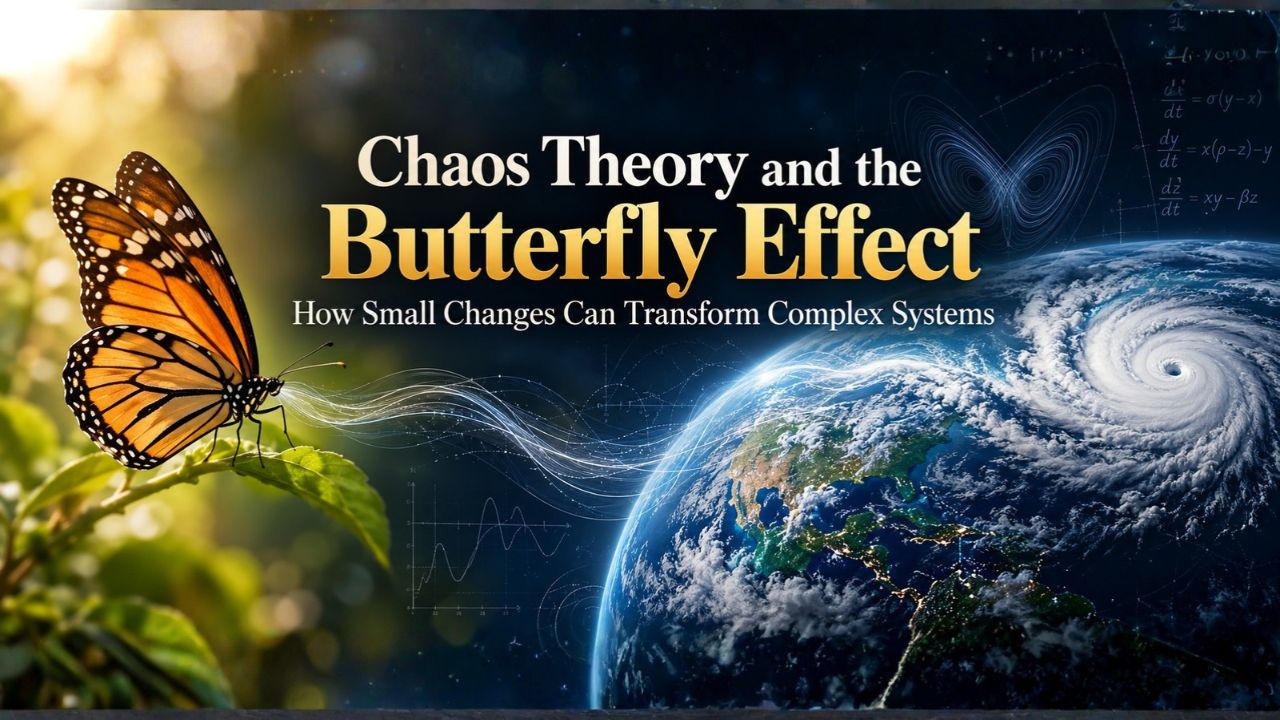
Chaos Theory and the Butterfly Effect: How Small Changes Can Transform Complex Systems

Have you ever wondered how a tiny change in the weather, a small decision, or a slight movement can lead to a completely different outcome? Mathematics offers a fascinating explanation through Chaos Theory and the Butterfly Effect — concepts that reveal how small changes can influence complex systems in surprising ways.

What Is Chaos Theory?

Chaos Theory is a branch of mathematics that studies systems that are highly sensitive to their initial conditions. These systems may follow precise mathematical rules, yet their long-term behaviour can be extremely difficult to predict.

Examples include weather patterns, ocean currents, population growth, and the movement of planets under certain conditions.

The interesting part is that chaotic systems are not necessarily random. They can follow mathematical laws while producing outcomes that appear unpredictable.

Understanding the Butterfly Effect

The Butterfly Effect is one of the best-known ideas in Chaos Theory. It suggests that a very small difference in the starting conditions of a system can eventually lead to a significantly different outcome.

The concept became widely known through meteorologist and mathematician Edward Lorenz, who studied mathematical models of weather in the 1960s.

Lorenz discovered that even tiny differences in the initial values of his calculations could produce dramatically different weather predictions over time.

The butterfly is a metaphor for this sensitivity. It does not mean that one butterfly literally creates a hurricane, but that small disturbances can influence complex systems in ways that are difficult to predict.

How Does Mathematics Explain Chaos?

A famous mathematical model associated with Chaos Theory is the Lorenz system, which uses three differential equations to describe simplified atmospheric motion.

Its behaviour demonstrates how two systems starting with nearly identical conditions can gradually follow very different paths.

In mathematical terms, this is called sensitive dependence on initial conditions. Even when the governing equations remain unchanged, small differences in starting values can grow over time.

This is why weather forecasts become less reliable the further into the future they attempt to predict.

Where Do We See the Butterfly Effect in Real Life?

  • Weather forecasting: Tiny differences in temperature, pressure, and wind can influence future weather patterns.

  • Nature and ecosystems: A small change in one species’ population can affect food chains and the balance of an entire ecosystem.

  • Human decisions: A seemingly minor choice can lead to unexpected opportunities or different life outcomes.

  • Technology and traffic: Small disruptions in traffic flow can sometimes develop into major congestion across a road network.

These examples show how interconnected systems can amplify small changes, although not every small event produces a major consequence.

Why Is Chaos Theory Important?

Chaos Theory helps mathematicians and scientists understand the limits of prediction. It encourages researchers to study how systems behave, how sensitive they are to changing conditions, and which outcomes may be difficult to forecast.

Rather than assuming that every complex system can be predicted perfectly, Chaos Theory teaches us to recognise uncertainty and the importance of initial conditions.

Conclusion

The Butterfly Effect reveals a remarkable truth about mathematics: small changes can sometimes lead to enormous consequences. From weather systems to ecosystems, Chaos Theory helps explain why complex systems can behave in unexpected ways, even when they follow mathematical rules.

Continue exploring fascinating mathematical ideas with more articles on International Maths Challenge.

Can Artificial Intelligence Discover New Mathematical Theorems?

Mathematics has always been about discovering patterns, solving problems, and proving ideas through logical reasoning. Today, Artificial Intelligence (AI) is helping mathematicians explore complex problems in new ways. But can AI actually discover new mathematical theorems?

Yes! AI can help discover new mathematical results, identify hidden patterns, and develop proofs. However, every proposed theorem must be supported by rigorous mathematical reasoning.

How Does AI Discover Mathematical Theorems?

AI contributes to mathematical research in three important ways:

  • Finding patterns: AI analyses mathematical data to identify relationships that may lead to new discoveries.

  • Generating conjectures: It proposes mathematical statements that researchers can investigate and attempt to prove.

  • Verifying proofs: Specialised AI systems can check logical steps to determine whether a mathematical argument is valid.

For example, AI might discover a pattern across thousands of number sequences. Mathematicians can then investigate whether the pattern holds universally and develop a proof.

Real Examples of AI in Mathematics

AI has already demonstrated its potential in mathematical research.

FunSearch: Introduced in 2023, this AI system discovered improved solutions to problems in combinatorics, including the cap set problem.

AlphaGeometry: Developed by Google DeepMind, this system solved challenging geometry problems by combining AI with symbolic reasoning.

AlphaProof: This system uses reinforcement learning and formal mathematical tools to search for rigorous proofs of difficult problems.

These achievements show that AI can do more than calculate answers: it can contribute to mathematical discoveries and proof development.

Can AI Replace Human Mathematicians?

Not entirely. AI can make mistakes, produce incorrect reasoning, or identify patterns without explaining why they work. Human mathematicians remain essential for interpreting results, developing new ideas, and checking the validity of proofs.

The strongest approach is collaboration: AI explores possibilities, while mathematical reasoning and verification establish what is true.

Conclusion

Artificial intelligence is opening new possibilities in mathematics. By identifying hidden patterns, generating conjectures, and helping verify proofs, AI is becoming a valuable research partner. Although it cannot replace the creativity and critical thinking of mathematicians, it may help uncover discoveries that were once extremely difficult to find.

Continue exploring more fascinating articles on International Maths Challenge.

The Mystery of Prime Numbers: Why Mathematicians Still Cannot Predict Them Perfectly

Prime numbers are among the most fascinating discoveries in mathematics. They are whole numbers greater than 1 that can be divided evenly only by 1 and themselves.

Examples include 2, 3, 5, 7, 11, 13, 17, 19 and 23.

Although their definition is simple, their arrangement along the number line is surprisingly difficult to predict. Mathematicians can identify prime numbers and estimate how frequently they occur, but their exact distribution continues to raise challenging questions.

1. Why Are Prime Numbers Difficult to Predict?

The gaps between consecutive prime numbers keep changing.

For example, the gap between 3 and 5 is 2, while the gap between 7 and 11 is 4. Sometimes primes occur close together, as with 29 and 31. These pairs are called twin primes.

There is no simple, repeating pattern that tells us exactly where every next prime will appear. However, prime numbers are not completely random; they follow mathematical rules that researchers continue to investigate.

2. How Do Mathematicians Find Prime Numbers?

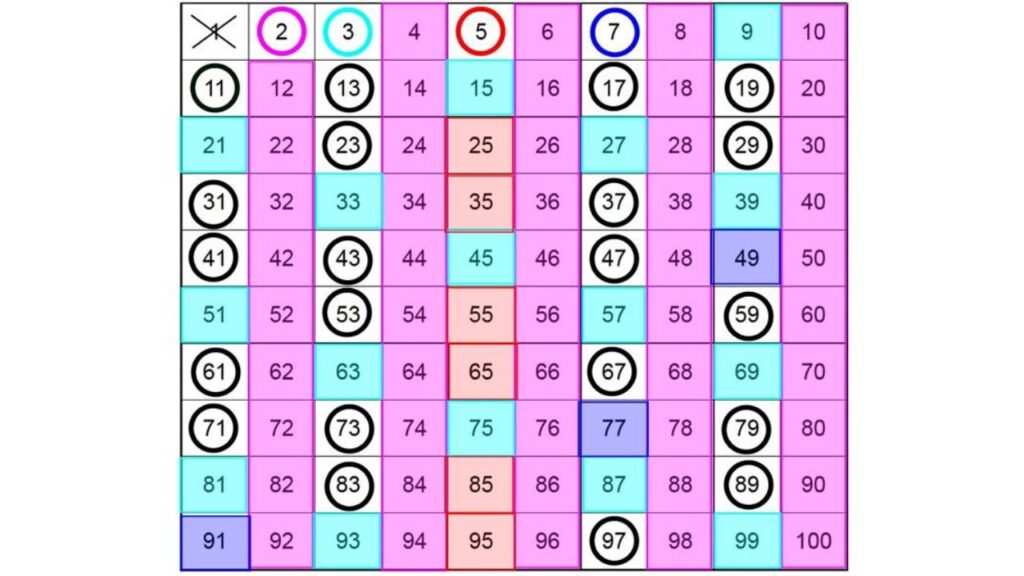
One famous method is the Sieve of Eratosthenes. It works by listing whole numbers and removing multiples of smaller primes. The numbers that remain are prime.

For checking an individual number, mathematicians can also test whether it is divisible by prime numbers up to its square root.

These methods help identify primes efficiently, even though understanding every detail of their distribution is a much bigger challenge.

3. The Prime Number Theorem: Finding a Pattern in the Mystery

As numbers become larger, prime numbers generally become less frequent, but they never end.

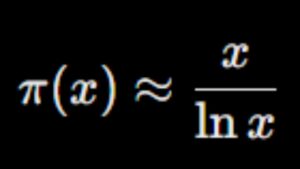
The Prime Number Theorem estimates the number of primes up to a large number \(x\) using the formula:

This formula describes the overall distribution of primes, rather than predicting the exact position of each one.

Another major mystery is the Riemann Hypothesis, an unsolved mathematical problem that could significantly improve our understanding of how primes are distributed.

4. Why Do Prime Numbers Matter Today?

Prime numbers have practical applications beyond theoretical mathematics.

  • Cybersecurity: Properties of large prime numbers help support widely used encryption systems such as RSA.

  • Computer science: Prime numbers are useful in hashing, modular arithmetic, and algorithm design.

  • Mathematical research: Their properties help researchers explore deeper connections between numbers.

Conclusion: A Mystery Still Waiting to Be Solved

Mathematicians have developed powerful ways to find prime numbers and understand their overall distribution. Yet, important questions about their exact patterns remain unanswered.

The mystery of prime numbers shows that even the simplest mathematical ideas can lead to extraordinary discoveries.

Continue with more articles on International Maths Challenge.

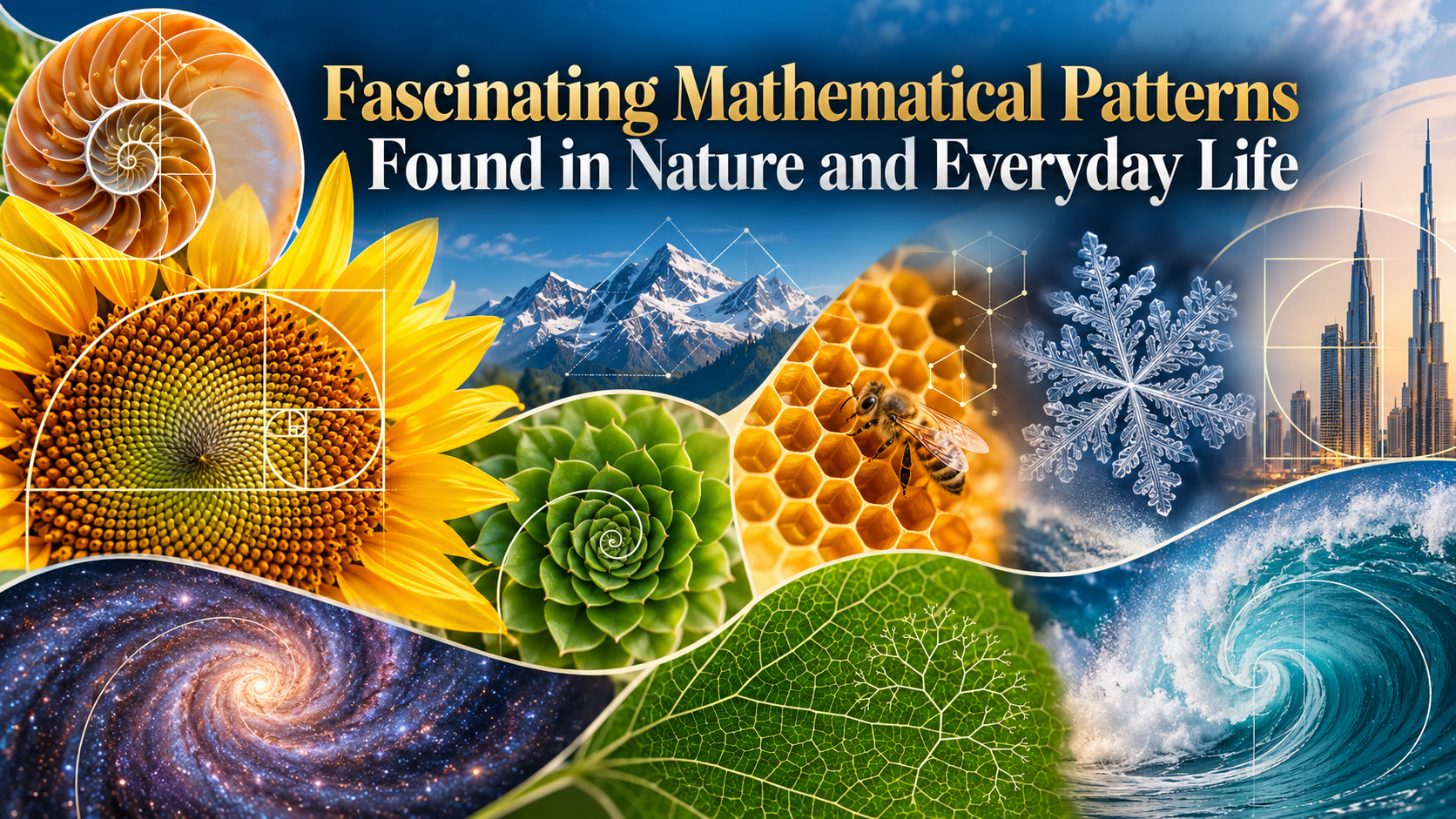
Fascinating Mathematical Patterns Found in Nature and Everyday Life

Mathematics is everywhere around us—not just in textbooks, equations, and classrooms. From the spirals of a sunflower to the symmetrical patterns of snowflakes, nature is filled with fascinating mathematical designs.

Have you ever wondered why honeycombs are made of hexagons or why tree branches form repeating patterns? These natural wonders reveal how mathematics helps us understand the world around us.

Let’s explore some incredible mathematical patterns found in nature and everyday life.

1. Fibonacci Sequence: The Secret Behind Natural Spirals

The Fibonacci sequence is a series of numbers in which each number is the sum of the two preceding numbers.
Example: 0, 1, 1, 2, 3, 5, 8, 13, 21, 34…
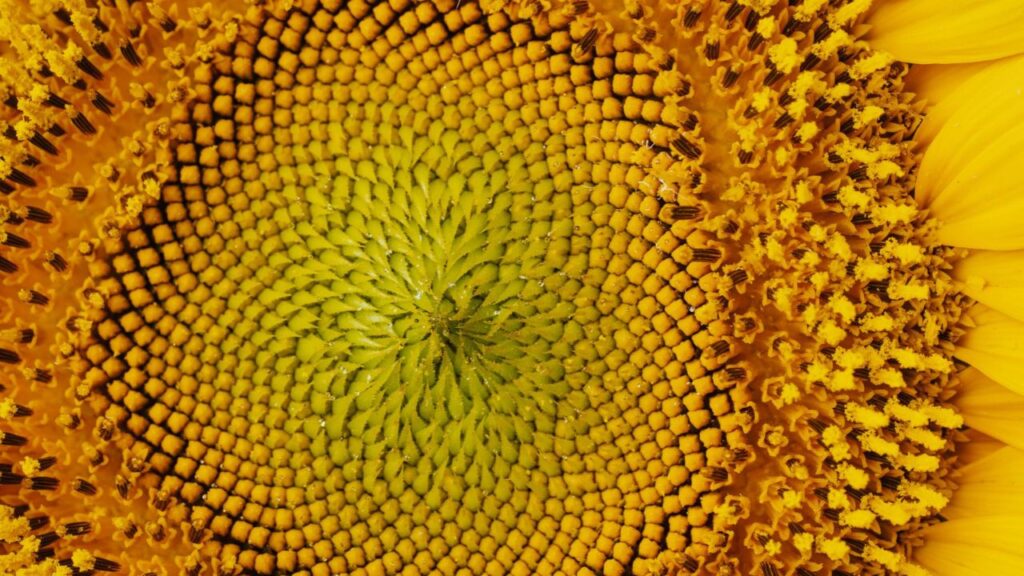
This sequence frequently appears in the arrangement of sunflower seeds, pinecones, and certain plants. These patterns help researchers understand how plants organise their growing structures.
The Fibonacci sequence is also connected to the golden ratio, approximately 1.618, which appears in some mathematical models of natural growth.

2. Fractals: Patterns That Repeat Themselves

Fractals are patterns that show similar structures at different scales. Look at a tree: its trunk divides into branches, which divide into smaller branches and twigs.

Similar patterns can be found in ferns, Romanesco broccoli, coastlines, and clouds.

Fractal geometry helps scientists describe complex structures that cannot easily be represented by simple circles, squares, or triangles.

3. Honeycombs: Why Do Bees Use Hexagons?

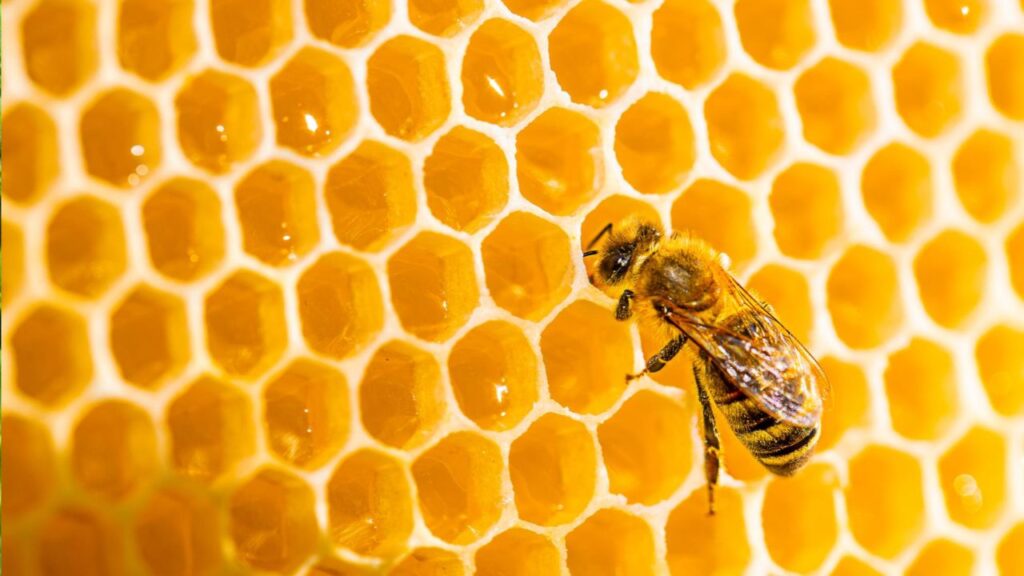
Honeycombs are made of repeating hexagonal cells. But why hexagons?

Regular hexagons fit together without gaps and can enclose a given area with relatively little boundary length compared with regular triangles and squares.

This makes hexagonal structures an efficient way to build connected cells. The pattern is a remarkable example of geometry appearing in the natural world.

Hexagons also appear in materials such as graphene and in certain geological formations.

4. Symmetry in Snowflakes and Flowers

Symmetry occurs when a shape remains unchanged under a transformation, such as reflection or rotation.

Snowflakes typically exhibit sixfold symmetry because of the molecular structure of ice. Many flowers display radial symmetry, while butterflies often show approximate reflection symmetry.

Symmetry is also important in architecture, art, and design, where it helps create balanced and repeating visual patterns.

5. Spirals in Seashells and Galaxies

Spirals can be found in seashells, hurricanes, and spiral galaxies. One mathematical model used to describe certain spirals is the logarithmic spiral, in which the distance from the centre increases as the curve turns.

Different natural spirals form through different processes, including biological growth, atmospheric motion, and gravitational effects.

Studying these shapes helps mathematicians and scientists understand how complex structures develop.

6. Mathematics in Everyday Life

Mathematical patterns are not limited to nature. They are part of our daily routines, too.

  • Architecture: Triangles provide rigidity in many structural frameworks.

  • Music: Rhythm uses fractions, timing, and repeating sequences.

  • Road networks: Graph theory helps analyse routes and connections.

  • Tile designs: Tessellations cover surfaces using repeating shapes without gaps.

  • Games of chance: Probability helps us understand the likelihood of different outcomes.

These examples show that mathematics is a practical tool for solving problems and understanding everyday experiences.

Conclusion

Mathematics connects the natural world with human creativity and scientific discovery. From the spirals of plants to the geometry of buildings, these patterns demonstrate how simple mathematical principles can explain surprisingly complex structures.

The next time you observe a flower, a snowflake, or a geometric design, look closely—you might discover mathematics hiding in plain sight.

Continue with more articles on International Maths Challenge.