Prime numbers are among the most fascinating discoveries in mathematics. They are whole numbers greater than 1 that can be divided evenly only by 1 and themselves.
Examples include 2, 3, 5, 7, 11, 13, 17, 19 and 23.
Although their definition is simple, their arrangement along the number line is surprisingly difficult to predict. Mathematicians can identify prime numbers and estimate how frequently they occur, but their exact distribution continues to raise challenging questions.
1. Why Are Prime Numbers Difficult to Predict?
The gaps between consecutive prime numbers keep changing.
For example, the gap between 3 and 5 is 2, while the gap between 7 and 11 is 4. Sometimes primes occur close together, as with 29 and 31. These pairs are called twin primes.
There is no simple, repeating pattern that tells us exactly where every next prime will appear. However, prime numbers are not completely random; they follow mathematical rules that researchers continue to investigate.
2. How Do Mathematicians Find Prime Numbers?
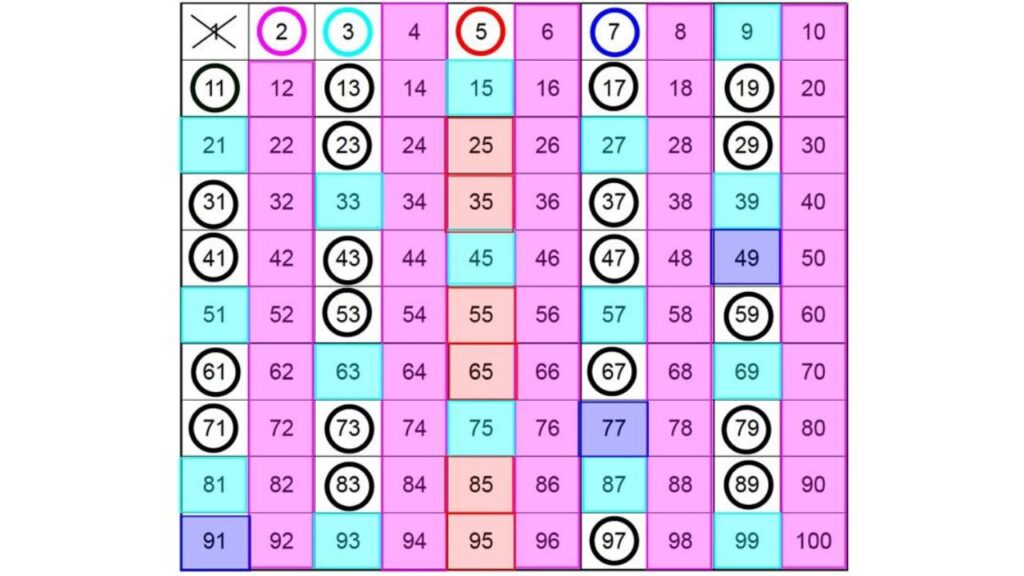
One famous method is the Sieve of Eratosthenes. It works by listing whole numbers and removing multiples of smaller primes. The numbers that remain are prime.
For checking an individual number, mathematicians can also test whether it is divisible by prime numbers up to its square root.
These methods help identify primes efficiently, even though understanding every detail of their distribution is a much bigger challenge.
3. The Prime Number Theorem: Finding a Pattern in the Mystery
As numbers become larger, prime numbers generally become less frequent, but they never end.
The Prime Number Theorem estimates the number of primes up to a large number \(x\) using the formula:
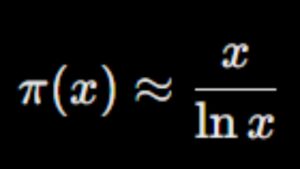
This formula describes the overall distribution of primes, rather than predicting the exact position of each one.
Another major mystery is the Riemann Hypothesis, an unsolved mathematical problem that could significantly improve our understanding of how primes are distributed.
4. Why Do Prime Numbers Matter Today?

Prime numbers have practical applications beyond theoretical mathematics.
-
Cybersecurity: Properties of large prime numbers help support widely used encryption systems such as RSA.
-
Computer science: Prime numbers are useful in hashing, modular arithmetic, and algorithm design.
-
Mathematical research: Their properties help researchers explore deeper connections between numbers.
Conclusion: A Mystery Still Waiting to Be Solved
Mathematicians have developed powerful ways to find prime numbers and understand their overall distribution. Yet, important questions about their exact patterns remain unanswered.
The mystery of prime numbers shows that even the simplest mathematical ideas can lead to extraordinary discoveries.
Continue with more articles on International Maths Challenge.