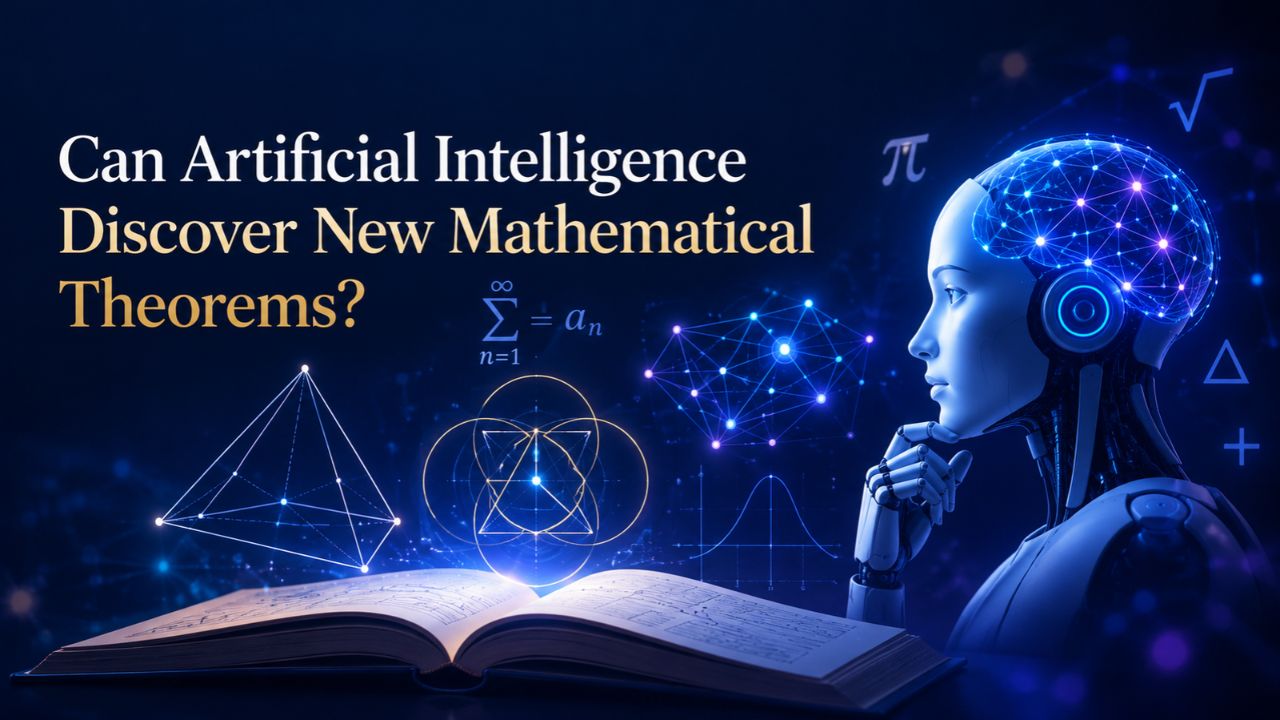
Mathematics has always been about discovering patterns, solving problems, and proving ideas through logical reasoning. Today, Artificial Intelligence (AI) is helping mathematicians explore complex problems in new ways. But can AI actually discover new mathematical theorems?
Yes! AI can help discover new mathematical results, identify hidden patterns, and develop proofs. However, every proposed theorem must be supported by rigorous mathematical reasoning.
How Does AI Discover Mathematical Theorems?
AI contributes to mathematical research in three important ways:
-
Finding patterns: AI analyses mathematical data to identify relationships that may lead to new discoveries.
-
Generating conjectures: It proposes mathematical statements that researchers can investigate and attempt to prove.
-
Verifying proofs: Specialised AI systems can check logical steps to determine whether a mathematical argument is valid.
For example, AI might discover a pattern across thousands of number sequences. Mathematicians can then investigate whether the pattern holds universally and develop a proof.
Real Examples of AI in Mathematics

AI has already demonstrated its potential in mathematical research.
FunSearch: Introduced in 2023, this AI system discovered improved solutions to problems in combinatorics, including the cap set problem.
AlphaGeometry: Developed by Google DeepMind, this system solved challenging geometry problems by combining AI with symbolic reasoning.
AlphaProof: This system uses reinforcement learning and formal mathematical tools to search for rigorous proofs of difficult problems.
These achievements show that AI can do more than calculate answers: it can contribute to mathematical discoveries and proof development.
Can AI Replace Human Mathematicians?
Not entirely. AI can make mistakes, produce incorrect reasoning, or identify patterns without explaining why they work. Human mathematicians remain essential for interpreting results, developing new ideas, and checking the validity of proofs.
The strongest approach is collaboration: AI explores possibilities, while mathematical reasoning and verification establish what is true.
Conclusion
Artificial intelligence is opening new possibilities in mathematics. By identifying hidden patterns, generating conjectures, and helping verify proofs, AI is becoming a valuable research partner. Although it cannot replace the creativity and critical thinking of mathematicians, it may help uncover discoveries that were once extremely difficult to find.
Continue exploring more fascinating articles on International Maths Challenge.