In May 2026, OpenAI made an announcement that sent ripples through the global mathematics community. A generative AI model had produced a refutation of the unit distance problem, an 80-year-old conjecture by the legendary mathematician Paul Erdős in combinatorial geometry. For some it was a moment of wonder. For others it was a warning. And for a group of mathematicians who had spent the previous nine months drafting a document in careful, measured language, it was confirmation that the moment they had been preparing for had arrived.
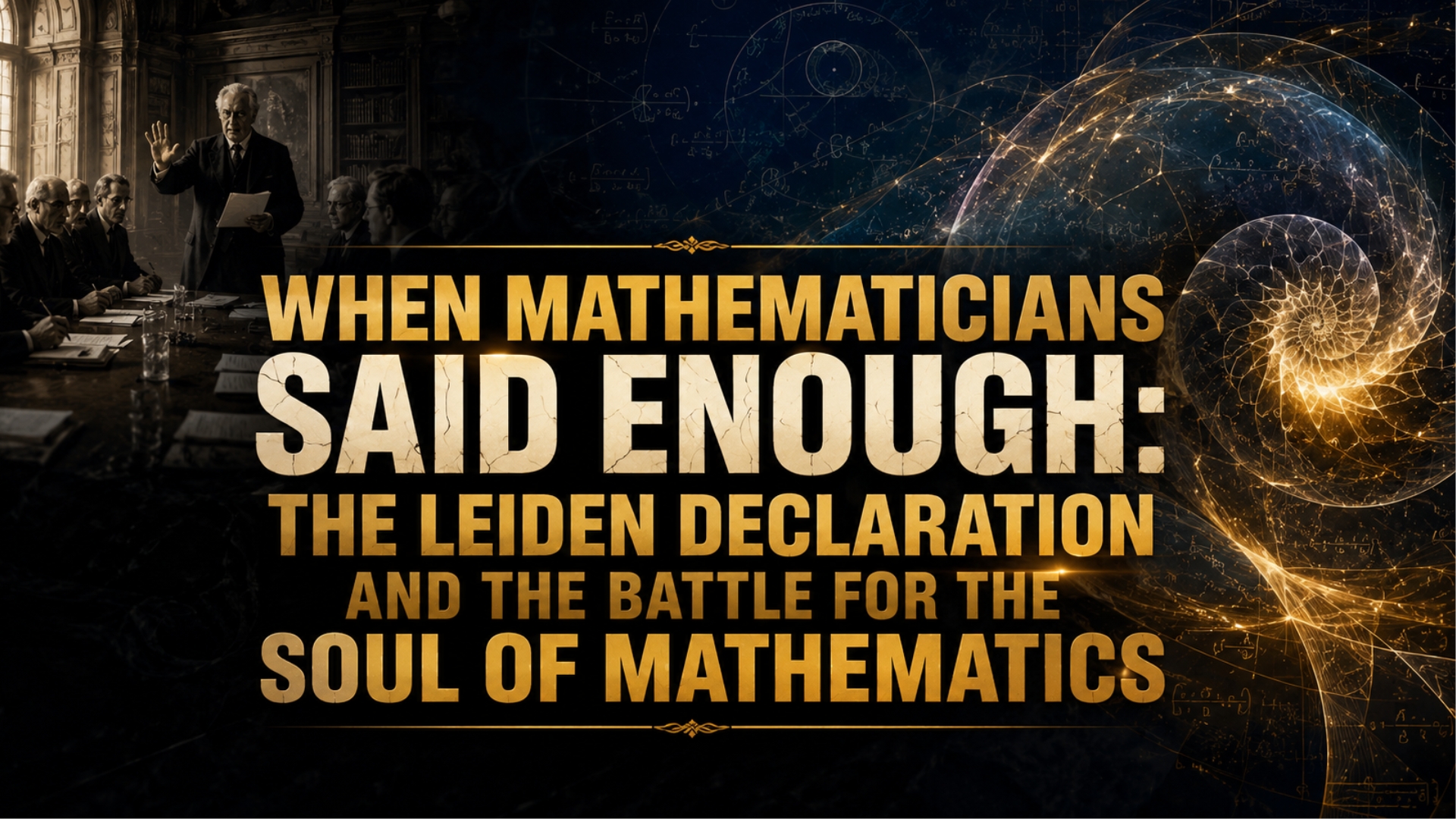
On 2 June 2026, the Leiden Declaration on Artificial Intelligence and Mathematics went public. Within 24 hours, more than 1,000 people had signed it. The International Mathematical Union announced its endorsement and published a thoughtful editorial on the declaration. An editorial in Nature also endorsed both the process and its conclusions. What had begun as a workshop conversation had become one of the most significant statements the mathematics community has made in a generation.
Where It Began
The declaration originated at a September 2025 workshop at the Lorentz Center at Leiden University, where sixty researchers and policymakers gathered to consider the effect of technology on mathematics, given the increase in proofs being written in part or whole by AI.
The Lorentz Center, named after the Dutch physicist Hendrik Lorentz, is known for convening focused workshops at the frontier of science. This one brought together mathematicians, computer scientists, philosophers and historians — people with very different relationships to artificial intelligence and very different views on what it means for their field. What emerged from those conversations was not a ban, not a manifesto against technology, but something more nuanced and ultimately more powerful: a shared articulation of values.
The declaration was issued by 16 researchers from 15 universities and is endorsed by the International Mathematical Union. By the time of publication it had drawn more than 130 signatories. That number would grow dramatically in the days that followed.
What the Declaration Actually Says
It is important to be clear about what the Leiden Declaration is and is not. The declaration does not call for an outright ban on AI in mathematics. It is not a Luddite document. It does not say that artificial intelligence has no place in mathematical research. What it does is something more sophisticated and more lasting — it articulates the values that mathematics depends on and asks the community, funders, journals, institutions and technology companies to take those values seriously in an age when they are under genuine threat.
The declaration defends five core commitments: proof, attribution, shared standards of evaluation, and the autonomy of the field — and warns that current AI use threatens each.
Its core concerns are the reliability of automatically generated results, attribution of work that uses proprietary models, and effects on publication and peer review. It sets out recommendations for individual researchers, professional bodies, funders and policymakers, including disclosing AI use and preserving rigorous review.
The Problem of the Unreliable Proof
At the heart of the declaration is a concern about mathematical proof itself — the thing that makes mathematics different from every other discipline. In science you run experiments and look at evidence. In mathematics you prove things. A proof is not a very good argument or a highly convincing demonstration. It is a logically airtight chain of reasoning that shows something must be true. Once something is proved it is proved forever. The permanence of mathematical truth is one of the most remarkable features of the discipline.
AI threatens this in a specific way. As Leslie Ann Goldberg, head of computer science at the University of Oxford, put it: “Inaccurate AI-generated drafts are cheap to produce, and there is a risk of cluttering the literature with claimed results that are simply wrong.”
The danger is not that AI will produce proofs that are obviously wrong — those would be caught. The danger is that AI will produce proofs that look right, that pass superficial review, that get published, that get cited, and that turn out on careful inspection to be subtly flawed. Mathematics builds on itself. A wrong result that enters the literature does not just mislead — it can corrupt entire branches of subsequent work that rely on it as a foundation.
What currently makes mathematics attractive for general-purpose AI development is that the correctness of formalized proofs can be checked automatically, without the need for human oversight. This makes it possible to generate and check vast numbers of problems to produce an effectively unlimited source of feedback for training AI models. But automated checking of formal proofs is not the same as human mathematical understanding. A proof can be formally verified and still be mathematically meaningless or deeply misleading.
The Problem of Attribution
The second major concern is attribution — the system by which mathematics gives credit for ideas. In most fields credit goes to the person who publishes a result first. In mathematics credit goes deeper than that. It goes to the person who had the idea, who found the connection, who saw what no one else had seen. The history of mathematics is a history of ideas, and that history depends on knowing who had which idea and when.
When OpenAI announced its resolution of the unit distance problem, some mathematicians were amazed while others expressed concern. One noted that OpenAI had not appropriately cited a history of closely related ideas in the literature. This is not a minor complaint. When a proprietary AI model produces a mathematical result by processing vast quantities of human mathematical work, who gets the credit? The mathematicians whose ideas trained the model? The engineers who built it? The company that owns it?
The declaration insists that mathematical attribution must remain tied to human intellectual effort, and that the use of AI tools must be disclosed so that readers can assess what kind of intellectual contribution is actually being claimed.
The Problem of Commercial Capture
Perhaps the most striking part of the declaration is its willingness to name something that makes many in the academic world uncomfortable: the growing power of technology companies over the direction of mathematical research.
The declaration warns that some of the general-purpose AI models being developed using mathematical theorem proving are being commercialised for applications that raise grave ethical concerns, including warfare, oppression, mass surveillance and the undermining of democracy.
The declaration asks whether the direction of mathematical research will be dictated by the commercial goals of AI labs rather than by mathematicians themselves. This is a profound question. Mathematics has always been driven by curiosity — by mathematicians following problems that interest them, regardless of whether those problems have immediate practical applications. Some of the most important mathematics in history was done for its own sake, centuries before anyone found a use for it. The worry is that when commercial AI labs set the agenda — training on problems that are useful for their systems, publishing results that serve their interests — the long-term independence and health of mathematics as a discipline is at risk.
What the Declaration Asks For
The declaration calls on mathematicians to be clear about how tools are used, and to remain responsible for correctness. It calls on journals and funders to develop policies that are usable, not just symbolic. It calls on governments to protect the rights of human authors and to take seriously the regulation of an AI industry whose systems may be used far beyond mathematics. And it calls on technology companies to recognise that mathematical results and proof tasks should not be treated simply as evidence for the broader reasoning capacities of commercial AI systems.
It encourages mathematicians to take their role in the public debate, to stay informed about the emerging technologies, to carefully consider which tools to use, to evaluate the ethical consequences of their activities and if necessary to withdraw from harmful work.
Why This Matters Beyond Mathematics
The Leiden Declaration is a document about mathematics. But its implications reach far beyond equations and proofs. Every discipline that depends on verified knowledge — medicine, law, engineering, climate science — faces versions of the same challenge. What happens when AI generates results that look authoritative but may be wrong? What happens when credit for ideas becomes untraceable? What happens when the agenda of research is set by commercial interests rather than by the communities of scholars who have developed the knowledge in the first place?
Mathematics is confronting these questions first and most sharply because AI has made such rapid and visible progress in mathematical reasoning. But the questions themselves belong to everyone.
The declaration is not a regulation. It is a voluntary code that individuals can sign and that professional bodies are invited to endorse and adapt. Its force is reputational and normative rather than legal — but that is exactly how many enforceable standards begin.
A Word for Young Mathematicians
For students encountering mathematics through competitions, classroom problems or personal curiosity, the Leiden Declaration carries a particular message worth hearing. The reason mathematics matters — the reason it has mattered for thousands of years — is that it is true. Not approximately true, not probably true, not true according to our best current model. True. A proved theorem is proved. That permanence is precious, and it is fragile in ways that are easy to underestimate.
AI can be a powerful tool for mathematical exploration. It can suggest directions, check calculations, find patterns and inspire new questions. But the declaration reminds us that the understanding — the genuine human insight into why something is true — is not replaceable. It is the whole point.