
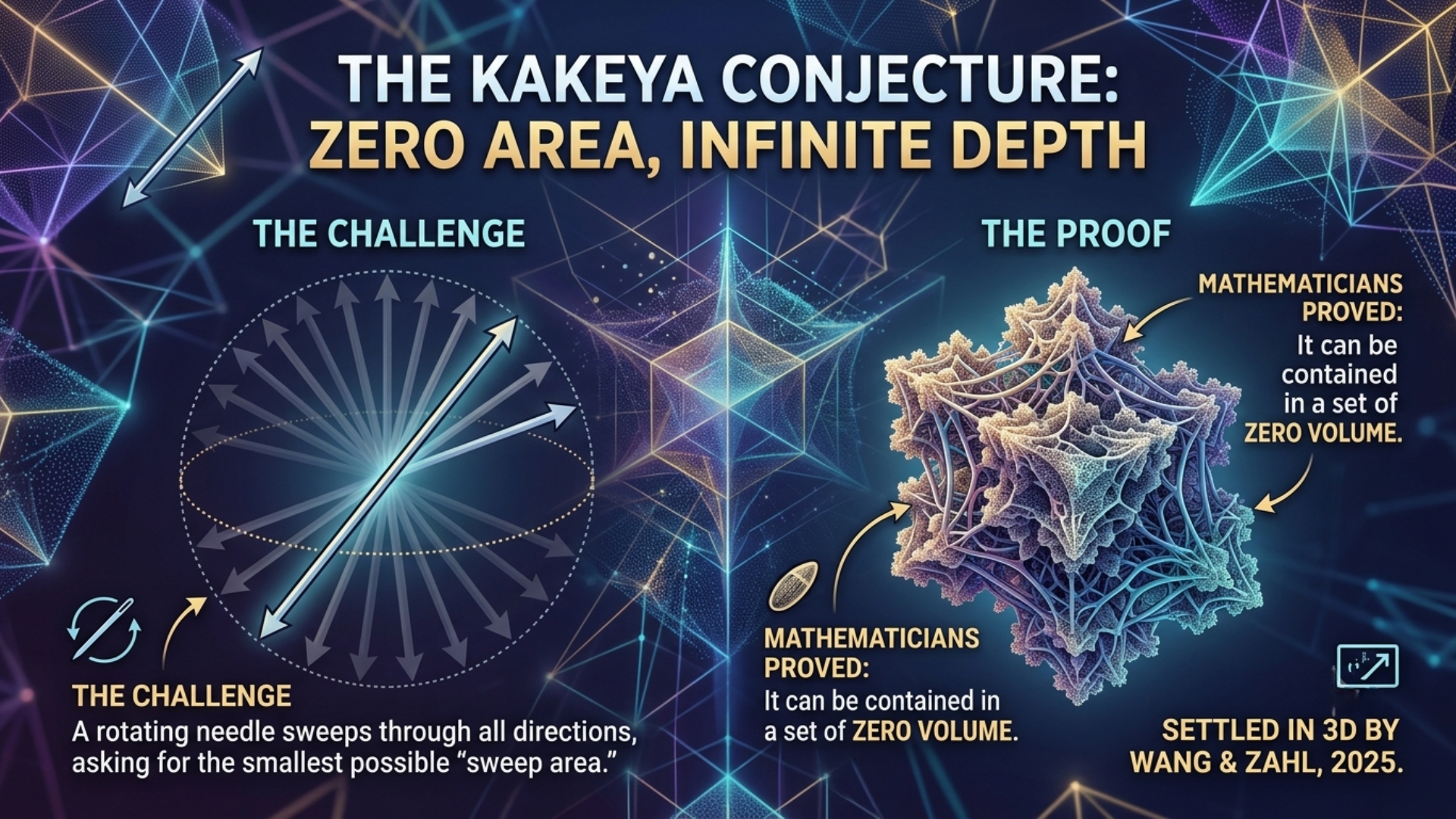
How mathematicians proved that a needle rotated through every direction in 3D space can do so in a set of zero volume.
A rotating needle sweeps through all directions — the Kakeya set question asks for the smallest possible “sweep area.” Settled in 3D by Wang & Zahl, 2025.
Imagine a needle — a thin line segment of length one — lying flat on a table. You want to rotate it through every possible direction in the plane, completing a full 360-degree turn. The region swept out by the needle must have some area. But how small can that area be? Intuitively, you might think it must be at least something reasonably large. Remarkably, in two dimensions, mathematicians proved in the 1920s that you can rotate a needle through every direction in a region of arbitrarily small area. These minimal regions are called Kakeya sets.
The Kakeya conjecture asks a harder question in higher dimensions: in n-dimensional space, what is the fractal dimension of a Kakeya set — a set that contains a unit line segment in every possible direction? In two dimensions, the answer is known: 2. The three-dimensional case, however, resisted proof for nearly a century. Until 2025.
Wang and Zahl settle 3D Kakeya
In early 2025, Hong Wang (New York University) and Joshua Zahl (University of British Columbia) published a proof of the three-dimensional Kakeya conjecture. Their result establishes that a Kakeya set in three-dimensional space must have Hausdorff dimension 3 — that is, it must be “full-dimensional” even if it has zero volume. The proof runs to over 100 pages and draws on sophisticated techniques from harmonic analysis and additive combinatorics.
“The three-dimensional Kakeya problem sat unsolved for nearly a century, and its resolution is one of the landmark achievements of 2025.” — Quanta Magazine
Beyond the abstract
The Kakeya problem might sound purely theoretical, but it has deep connections to some of the most important unsolved problems in mathematics, including the Riemann Hypothesis and the behaviour of the Fourier transform in higher dimensions. Progress on Kakeya-type problems has historically driven breakthroughs in signal processing and the mathematics of waves — areas that underpin everything from medical imaging to wireless communication. Wang and Zahl’s result is not merely an isolated geometric curiosity; it opens new avenues of attack on problems that have blocked progress in analysis for decades.
Sources & Further Reading
Wang, H. & Zahl, J. (2025). Three-dimensional Kakeya conjecture: proof. Annals of Mathematics (preprint).
Quanta Magazine (2025). The Biggest Breakthroughs in Mathematics: 2025. quantamagazine.org
Scientific American (2025). The Top 10 Math Discoveries of 2025. scientificamerican.com
Medium (2025). Mathematics in 2025: Breakthroughs That Redefined the Field. medium.com