
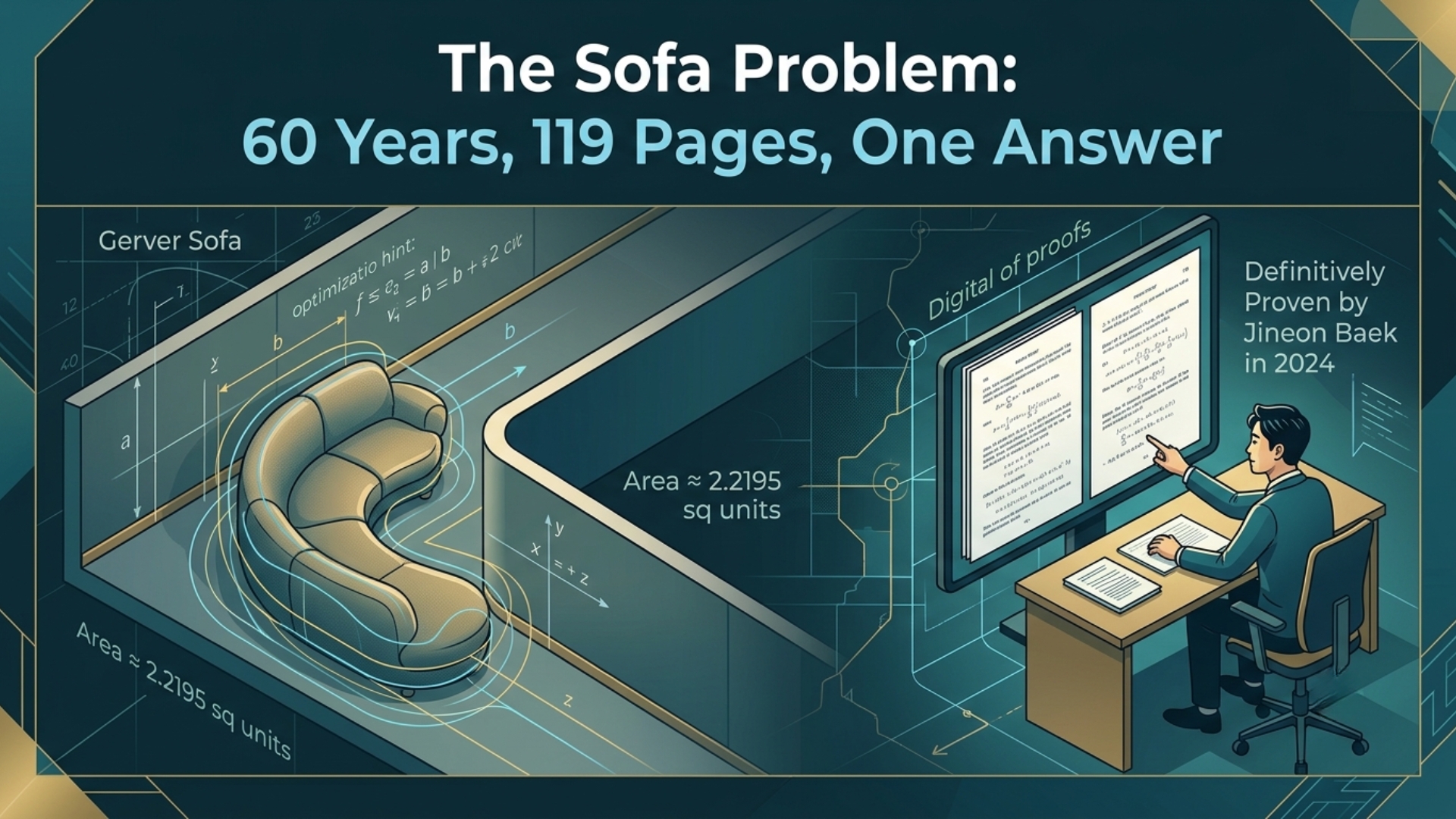
How a Korean mathematician solved the problem of moving furniture around a corner — a question that stumped the world since 1966.
The optimal “Gerver sofa” shape, with area 2.2195 square units — proven definitively by Jineon Baek in 2024 (arXiv:2411.19826)
Anyone who has ever wrestled a sofa around a tight corner knows the frustration. Mathematicians, it turns out, have been equally frustrated by the theoretical version of this problem since 1966, when Canadian mathematician Leo Moser posed it formally: what is the largest two-dimensional shape that can be manoeuvred around a right-angled corner in a hallway of unit width?
The question is deceptively simple. A plain square can make it around the corner, as can a semicircle. But what is the absolute maximum area any shape could have while still fitting through? For nearly six decades, mathematicians circled this problem (sometimes literally), proposing shapes and proving partial results, but never settling on a definitive answer.
Gerver’s candidate — and the missing proof
In 1992, mathematician Joseph Gerver proposed a beautiful, 18-curve shape that looked somewhat like the handset of a landline telephone. It had an area of approximately 2.2195 square units — an improvement on all previous candidates. But Gerver could not prove that nothing larger was possible. His shape sat as the best known answer for more than three decades: a champion with no certificate of victory.
“You keep holding on to hope, then breaking it, and moving forward by picking up ideas from the ashes.” — Jineon Baek
Baek’s 119-page proof
In late November 2024, Jineon Baek — a postdoctoral researcher at Yonsei University in Seoul — posted a 119-page paper to the preprint server arXiv that claimed to settle the matter. After seven years of work, Baek proved that no shape with an area larger than Gerver’s sofa can exist. The maximum sofa constant is 2.2195 square units, and that is final.
What is especially striking about Baek’s proof is that it relies entirely on logical reasoning — no large-scale computer simulations, no numerical approximations. Scientific American called it “surprising” that the final solution avoids computers altogether. The proof has been submitted to the prestigious Annals of Mathematics and is under peer review; early responses from leading geometers have been optimistic.
The moving sofa problem has a cultural footprint as well. The US sitcom Friends features a famous scene in which characters struggle to manoeuvre a sofa up a staircase while Ross Geller shouts “Pivot!” Scientific American noted, tongue in cheek, that “explaining the pivot required a 119-page paper.”
Sources & Further Reading
Baek, J. (2024). Optimality of Gerver’s Sofa. arXiv:2411.19826. arxiv.org
Scientific American (2025). Mathematicians Solve Infamous Moving Sofa Problem. scientificamerican.com
Phys.org (2024). Mathematician solves the moving sofa problem. phys.org
Korea Herald (2026). Six-decade math puzzle solved by Korean mathematician. koreaherald.com
Quanta Magazine (2025). The Largest Sofa You Can Move Around a Corner. quantamagazine.org