Team develops a solution for temporal asymmetry

Life, from the perspective of thermodynamics, is a system out of equilibrium, resisting tendencies towards increasing their levels of disorder. In such a state, the dynamics are irreversible over time. This link between the tendency toward disorder and irreversibility is expressed as the ‘arrow of time’ by the English physicist Arthur Eddington in 1927.

Now, an international team including researchers from Kyoto University, Hokkaido University, and the Basque Center for Applied Mathematics, has developed a solution for temporal asymmetry, furthering our understanding of the behaviour of biological systems, machine learning, and AI tools.

“The study offers, for the first time, an exact mathematical solution of the temporal asymmetry—also known as entropy production—of nonequilibrium disordered Ising networks,” says co-author Miguel Aguilera of the Basque Center for Applied Mathematics.

The researchers focused on a prototype of large-scale complex networks called the Ising model, a tool used to study recurrently connected neurons. When connections between neurons are symmetric, the Ising model is in a state of equilibrium and presents complex disordered states called spin glasses. The mathematical solution of this state led to the award of the 2021 Nobel Prize in physics to Giorgio Parisi.

Unlike in living systems, however, spin crystals are in equilibrium and their dynamics are time reversible. The researchers instead worked on the time-irreversible Ising dynamics caused by asymmetric connections between neurons.

The exact solutions obtained serve as benchmarks for developing approximate methods for learning artificial neural networks. The development of learning methods used in multiple phases may advance machine learning studies.

“The Ising model underpins recent advances in deep learning and generative artificial neural networks. So, understanding its behaviour offers critical insights into both biological and artificial intelligence in general,” added Hideaki Shimazaki at KyotoU’s Graduate School of Informatics.

“Our findings are the result of an exciting collaboration involving insights from physics, neuroscience and mathematical modeling,” remarked Aguilera. “The multidisciplinary approach has opened the door to novel ways to understand the organization of large-scale complex networks and perhaps decipher the thermodynamic arrow of time.”

For more such insights, log into our website https://international-maths-challenge.com

Credit of the article given to Kyoto University


Should All Mathematical Proofs Be Checked By A Computer?

Proofs, the central tenet of mathematics, occasionally have errors in them. Could computers stop this from happening, asks mathematician Emily Riehl.

Computer proof assistants can verify that mathematical proofs are correct

One miserable morning in 2017, in the third year of my tenure-track job as a mathematics professor, I woke up to a worrying email. It was from a colleague and he questioned the proof of a key theorem in a highly cited paper I had co-authored. “I had always kind of assumed that this was probably not true in general, though I have no proof either way. Did I miss something?” he asked. The proof, he noted, appeared to rest on a tacit assumption that was not warranted.

Much to my alarm and embarrassment, I realised immediately that my colleague was correct. After an anxious week working to get to the bottom of my mistake, it turned out I was very lucky. The theorem was true; it just needed a new proof, which my co-authors and I supplied in a follow-up paper. But if the theorem had been false, the whole edifice of consequences “proven” using it would have come crashing down.

The essence of mathematics is the concept of proof: a combination of assumed axioms and logical inferences that demonstrate the truth of a mathematical statement. Other mathematicians can then attempt to follow the argument for themselves to identify any holes or convince themselves that the statement is indeed true. Patched up in this way, theorems originally proven by the ancient Greeks about the infinitude of primes or the geometry of planar triangles remain true today – and anyone can see the arguments for why this must be.

Proofs have meant that mathematics has largely avoided the replication crises pervading other sciences, where the results of landmark studies have not held up when the experiments were conducted again. But as my experience shows, mistakes in the literature still occur. Ideally, a false claim, like the one I made, would be caught by the peer review process, where a submitted paper is sent to an expert to “referee”. In practice, however, the peer review process in mathematics is less than perfect – not just because experts can make mistakes themselves, but also because they often do not check every step in a proof.

This is not laziness: theorems at the frontiers of mathematics can be dauntingly technical, so much so that it can take years or even decades to confirm the validity of a proof. The mathematician Vladimir Voevodsky, who received a Fields medal, the discipline’s highest honour, noted that “a technical argument by a trusted author, which is hard to check and looks similar to arguments known to be correct, is hardly ever checked in detail”. After several experiences in which mistakes in his proofs took over a decade to be resolved – a long time for something to sit in logical limbo – Voevodsky’s subsequent crisis of confidence led him to take the unusual step of abandoning his “curiosity-driven research” to develop a computer program that could verify the correctness of his work.

This kind of computer program is known as a proof assistant, though it might be better called a “proof checker”. It can verify that a string of text proves the stated theorem. The proof assistant knows the methods of logical reasoning and is equipped with a library of proofs of standard results. It will accept a proof only after satisfying each step in the reasoning process, with no shortcuts of the sort that human experts often use.

For instance, a computer can verify that there are infinitely many prime numbers by validating the following proof, which is an adaptation of Greek mathematician Euclid’s argument. The human mathematician first tells the computer exactly what is being claimed – in this case that for any natural number N there is always some prime number p that is larger. The human then tells the computer the formula, defining p to be the minimum prime factor of the number formed by multiplying all the natural numbers up to N together and adding 1, represented as N! + 1.

For the computer proof assistant to make sense of this, it needs a library that contains definitions of the basic arithmetic operations. It also needs proofs of theorems, like the fundamental theorem of arithmetic, which tells us that every natural number can be factored uniquely into a product of primes. The proof assistant then demands a proof that this prime number p is greater than N. This is argued by contradiction – a technique where following an assumption to its conclusion leads to something that cannot possibly be true, demonstrating that the original assumption was false. In this case, if p is less than or equal to N, it should be a factor of both N! + 1 and N!. Some simple mathematics says this means that p must also be a factor of 1, which is absurd.

Computer proof assistants can be used to verify proofs that are so long that human referees are unable to check every step. In 1998, for example, Samuel Ferguson and Thomas Hales announced a proof of Johannes Kepler’s 1611 conjecture that the most efficient way to pack spheres into three-dimensional space is the familiar “cannonball” packing. When their result was accepted for publication in 2005 it came with a caveat: the journal’s reviewers attested to “a strong degree of conviction of the essential correctness of this proof approach” – they declined to certify that every step was correct.

Ferguson and Hales’s proof was based on a strategy proposed by László Fejes Tóth in 1953, which reduced the Kepler conjecture to an optimisation problem in a finite number of variables. Ferguson and Hales figured out how to subdivide this optimisation problem into a few thousand cases that could be solved by linear programming, which explains why human referees felt unable to vouch for the correctness of each calculation. In frustration, Hales launched a formalisation project, where a team of mathematicians and computer scientists meticulously verified every logical and computational step in the argument. The resulting 22-author paper was published in 2017 to as much fanfare as the original proof announcement.

Computer proof assistants can also be used to verify results in subfields that are so technical that only specialists understand the meaning of the central concepts. Fields medallist Peter Scholze spent a year working out the proof of a theorem that he wasn’t quite sure he believed and doubted anyone else would have the stamina to check. To be sure that his reasoning was correct before building further mathematics on a shaky foundation, Scholze posed a formalisation challenge in a SaiBlog post entitled the “liquid tensor experiment” in December 2020. The mathematics involved was so cutting edge that it took 60,000 lines of code to formalise the last five lines of the proof – and all the background results that those arguments relied upon – but nevertheless this project was completed and the proof confirmed this past July by a team led by Johan Commelin.

Could computers just write the proofs themselves, without involving any human mathematicians? At present, large language models like ChatGPT can fluently generate mathematical prose and even output it in LaTeX, a typesetting program for mathematical writing. However, the logic of these “proofs” tends to be nonsense. Researchers at Google and elsewhere are looking to pair large language models with automatically generated formalised proofs to guarantee the correctness of the mathematical arguments, though initial efforts are hampered by sparse training sets – libraries of formalised proofs are much smaller than the collective mathematical output. But while machine capabilities are relatively limited today, auto-formalised maths is surely on its way.

In thinking about how the human mathematics community might wish to collaborate with computers in the future, we should return to the question of what a proof is for. It’s never been solely about separating true statements from false ones, but about understanding why the mathematical world is the way it is. While computers will undoubtedly help humans check their work and learn to think more clearly – it’s a much more exacting task to explain mathematics to a computer than it is to explain it to a kindergartener – understanding what to make of it all will always remain a fundamentally human endeavour.

For more such insights, log into www.international-maths-challenge.com.

*Credit for article given to Emily Riehl*


Two mathematicians explain how building bridges within the discipline helped prove Fermat’s last theorem

On June 23, 1993, the mathematician Andrew Wiles gave the last of three lectures detailing his solution to Fermat’s last theorem, a problem that had remained unsolved for three and a half centuries. Wiles’ announcement caused a sensation, both within the mathematical community and in the media.

Beyond providing a satisfying resolution to a long-standing problem, Wiles’ work marks an important moment in the establishment of a bridge between two important, but seemingly very different, areas of mathematics.

History demonstrates that many of the greatest breakthroughs in math involve making connections between seemingly disparate branches of the subject. These bridges allow mathematicians, like the two of us, to transport problems from one branch to another and gain access to new tools, techniques and insights.

What is Fermat’s last theorem?

Fermat’s last theorem is similar to the Pythagorean theorem, which states that the sides of any right triangle give a solution to the equation x2 + y2 = z2 .

Every differently sized triangle gives a different solution, and in fact there are infinitely many solutions where all three of x, y and z are whole numbers—the smallest example is x=3, y=4 and z=5.

Fermat’s last theorem is about what happens if the exponent changes to something greater than 2. Are there whole-number solutions to x3 + y3 = z3 ? What if the exponent is 10, or 50, or 30 million? Or, most generally, what about any positive number bigger than 2?

Around the year 1637, Pierre de Fermat claimed that the answer was no, there are no three positive whole numbers that are a solution to xn + yn = zn for any n bigger than 2. The French mathematician scribbled this claim into the margins of his copy of a math textbook from ancient Greece, declaring that he had a marvelous proof that the margin was “too narrow to contain.”

Fermat’s purported proof was never found, and his “last theorem” from the margins, published posthumously by his son, went on to plague mathematicians for centuries.

Searching for a solution

For the next 356 years, no one could find Fermat’s missing proof, but no one could prove him wrong either—not even Homer Simpson. The theorem quickly gained a reputation for being incredibly difficult or even impossible to prove, with thousands of incorrect proofs put forward. The theorem even earned a spot in the Guinness World Records as the “most difficult math problem.”

That is not to say that there was no progress. Fermat himself had proved it for n=3 and n=4. Many other mathematicians, including the trailblazer Sophie Germain, contributed proofs for individual values of n, inspired by Fermat’s methods.

But knowing Fermat’s last theorem is true for certain numbers isn’t enough for mathematicians—we need to know it’s true for infinitely many of them. Mathematicians wanted a proof that would work for all numbers bigger than 2 at once, but for centuries it seemed as though no such proof could be found.

However, toward the end of the 20th century, a growing body of work suggested Fermat’s last theorem should be true. At the heart of this work was something called the modularity conjecture, also known as the Taniyama-Shimura conjecture.

A bridge between two worlds

The modularity conjecture proposed a connection between two seemingly unrelated mathematical objects: elliptic curves and modular forms.

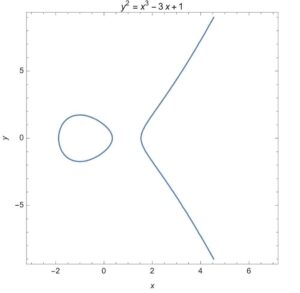
Elliptic curves are neither ellipses nor curves. They are doughnut-shaped spaces of solutions to cubic equations, like y2 = x3—3x + 1.

A modular form is a kind of function which takes in certain complex numbers—numbers with two parts: a real part and an imaginary part—and outputs another complex number. What makes these functions special is that they are highly symmetrical, meaning there are lots of conditions on what they can look like.

There is no reason to expect that those two concepts are related, but that is what the modularity conjecture implied.

Finally, a proof

The modularity conjecture doesn’t appear to say anything about equations like xn + yn = zn . But work by mathematicians in the 1980s showed a link between these new ideas and Fermat’s old theorem.

First, in 1985, Gerhard Frey realized that if Fermat was wrong and there could be a solution to xn + yn = zn for some n bigger than 2, that solution would produce a peculiar elliptic curve. Then Kenneth Ribet showed in 1986 that such a curve could not exist in a universe where the modularity conjecture was also true.

Their work implied that if mathematicians could prove the modularity conjecture, then Fermat’s last theorem had to be true. For many mathematicians, including Andrew Wiles, working on the modularity conjecture became a path to proving Fermat’s last theorem.


Wiles worked for seven years, mostly in secret, trying to prove this difficult conjecture. By 1993, he was close to having a proof of a special case of the modularity conjecture—which was all he needed to prove Fermat’s last theorem.

He presented his work in a series of lectures at the Isaac Newton Institute in June 1993. Though subsequent peer review found a gap in Wiles’ proof, Wiles and his former student Richard Taylor worked for another year to fill in that gap and cement Fermat’s last theorem as a mathematical truth.

Lasting consequences

The impacts of Fermat’s last theorem and its solution continue to reverberate through the world of mathematics. In 2001, a group of researchers, including Taylor, gave a full proof of the modularity conjecture in a series of papers that were inspired by Wiles’ work. This completed bridge between elliptic curves and modular forms has been—and will continue to be—foundational to understanding mathematics, even beyond Fermat’s last theorem.

Wiles’ work is cited as beginning “a new era in number theory” and is central to important pieces of modern math, including a widely used encryption technique and a huge research effort known as the Langlands Program that aims to build a bridge between two fundamental areas of mathematics: algebraic number theory and harmonic analysis.

Although Wiles worked mostly in isolation, he ultimately needed help from his peers to identify and fill in the gap in his original proof. Increasingly, mathematics today is a collaborative endeavor, as witnessed by what it took to finish proving the modularity conjecture. The problems are large and complex and often require a variety of expertise.

So, finally, did Fermat really have a proof of his last theorem, as he claimed? Knowing what mathematicians know now, many of us today don’t believe he did. Although Fermat was brilliant, he was sometimes wrong. Mathematicians can accept that he believed he had a proof, but it’s unlikely that his proof would stand up to modern scrutiny.

For more such insights, log into our website https://international-maths-challenge.com

Credit of the article given to Maxine Calle and David Bressoud, The Conversation


Mathematicians Calculate 42-Digit Number After Decades Of Trying

Dedekind numbers describe the number of ways sets of logical operations can be combined, and are fiendishly difficult to calculate, with only eight known since 1991 – and now mathematicians have calculated the ninth in the series.

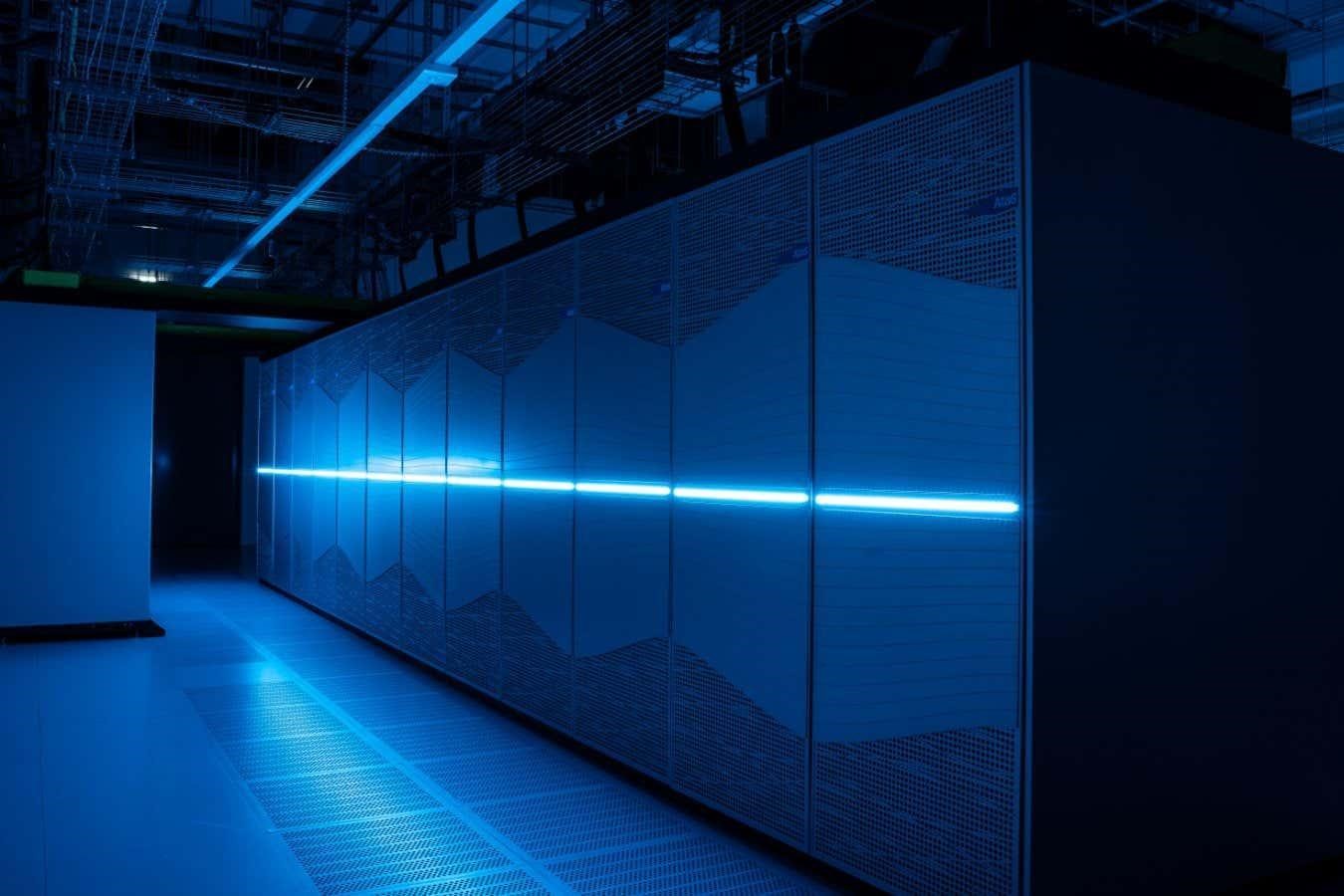
The ninth Dedekind number was calculated using the Noctua 2 supercomputer at Paderborn University in Germany

A 42-digit-long number that mathematicians have been hunting for decades, thanks to its sheer difficulty to calculate, has suddenly been found by two separate groups at the same time. This ninth Dedekind number, as it is known, may be the last in the sequence that is feasible to discover.

Dedekind numbers describe the number of ways a set of logical operations can be combined. For sets of just two or three elements, the total number is easy to calculate by hand, but for larger sets it rapidly becomes impossible because the number grows so quickly, at what is known as a double exponential speed.

“You’ve got two to the power two to the power n, as a very rough estimate of the complexity of this system,” says Patrick de Causmaecker at KU Leuven in Belgium. “If you want to find the Dedekind numbers, that is the kind of magnitude of counting that you will have to face.”

The challenge of calculating higher Dedekind numbers has attracted researchers in many disciplines, from pure mathematicians to computer scientists, over the years. “It’s an old, famous problem and, because it’s hard to crack, it’s interesting,” says Christian Jäkel at Dresden University of Technology in Germany.

In 1991, mathematician Doug Wiedemann found the eighth Dedekind number using 200 hours of number crunching on the Cray-2 supercomputer, one of the most powerful machines at the time. No one could do any better, until now.

After working on the problem on and off for six years, Jäkel published his calculation for the ninth Dedekind number in early April. Coincidently, Causmaecker and Lennart van Hirtum, also at KU Leuven, published their work three days later, having produced the same result. Both groups were unaware of one another. “I was shocked, I didn’t know about their work. I thought it would take at least 10 years or whatever to recompute it,” says Jäkel.

The resulting number is 286,386,577,668,298,411,128,469,151,667,598,498,812,366, which is 42 digits long.

Jäkel’s calculation took 28 days on eight graphical processing units (GPUs). To reduce the number of calculations required, he multiplied together elements from the much smaller fifth Dedekind number.

Causmaecker and van Hirtum instead used a processor called a field-programmable gate array (FPGA) for their work. Unlike a CPU or a GPU, these can perform many different kinds of interrelated calculations at the same time. “In an FPGA, everything is always happening all at once,” says van Hirtum. “You can compare it to a car assembly line.”

Like Jäkel, the team used elements from a smaller Dedekind number, in their case the sixth, but this still required 5.5 quadrillion operations and more than four months of computing time using the Noctua 2 supercomputer at Paderborn University, says van Hirtum.

People are divided on whether another Dedekind number will ever be found. “The tenth Dedekind number will be in the realm of 10 to the power of 82, which puts you at the number of atoms in the visible universe, so you can imagine you need something big in technical advancement that also grows exponentially,” says Jakel.

Van Hirtum also thinks the amount of computing power becomes impractical for the next number, requiring trillions more computations which would require capturing the power output of the entire sun. “This jump in complexity remains absolutely astronomical,” he says.

Causmaecker, however, is more positive, as he thinks new ways of calculating could bring that requirement down. “The combination of exponential growth of computing power, and the power of the mathematical algorithms, will go together and maybe in 20 or 30 years we can compute [Dedekind number] 10.”

For more such insights, log into www.international-maths-challenge.com.

*Credit for article given to Alex Wilkins*


Combining math with music leads to higher test scores, according to review of 50 years of research

Children do better at math when music is a key part of their lessons, an analysis of almost 50 years of research on the topic has revealed.

It is thought that music can make math more enjoyable, keep students engaged and help many ease fear or anxiety they have about math. Motivation may be increased and pupils may appreciate math more, the peer-reviewed article in Educational Studies details.

Techniques for integrating music into math lessons range from clapping to pieces with different rhythms when learning numbers and fractions, to using math to design musical instruments.

Previous research has shown that children who are better at music also do better at math. But whether teaching music to youngsters actually improves their math has been less clear.

To find out more, Turkish researcher Dr. Ayça Akın, from the Department of Software Engineering, Antalya Belek University, searched academic databases for research on the topic published between 1975 and 2022.

She then combined the results of 55 studies from around the world, involving almost 78,000 young people from kindergarten pupils to university students, to come up with an answer.

Three types of musical intervention were included the meta-analysis: standardized music interventions (typical music lessons, in which children sing and listen to, and compose, music), instrumental musical interventions (lessons in which children learn how to play instruments, either individually or as part of a band) and music-math integrated interventions, in which music is integrated into math lessons.

Students took math tests before and after taking part in the intervention and the change in their scores was compared with that of youngsters who didn’t take part in an intervention.

The use of music, whether in separate lessons or as part of math classes, was associated with greater improvement in math over time.

The integrated lessons had the biggest effect, with around 73% of students who had integrated lessons doing significantly better than youngsters who didn’t have any type of musical intervention.

Some 69% of students who learned how to play instruments and 58% of students who had normal music lessons improved more than pupils with no musical intervention.

The results also indicate that music helps more with learning arithmetic than other types of math and has a bigger impact on younger pupils and those learning more basic mathematical concepts.

Dr. Akin, who carried out the research while at Turkey’s National Ministry of Education and Antalya Belek University, points out that math and music have much in common, such as the use of symbols symmetry. Both subjects also require abstract thought and quantitative reasoning.

Arithmetic may lend itself particularly well to being taught through music because core concepts, such as fractions and ratios, are also fundamental to music. For example, musical notes of different lengths can be represented as fractions and added together to create several bars of music.

Integrated lessons may be especially effective because they allow pupils to build connections between math and music and provide extra opportunities to explore, interpret and understand math.

Plus, if they are more enjoyable than traditional math lessons, any anxiety students feel about math may be eased.

Limitations of the analysis include the relatively small number of studies available for inclusion. This meant it wasn’t possible to look at the effect of factors such as gender, socio-economic status and length of musical instruction on the results.

Dr. Akin, who is now based at Antalya Belek University, concludes that while musical instruction overall has a small to moderate effect on achievement in math, integrated lessons have a large impact.

She adds, “Encouraging mathematics and music teachers to plan lessons together could help ease students’ anxiety about mathematics, while also boosting achievement.”

For more such insights, log into our website https://international-maths-challenge.com

Credit of the article given to Taylor & Francis


Study breaks down science of sports betting

It’s a dilemma that many a regular bettor probably faces often—deciding when to place a sports bet. In a study entitled, “A statistical theory of optimal decision-making in sports betting,” Jacek Dmochowski, Associate Professor in the Grove School of Engineering at The City College of New York, provides the answer. His original finding appears in the journal PLOS One.

“The central finding of the work is that the objective in sports betting is to estimate the median outcome. Importantly, this is not the same as the average outcome,” said Dmochowski, whose expertise includes machine learning, signal processing and brain-computer interfaces. “I approach this from a statistical point-of-view, but also provide some intuitive results with sample data from the NFL that can be digested by those without a background in math.”

To illustrate one of the findings, he presents a hypothetical example. “Assume that Kansas City has played Philadelphia three times previously. Kansas City has won each of those games by margins of 3, 7, and 35 points. They are playing again, and the point spread has been posted as ‘Kansas City -10.’ This means that Kansas City is favoured to win the game by 10 points according to the sportsbooks.”

For a bettor, Dmochowski added, the optimal decision in this scenario is to bet on Philadelphia (+10), even though they have lost the last three games by an average margin of 15 points. The reason is that the median margin of victory in those games was only 7, which is less than the point spread of 10.

He noted that because a bettor’s intuition may sometimes be more linked to an average outcome rather than the median, the utilization of some data, or even better, a model, is strongly encouraged.

On his new findings, Dmochowski said he was surprised that the derived theorems have not been previously presented, although it is possible that sports books and some statistically-minded bettors have understood at least the basic intuitions that are conveyed by the math.

Moreover, other investigators have reported findings that align with what’s in the paper, principally Fabian Wunderlich and Daniel Memmert at the German Sports University of Cologne.

With a Pew Research poll establishing that one in five Americans have placed a sports bet in the last year, Dmochowski’s study should be of interest to many bettors in this growing enterprise.

He had other advice for potential bettors. Firstly, “Avoid betting on matches for which the sports book has produced estimates that are ‘very close’ to the median outcome. In the case of the National Football League, the analysis shows that ‘very close’ is equivalent to the point spread being within one point of the true median.”

“Secondly, understand that the sports books are incredibly skilled at setting the odds. At the same time, they only need to make a small error to allow a profitable bet. So the goal is to seek out those opportunities.”

For more such insights, log into our website https://international-maths-challenge.com

Credit of the article given to Jay Mwamba, City College of New York


How Maths Can Help You Pack Your Shopping More Efficiently

How can you ensure you use the fewest bags when loading your shopping? A dash of maths will help, says Peter Rowlett.

You have heaped your shopping on the supermarket conveyor belt and a friendly member of the checkout staff is scanning it through. Items are coming thick and fast and you would like to get them in as few bags as possible. What is your strategy?

This is an example of an optimisation problem, from an area of maths called operational research. One important question is, what are you trying to optimise? Are you thinking about the weight of the items, or how much space they will take up? Do you guess how many bags you might need and start filling that many, or put everything in one until you need to start another?

We design algorithms to solve packing problems when they come up at a larger scale than your weekly shop, like making better use of warehouse space or fitting boxes into delivery vans. Similar algorithms are used for cutting raw materials with minimal waste and storing data on servers.

Bag-packing algorithms generally involve placing items into a single bag until you get to one that won’t fit because you have hit a maximum weight or size. When necessary, you open a second bag, and each time you reach an item that won’t fit in an existing bag, you start a new one.

If you are filling multiple bags at once, it is likely you will come across an item that could fit in more than one bag. Which do you choose? There is no clear best answer, but different algorithms give different ways to make this decision. We are looking for rules that can be applied without detailed thought. You might have more subtle requirements, like putting two items in the same bag because they go in the same cupboard at home, but here we want the kind of simple rule a computer program can mindlessly apply to get the most efficient outcomes, using the fewest bags, every time.

One algorithm we could employ is called first fit. For each new item, you look through the bags in the order you opened them, placing the item in the first one it fits in. An advantage is that this is quick to implement, but it can overlook options and end up using more bags than needed.

An alternative that often uses fewer bags overall is called worst fit. When faced with a choice, you look through the currently open bags for the one with the most space and place the item there.

These algorithms work more effectively if you handle the objects in decreasing order – packing the largest or heaviest first will usually need fewer bags.

So now you are armed with a secret weapon for packing: the worst-fit decreasing algorithm. The next time you are in the checkout line, load your bulkiest shopping onto the conveyor belt first, and always put items in the bag with the most space available – it might just help you use fewer bags overall.

For more such insights, log into www.international-maths-challenge.com.

*Credit for article given to Peter Rowlett*


What game theory can teach us about standing up to bullies

In a time of income inequality and ruthless politics, people with outsized power or an unrelenting willingness to browbeat others often seem to come out ahead.

New research from Dartmouth, however, shows that being uncooperative can help people on the weaker side of the power dynamic achieve a more equal outcome—and even inflict some loss on their abusive counterpart.

The findings provide a tool based in game theory—the field of mathematics focused on optimizing competitive strategies—that could be applied to help equalize the balance of power in labor negotiations or international relations, and could even be used to integrate cooperation into interconnected artificial intelligence systems such as driverless cars.

Published in PNAS Nexus, the study takes a fresh look at what are known in game theoryas “zero-determinant strategies” developed by renowned scientists William Press, now at the University of Texas at Austin, and the late Freeman Dyson at the Institute for Advanced Study in Princeton, New Jersey.

Zero-determinant strategies dictate that “extortionists” control situations to their advantage by becoming less and less cooperative—though just cooperative enough to keep the other party engaged—and by never being the first to concede when there’s a stalemate. Theoretically, they will always outperform their opponent by demanding and receiving a larger share of what’s at stake.

But the Dartmouth paper uses mathematical models of interactions to uncover an “Achilles heel” to these seemingly uncrackable scenarios, said senior author Feng Fu, an associate professor of mathematics. Fu and first author Xingru Chen, who received her Ph.D. in mathematics from Dartmouth in 2021, discovered an “unbending strategy” in which resistance to being steamrolled not only causes an extortionist to ultimately lose more than their opponent but can result in a more equal outcome as the overbearing party compromises in a scramble to get the best payoff.

“Unbending players who choose not to be extorted can resist by refusing to fully cooperate. They also give up part of their own payoff, but the extortioner loses even more,” said Chen, who is now an assistant professor at the Beijing University of Posts and Telecommunications.

“Our work shows that when an extortioner is faced with an unbending player, their best response is to offer a fair split, thereby guaranteeing an equal payoff for both parties,” she said. “In other words, fairness and cooperation can be cultivated and enforced by unbending players.”

These scenarios frequently play out in the real world, Fu said. Labor relations provide a poignant model. A large corporation can strong-arm suppliers and producers such as farmworkers to accept lower prices for their effort by threatening to replace them and cut them off from a lucrative market. But a strike or protest can turn the balance of power back toward the workers’ favour and result in more fairness and cooperation, such as when a labor union wins some concessions from an employer.

While the power dynamic in these scenarios is never equal, Fu said, his and Chen’s work shows that unbending players can reap benefits by defecting from time to time and sabotaging what extortioners are truly after—the highest payoff for themselves.

“The practical insight from our work is for weaker parties to be unbending and resist being the first to compromise, thereby transforming the interaction into an ultimatum game in which extortioners are incentivized to be fairer and more cooperative to avoid ‘lose-lose’ situations,” Fu said.

“Consider the dynamics of power between dominant entities such as Donald Trump and the lack of unbending from the Republican Party, or, on the other hand, the military and political resistance to Russia’s invasion of Ukraine that has helped counteract incredible asymmetry,” he said. “These results can be applied to real-world situations, from social equity and fair pay to developing systems that promote cooperation among AI agents, such as autonomous driving.”

Chen and Fu’s paper expands the theoretical understanding of zero-determinant interactions while also outlining how the outsized power of extortioners can be checked, said mathematician Christian Hilbe, leader of the Dynamics of Social Behaviour research group at the Max Planck Institute for Evolutionary Biology in Germany

“Among the technical contributions, they stress that even extortioners can be outperformed in some games. I don’t think that has been fully appreciated by the community before,” said Hilbe, who was not involved in the study but is familiar with it. “Among the conceptual insights, I like the idea of unbending strategies, behaviours that encourage an extortionate player to eventually settle at a fairer outcome.”

Behavioural research involving human participants has shown that extortioners may constitute a significant portion of our everyday interactions, said Hilbe, who published a 2016 paper in the journal PLOS ONE reporting just that. He also co-authored a 2014 study in Nature Communications that found people playing against a computerized opponent strongly resisted when the computer engaged in threatening conduct, even when it reduced their own payout.

“The empirical evidence to date suggests that people do engage in these extortionate behaviours, especially in asymmetric situations, and that the extorted party often tries to resist it, which is then costly to both parties,” Hilbe said.

For more such insights, log into our website https://international-maths-challenge.com

Credit of the article given to Morgan Kelly, Dartmouth College


Ninth Dedekind number discovered: Scientists solve long-known problem in mathematics

Making history with 42 digits, scientists at Paderborn University and KU Leuven have unlocked a decades-old mystery of mathematics with the so-called ninth Dedekind number.

Experts worldwide have been searching for the value since 1991. The Paderborn scientists arrived at the exact sequence of numbers with the help of the Noctua supercomputer located there. The results will be presented in September at the International Workshop on Boolean Functions and their Applications (BFA) in Norway.

What started as a master’s thesis project by Lennart Van Hirtum, then a computer science student at KU Leuven and now a research associate at the University of Paderborn, has become a huge success. The scientists join an illustrious group with their work. Earlier numbers in the series were found by mathematician Richard Dedekind himself when he defined the problem in 1897, and later by greats of early computer science such as Randolph Church and Morgan Ward. “For 32 years, the calculation of D(9) was an open challenge, and it was questionable whether it would ever be possible to calculate this number at all,” Van Hirtum says.

The previous number in the Dedekind sequence, the 8th Dedekind number, was found in 1991 using a Cray 2, the most powerful supercomputer at the time. “It therefore seemed conceivable to us that it should be possible by now to calculate the 9th number on a large supercomputer,” says Van Hirtum, describing the motivation for the ambitious project, which he initially implemented jointly with the supervisors of his master’s thesis at KU Leuven.

Grains of sand, chess and supercomputers

The main subject of Dedekind numbers are so-called monotone Boolean functions. Van Hirtum explains, “Basically, you can think of a monotone Boolean function in two, three, and infinite dimensions as a game with an n-dimensional cube. You balance the cube on one corner and then color each of the remaining corners either white or red. There is only one rule: you must never place a white corner above a red one. This creates a kind of vertical red-white intersection.

“The object of the game is to count how many different cuts there are. Their number is what is defined as the Dedekind number. Even if it doesn’t seem like it, the numbers quickly become gigantic in the process: the 8th Dedekind number already has 23 digits.”

Comparably large—but incomparably easier to calculate—numbers are known from a legend concerning the invention of the game of chess. “According to this legend, the inventor of the chess game asked the king for only a few grains of rice on each square of the chess board as a reward: one grain on the first square, two grains on the second, four on the third, and twice as many on each of the following squares. The king quickly realized that this request was impossible to fulfill, because so much rice does not exist in the whole world.

“The number of grains of rice on the complete board would have 20 digits—an unimaginable amount, but still less than D(8). When you realize these orders of magnitude, it is obvious that both an efficient computational method and a very fast computer would be needed to find D(9),” Van Hirtum said.

Milestone: Years become months

To calculate D(9), the scientists used a technique developed by master’s thesis advisor Patrick De Causmaecker known as the P-coefficient formula. It provides a way to calculate Dedekind numbers not by counting, but by a very large sum. This allows D(8) to be decoded in just eight minutes on a normal laptop. But, “What takes eight minutes for D(8) becomes hundreds of thousands of years for D(9). Even if you used a large supercomputer exclusively for this task, it would still take many years to complete the calculation,” Van Hirtum points out.

The main problem is that the number of terms in this formula grows incredibly fast. “In our case, by exploiting symmetries in the formula, we were able to reduce the number of terms to ‘only’ 5.5×10¹⁸—an enormous amount. By comparison, the number of grains of sand on Earth is about 7.5×10¹⁸, which is nothing to sneeze at, but for a modern supercomputer, 5.5×10¹⁸ operations are quite manageable,” the computer scientist said.

The problem: The calculation of these terms on normal processors is slow and also the use of GPUs as currently the fastest hardware accelerator technology for many AI applications is not efficient for this algorithm.

The solution: Application-specific hardware using highly specialized and parallel arithmetic units—so-called FPGAs (field programmable gate arrays). Van Hirtum developed an initial prototype for the hardware accelerator and began looking for a supercomputer that had the necessary FPGA cards. In the process, he became aware of the Noctua 2 computer at the “Paderborn Center for Parallel Computing (PC2)” at the University of Paderborn, which has one of the world’s most powerful FPGA systems.

Prof. Dr. Christian Plessl, head of PC2, explains, “When Lennart Van Hirtum and Patrick De Causmaeker contacted us, it was immediately clear to us that we wanted to support this moonshot project. Solving hard combinatorial problems with FPGAs is a promising field of application and Noctua 2 is one of the few supercomputers worldwide with which the experiment is feasible at all. The extreme reliability and stability requirements also pose a challenge and test for our infrastructure. The FPGA expert consulting team worked closely with Lennart to adapt and optimize the application for our environment.”

After several years of development, the program ran on the supercomputer for about five months. And then the time had come: on March 8, the scientists found the 9th Dedekind number: 286386577668298411128469151667598498812366.

Today, three years after the start of the Dedekind project, Van Hirtum is working as a fellow of the NHR Graduate School at the Paderborn Center for Parallel Computing to develop the next generation of hardware tools in his Ph.D. The NHR (National High Performance Computing) Graduate School is the joint graduate school of the NHR centers. He will report on his extraordinary success together with Patrick De Causmaecker on June 27 at 2 p.m. in Lecture Hall O2 of the University of Paderborn.

For more such insights, log into our website https://international-maths-challenge.com

Credit of the article given to Universität Paderborn


Bridging traditional economics and econophysics

In a new study, researchers of the Complexity Science Hub highlight the connecting elements between traditional financial market research and econophysics. “We want to create an overview of the models that exist in financial economics and those that researchers in physics and mathematics have developed so that everybody can benefit from it,” explains Matthias Raddant from the Complexity Science Hub and the University for Continuing Education Krems.

Scientists from both fields try to classify or even predict how the market will behave. They aim to create a large-scale correlation matrix describing the correlation of one stock to all other stocks. “Progress, however, is often barely noticed, if at all, by researchers in other disciplines. Researchers in finance hardly know that physicists are researching similar topics and just call it something different. That’s why we want to build a bridge,” says Raddant.

What are the differences?

Experts in the traditional financial markets field are very concerned with accurately describing how volatile stocks are statistically. However, their fine-grained models no longer work adequately when the data set becomes too large and includes tens of thousands of stocks.

Physicists, on the other hand, can handle large amounts of data very well. Their motto is: “The more data I have, the nicer it is because then I can see certain regularities better,” explains Raddant. They also work based on correlations, but they model financial markets as evolving complex networks.

These networks describe dependencies that can reveal asset comovement, i.e., which stocks behave fundamentally similarly and therefore group together. However, physicists and mathematicians may not know what insights already exist in the finance literature and what factors need to be considered.

Different language

In their study, Raddant and his co-author, CSH external faculty member Tiziana Di Matteo of King’s College London, note that the mechanical parts that go into these models are often relatively similar, but their language is different. On the one hand, researchers in finance try to discover companies’ connecting features.

On the other hand, physicists and mathematicians are working on creating order out of many time series of stocks, where certain regularities occur. “What physicists and mathematicians call regularities, economists call properties of companies, for example,” says Raddant.

Avoiding research that gets lost

“Through this study, we wish to sensitize young scientists, in particular, who are working on an interdisciplinary basis in financial markets, to the connecting elements between the disciplines,” says Raddant. So that researchers who do not come from financial economics know what the vocabulary is and what the essential research questions are that they have to address. Otherwise, there is a risk of producing research that is of no interest to anyone in finance and financial economics.

On the other hand, scientists from the disciplines traditionally involved with financial markets must understand how to describe large data sets and statistical regularities with methods from physics and network science.

For more such insights, log into our website https://international-maths-challenge.com

Credit of the article given to Complexity Science Hub Vienna.