
Maths Week England has been running for six years now and is designed to raise the profile of mathematics and promote a more positive and inclusive approach to its enjoyment in all walks of life. Two of its primary aims are to make the subject accessible to all students and to help teachers with planning special, low-cost yet high-impact maths activities in their own settings.
Cambridge Mathematics’ contribution in November 2025 was to offer teachers and their classes a chance to participate in a live webinar called “Fraction Exploration: ‘Knowing a half’ and ‘Seeing the whole'”. Teachers signed up to participate in one of two time slots and were invited to equip themselves and their students with paper, pencils, whiteboards, pens and dice for the expedition.
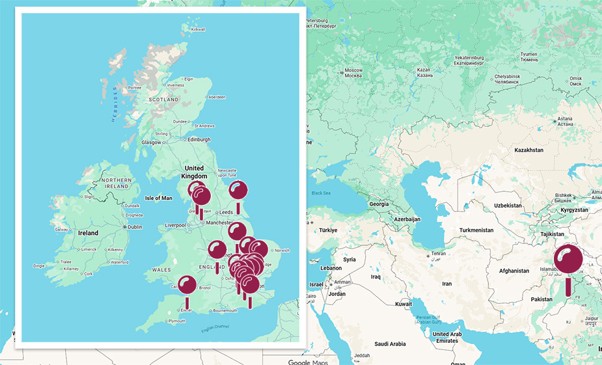
The who and where
Schools signed up from all over England and beyond!
The what
The teaching and learning of fractions is a common talking point for practitioners as they attempt to balance the mathematical significance of the topic with the challenges faced by learners in attempting to make sense of the numerous new concepts and techniques. We explored this topic in the Cambridge Mathematics Framework (a network of mathematical concepts and ideas), creating what we call a ‘submap’ of fractions learning and this was then tied to England’s National Curriculum objectives to focus the activities selected for this webinar.
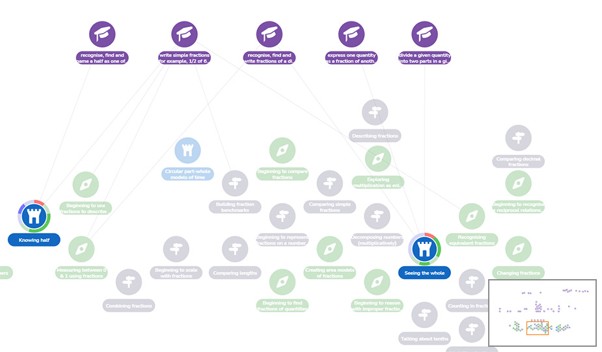
This highlighted two landmarks in the development of fractions concepts that we have called ‘Knowing a half’ and ‘Seeing the whole’. A significant influence for both landmark ideas is a piece of research by Cortina and Visnovska (2015), which became the inspiration for the tasks and games which we designed to provide opportunities for discussion, reasoning and representation of these ideas on a number line.
The how
The bitesize tasks and discussions in the webinar gradually build up to these dice games:
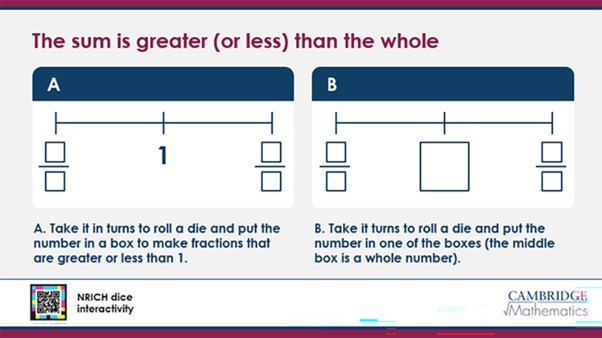
Individual players, or pairs, score points during their turn for filling in one of the empty boxes with the number they roll on the die. The number they roll must be able to be entered into an empty box to continue or finish the game, otherwise they must miss that turn.
The images below capture a snapshot from two different games (A at the top and B below it). How might you answer the questions? And how do you think your students might answer?
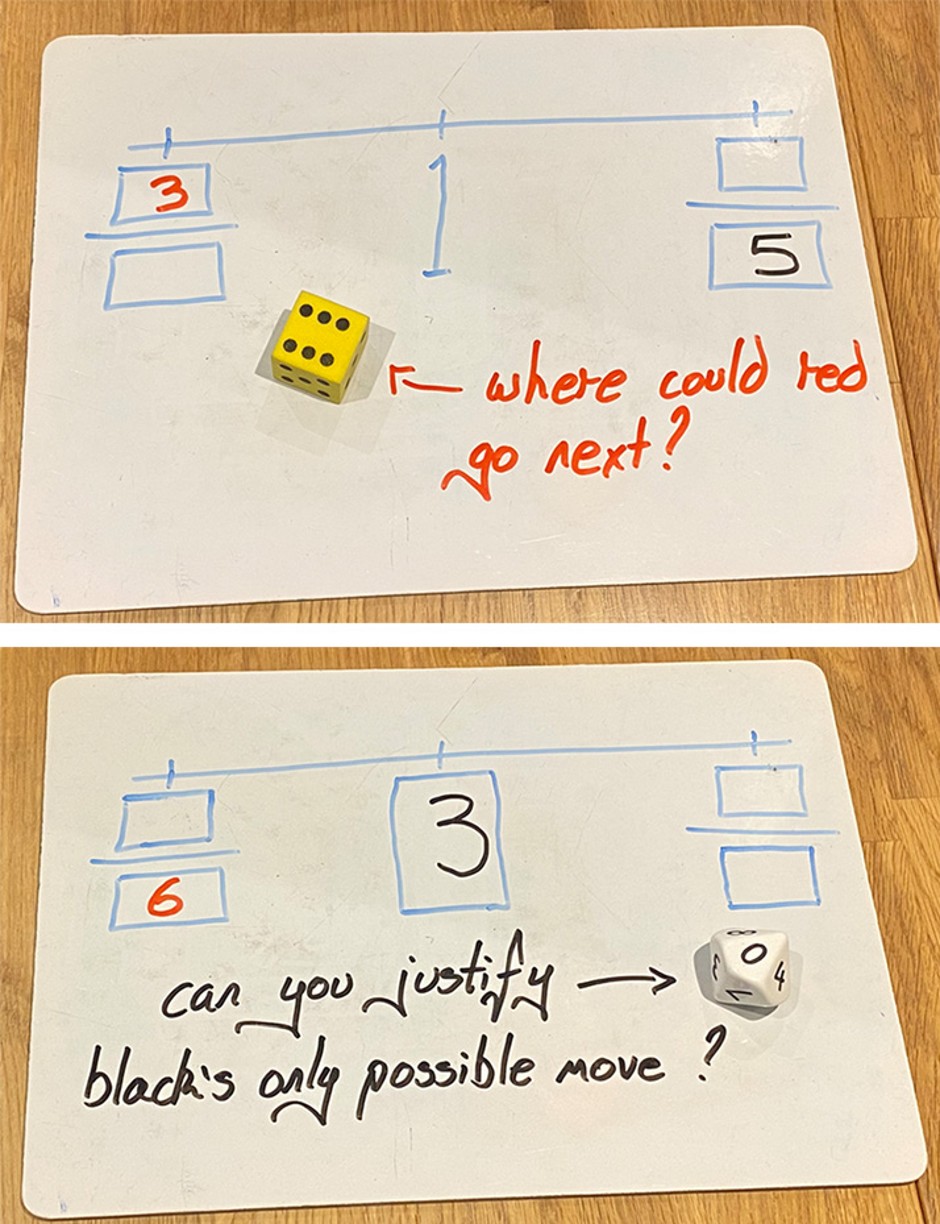
Whether you use 1–6 or 0–9 dice, perhaps you’d like to explore the following questions:
- When is it not possible to make two different fractions from rolling two numbers?
- Is it ever possible to create two different fractions from rolling two numbers, which would end up on the same side of 1 when positioned on a number line?
- Why can’t you use a zero in the denominator position of a fraction?
- How does the game change if you play collaboratively, roll all the numbers first and see how many different ways there are to fill the empty boxes?
For more such insights, log into www.international-maths-challenge.com.
*Credit for article given to Tabitha Gould & Fran Watson*