Mathematicians Make Even Better Never-Repeating Tile Discovery

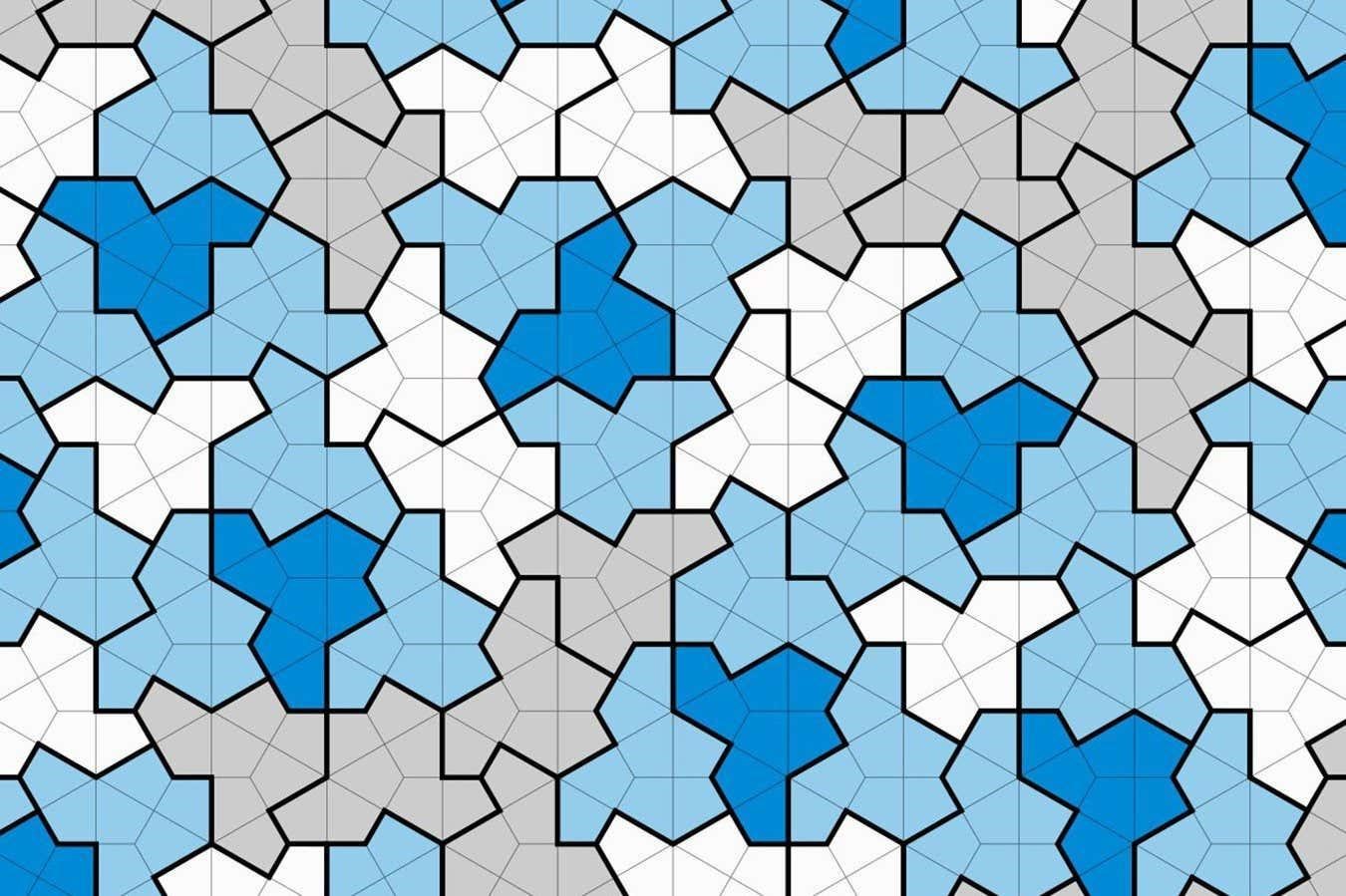
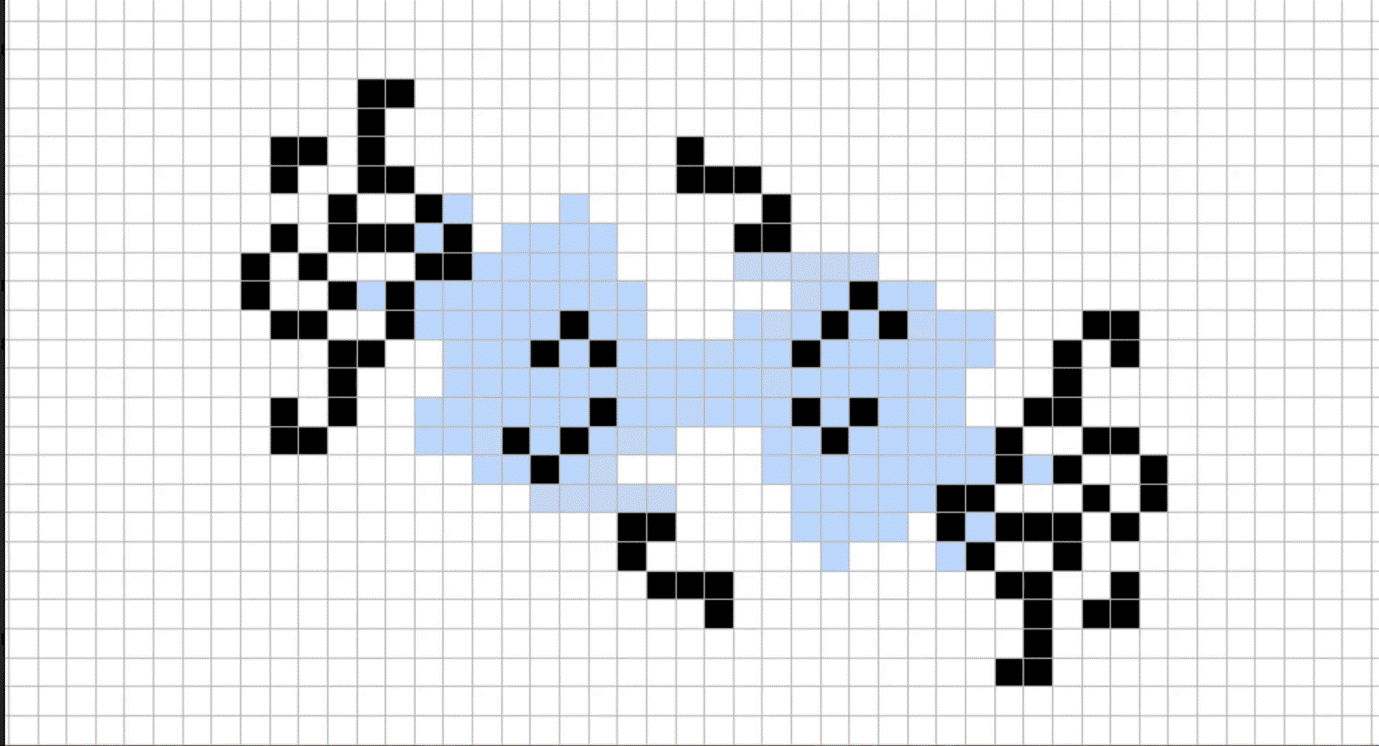
An unsatisfying caveat in a mathematical breakthrough discovery of a single tile shape that can cover a surface without ever creating a repeating pattern has been eradicated. The newly discovered “spectre” shape can cover a surface without repeating and without mirror images.

The pattern on the left side is made up of the “hat” shape, including reflections. The pattern on the right is made up of round-edged “spectre” shapes that repeat infinitely without reflections

David Smith et al

Mathematicians solved a decades-long mystery earlier this year when they discovered a shape that can cover a surface completely without ever creating a repeating pattern. But the breakthrough had come with a caveat: both the shape and its mirror image were required. Now the same team has discovered that a tweaked version of the original shape can complete the task without its mirror.

Simple shapes such as squares and equilateral triangles can tile a surface without gaps in a repeating pattern. Mathematicians have long been interested in a more complex version of tiling, known as aperiodic tiling, which involves using more complex shapes that never form such a repeating pattern.

The most famous aperiodic tiles were created by mathematician Roger Penrose, who in the 1970s discovered that two different shapes could be combined to create an infinite, never-repeating tiling. In March, Chaim Goodman-Strauss at the University of Arkansas and his colleagues found the “hat”, a shape that could technically do it alone, but using a left-handed and right-handed version. This was a slightly unsatisfying solution and left the question of whether a single shape could achieve the same thing with no reflections remaining.

The researchers have now tweaked the equilateral polygon from their previous research to create a new family of shapes called spectres. These shapes allow non-repeating pattern tiling using no reflections at all.

Until now, it wasn’t clear whether such a single shape, known as an einstein (from the German “ein stein” or “one stone”), could even exist. The researchers say in their paper that the previous discovery of the hat was a reminder of how little understood tiling patterns are, and that they were surprised to make another breakthrough so soon.

“Certainly there is no evidence to suggest that the hat (and the continuum of shapes to which it belongs) is somehow unique, and we might therefore hope that a zoo of interesting new monotiles will emerge in its wake,” the researchers write in their new paper. “Nonetheless, we did not expect to find one so close at hand.”

Sarah Hart at Birkbeck, University of London, says the new result is even more impressive than the original finding. “It’s very intellectually satisfying to have a solution that doesn’t need the mirror image because if you actually had real tiles then a tile and its mirror image are not the same,” she says. “With this new tile there are no such caveats.”

For more such insights, log into www.international-maths-challenge.com.

*Credit for article given to Matthew Sparkes*


How Maths Reveals The Best Time to Add Milk For Hotter Tea

If you want your cup of tea to stay as hot as possible, should you put milk in immediately, or wait until you are ready to drink it? Katie Steckles does the sums.

Picture the scene: you are making a cup of tea for a friend who is on their way and won’t be arriving for a little while. But – disaster – you have already poured hot water onto a teabag! The question is, if you don’t want their tea to be too cold when they come to drink it, do you add the cold milk straight away or wait until your friend arrives?

Luckily, maths has the answer. When a hot object like a cup of tea is exposed to cooler air, it will cool down by losing heat. This is the kind of situation we can describe using a mathematical model – in this case, one that represents cooling. The rate at which heat is lost depends on many factors, but since most have only a small effect, for simplicity we can base our model on the difference in temperature between the cup of tea and the cool air around it.

A bigger difference between these temperatures results in a much faster rate of cooling. So, as the tea and the surrounding air approach the same temperature, the heat transfer between them, and therefore cooling of the tea, slows down. This means that the crucial factor in this situation is the starting condition. In other words, the initial temperature of the tea relative to the temperature of the room will determine exactly how the cooling plays out.

When you put cold milk into the hot tea, it will also cause a drop in temperature. Your instinct might be to hold off putting milk into the tea, because that will cool it down and you want it to stay as hot as possible until your friend comes to drink it. But does this fit with the model?

Let’s say your tea starts off at around 80°C (176°F): if you put milk in straight away, the tea will drop to around 60°C (140°F), which is closer in temperature to the surrounding air. This means the rate of cooling will be much slower for the milky tea when compared with a cup of non-milky tea, which would have continued to lose heat at a faster rate. In either situation, the graph (pictured above) will show exponential decay, but adding milk at different times will lead to differences in the steepness of the curve.

Once your friend arrives, if you didn’t put milk in initially, their tea may well have cooled to about 55°C (131°F) – and now adding milk will cause another temperature drop, to around 45°C (113°F). By contrast, the tea that had milk put in straight away will have cooled much more slowly and will generally be hotter than if the milk had been added at a later stage.

Mathematicians use their knowledge of the rate at which objects cool to study the heat from stars, planets and even the human body, and there are further applications of this in chemistry, geology and architecture. But the same mathematical principles apply to them as to a cup of tea cooling on your table. Listening to the model will mean your friend’s tea stays as hot as possible.

For more such insights, log into www.international-maths-challenge.com.

*Credit for article given to Katie Steckles*


Mathematician Wins Abel Prize For Solving Equations With Geometry

Luis Caffarelli has been awarded the most prestigious prize in mathematics for his work on nonlinear partial differential equations, which have many applications in the real world.

Luis Caffarelli has won the 2023 Abel prize, unofficially called the Nobel prize for mathematics, for his work on a class of equations that describe many real-world physical systems, from melting ice to jet engines.

Caffarelli was having breakfast with his wife when he found out the news. “The breakfast was better all of a sudden,” he says. “My wife was happy, I was happy — it was an emotional moment.”

Based at the University of Texas at Austin, Caffarelli started work on partial differential equations (PDEs) in the late 1970s and has contributed to hundreds of papers since. He is known for making connections between seemingly distant mathematical concepts, such as how a theory describing the smallest possible areas that surfaces can occupy can be used to describe PDEs in extreme cases.

PDEs have been studied for hundreds of years and describe almost every sort of physical process, ranging from fluids to combustion engines to financial models. Caffarelli’s most important work concerned nonlinear PDEs, which describe complex relationships between several variables. These equations are more difficult to solve than other PDEs, and often produce solutions that don’t make sense in the physical world.

Caffarelli helped tackle these problems with regularity theory, which sets out how to deal with problematic solutions by borrowing ideas from geometry. His approach carefully elucidated the troublesome parts of the equations, solving a wide range of problems over his more than four-decade career.

“Forty years after these papers appeared, we have digested them and we know how to do some of these things more efficiently,” says Francesco Maggi at the University of Texas at Austin. “But when they appeared back in the day, in the 80s, these were alien mathematics.”

Many of the nonlinear PDEs that Caffarelli helped describe were so-called free boundary problems, which describe physical scenarios where two objects in contact share a changing surface, like ice melting into water or water seeping through a filter.

“He has used insights that combined ingenuity, and sometimes methods that are not ultra-complicated, but which are used in a manner that others could not see — and he has done that time and time again,” says Thomas Chen at the University of Texas at Austin.

These insights have also helped other researchers translate equations so that they can be solved on supercomputers. “He has been one of the most prominent people in bringing this theory to a point where it’s really useful for applications,” says Maggi.

For more such insights, log into www.international-maths-challenge.com.

*Credit for article given to Alex Wilkins*


Why Maths, Our Best Tool To Describe The Universe, May Be Fallible

Our laws of nature are written in the language of mathematics. But maths itself is only as dependable as the axioms it is built on, and we have to assume those axioms are true.

You might think that mathematics is the most trustworthy thing humans have ever come up with. It is the basis of scientific rigour and the bedrock of much of our other knowledge too. And you might be right. But be careful: maths isn’t all it seems. “The trustworthiness of mathematics is limited,” says Penelope Maddy, a philosopher of mathematics at the University of California, Irvine.

Maddy is no conspiracy theorist. All mathematicians know her statement to be true because their subject is built on “axioms” – and try as they might, they can never prove these axioms to be true.

An axiom is essentially an assumption based on observations of how things are. Scientists observe a phenomenon, formalise it and write down a law of nature. In a similar way, mathematicians use their observations to create an axiom. One example is the observation that there always seems to be a unique straight line that can be drawn between two points. Assume this to be universally true and you can build up the rules of Euclidean geometry. Another is that 1 + 2 is the same as 2 + 1, an assumption that allows us to do arithmetic. “The fact that maths is built on unprovable axioms is not that surprising,” says mathematician Vera Fischer at the University of Vienna in Austria.

These axioms might seem self-evident, but maths goes a lot further than arithmetic. Mathematicians aim to uncover things like the properties of numbers, the ways in which they are all related to one another and how they can be used to model the real world. These more complex tasks are still worked out through theorems and proofs built on axioms, but the relevant axioms might have to change. Lines between points have different properties on curved surfaces than flat ones, for example, which means the underlying axioms have to be different in different geometries. We always have to be careful that our axioms are reliable and reflect the world we are trying to model with our maths.

Set theory

The gold standard for mathematical reliability is set theory, which describes the properties of collections of things, including numbers themselves. Beginning in the early 1900s, mathematicians developed a set of underpinning axioms for set theory known as ZFC (for “Zermelo-Fraenkel”, from two of its initiators, Ernst Zermelo and Abraham Fraenkel, plus something called the “axiom of choice”).

ZFC is a powerful foundation. “If it could be guaranteed that ZFC is consistent, all uncertainty about mathematics could be dispelled,” says Maddy. But, brutally, that is impossible. “Alas, it soon became clear that the consistency of those axioms could be proved only by assuming even stronger axioms,” she says, “which obviously defeats the purpose.”

Maddy is untroubled by the limits: “Set theorists have been proving theorems from ZFC for 100 years with no hint of a contradiction.” It has been hugely productive, she says, allowing mathematicians to create no end of interesting results, and they have even been able to develop mathematically precise measures of just how much trust we can put in theories derived from ZFC.

In the end, then, mathematicians might be providing the bedrock on which much scientific knowledge is built, but they can’t offer cast-iron guarantees that it won’t ever shift or change. In general, they don’t worry about it: they shrug their shoulders and turn up to work like everybody else. “The aim of obtaining a perfect axiomatic system is exactly as feasible as the aim of obtaining a perfect understanding of our physical universe,” says Fischer.

At least mathematicians are fully aware of the futility of seeking perfection, thanks to the “incompleteness” theorems laid out by Kurt Gödel in the 1930s. These show that, in any domain of mathematics, a useful theory will generate statements about this domain that can’t be proved true or false. A limit to reliable knowledge is therefore inescapable. “This is a fact of life mathematicians have learned to live with,” says David Aspero at the University of East Anglia, UK.

All in all, maths is in pretty good shape despite this – and nobody is too bothered. “Go to any mathematics department and talk to anyone who’s not a logician, and they’ll say, ‘Oh, the axioms are just there’. That’s it. And that’s how it should be. It’s a very healthy approach,” says Fischer. In fact, the limits are in some ways what makes it fun, she says. “The possibility of development, of getting better, is exactly what makes mathematics an absolutely fascinating subject.”

HOW BIG IS INFINITY?

Infinity is infinitely big, right? Sadly, it isn’t that simple. We have long known that there are different sizes of infinity. In the 19th century, mathematician Georg Cantor showed that there are two types of infinity. The “natural numbers” (1, 2, 3 and so on forever) are a countable infinity. But between each natural number, there is a continuum of “real numbers” (such as 1.234567… with digits that go on forever). Real number infinities turn out not to be countable. And so, overall, Cantor concluded that there are two types of infinity, each of a different size.

In the everyday world, we never encounter anything infinite. We have to content ourselves with saying that the infinite “goes on forever” without truly grasping conceptually what that means. This matters, of course, because infinities crop up all the time in physics equations, most notably in those that describe the big bang and black holes. You might have expected mathematicians to have a better grasp of this concept, then – but it remains tricky.

This is especially true when you consider that Cantor suggested there might be another size of infinity nestled between the two he identified, an idea known as the continuum hypothesis. Traditionally, mathematicians thought that it would be impossible to decide whether this was true, but work on the foundations of mathematics has recently shown that there may be hope of finding out either way after all.

For more such insights, log into www.international-maths-challenge.com.

*Credit for article given to Michael Brooks*


The Mathematician Who Worked Out How To Time Travel

Mathematics suggested that time travel is physically possible – and Kurt Gödel proved it. Mathematician Karl Sigmund explains how the polymath did it.

The following is an extract from our Lost in Space-Time newsletter. Each month, we hand over the keyboard to a physicist or mathematician to tell you about fascinating ideas from their corner of the universe. You can sign up for Lost in Space-Time for free here.

There may be no better way to get truly lost in space-time than to travel to the past and fiddle around with causality. Polymath Kurt Gödel suggested that you could, for instance, land near your younger self and “do something” to that person. If your action was drastic enough, like murder (or is it suicide?), then you could neither have embarked on your time trip, nor perpetrated the dark deed. But then no one would have stopped you from going back in time and so you can commit your crime after all. You are lost in a loop. It’s no longer where you are, but whether you are.

Gödel was the first to prove that, according to general relativity, this sort of time travel can be done. While logically impossible, the equations say it is physically possible. How can that actually be the case?

Widely hailed as “the greatest logician since Aristotle”, Gödel is mainly known for his mathematical and philosophical work. By age 25, while at the University of Vienna, he developed his notorious incompleteness theorems. These basically say that there is no finite set of assumptions that can underpin all of mathematics. This was quickly perceived as a turning point in the subject.

In 1934, Gödel, now 28, was among the first to be invited to the newly founded Institute for Advanced Study in Princeton, New Jersey. During the following years, he commuted between Princeton and Vienna.

After a traumatic journey around a war-torn globe, Gödel settled in Princeton for good in 1940. This is when his friendship with Albert Einstein developed. Their daily walks became legendary. Einstein quipped: “I come to my office just for the privilege to escort Gödel back home.”  The two strollers seemed eerily out of their time. The atomic bomb was built without Einstein, and the computer without Gödel.

When Einstein’s 70th birthday approached, Gödel was asked to contribute to the impending Festschrift a philosophical chapter on German philosopher Immanuel Kant and relativity – a well-grazed field. To his mother, he wrote: “I was asked to write a paper for a volume on the philosophical meaning of Einstein and his theory; of course, I could not very well refuse.”

Gödel began to reflect on Kant’s view that time was not, as Newton would have it, an absolute, objective part of the world, but an a priori form of intuition constraining our cognition. As Kant said: “What we represent ourselves as changes would, in beings with other forms of cognition, give rise to a perception in which… change would not occur at all.” Such “beings” would experience the world as timeless.

In his special relativity, Einstein had famously shown that different observers can have different notions of “now”. Hence, no absolute time. (“Newton, forgive me!” sighed Einstein.) However, this theory does not include gravitation. Add mass, and a kind of absolute time seems to sneak back! At least, it does so in the standard model of cosmology. There, the overall flow of matter works as a universal clock. Space-time is sliced in an infinity of layers, each representing a “now”, one succeeding another. Is this a necessary feature of general relativity? Gödel had found a mathematical kernel in a philosophical problem. That was his trademark.

At this stage, according to cosmologist Wolfgang Rindler, serendipity stepped in: Gödel stumbled across a letter to the journal Nature by physicist George Gamow, entitled “Rotating universe?”. It points out that apparently most objects in the sky spin like tops. Stars do it, planets do it, even spiral galaxies do it. They rotate. But why?

Gamow suggested that the whole universe rotates, and that this rotation trickles down, so to speak, to smaller and smaller structures: from universe to galaxies, from galaxies to stars, from stars to planets. The idea was ingenious, but extremely vague. No equations, no measurements. However, the paper ended with a friendly nudge for someone to start calculating.

With typical thoroughness, Gödel took up the gauntlet. He had always been a hard worker, who used an alarm clock not for waking up but for going to bed. He confided to his mother that his cosmology absorbed him so much that even when he tried to listen to the radio or to movies, he could do so “only with half an ear”. Eventually, Gödel discovered exact solutions of Einstein’s equations, which described a rotating universe.

However, while Gamow had imagined that the centre of rotation of our world is somewhere far away, beyond the reach of the strongest telescopes, Gödel’s universe rotates in every point. This does not solve Gamow’s quest for the cause of galactic rotations, but yields another, amazing result. In contrast to all then-known cosmological models, Gödel’s findings showed that there is no “now” that’s valid everywhere. This was exactly what he had set out to achieve: vindicate Kant (and Einstein) by showing that there is no absolute time.

“Talked a lot with Gödel,” wrote his friend Oskar Morgenstern, the economist who, together with John von Neumann, had founded game theory. He knew Gödel from former Viennese days and reported all their meetings in his diary. “His cosmological work makes good progress. Now one can travel into the past, or reach arbitrarily distant places in arbitrarily short time. This will cause a nice stir.” Time travel had been invented.

In Gödel’s universe, you don’t have to flip the arrow of time to go back to the past. Your time runs as usual. No need to shift entropy in return gear. You just step into a rocket and take off, to fly in a very wide curve (very wide!) at a very high speed (but less than the speed of light). The rocket’s trajectory weaves between light cones, never leaving them but exploiting the fact that in a rotating universe, they are not arrayed in parallel. The trip would consume an awful amount of energy.

Gödel just managed to meet the editorial timeline. On his 70th birthday, Einstein got Gödel’s manuscript for a present (and a sweater knitted by Kurt’s wife Adele). He thanked him for the gifts and confessed that the spectre of time travel had worried him for decades. Now the spectre had materialised. Einstein declared Gödel’s paper “one of the most important since my own”, and stated his hope that time travel could be excluded by some as yet unknown physical law. Soon after, Gödel received the first Albert Einstein award. It went with a modest amount of money which Gödel, as it turned out, could use well.

Next, according to philosopher Palle Yourgrau, “something extraordinary happened: nothing”.

For several decades, the mind-bending discovery of Gödel, far from causing “a nice stir”, got very little attention. When Harry Woolf, the director of the Institute for Advanced Study, arranged the eulogies to be given at Gödel’s funeral in 1978, he listed the topics to be covered: set theory and logic, followed by relativity, which he noted was “not worth a talk”.

Only by and by did eminent cosmologists, such as Stephen Hawking, Kip Thorne or John Barrow, convey an area of respectability to the field. Today, it is mainstream. With time, it transpired that, years before Gödel’s breakthrough, several other cosmological models had exhibited both rotation and the possibility of time travel. However, this aspect had never been noticed, not even by the engineers of these universes.

Many physicists are happy to leave the paradoxical aspects of time travel to philosophers. They invoke a “chronology protection law” that would step in to prevent the worst. It sounds like whistling in the dark but helps to overcome the problem of haunting your own present as a revenant from the future.

And does our universe rotate? Gödel was equivocal on that issue. Sometimes he claimed that his model only served as a thought experiment, to display the illusionary character of time, which cannot depend on accidental features of the place we happen to inhabit. Cosmologist Freeman Dyson, however, reported that Gödel, near the end of his life, had shown dismay when told that evidence for a rotating universe is lacking.

For more such insights, log into www.international-maths-challenge.com.

*Credit for article given to Karl Sigmund*


To Make Maths Classes Sizzle, Inject Some Politics And Social Justice

Relating mathematics to questions that are relevant to many students can help address its image problem, argues Eugenia Cheng.

Mathematics has an image problem: far too many people are put off it and conclude that the subject just isn’t for them. There are many issues, including the curriculum, standardised tests and constraints placed on teachers. But one of the biggest problems is how maths is presented, as cold and dry.

Attempts at “real-life” applications are often detached from our daily lives, such as arithmetic problems involving a ludicrous number of watermelons or using a differential equation to calculate how long a hypothetical cup of coffee will take to cool.

I have a different approach, which is to relate abstract maths to questions of politics and social justice. I have taught fairly maths-phobic art students in this way for the past seven years and have seen their attitudes transformed. They now believe maths is relevant to them and can genuinely help them in their everyday lives.

At a basic level, maths is founded on logic, so when I am teaching the principles of logic, I use examples from current events rather than the old-fashioned, detached type of problem. Instead of studying the logic of a statement like “all dogs have four legs”, I might discuss the (also erroneous) statement “all immigrants are illegal”.

But I do this with specific mathematical structures, too. For example, I teach a type of structure called an ordered set, which is a set of objects subject to an order relation such as “is less than”. We then study functions that map members of one ordered set to members of another, and ask which functions are “order-preserving”. A typical example might be the function that takes an ordinary number and maps it to the number obtained from multiplying by 2. We would then say that if x < y then also 2x < 2y, so the function is order-preserving. By contrast the function that squares numbers isn’t order-preserving because, for example, -2 < -1, but (-2)2 > (-1)2. If we work through those squaring operations, we get 4 and 1.

However, rather than sticking to this type of dry mathematical example, I introduce ones about issues like privilege and wealth. If we think of one ordered set with people ordered by privilege, we can make a function to another set where the people are now ordered by wealth instead. What does it mean for that to be order-preserving, and do we expect it to be so? Which is to say, if someone is more privileged than someone else, are they automatically more wealthy? We can also ask about hours worked and income: if someone works more hours, do they necessarily earn more? The answer there is clearly no, but then we go on to discuss whether we think this function should be order-preserving or not, and why.

My approach is contentious because, traditionally, maths is supposed to be neutral and apolitical. I have been criticised by people who think my approach will be off-putting to those who don’t care about social justice; however, the dry approach is off-putting to those who do care about social justice. In fact, I believe that all academic disciplines should address our most important issues in whatever way they can. Abstract maths is about making rigorous logical arguments, which is relevant to everything. I don’t demand that students agree with me about politics, but I do ask that they construct rigorous arguments to back up their thoughts and develop the crucial ability to analyse the logic of people they disagree with.

Maths isn’t just about numbers and equations, it is about studying different logical systems in which different arguments are valid. We can apply it to balls rolling down different hills, but we can also apply it to pressing social issues. I think we should do both, for the sake of society and to be more inclusive towards different types of student in maths education.

For more such insights, log into www.international-maths-challenge.com.

*Credit for article given to Eugenia Cheng*


Eleven games and activities for parents to encourage maths in early learning

How can parents best help their children with their schooling without actually doing it for them? This article is part of our series on Parents’ Role in Education, focusing on how best to support learning from early childhood to Year 12.

Before beginning official schooling, parents can give their young children a boost in learning mathematics by noticing, exploring and talking about maths during everyday activities at home or out and about.

New research shows that parents play a key role in helping their children learn mathematics concepts involving time, shape, measurement and number. This mathematical knowledge developed before school is predictive of literacy and numeracy achievements in later grades.

One successful approach for strengthening the role of parents in mathematics learning is Let’s Count, implemented by The Smith Family. This builds on parents’ strengths and capabilities as the first mathematics educators of their children.

The Let’s Count longitudinal evaluation findings show that when early years educators encourage parents and families to confidently notice, explore and talk about mathematics in everyday activities, their young children’s learning flourishes.

Indeed, children whose families had taken part in Let’s Count showed greater mathematical skills than those in a comparison group whose families had not participated. For example, they were more successful with correctly making a group of seven (89% versus 63%); continuing patterns (56% versus 34%); and counting collections of 20 objects (58% versus 37%).

These findings, among many others, are a strong endorsement of the power of families helping their children to learn about mathematics in everyday contexts.

What parents can do to promote maths every day

Discussing and exploring mathematics with children requires no special resources. Instead, what is needed is awareness and confidence for parents about how to engage.

However, our research shows that one of the biggest barriers to this is parents’ lack of confidence in leading maths education at home.

Through examining international research, we identified the type of activities that are important for early maths learning which are easy for parents to use. These include:

  1. Comparing objects and describing which is longer, shorter, heavier, or holds less.
  2. Playing with and describing 2D shapes and 3D objects.
  3. Describing where things are positioned, for example, north, outside, behind, opposite.
  4. Describing, copying, and extending patterns found in everyday situations.
  5. Using time-words to describe points in time, events and routines (including days, months, seasons and celebrations).
  6. Comparing and talking about the duration of everyday events and the sequence in which they occur.
  7. Saying number names forward in sequence to ten (and eventually to 20 and beyond).
  8. Using numbers to describe and compare collections.
  9. Using perceptual and conceptual subitising (recognising quantities based on visual patterns), counting and matching to compare the number of items in one collection with another.
  10. Showing different ways to make a total (at first with models and small numbers).
  11. Matching number names, symbols and quantities up to ten.

Games to play using everyday situations

Neuroscience research has provided crucial evidence about the importance of early nurturing and support for learning, brain development, and the development of positive dispositions for learning.

Early brain development or “learning” is all about the quality of children’s sensory and motor experiences within positive and nurturing relationships and environments. This explains why programs such as Let’s Count are successful.

Sometimes it can be difficult to come up with activities and games to play that boost children’s mathematics learning, but there are plenty. For example, talk with your children as you prepare meals together. Talk about measuring and comparing ingredients and amounts.

You can play children’s card games and games involving dice, such as Snakes and Ladders, or maps, shapes and money. You can also read stories and notice the mathematics – the sequence of events, and the descriptions of characters and settings.

Although these activities may seem simple and informal, they build on what children notice and question, give families the chance to talk about mathematical ideas and language, and show children that maths is used throughout the day.

Parents are encouraged to provide learning opportunities that are engaging and relevant to their children. www.shutterstock.com

Make it relevant to them

Most importantly, encouraging maths and numeracy in young children relies on making it appealing and relevant to them.

For example, when you take your child for a walk down the street, in the park or on the beach, bring their attention to the objects around them – houses, cars, trees, signs.

Talk about the shapes and sizes of the objects, talk about and look for similarities and differences (for example: let’s find a taller tree or a heavier rock), count the number of cars parked in the street or time how long it takes to reach the next corner.

Discuss the temperature or the speed of your walking pace.

Collect leaves or shells, and make repeating patterns on the sand or grass, or play Mathematical I Spy (I spy with my little eye, something that’s taller than mum).

It is never too soon to begin these activities. Babies who are only weeks old notice differences in shapes and the number of objects in their line of sight.

So, from the earliest of ages, talk with your child about the world around them, being descriptive and using mathematical words. As they grow, build on what they notice about shapes, numbers, and measures. This is how you teach them mathematics.

For more insights like this, visit our website at www.international-maths-challenge.com.
Credit of the article given to Sivanes Phillipson, Ann Gervasoni


Maths: why many great discoveries would be impossible without it

There are some great uses. Shutterstock

Despite the fact that mathematics is often described as the underpinning science, it is often not given enough credit when scientific discoveries are presented. But the contribution of mathematics and statistics is essential and has transformed entire areas of research – many discoveries would not have been possible without it. In fact, as a mathematician, I have contributed to scientific discoveries and provided solutions to problems that biology was yet to solve.

Seven years ago, I attended a lecture on some biological research that was taking place at Heriot-Watt University. My colleagues had an unsolved problem which related to the movement of bag-like structures called vesicles which move hormones and neurotransmitters such as insulin or serotonin around cells and the body.

Their problem lay in that vesicles were known to follow specific tracks along the cell skeleton which lead to special molecules which then caused the vesicle to release its contents into the cell. However, when the biologists themselves tried to find these tracks, they were not in the expected places.

A bag that carries hormones to their location. OpenStaxCC BY

It is important to understand how vesicles behave, or in fact misbehave, as they have been linked to conditions such diabetes and neurological disorders. The biologists were struggling to find a way to understand the vesicles – but I had a solution in my mathematical toolkit.

Maths can beat biology

After two years of collaboration I told my colleagues: “my model and computer experiments are better than your microscope!”

What I meant by this rather confident statement was that by using mathematics to model how molecules move in a cell we could predict and run multiple experiments on a computer at a smaller scale and faster rate than a microscope. It could allow us to uncover things that the biologist’s resources could not, and might even point us in the direction of target molecules for future treatments of diabetes and neurological disorders.

The mathematical model allowed us to recognise that the movement of vesicles requires energy – and the maths models it through an energy landscape. It imagined a vesicle to be like a cyclist riding a bicycle – the landscape may have easy level sections but also hills that require more energy input to get over them, and so we wanted to test whether they actually avoided these hills.

After seven years of working in partnership with the biologists, my colleagues and I proved our hypothesis was correct. Vesicles do follow lower energy “valleys” in the landscape, avoiding molecules which create the high energy hills in the energy landscape – taking the easiest path. The overall result is just the same as the biologists had found – the vesicles end up in the same end location and they reuse similar routes over and over again. But the difference lies in the way in which they do it, and it was not by following the cell skeleton as biologists had first believed – they take an easier route. It really shows the power of maths and how it can change the way we see things.

Mathematical models allow you to capture many gigabytes of raw data in a compact form in a way that is impossible for a biologist with a microscope. You can make modifications to the model easily and show how vesicle behaviour may change during disease, when they are disrupted or mutated. It could then reveal which molecules to target in future treatment studies – and lay the groundwork for larger and more thorough modelling of complex biological processes.

A modelled energy landscape. Shutterstock

The integration of cutting-edge microscopy with cell biology and mathematical modelling could be applied to many other problems in bio-medicine and will accelerate discovery in the years to come. The movement of molecules and other cell components is just one example of where the power of mathematics is unrivalled, but it is by no means its limit.

Useful is an understatement

Maths is often criticised by the public for lacking in “real-world” applications, but it is being applied to many real-world problems all the time. Groundwater contaminationfinancial and economic forecastingplume heights in volcanic eruptions, the modelling of biological processes and drug delivery are just a few places where maths is making a huge difference.

I’m proud to say that I co-authored a paper with my biology colleagues, and I hope to see more mathematicians coming to the fore for science research in the future. Mathematics plays a central role in so many of the world’s scientific breakthroughs and deserves a headline role in more academic publications. Power to the mathematician – they’re behind more discoveries than you think.

For more insights like this, visit our website at www.international-maths-challenge.com.
Credit of the article given to Gabriel Lord


Unraveling the Mathematics of Smell

Credit: Monty Rakusen Getty Images

Scientists have created a “map” of odor molecules, which could ultimately be used to predict new scent combinations 

The human nose finds it simple to distinguish the aroma of fresh coffee from the stink of rotten eggs, but the underlying biochemistry is complicated. Researchers have now created an olfactory “map”—a geometric model of how molecules combine to produce various scents. This map could inspire a way to predict how people might perceive certain odor combinations and help to drive the development of new fragrances, scientists say.

Researchers have been trying for years to tame the elaborate landscape of odor molecules. Neuroscientists want to better understand how we process scents; perfume and food manufacturers want better ways to synthesize familiar aromas for their products. The new approach may appeal to both camps.

One earlier strategy for mapping the olfactory system involves grouping odor molecules that have similar molecular structures and using those similarities to predict the scents of novel combinations. But that avenue often leads to a dead end. “It’s not necessary that chemicals with the same chemical structures will be perceived similarly,” says Tatyana Sharpee, a neurobiologist at the Salk Institute for Biological Studies in La Jolla, Calif., and lead author of the study, which appeared in August in Science Advances.

Sharpee and her colleagues analyzed odor molecules found in four familiar and unmistakable scents: strawberries, tomatoes, blueberries and mouse urine. The researchers calculated how often and in what concentrations certain molecules turned up together in these scents. They then created a mathematical model in which molecules that occurred together frequently were represented as closer in space and molecules that rarely did so were farther apart. The result was a “saddle”-shaped surface—a hallmark of a field called hyperbolic geometry, which obeys different rules from the geometry most people learn in school.

The researchers envision an algorithm, trained on this hyperbolic geometry model, that can predict the scents of new odor combinations—or even help to synthesize them. One of Sharpee’s collaborators, behavioral neuroscientist Brian Smith of Arizona State University, wants to use this method to create olfactory environments in places devoid of natural scents.

Such a tool would be useful to scientists and odor manufacturers alike, says olfactory neuroscientist Joel Mainland of the Monell Chemical Senses Center in Philadelphia, who was not involved in the study. The ultimate goal is to know enough about how odors work to replicate natural smells without the natural sources, Mainland says: “We want to identify a strawberry flavor without worrying about replicating the ingredients that are in a strawberry.”

For more insights like this, visit our website at www.international-maths-challenge.com.

Credit of the article given to Stephen Ornes


There’s a mathematical formula for choosing the fastest queue

It seems obvious. You arrive at the checkouts and see one queue is much longer than the other, so you join the shorter one. But, before long, the people in the bigger line zoom past you and you’ve barely moved towards the exit.

When it comes to queuing, the intuitive choice is often not the fastest one. Why do queues feel like they slow down as soon as you join them? And is there a way to decide beforehand which line is really the best one to join? Mathematicians have been studying these questions for years. So can they help us spend less time waiting in line?

The intuitive strategy seems to be to join the shortest queue. After all, a short queue could indicate it has an efficient server, and a long queue could imply it has an inexperienced server or customers who need a lot of time. But generally this isn’t true.

Without the right information, it could even be disadvantageous to join the shortest queue. For example, if the short queue at the supermarket has two very full trolleys and the long queue has four relatively empty baskets, many people would actually join the longer queue. If the servers are equally efficient, the important quantity here is the number of total items in the queue, not the number of customers. But if the trolleys weren’t very full but the hand baskets were, it wouldn’t be so easy to estimate and the choice wouldn’t be so clear.

This simple example introduces the concept of service time distribution. This is a random variable that measures how long it will take a customer to be served. It contains information about the average (mean) service time and about the standard deviation from the mean, which represents how the service time fluctuates depending on how long different customers need.

The other important variable is how often customers join the queue (the arrival rate). This depends on the average amount of time that passes between two consecutive customers entering the shop. The more people that arrive to use a service at a specific time, the longer the queues will be.

Never mind the queue, I picked the wrong shop. Shutterstock

Depending on what these variables are, the shortest queue might be the best one to join – or it might not. For example, in a fish and chip shop you might have two servers both taking orders and accepting money. Then it is most often better to join the shortest queue since the time the servers’ tasks take doesn’t vary much.

Unfortunately, in practice, it’s hard to know exactly what the relevant variables are when you enter a shop. So you can still only guess what the fastest queue to join will be, or rely on tricks of human psychology, such as joining the leftmost queue because most right-handed people automatically turn right.

Did you get it right?

Once you’re in the queue, you’ll want to know whether you made the right choice. For example, is your server the fastest? It is easy to observe the actual queue length and you can try to compare it to the average. This is directly related to the mean and standard deviation of the service time via something called the Pollaczek-Khinchine formula, first established in 1930. This also uses the mean inter-arrival time between customers.

Unfortunately, if you try to measure the time the first person in the queue takes to get served, you’ll likely end up feeling like you chose the wrong line. This is known as Feller’s paradox or the inspection paradox. Technically, this isn’t an actual logical paradox but it does go against our intuition. If you start measuring the time between customers when you join a queue, it is more likely that the first customer you see will take longer than average to be served. This will make you feel like you were unlucky and chose the wrong queue.

The inspection paradox works like this: suppose a bank offers two services. One service takes either zero or five minutes, with equal probability. The other service takes either ten or 20 minutes, again with equal probability. It is equally likely for a customer to choose either service and so the bank’s average service time is 8.75 minutes.

If you join the queue when a customer is in the middle of being served then their service can’t take zero minutes. They must be using either the five, ten or 20 minute service. This pushes the time that customer will take to be served to more than 11 minutes on average, more than the true average for the of 8.75 minutes. In fact, two out of three times you encounter the same situation, the customer will want either the 10 or 20 minute service. This will make it seem like the line is moving more slowly than it should, all because a customer is already there and you have extra information.

So while you can use maths to try to determine the fastest queue, in the absence of accurate data – and for your own peace of mind – you’re often better just taking a gamble and not looking at the other options once you’ve made your mind up.

For more insights like this, visit our website at www.international-maths-challenge.com.
Credit of the article given to Enrico Scalas, Nicos Georgiou