Mathematicians Discover ‘Soft Cell’ Shapes Behind The Natural World

The mathematical study of how repeating tiles fit together usually involves pointed shapes like triangles or squares, but these aren’t normally found in the natural world.

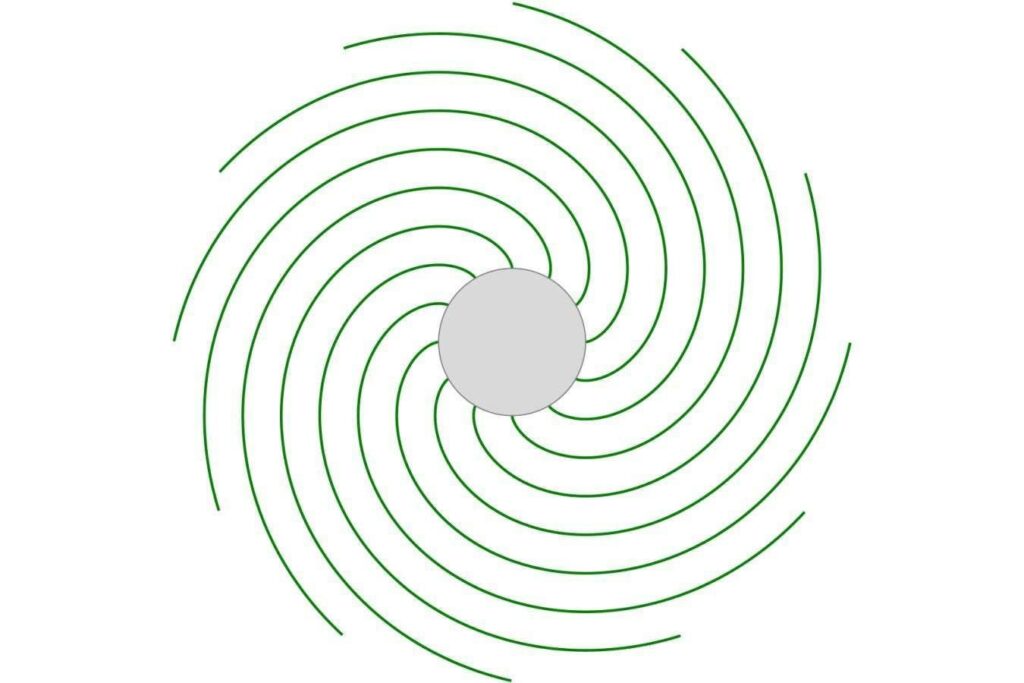
The chambers of a nautilus shell are an example of a soft cell in nature

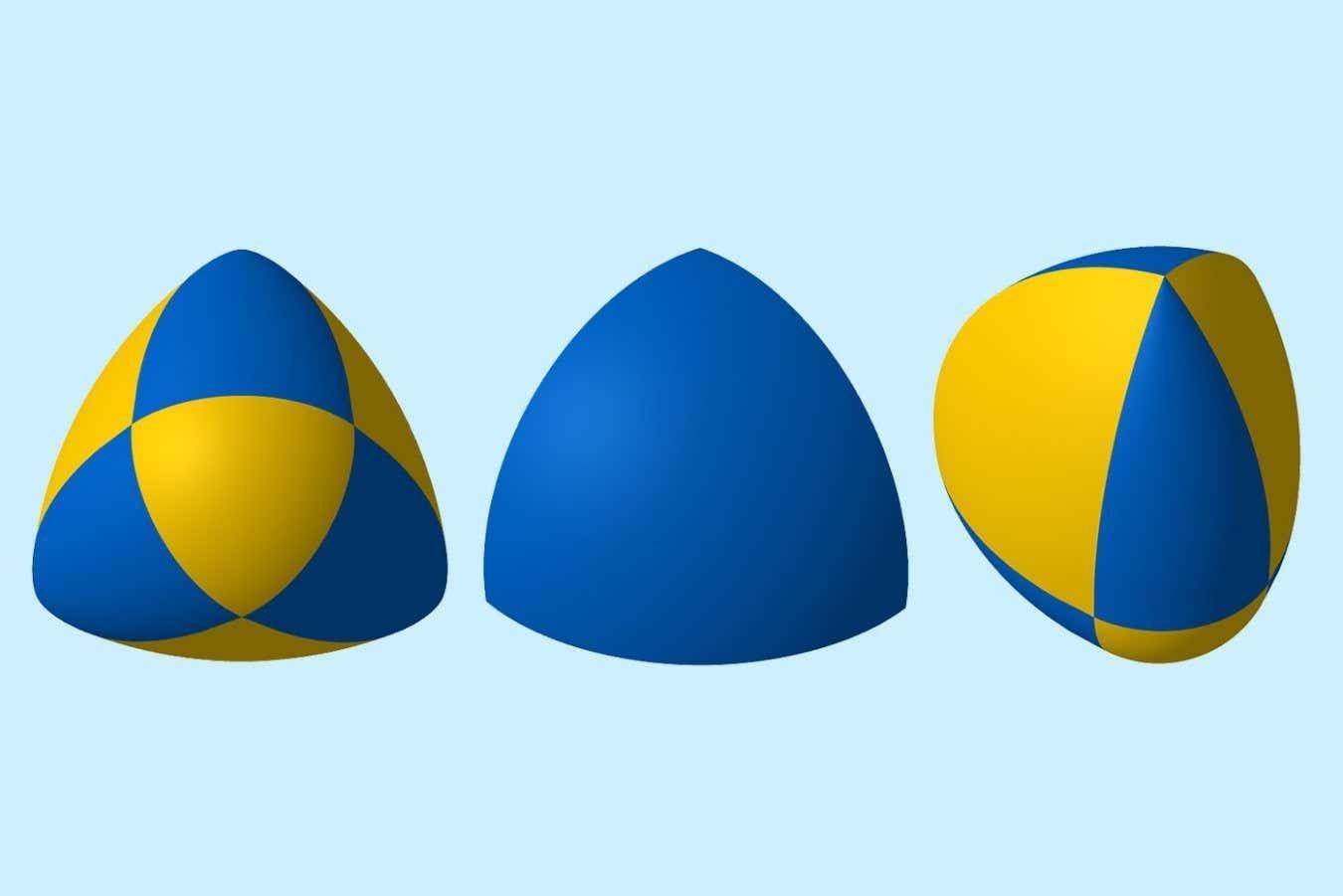
A new class of mathematical shapes called soft cells can be used to describe how a remarkable variety of patterns in living organisms – such as muscle cells and nautilus shells – form and grow.

Mathematicians have long studied how tiles fit together and cover surfaces, but they have largely focused on simple shapes that fit together without gaps, such as squares and triangles, because these are easier to work with.

It is rare, however, for nature to use perfectly straight lines and sharp points. Some natural objects are similar enough to straight-edged tiles, known as polyhedrons, that they can be described by polyhedral models, such as a collection of bubbles in a foam or the cracked surface of Mars. But there are some curved shapes, such as three-dimensional polygons found in the epithelial cells that tile the lining of blood vessels and organs, that are harder to describe.

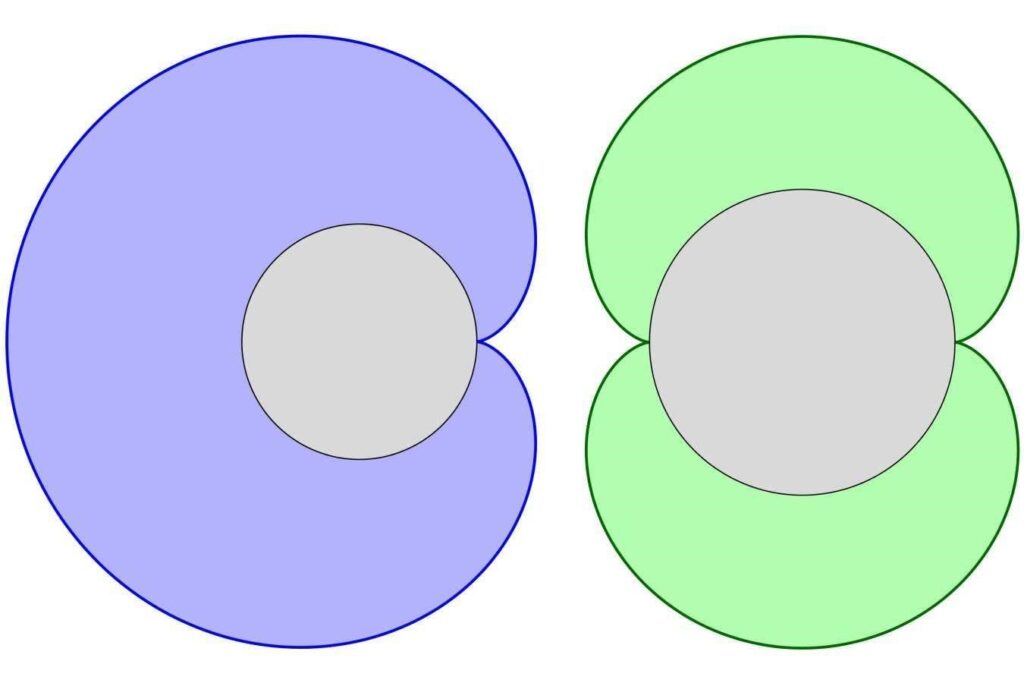
Now, Gábor Domokos at the Budapest University of Technology, Hungary, and his colleagues have discovered a class of shapes that describe tilings with curved edges, which they call soft cells. The key to these shapes is that they contain as few sharp corners as possible, while also fitting together as snugly as they can.

“These shapes emerge in art, but also in biology,” says Domokos. “If you look at sections of muscle tissue, you’ll see the cells having just two sharp corners, which is one less than the triangle – it is a very special kind of tiling.”

In two dimensions, soft cells have just two sharp points connected by curved edges and can take on an infinite number of different forms. But in three dimensions, these shapes have no sharp points, or corners, at all. It isn’t obvious how many of these 3D soft cells, which Domokos and his team call z-cells, there might be or how to easily make them, he says.

After defining soft cells mathematically, Domokos and his team looked for examples in nature and discovered they were widespread. “We found that architects have found these kinds of shapes intuitively when they wanted to avoid corners,” says Domokos. They also found z-cells were common in biological processes that grow from the tip of an object.

One of the clearest examples of z-cells was in seashells made from multiple chambers, such as the nautilus shell, which is an object of fascination for mathematicians because its structure follows a logarithmic pattern.

Domokos and his team noticed that the two-dimensional slices of each of the shell’s chambers looked like a soft cell, so they examined nautilus shells with a CT scanner to measure the chambers in three dimensions. “We saw no corners,” says Domokos, which suggested that the chambers were like the z-cells they had described mathematically.

“They’ve come up with a language for describing cellular materials that might be more physically realistic than the strict polyhedral model that mathematicians have been playing with for millennia,” says Chaim Goodman-Strauss at the University of Arkansas. These models could improve our understanding of how the geometry of biological systems, like in soft tissues, affects their material properties, says Goodman-Strauss. “The way that geometry influences the mechanical properties of tissue is really very poorly understood.”

For more such insights, log into www.international-maths-challenge.com.

*Credit for article given to Alex Wilkins*


Why Science Relies Too Much On Mathematics

Mathematics is at the heart of modern science but we shouldn’t forget other ways to reason, says author and researcher Roland Ennos.

“Science is written in the language of mathematics,” proclaimed Galileo in 1623. And over the past few centuries science has become ever more mathematical. Nowadays, mathematics seems to hold total hegemony, particularly in the fields of quantum physics and relativity – the teaching of modern physics seems to involve deriving an endless series of equations.

But though it is an important tool, mathematical analysis is not the only way of approaching scientific enquiry. Scientists also need to develop concepts on which to build the mathematics and carry out experiments to test and demonstrate their ideas. And they also need to translate the equations back into physical concepts and verbal explanations to make them comprehensible. These other aspects have long been undervalued – in both the teaching and practice of physics – and this has damaged and is continuing to damage our understanding of the world around us.

Nowhere is this better exemplified than in the science of rotation and spin, which might at first glance appear to be a shining example of the triumph of mathematics. In his 1687 magnum opus Principia, Isaac Newton laid out the mathematical workings of our solar system: he showed how the laws of motion and gravity explain how the planets orbit around the sun, and how the spin of the earth causes it to bulge, drives the tides and makes its tilted axis slowly wobble. Over the next hundred years, Newton’s analysis was extended and translated into modern mathematical language. All the problems of cosmology appeared to have been solved, the first of many occasions when scientists have mistakenly thought they had uncovered all the secrets of the universe.

Yet Newton’s triumph was only made possible by his more down-to-earth contemporary Robert Hooke. It was Hooke who made the conceptual leap that an object moving in a circle is travelling at a constant speed but is also accelerating at right angles towards the centre of the circle. He also went on to show experimentally how a universal gravity could provide the force that causes the planets to orbit around the sun and the moon around Earth. He hung a large ball, representing Earth, from the ceiling and a small ball, representing the moon, from the large ball, before pulling them away from vertical and setting them moving. The tension in the ropes, representing gravity, provided the inward force that kept them travelling around in a circle.

Unfortunately, Newton, who came to dominate world science, had little time for such conceptual and experimental approaches, insisting that equations were the only way to describe physical reality. His influence impeded further conceptual advances in mechanics and consequently progress in cosmology. For instance, it delayed our understanding of how the solar system was created.

The accepted model – the nebular hypothesis – was put forward in the 18th century by such luminaries as the philosopher Immanuel Kant and the mathematician Pierre-Simon Laplace. The hypothesis proposed that the solar system formed from a spinning ball of dust and gas. Gravity flattened the ball into a disc before the attraction between the particles pulled them together into planets and moons, all orbiting in the same plane and in the same direction.

All seemed well until the 1850s when engineers such as William Rankine finally developed a new mechanical concept – the conservation of angular momentum – 150 years after the conservation of linear momentum had been accepted. This new concept revealed a potential flaw in the nebular hypothesis that had remained hidden in Newton’s equations. To have shrunk to its size and to spin so slowly, the sun must have lost almost all its angular momentum, something that seemed to break this new law of nature.

It was only 40 years ago that a convincing explanation was proposed about how the sun lost its angular momentum. The charged particles shot out by the sun in the solar wind are channelled within magnetic fields before being flung out slowing the spin of the material that remained and allowing gravity to draw it inwards. It was only two years ago that this explanation was finally verified by the Parker Solar Probe, which found that the solar particles were channelled up to 32 million kilometres outwards before being released. And only in October 2023 did the James Webb Space Telescope reveal the same process occurring in the newly forming solar system of the star HH212.

The overreliance on mathematics also delayed our understanding of how the spin of Earth makes it habitable. By the end of the 18th century, Laplace had derived equations describing how Earth’s spin deflects bodies of water moving over its surface. However, even he failed to observe that it would also affect solid objects and gases, so his work was ignored by the early meteorologists.

This only changed in 1851, when the French physicist Jean Foucault produced a free-hanging pendulum that demonstrated Laplace’s forces in action. The forces diverted the bob to the right during each sweep so that its plane of swing gradually rotated, like a Spirograph drawing. Not only did this prove the spin of Earth to a sceptical public, but it showed schoolteacher William Ferrel that Laplace’s forces would also deflect air masses moving around Earth’s surface. This would explain how global air currents are deflected east and west to form the three convection cells that cover each hemisphere and create the world’s climate zones, and how they divert winds into rotating weather systems, creating depressions, hurricanes and anticyclones. Modern meteorology was born.

In 1835, the French engineer Gaspard-Gustave de Coriolis produced more general equations describing the forces on bodies moving within a rotating reference frame. However, since these were in a paper examining the efficiency of water wheels, his work was largely ignored by scientists. Instead, it was a simple experiment that enabled geophysicists to understand how Earth’s spin diverts fluid movements in its interior and produces its magnetic field.

In 1911, the British physicist G. I. Taylor investigated how beakers of water behave when they are set spinning. The water quickly spins with the beaker and its surface rises in a parabola until the extra pressure counters the centrifugal force on the water. What’s interesting is how the water behaves when it is disturbed. Its movement changes the centrifugal force on it, as Coriolis’s equations predicted, so that when heated from below, it moves not in huge convection currents but up and down in narrow rotating columns. This discovery led the geophysicists Walter Elsasser and Edward Bullard to realise that the same forces would deflect convection currents in Earth’s metal outer core that are driven by radioactive decay. They are diverted into north-to-south columns of rotating metal that act like self-excited dynamos, producing the magnetic field that shields Earth from charged particles. A simple laboratory demonstration had illuminated events in Earth’s core that had been hidden in Coriolis’s equations.

Today, perhaps the most damaging failure to translate the mathematics of spin into easy-to-grasp concepts is in the fields of biomechanics and sports science. Our bodies are complex systems of rotating joints, but despite the sophistication of modern motion analysis software, few researchers realise that accelerating our joints can produce torques that actively accelerate our limbs. Biomechanics researchers are only starting to realise that accelerating our bodies upwards at the start of each step swings our arms and legs when we walk, and that a sling action straightens them at the end of each step.

In the same way, when we throw things, we use a multi-stage sling action; rotating our shoulders accelerates first our upper arm, then our forearm and finally our hands. And the reason we can wield heavy sledgehammers and swing wooden clubs to smash golf balls down the fairway is that their handles act as further sling elements; they accelerate forwards due to the centrifugal forces on them without us having to flex our wrists. Failing to articulate these simple mechanical concepts has made biomechanics ill-equipped to communicate with and help physiotherapists, sports coaches and roboticists.

And there is still confusion about the simplest aspects of rotation among physicists. Even Richard Feynman, for instance, was unable to explain the so-called Dzhanibekov effect – why spinning wing nuts on the International Space Station flip every few seconds. This was despite the fact that the mathematician Leonhard Euler had shown this should happen almost 300 years ago. The same is also true of more down-to-earth events: how children power playground swings and how cats land on their feet, for example.

The truth is that the basics of physics, despite involving simple mathematics, are harder to grasp than we tend to think. It took me two years, for instance, to master just the science of spin and rotation for my latest book. We need to spend more time thinking about, visualising and demonstrating basic physical concepts. If we do, we could produce a generation of physicists who can communicate better with everyone else and discover more about the world around us. The answers are probably already there, hidden in the equations.

The Science of Spin by Roland Ennos is out now.

For more such insights, log into www.international-maths-challenge.com.

*Credit for article given to Roland Ennos*


What are ‘multiplication facts’? Why are they essential to your child’s success in maths?

One of the essential skills students need to master in primary school mathematics are “multiplication facts”.

What are they? What are they so important? And how can you help your child master them?

What are multiplication facts?

Multiplication facts typically describe the answers to multiplication sums up to 10×10. Sums up to 10×10 are called “facts” as it is expected they can be easily and quickly recalled. You may recall learning multiplication facts in school from a list of times tables.

The shift from “times tables” to “multiplication facts” is not just about language. It stems from teachers wanting children to see how multiplication facts can be used to solve a variety of problems beyond the finite times table format.

For example, if you learned your times tables in school (which typically went up to 12×12 and no further), you might be stumped by being asked to solve 15×8 off the top of your head. In contrast, we hope today’s students can use their multiplication facts knowledge to quickly see how 15×8 is equivalent to 10×8 plus 5×8.

The shift in terminology also means we are encouraging students to think about the connections between facts. For example, when presented only in separate tables, it is tricky to see how 4×3 and 3×4 are directly connected.

Maths education has changed

In a previous piece, we talked about how mathematics education has changed over the past 30 years.

In today’s mathematics classrooms, teachers still focus on developing students’ mathematical accuracy and fast recall of essential facts, including multiplication facts.

But we also focus on developing essential problem-solving skills. This helps students form connections between concepts, and learn how to reason through a variety of real-world mathematical tasks.

Why are multiplication facts so important?

By the end of primary school, it is expected students will know multiplication facts up to 10×10 and can recall the related division fact (for example, 10×9=90, therefore 90÷10=9).

Learning multiplication facts is also essential for developing “multiplicative thinking”. This is an understanding of the relationships between quantities, and is something we need to know how to do on a daily basis.

When we are deciding whether it is better to purchase a 100g product for $3 or a 200g product for $4.50, we use multiplicative thinking to consider that 100g for $3 is equivalent to 200g for $6 – not the best deal!

Multiplicative thinking is needed in nearly all maths topics in high school and beyond. It is used in many topics across algebra, geometry, statistics and probability.

This kind of thinking is profoundly important. Research showsstudents who are more proficient in multiplicative thinking perform significantly better in mathematics overall.

In 2001, an extensive RMIT study found there can be as much as a seven-year difference in student ability within one mathematics class due to differences in students’ ability to access multiplicative thinking.

These findings have been confirmed in more recent studies, including a 2021 paper.

So, supporting your child to develop their confidence and proficiency with multiplication is key to their success in high school mathematics. How can you help?

Below are three research-based tips to help support children from Year 2 and beyond to learn their multiplication facts.

1. Discuss strategies

One way to help your child’s confidence is to discuss strategies for when they encounter new multiplication facts.

Prompt them to think of facts they already and how they can be used for the new fact.

For example, once your child has mastered the x2 multiplication facts, you can discuss how 3×6 (3 sixes) can be calculated by doubling 6 (2×6) and adding one more 6. We’ve now realised that x3 facts are just x2 facts “and one more”!

The Conversation, CC BY-SA

Strategies can be individual: students should be using the strategy that makes the most sense to them. So you could ask a questions such as “if you’ve forgotten 6×7, how could you work it out?” (we might personally think of 6×6=36 and add one more 6, but your child might do something different and equally valid).

This is a great activity for any quiet car trip. It can also be a great drawing activity where you both have a go at drawing your strategy and then compare. Identifying multiple strategies develops flexible thinking.

2. Help them practise

Practising recalling facts under a friendly time crunch can be helpful in achieving what teachers call “fluency” (that is, answering quickly and easily).

A great game you could play with your children is “multiplication heads up” . Using a deck of cards, your child places a card to their forehead where you can see but they cannot. You then flip over the top card on the deck and reveal it to your child. Using the revealed card and the card on your child’s head you tell them the result of the multiplication (for example, if you flip a 2 and they have a 3 card, then you tell them “6!”).

Based on knowing the result, your child then guesses what their card was.

If it is challenging to organise time to pull out cards, you can make an easier game by simply quizzing your child. Try to mix it up and ask questions that include a range of things they know well with and ones they are learning.

Repetition and rehearsal will mean things become stored in long-term memory.

3. Find patterns

Another great activity to do at home is print some multiplication grids and explore patterns with your child.

The Conversation, CC BY-SA

A first start might be to give your child a blank or partially blankmultiplication grid which they can practise completing.

Then, using coloured pencils, they can colour in patterns they notice. For example, the x6 column is always double the answer in the x3 column. Another pattern they might see is all the even answers are products of 2, 4, 6, 8, 10. They can also notice half of the grid is repeated along the diagonal.

This also helps your child become a mathematical thinker, not just a calculator.

The importance of multiplication for developing your child’s success and confidence in mathematics cannot be understated. We believe these ideas will give you the tools you need to help your child develop these essential skills.

For more such insights, log into our website https://international-maths-challenge.com


What are ‘multiplication facts’? Why are they essential to your child’s success in math?

One of the essential skills students need to master in primary school mathematics are “multiplication facts.”

What are they? What are they so important? And how can you help your child master them?

What are multiplication facts?

Multiplication facts typically describe the answers to multiplication sums up to 10×10. Sums up to 10×10 are called “facts” as it is expected they can be easily and quickly recalled. You may recall learning multiplication facts in school from a list of times tables.

The shift from “times tables” to “multiplication facts” is not just about language. It stems from teachers wanting children to see how multiplication facts can be used to solve a variety of problems beyond the finite times table format.

For example, if you learned your times tables in school (which typically went up to 12×12 and no further), you might be stumped by being asked to solve 15×8 off the top of your head. In contrast, we hope today’s students can use their multiplication facts knowledge to quickly see how 15×8 is equivalent to 10×8 plus 5×8.

The shift in terminology also means we are encouraging students to think about the connections between facts. For example, when presented only in separate tables, it is tricky to see how 4×3 and 3×4 are directly connected.

Math education has changed

In a previous piece, we talked about how mathematics education has changed over the past 30 years.

In today’s mathematics classrooms, teachers still focus on developing students’ mathematical accuracy and fast recall of essential facts, including multiplication facts.

But we also focus on developing essential problem-solving skills. This helps students form connections between concepts, and learn how to reason through a variety of real-world mathematical tasks.

Why are multiplication facts so important?

By the end of primary school, it is expected students will know multiplication facts up to 10×10 and can recall the related division fact (for example, 10×9=90, therefore 90÷10=9).

Learning multiplication facts is also essential for developing “multiplicative thinking.” This is an understanding of the relationships between quantities, and is something we need to know how to do on a daily basis.

When we are deciding whether it is better to purchase a 100g product for $3 or a 200g product for $4.50, we use multiplicative thinking to consider that 100g for $3 is equivalent to 200g for $6—not the best deal!

Multiplicative thinking is needed in nearly all math topics in high school and beyond. It is used in many topics across algebra, geometry, statistics and probability.

This kind of thinking is profoundly important. Research shows students who are more proficient in multiplicative thinking perform significantly better in mathematics overall.

In 2001, an extensive RMIT study found there can be as much as a seven-year difference in student ability within one mathematics class due to differences in students’ ability to access multiplicative thinking.

These findings have been confirmed in more recent studies, including a 2021 paper.

So, supporting your child to develop their confidence and proficiency with multiplication is key to their success in high school mathematics. How can you help?

Below are three research-based tips to help support children from Year 2 and beyond to learn their multiplication facts.

  1. Discuss strategies

One way to help your child’s confidence is to discuss strategies for when they encounter new multiplication facts.

Prompt them to think of facts they already and how they can be used for the new fact.

For example, once your child has mastered the x2 multiplication facts, you can discuss how 3×6 (3 sixes) can be calculated by doubling 6 (2×6) and adding one more 6. We’ve now realized that x3 facts are just x2 facts “and one more”!

Strategies can be individual: students should be using the strategy that makes the most sense to them. So you could ask a questions such as “if you’ve forgotten 6×7, how could you work it out?” (we might personally think of 6×6=36 and add one more 6, but your child might do something different and equally valid).

This is a great activity for any quiet car trip. It can also be a great drawing activity where you both have a go at drawing your strategy and then compare. Identifying multiple strategies develops flexible thinking.

  1. Help them practice

Practicing recalling facts under a friendly time crunch can be helpful in achieving what teachers call “fluency” (that is, answering quickly and easily).

A great game you could play with your children is “multiplication heads up” . Using a deck of cards, your child places a card to their forehead where you can see but they cannot. You then flip over the top card on the deck and reveal it to your child. Using the revealed card and the card on your child’s head you tell them the result of the multiplication (for example, if you flip a 2 and they have a 3 card, then you tell them “6!”).

Based on knowing the result, your child then guesses what their card was.

If it is challenging to organize time to pull out cards, you can make an easier game by simply quizzing your child. Try to mix it up and ask questions that include a range of things they know well with and ones they are learning.

Repetition and rehearsal will mean things become stored in long-term memory.

  1. Find patterns

Another great activity to do at home is print some multiplication grids and explore patterns with your child.

A first start might be to give your child a blank or partially blank multiplication grid which they can practice completing.

Then, using colored pencils, they can color in patterns they notice. For example, the x6 column is always double the answer in the x3 column. Another pattern they might see is all the even answers are products of 2, 4, 6, 8, 10. They can also notice half of the grid is repeated along the diagonal.

This also helps your child become a mathematical thinker, not just a calculator.

The importance of multiplication for developing your child’s success and confidence in mathematics cannot be understated. We believe these ideas will give you the tools you need to help your child develop these essential skills.

For more such insights, log into our website https://international-maths-challenge.com

Credit of the article given to Bronwyn Reid O’Connor and Benjamin Zunica, The Conversation


Mathematicians Have Finally Proved That Bach was a Great Composer

Converting hundreds of compositions by Johann Sebastian Bach into mathematical networks reveals that they store lots of information and convey it very effectively.

Johann Sebastian Bach is considered one of the great composers of Western classical music. Now, researchers are trying to figure out why – by analysing his music with information theory.

Suman Kulkarni at the University of Pennsylvania and her colleagues wanted to understand how the ability to recall or anticipate a piece of music relates to its structure. They chose to analyse Bach’s opus because he produced an enormous number of pieces with many different structures, including religious hymns called chorales and fast-paced, virtuosic toccatas.

First, the researchers translated each composition into an information network by representing each note as a node and each transition between notes as an edge, connecting them. Using this network, they compared the quantity of information in each composition. Toccatas, which were meant to entertain and surprise, contained more information than chorales, which were composed for more meditative settings like churches.

Kulkarni and her colleagues also used information networks to compare Bach’s music with listeners’ perception of it. They started with an existing computer model based on experiments in which participants reacted to a sequence of images on a screen. The researchers then measured how surprising an element of the sequence was. They adapted information networks based on this model to the music, with the links between each node representing how probable a listener thought it would be for two connected notes to play successively – or how surprised they would be if that happened. Because humans do not learn information perfectly, networks showing people’s presumed note changes for a composition rarely line up exactly with the network based directly on that composition. Researchers can then quantify that mismatch.

In this case, the mismatch was low, suggesting Bach’s pieces convey information rather effectively. However, Kulkarni hopes to fine-tune the computer model of human perception to better match real brain scans of people listening to the music.

“There is a missing link in neuroscience between complicated structures like music and how our brains respond to it, beyond just knowing the frequencies [of sounds]. This work could provide some nice inroads into that,” says Randy McIntosh at Simon Fraser University in Canada. However, there are many more factors that affect how someone perceives music – for example, how long a person listens to a piece and whether or not they have musical training. These still need to be accounted for, he says.

Information theory also has yet to reveal whether Bach’s composition style was exceptional compared with other types of music. McIntosh says his past work found some general similarities between musicians as different from Bach as the rock guitarist Eddie Van Halen, but more detailed analyses are needed.

“I would love to perform the same analysis for different composers and non-Western music,” says Kulkarni.

For more such insights, log into www.international-maths-challenge.com.

*Credit for article given to Karmela Padavic-Callaghan*


Mathematicians Discovered The Ultimate Bathroom Tile In 2023

After decades of searching, mathematicians discovered a single shape that can cover a surface without forming repeating patterns, launching a small industry of “aperiodic monotile” merchandise.

The “hat” shape can tile an infinite plane without creating repeating patterns

It is rare for a shape to make a splash, but this year one did just that with the announcement of the first ever single tile that can cover a surface without forming repeating patterns. The discovery of this “aperiodic monotile” in March has since inspired everything from jigsaw puzzles to serious research papers.

“It’s more than I can keep up with in terms of the amount and even, to some extent, the level and depth of the material, because I’m not really a practising mathematician, I’m more of a computer scientist,” says Craig Kaplan at the University of Waterloo, Canada. He is on the team that found the shape, which it called the “hat”. Mathematicians had sought such an object for decades.

After revealing the tile in March, the team unveiled a second shape in May, the “spectre”, which improved on the hat by not requiring its mirror image to tile fully, making it more useful for real surfaces.

The hat has since appeared on T-shirts, badges, bags and as cutters that allow you to make your own ceramic versions.

It has also sparked more than a dozen papers in fields from engineering to chemistry. Researchers have investigated how the structure maps into six-dimensional spaces and the likely physical properties of a material with hat-shaped crystals. Others have found that structures built with repeating hat shapes could be more resistant to fracturing than a honeycomb pattern, which is renowned for its strength.

Kaplan says a scientific instrument company has also expressed an interest in using a mesh with hat-shaped gaps to collect atmospheric samples on Mars, as it believes that the pattern may be less susceptible to problems than squares.

“It’s a bit bittersweet,” says Kaplan. “We’ve set these ideas free into the world and they’ve taken off, which is wonderful, but leaves me a little bit melancholy because it’s not mine any more.”

However, the team has no desire to commercialise the hat, he says. “The four of us agreed early on that we’d much rather let this be free and see what wonderful things people do with it, rather than trying to protect it in any way. Patents are something that, as mathematicians, we find distasteful.”

For more such insights, log into www.international-maths-challenge.com.

*Credit for article given to Matthew Sparkes*


The Mathematically Perfect Table Size For Solving Any Jigsaw Puzzle

When choosing the perfectly sized table to do your jigsaw puzzle on, work out the area of the completed puzzle and multiply it by 1.73.

People may require a larger table if they like to lay all the pieces out at the start, rather than keeping them in the box or in piles

How large does your table need to be when doing a jigsaw puzzle? The answer is the area of the puzzle when assembled multiplied by 1.73. This creates just enough space for all the pieces to be laid flat without any overlap.

“My husband and I were doing a jigsaw puzzle one day and I just wondered if you could estimate the area that the pieces take up before you put the puzzle together,” says Madeleine Bonsma-Fisher at the University of Toronto in Canada.

To uncover this, Bonsma-Fisher and her husband Kent Bonsma-Fisher, at the National Research Council Canada, turned to mathematics.

Puzzle pieces take on a range of “funky shapes” that are often a bit rectangular or square, says Madeleine Bonsma-Fisher. To get around the variation in shapes, the pair worked on the basis that all the pieces took up the surface area of a square. They then imagined each square sitting inside a circle that touches its corners.

By considering the area around each puzzle piece as a circle, a shape that can be packed in multiple ways, they found that a hexagonal lattice, similar to honeycomb, would mean the pieces could interlock with no overlap. Within each hexagon is one full circle and parts of six circles.

They then found that the area taken up by the unassembled puzzle pieces arranged in the hexagonal pattern would always be the total area of the completed puzzle – calculated by multiplying its length by its width – multiplied by the root of 3, or 1.73.

This also applies to jigsaw puzzle pieces with rectangular shapes, seeing as these would similarly fit within a circle.

While doing a puzzle, some people keep pieces that haven’t yet been used in the box, while others arrange them in piles or lay them on a surface, the latter being Madeleine Bonsma-Fisher’s preferred method. “If you really want to lay all your pieces out flat and be comfortable, your table should be a little over twice as big as your sample puzzle,” she says.

For more such insights, log into www.international-maths-challenge.com.

*Credit for article given to Chen Ly*


Mathematicians Found a Guaranteed Way to Win The Lottery

A pair of mathematicians studied the UK National Lottery and figured out a combination of 27 tickets that guarantees you will always win, but they tell New Scientist they don’t bother to play.

David Cushing and David Stewart calculate a winning solution

Earlier this year, two mathematicians revealed that it is possible to guarantee a win on the UK national lottery by buying just 27 tickets, despite there being 45,057,474 possible draw combinations. The pair were shocked to see their findings make headlines around the world and inspire numerous people to play these 27 tickets – with mixed results – and say they don’t bother to play themselves.

David Cushing and David Stewart at the University of Manchester, UK, used a mathematical field called finite geometry to prove that particular sets of 27 tickets would guarantee a win.

They placed each of the lottery numbers from 1 to 59 in pairs or triplets on a point within one of five geometrical shapes, then used these to generate lottery tickets based on the lines within the shapes. The five shapes offer 27 such lines, meaning that 27 tickets will cover every possible winning combination of two numbers, the minimum needed to win a prize. Each ticket costs £2.

It was an elegant and intuitive solution to a tricky problem, but also an irresistible headline that attracted newspapers, radio stations and television channels from around the world. And it also led many people to chance their luck – despite the researchers always pointing out that it was, statistically speaking, a very good way to lose money, as the winnings were in no way guaranteed to even cover the cost of the tickets.

Cushing says he has received numerous emails since the paper was released from people who cheerily announce that they have won tiny amounts, like two free lucky dips – essentially another free go on the lottery. “They were very happy to tell me how much they’d lost basically,” he says.

The pair did calculate that their method would have won them £1810 if they had played on one night during the writing of their research paper – 21 June. Both Cushing and Stewart had decided not to play the numbers themselves that night, but they have since found that a member of their research group “went rogue” and bought the right tickets – putting himself £1756 in profit.

“He said what convinced him to definitely put them on was that it was summer solstice. He said he had this feeling,” says Cushing, shaking his head as he speaks. “He’s a professional statistician. He is incredibly lucky with it; he claims he once found a lottery ticket in the street and it won £10.”

Cushing and Stewart say that while their winning colleague – who would prefer to remain nameless – has not even bought them lunch as a thank you for their efforts, he has continued to play the 27 lottery tickets. However, he now randomly permutes the tickets to alternative 27-ticket, guaranteed-win sets in case others have also been inspired by the set that was made public. Avoiding that set could avert a situation where a future jackpot win would be shared with dozens or even hundreds of mathematically-inclined players.

Stewart says there is no way to know how many people are doing the same because Camelot, which runs the lottery, doesn’t release that information. “If the jackpot comes up and it happens to match exactly one of the [set of] tickets and it gets split a thousand ways, that will be some indication,” he says.

Nonetheless, Cushing says that he no longer has any interest in playing the 27 tickets. “I came to the conclusion that whenever we were involved, they didn’t make any money, and then they made money when we decided not to put them on. That’s not very mathematical, but it seemed to be what was happening,” he says.

And Stewart is keen to stress that mathematics, no matter how neat a proof, can never make the UK lottery a wise investment. “If every single man, woman and child in the UK bought a separate ticket, we’d only have a quarter chance of someone winning the jackpot,” he says.

For more such insights, log into www.international-maths-challenge.com.

*Credit for article given to Matthew Sparkes*


Decades-Old Mathematical Mystery About The Game Of Life Finally Solved

A mathematical game governed by simple rules throws up patterns of seemingly infinite complexity – and now a question that has puzzled hobbyists for decades has a solution.

A pattern in the Game of Life that repeats after every 19 steps

A long-standing mystery about repeating patterns in a two-dimensional mathematical game has been solved after more than 50 years with the discovery of two final pieces in the puzzle.

The result is believed to have no practical application whatsoever, but will satisfy the curiosity of the coterie of hobbyists obsessed with the Game of Life.

Invented by mathematician John Conway in 1970, the Game of Life is a cellular automaton – a simplistic world simulation that consists of a grid of “live” cells and “dead” cells. Players create a starting pattern as an input and the pattern is updated generation after generation according to simple rules.

A live cell with fewer than two neighbouring live cells is dead in the next generation; a live cell with two or three neighbouring live cells remains live; and a live cell with more than three neighbouring live cells dies. A dead cell with exactly three neighbouring live cells becomes live in the next generation. Otherwise, it remains dead.

These rules create evolving patterns of seemingly infinite complexity that throw up three types of shape: static objects that don’t change; “oscillators”, which form a repeating but stationary pattern; and “spaceships”, which repeat but also move across the grid.

One of the enduring problems in Game of Life research is whether there are oscillators with every “period”: ones that repeat every two steps, every three steps and so on, to infinity. There was a strong clue that this would be true when mathematician David Buckingham designed a technique that could create oscillators with any period above 57, but there were still missing oscillators for some smaller numbers.

Now, a team of hobbyists has filled those last remaining gaps by publishing a paper that describes oscillators with periods of 19 and 41 – the final missing shapes.

One member of the team, Mitchell Riley at New York University Abu Dhabi, works on the problem as a hobby alongside his research in a quantum computing group. He says there are lots of methods to generate new oscillators, but no way has been found to create them with specific periods, meaning that research in this area is a game of chance. “It’s just like playing darts – we’ve just never hit 19, and we’ve never hit 41,” he says.

Riley had been scouring lists of known shapes that consist of two parts, a hassler and a catalyst. Game of Life enthusiasts coined these terms for static shapes – catalysts – that contain a changing shape inside – a hassler. The interior reacts to the exterior, but leaves it unchanged, and together they form an oscillator of a certain period. Riley’s contribution was writing a computer program to discover potentially useful catalysts.

“The stars have to align,” he says. “You need the reaction in the middle to not destroy the thing on the outside, and the reaction in the middle, just by chance, to return to its original state in one of these new periods.”

Riley says that there are no applications known for this research and that he was drawn to the problem by “pure curiosity”.

Susan Stepney at the University of York, UK, says the work demonstrates some “extremely clever and creative techniques”, but it certainly isn’t the final conclusion of research on Conway’s creation.

“I don’t think work on Game of Life will ever be complete,” says Stepney. “The system is computationally universal, so there is always more behaviour to find, and it is seemingly so simple to describe, but so complex in its behaviour, that it remains fascinating to many.”

For more such insights, log into www.international-maths-challenge.com.

*Credit for article given to Matthew Sparkes*


AI Is Helping Mathematicians Build A Periodic Table Of Shapes

Atomic shapes are so simple that they can’t be broken down any further. Mathematicians are trying to build a “periodic table” of these shapes, and they hope artificial intelligence can help.

Mathematicians attempting to build a “periodic table” of shapes have turned to artificial intelligence for help – but say they don’t understand how it works or whether it can be 100 per cent reliable.

Tom Coates at Imperial College London and his colleagues are working to classify shapes known as Fano varieties, which are so simple that they can’t be broken down into smaller components. Just as chemists arranged elements in the periodic table by their atomic weight and group to reveal new insights, the researchers hope that organising these “atomic” shapes by their various properties will help in understanding them.

The team has assigned each atomic shape a sequence of numbers derived from features such as the number of holes it has or the extent to which it twists around itself. This acts as a bar code to identify it.

Coates and his colleagues have now created an AI that can predict certain properties of these shapes from their bar code numbers alone, with an accuracy of 98 per cent – suggesting a relationship that some mathematicians intuitively thought might be real, but have found impossible to prove.

Unfortunately, there is a vast gulf between demonstrating that something is very often true and mathematically proving that it is always so. While the team suspects a one-to-one connection between each shape and its bar code, the mathematics community is “nowhere close” to proving this, says Coates.

“In pure mathematics, we don’t regard anything as true unless we have an actual proof written down on a piece of paper, and no advances in our understanding of machine learning will get around this problem,” says team member Alexander Kasprzyk at the University of Nottingham, UK.

Even without a proven link between the Fano varieties and bar codes, Kasprzyk says that the AI has let the team organise atomic shapes in a way that begins to mimic the periodic table, so that when you read from left to right, or up and down, there seem to be generalisable patterns in the geometry of the shapes.

“We had no idea that would be true, we had no idea how to begin doing it,” says Kasprzyk. “We probably would still not have had any idea about this in 50 years’ time. Frankly, people have been trying to study these things for 40 years and failing to get to a picture like this.”

The team hopes to refine the model to the point where missing spaces in its periodic table could point to the existence of unknown shapes, or where clustering of shapes could lead to logical categorisation, resulting in a better understanding and new ideas that could create a method of proof. “It clearly knows more things than we know, but it’s so mysterious right now,” says team member Sara Veneziale at Imperial College London.

Graham Niblo at the University of Southampton, UK, who wasn’t involved in the research, says that the work is akin to forming an accurate picture of a cello or a French horn just from the sound of a G note being played – but he stresses that humans will still need to tease understanding from the results provided by AI and create robust and conclusive proofs of these ideas.

“AI has definitely got uncanny abilities. But in the same way that telescopes didn’t put astronomers out of work, AI doesn’t put mathematicians out of work,” he says. “It just gives us a new tool that allows us to explore parts of the mathematical landscape that were out of reach, or, like a microscope, that were too obscure for us to notice with our current understanding.”

For more such insights, log into www.international-maths-challenge.com.

*Credit for article given to Matthew Sparkes *