Vindication For Maths Teachers: Pythagoras’s Theorem Seen in the Wild

For all the students wondering why they would ever need to use the Pythagorean theorem, Katie Steckles is delighted to report on a real-world encounter.

Recently, I was building a flat-pack wardrobe when I noticed something odd in the instructions. Before you assembled the wardrobe, they said, you needed to measure the height of the ceiling in the room you were going to put it in. If it was less than 244 centimetres high, there was a different set of directions to follow.

These separate instructions asked you to build the wardrobe in a vertical orientation, holding the side panels upright while you attached them to the base. The first set of directions gave you a much easier job, building the wardrobe flat on the floor before lifting it up into place. I was intrigued by the value of 244 cm: this wasn’t the same as the height of the wardrobe, or any other dimension on the package, and I briefly wondered where that number had come from. Then I realised: Pythagoras.

The wardrobe was 236 cm high and 60 cm deep. Looking at it side-on, the length of the diagonal line from corner to corner can be calculated using Pythagoras’s theorem. The vertical and horizontal sides meet at a right angle, meaning if we square the length of each then add them together, we get the well-known “square of the hypotenuse”. Taking the square root of this number gives the length of the diagonal.

In this case, we get a diagonal length a shade under 244 cm. If you wanted to build the wardrobe flat and then stand it up, you would need that full diagonal length to fit between the floor and the ceiling to make sure it wouldn’t crash into the ceiling as it swung past – so 244 cm is the safe ceiling height. It is a victory for maths in the real world, and vindication for maths teachers everywhere being asked, “When am I going to use this?”

This isn’t the only way we can connect Pythagoras to daily tasks. If you have ever needed to construct something that is a right angle – like a corner in joinery, or when laying out cones to delineate the boundaries of a sports pitch – you can use the Pythagorean theorem in reverse. This takes advantage of the fact that a right-angled triangle with sides of length 3 and 4 has a hypotenuse of 5 – a so-called 3-4-5 triangle.

If you measure 3 units along one side from the corner, and 4 along the other, and join them with a diagonal, the diagonal’s length will be precisely 5 units, if the corner is an exact right angle. Ancient cultures used loops of string with knots spaced 3, 4 and 5 units apart – when held out in a triangle shape, with a knot at each vertex, they would have a right angle at one corner. This technique is still used as a spot check by builders today.

Engineers, artists and scientists might use geometrical thinking all the time, but my satisfaction in building a wardrobe, and finding the maths checked out perfectly, is hard to beat.

Katie Steckles is a mathematician, lecturer, YouTuber and author based in Manchester, UK. She is also puzzle adviser for New Scientist’s puzzle column, BrainTwister. Follow her @stecks

For more such insights, log into www.international-maths-challenge.com.

*Credit for article given to Peter Rowlett*


Particles Move In Beautiful Patterns When They Have ‘Spatial Memory’

A mathematical model of a particle that remembers its past so that it never travels the same path twice produces stunningly complex patterns.

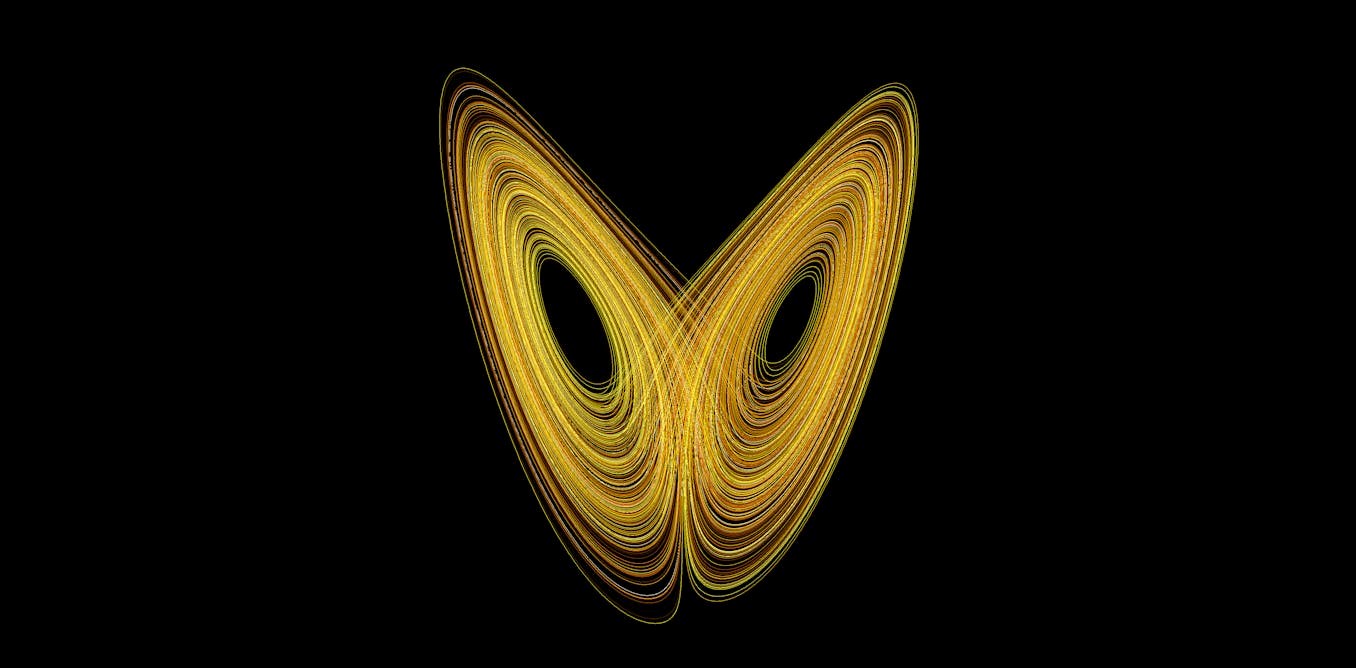
A beautiful and surprisingly complex pattern produced by ‘mathematical billiards’

Albers et al. PRL 2024

In a mathematical version of billiards, particles that avoid retracing their paths get trapped in intricate and hard-to-predict patterns – which might eventually help us understand the complex movement patterns of living organisms.

When searching for food, animals including ants and slime moulds leave chemical trails in their environment, which helps them avoid accidentally retracing their steps. This behaviour is not uncommon in biology, but when Maziyar Jalaal at the University of Amsterdam in the Netherlands and his colleagues modelled it as a simple mathematical problem, they uncovered an unexpected amount of complexity and chaos.

They used the framework of mathematical billiards, where an infinitely small particle bounces between the edges of a polygonal “table” without friction. Additionally, they gave the particle “spatial memory” – if it reached a point where it had already been before, it would reflect off it as if there was a wall there.

The researchers derived equations describing the motion of the particle and then used them to simulate this motion on a computer. They ran over 200 million simulations to see the path the particle would take inside different polygons – like a triangle and a hexagon – over time. Jalaal says that though the model was simple, idealised and deterministic, what they found was extremely intricate.

Within each polygon, the team identified regions where the particle was likely to become trapped after bouncing around for a long time due to its “remembering” its past trajectories, but zooming in on those regions revealed yet more patterns of motion.

“So, the patterns that you see if you keep zooming in, there is no end to them. And they don’t repeat, they’re not like fractals,” says Jalaal.

Katherine Newhall at the University of North Carolina at Chapel Hill says the study is an “interesting mental exercise” but would have to include more detail to accurately represent organisms and objects that have spatial memory in the real world. For instance, she says that a realistic particle would eventually travel in an imperfectly straight line or experience friction, which could radically change or even eradicate the patterns that the researchers found.

For more such insights, log into www.international-maths-challenge.com.

*Credit for article given to Karmela Padavic-Callaghan*


Mathematician Wins Turing Award For Harnessing Randomness

Avi Wigderson has won the 2023 Turing award for his work on understanding how randomness can shape and improve computer algorithms.

The mathematician Avi Wigderson has won the 2023 Turing award, often referred to as the Nobel prize for computing, for his work on understanding how randomness can shape and improve computer algorithms.

Wigderson, who also won the prestigious Abel prize in 2021 for his mathematical contributions to computer science, was taken aback by the award. “The [Turing] committee fooled me into believing that we were going to have some conversation about collaborating,” he says. “When I zoomed in, the whole committee was there and they told me. I was excited, surprised and happy.”

Computers work in a predictable way at the hardware level, but this can make it difficult for them to model real-world problems, which often have elements of randomness and unpredictability. Wigderson, at the Institute for Advanced Study in Princeton, New Jersey, has shown over a decades-long career that computers can also harness randomness in the algorithms that they run.

In the 1980s, Wigderson and his colleagues discovered that by inserting randomness into some algorithms, they could make them easier and faster to solve, but it was unclear how general this technique was. “We were wondering whether this randomness is essential, or maybe you can always get rid of it somehow if you’re clever enough,” he says.

One of Wigderson’s most important discoveries was making clear the relationship between types of problems, in terms of their difficulty to solve, and randomness. He also showed that certain algorithms that contained randomness and were hard to run could be made deterministic, or non-random, and easier to run.

These findings helped computer scientists better understand one of the most famous unproven conjectures in computer science, called “P ≠ NP”, which proposes that easy and hard problems for a computer to solve are fundamentally different. Using randomness, Wigderson discovered special cases where the two classes of problem were the same.

Wigderson first started exploring the relationship between randomness and computers in the 1980s, before the internet existed, and was attracted to the ideas he worked on by intellectual curiosity, rather than how they might be used. “I’m a very impractical person,” he says. “I’m not really motivated by applications.”

However, his ideas have become important for a wide swath of modern computing applications, from cryptography to cloud computing. “Avi’s impact on the theory of computation in the last 40 years is second to none,” says Oded Goldreich at the Weizmann Institute of Science in Israel. “The diversity of the areas to which he has contributed is stunning.”

One of the unexpected ways in which Wigderson’s ideas are now widely used was his work, with Goldreich and others, on zero-knowledge proofs, which detail ways of verifying information without revealing the information itself. These methods are fundamental for cryptocurrencies and blockchains today as a way to establish trust between different users.

Although great strides in the theory of computation have been made over Wigderson’s career, he says that the field is still full of interesting and unsolved problems. “You can’t imagine how happy I am that I am where I am, in the field that I’m in,” he says. “It’s bursting with intellectual questions.”

Wigderson will receive a $1 million prize as part of the Turing award.

For more such insights, log into www.international-maths-challenge.com.

*Credit for article given to Alex Wilkins*


Mathematicians Are Bitterly Divided Over A Controversial Proof

An attempt to settle a decade-long argument over a controversial proof by mathematician Shinichi Mochizuki has seen a war of words on both sides, with Mochizuki dubbing the latest effort as akin to a “hallucination” produced by ChatGPT,

An attempt to fix problems with a controversial mathematical proof has itself become mired in controversy, in the latest twist in a saga that has been running for over a decade and has seen mathematicians trading unusually pointed barbs.

The story began in 2012, when Shinichi Mochizuki at Kyoto University, Japan, published a 500-page proof of a problem called the ABC conjecture. The conjecture concerns prime numbers involved in solutions to the equation a + b = c, and despite its seemingly simple form, it provides deep insights into the nature of numbers. Mochizuki published a series of papers claiming to have proved ABC using new mathematical tools he collectively called Inter-universal Teichmüller (IUT) theory, but many mathematicians found the initial proof baffling and incomprehensible.

While a small number of mathematicians have since accepted that Mochizuki’s papers prove the conjecture, other researchers say there are holes in his argument and it needs further work, dividing the mathematical community in two and prompting a prize of up to $1 million for a resolution to the quandary.

Now, Kirti Joshi at the University of Arizona has published a proposed proof that he says fixes the problems with IUT and proves the ABC conjecture. But Mochizuki and his supporters, as well as mathematicians who critiqued Mochizuki’s original papers, remain unconvinced, with Mochizuki declaring that Joshi’s proposal doesn’t contain “any meaningful mathematical content whatsoever”.

Central to Joshi’s work is an apparent problem, previously identified by Peter Scholze at the University of Bonn, Germany, and Jakob Stix at Goethe University Frankfurt, Germany, with a part of Mochizuki’s proof called Conjecture 3.12. The conjecture involves comparing two mathematical objects, which Scholze and Stix say Mochizuki did incorrectly. Joshi claims to have found a more satisfactory way to make the comparison.

Joshi also says that his theory goes beyond Mochizuki’s and establishes a “new and radical way of thinking about arithmetic of number fields”. The paper, which hasn’t been peer-reviewed, is the culmination of several smaller papers on ABC that Joshi has published over several years, describing them as a “Rosetta Stone” for understanding Mochizuki’s impenetrable maths.

Neither Joshi nor Mochizuki responded to a request for comment on this article, and, indeed, the two seem reluctant to communicate directly with each other. In his paper, Joshi says Mochizuki hasn’t responded to his emails, calling the situation “truly unfortunate”. And yet, several days after the paper was posted online, Mochizuki published a 10-page response, saying that Joshi’s work was “mathematically meaningless” and that it reminded him of “hallucinations produced by artificial intelligence algorithms, such as ChatGPT”.

Mathematicians who support Mochizuki’s original proof express a similar sentiment. “There is nothing to talk about, since his [Joshi’s] proof is totally flawed,” says Ivan Fesenko at Westlake University in China. “He has no expertise in IUT whatsoever. No experts in IUT, and the number is in two digits, takes his preprints seriously,” he says. “It won’t pass peer review.”

And Mochizuki’s critics also disagree with Joshi. “Unfortunately, this paper and its predecessors does not introduce any powerful mathematical technology, and falls far short of giving a proof of ABC,” says Scholze, who has emailed Joshi to discuss the work further. For now, the saga continues.

For more such insights, log into www.international-maths-challenge.com.

*Credit for article given to Alex Wilkins*


Try These Mathematical Magic Tricks That Are Guaranteed To Work

There are no rabbits pulled out of hats here – these tricks rely on mathematical principles and will never fail you, says Peter Rowlett.

LOOK, I’ve got nothing up my sleeves. There are magic tricks that work by sleight of hand, relying on the skill of the performer and a little psychology. Then there are so-called self-working magic tricks, which are guaranteed to work by mathematical principles.

For example, say I ask you to write down a four-digit number and show me. I will write a prediction but keep it secret. Write another four-digit number and show me, then I will write one and show you. Now, sum the three visible numbers and you may be surprised to find the answer matches the prediction I made when I had only seen one number!

The trick is that while the number I wrote and showed you appeared random, I was actually choosing digits that make 9 when added to the digits of your second number. So if you wrote 3295, I would write 6704. This means the two numbers written after I made my prediction sum to 9999. So, my prediction was just your original number plus 9999. This is the same as adding 10,000 and subtracting 1, so I simply wrote a 1 to the left of your number and decreased the last digit by 1. If you wrote 2864, I would write 12863 as my prediction.

Another maths trick involves a series of cards with numbers on them (pictured). Someone thinks of a number and tells you which of the cards their number appears on. Quick as a flash, you tell them their number. You haven’t memorised anything; the trick works using binary numbers.

Regular numbers can be thought of as a series of columns containing digits, with each being 10 times the previous. So the right-most digit is the ones, to its left is the tens, then the hundreds, and so on. Binary numbers also use columns, but with each being worth two times the one to its right. So 01101 means zero sixteens, one eight, one four, zero twos and one one: 8+4+1=13.

Each card in this trick represents one of the columns in a binary number, moving from right to left: card 0 is the ones column, card 1 is the twos column, etc. Numbers appear on a card if their binary equivalent has a 1 in that place, and are omitted if it has a 0 there. For instance, the number 25 is 11001 in binary, so it is on cards 0, 3 and 4.

You can work this trick by taking the cards the person’s number appears on and converting them to their binary columns. From there, you can figure out the binary number and convert it to its regular number. But here’s a simple shortcut: the binary column represented by each card is the first number on the card, so you can just add the first number that appears on the cards the person names. So, for cards 0 and 2, you would add 1 and 4 to get 5.

Many self-working tricks embed mathematical principles in card magic, memorisation tricks or mind-reading displays, making the maths harder to spot. The key is they work every time.

For more such insights, log into www.international-maths-challenge.com.

*Credit for article given to Peter Rowlett*


Mathematicians Plan Computer Proof Of Fermat’s Last Theorem

Fermat’s last theorem puzzled mathematicians for centuries until it was finally proven in 1993. Now, researchers want to create a version of the proof that can be formally checked by a computer for any errors in logic.

Mathematicians hope to develop a computerised proof of Fermat’s last theorem, an infamous statement about numbers that has beguiled them for centuries, in an ambitious, multi-year project that aims to demonstrate the potential of computer-assisted mathematical proofs.

Pierre de Fermat’s theorem, which he first proposed around 1640, states that there are no integers, or whole numbers, a, b, and c that satisfy the equation an + bn = cn for any integer n greater than 2. Fermat scribbled the claim in a book, famously writing: “I have discovered a truly marvellous proof of this, which this margin is too narrow to contain.”

It wasn’t until 1993 that Andrew Wiles, then at Princeton University, set the mathematical world alight by announcing he had a proof. Spanning more than 100 pages, the proof contained such advanced mathematics that it took more than two years for his colleagues to verify it didn’t contain any errors.

Many mathematicians hope that this work of checking, and eventually writing, proofs can be sped up by translating them into a computer-readable language. This process of formalisation would let computers instantly spot logical mistakes and, potentially, use the theorems as building blocks for other proofs.

But formalising modern proofs can itself be tricky and time-consuming, as much of the modern maths they rely on is yet to be made machine-readable. For this reason, formalising Fermat’s last theorem has long been considered far out of reach. “It was regarded as a tremendously ambitious proof just to prove it in the first place,” says Lawrence Paulson at the University of Cambridge.

Now, Kevin Buzzard at Imperial College London and his colleagues have announced plans to take on the challenge, attempting to formalise Fermat’s last theorem in a programming language called Lean.

“There’s no point in Fermat’s last theorem, it’s completely pointless. It doesn’t have any applications – either theoretical or practical – in the real world,” says Buzzard. “But it’s also a really hard question that’s become infamous because, for centuries, people have generated loads of brilliant new ideas in an attempt to solve it.”

He hopes that by formalising many of these ideas, which now include routine mathematical tools in number theory such as modular forms and Galois representations, it will help other researchers whose work is currently too far beyond the scope of computer assistants.

“It’s the kind of project that could have quite far-reaching and unexpected benefits and consequences,” says Chris Williams at the University of Nottingham, UK.

The proof itself will loosely follow Wiles’s, with slight modifications. A publicly available blueprint will be available online once the project is live, in April, so that anyone from Lean’s fast-growing community can contribute to formalising sections of the proof.

“Ten years ago, this would have taken an infinite amount of time,” says Buzzard. Even so, he will be concentrating on the project full-time from October, putting his teaching responsibilities on hold for five years in an effort to complete it.

“I think it’s unlikely he’ll be able to formalise the entire proof in the next five years, that would be a staggering achievement,” says Williams. “But because a lot of the tools that go into it are so ubiquitous now in number theory and arithmetic geometry, I’d expect any substantial progress towards it would be very useful in the future.”

For more such insights, log into www.international-maths-challenge.com.

*Credit for article given to Alex Wilkins*


These 7 Mathematical Facts Will Blow Your Mind

What better way is there to celebrate pi day than with a slice of mathematics? Here are 7 mathematical facts to enjoy.

There’s a mathematical trick to get out of any maze

It will soon be 14 March and that means pi day. We like to mark this annual celebration of the great mathematical constant at New Scientist by remembering some of our favourite recent stories from the world of mathematics. We have extracted a list of surprising facts from them to whet your appetite, but for the full pi day feast click through for the entire articles. These are normally only available to subscribers but to honour the world’s circumferences and diameters we have decided to make them free for a limited time.

The world’s best kitchen tile

There is a shape called “the hat” that can completely cover a surface without ever creating a repeating pattern. For decades, mathematicians had wondered whether a single tile existed that could do such a thing. Roger Penrose discovered pairs of tiles in the 1970s that could do the job but nobody could find a single tile that when laid out would have the same effect. That changed when the hat was discovered last year.

Why you’re so unique

You are one in a million. Or really, it should be 1 in a 1010^68.  This number, dubbed the doppelgängion by mathematician Antonio Padilla, is so large it is hard to wrap your head around. It is 1 followed by 100 million trillion trillion trillion trillion trillion zeroes and relates to the chances of finding an exact you somewhere else in the universe. Imagining a number of that size is so difficult that the quantum physics required to calculate it seems almost easy in comparison. There are only a finite number of quantum states that can exist in a you-sized portion of space. You reach the doppelgängion by adding them all up. Padilla also wrote about four other mind-blowing numbers for New Scientist. Here they all are.

An amazing trick

There is a simple mathematical trick that will get you out of any maze: always turn right. No matter how complicated the maze, how many twists, turns and dead ends there are, the method always works. Now you know the trick, can you work out why it always leads to success?

And the next number is

There is a sequence of numbers so difficult to calculate that mathematicians have only just found the ninth in the series and it may be impossible to calculate the tenth. These numbers are called Dedekind numbers after mathematician Richard Dedekind and describe the number of possible ways a set of logical operations can be combined. When the set contains just a few elements, calculating the corresponding Dedekind number is relatively straightforward, but as the number of elements increases, the Dedekind number grows at “double exponential speed”. Number nine in the series is 42 digits long and took a month of calculation to find.

Can’t see the forest for the TREE(3)

There is a number so big that in can’t fit in the universe. TREE(3) comes from a simple mathematical game. The game involves generating a forest of trees using different combinations of seeds according to a few simple rules. If you have one type of seed, the largest forest allowed can have one tree. For two types of seed, the largest forest is three trees. But for three types of seed, well, the largest forest has TREE(3) trees, a number that is just too big for the universe.

The language of the universe

There is a system of eight-dimensional numbers called octonions that physicists are trying to use to mathematically describe the universe. The best way to understand octonions is first to consider taking the square root of -1. There is no such number that is the result of that calculation among the real numbers (which includes all the counting numbers, fractions, numbers like pi, etc.), so mathematicians add another called i. When combined with the real numbers, this gives a system called the complex numbers, which consist of a real part and an “imaginary part”, such as 3+7i. In other words, it is two-dimensional. Octonions arise by continuing to build up the system until you get to eight dimensions. It isn’t just mathematical fun and games though – there is reason to believe that octonions may be the number system we need to understand the laws of nature.

So many new solutions

Mathematicians went looking for solutions to the three-body problem and found 12,000 of them. The three-body problem is a classic astronomy problem of how three objects can form a stable orbit around each other. Such an arrangement is described by Isaac Newton’s laws of motion but actually finding permissible solutions is incredibly difficult. In 2007, mathematicians managed to find 1223 new solutions to the problem but this was greatly surpassed last year when a team found more than 12,000 more.

For more such insights, log into www.international-maths-challenge.com.

*Credit for article given to Timothy Revell*


How The Maths Behind Honeycombs Can Help You Work A Jigsaw Puzzle

Maths tells us the best way to cover a surface with copies of a shape – even when it comes to jigsaw puzzles, says Katie Steckles.

WHAT do a bathroom wall, a honeycomb and a jigsaw puzzle have in common? Obviously, the answer is mathematics.

If you are trying to cover a surface with copies of a shape – say, for example, you are tiling a bathroom – you ideally want a shape like a square or rectangle. They will cover the whole surface with no gaps, which is why these boring shapes get used as wall tiles so often.

But if your shapes don’t fit together exactly, you can still try to get the best coverage possible by arranging them in an efficient way.

Imagine trying to cover a surface with circular coins. The roundness of the circles means there will be gaps between them. For example, we could use a square grid, placing the coins on the intersections. This will cover about 78.5 per cent of the area.

But this isn’t the most efficient way: in 1773, mathematician Joseph-Louis Lagrange showed that the optimal arrangement of circles involves a hexagonal grid, like the cells in a regular honeycomb – neat rows where each circle sits nestled between the two below it.

In this situation, the circles will cover around 90.7 per cent of the space, which is the best you can achieve with this shape. If you ever need to cover a surface with same-size circles, or pack identical round things into a tray, the hexagon arrangement is the way to go.

But this isn’t just useful knowledge if you are a bee: a recent research paper used this hexagonal arrangement to figure out the optimal size table for working a jigsaw puzzle. The researchers calculated how much space would be needed to lay out the pieces of an unsolved jigsaw puzzle, relative to the solved version. Puzzle pieces aren’t circular, but they can be in any orientation and the tabs sticking out stop them from moving closer together, so each takes up a theoretically circular space on the table.

By comparing the size of the central rectangular section of the jigsaw piece to the area it would take up in the hexagonal arrangement, the paper concluded that an unsolved puzzle takes up around 1.73 times as much space.

This is the square root of three (√3), a number with close connections to the regular hexagon – one with a side length of 1 will have a height of √3. Consequently, there is also a √3 in the formula for the hexagon’s area, which is 3/2 × √3 × s2, where s is the length of a side. This is partly why it pops out, after some fortuitous cancellation, as the answer here.

So if you know the dimensions of a completed jigsaw puzzle, you can figure out what size table you need to lay out all the pieces: multiply the width and height, then multiply that by 1.73. For this ingenious insight, we can thank the bees.

For more such insights, log into www.international-maths-challenge.com.

*Credit for article given to Katie Steckles*


Understanding how the brain works can transform how school students learn maths

School mathematics teaching is stuck in the past. An adult revisiting the school that they attended as a child would see only superficial changes from what they experienced themselves.

Yes, in some schools they might see a room full of electronic tablets, or the teacher using a touch-sensitive, interactive whiteboard. But if we zoom in on the details – the tasks that students are actually being given to help them make sense of the subject – things have hardly changed at all.

We’ve learnt a huge amount in recent years about cognitive science – how our brains work and how people learn most effectively. This understanding has the potential to revolutionise what teachers do in classrooms. But the design of mathematics teaching materials, such as textbooks, has benefited very little from this knowledge.

Some of this knowledge is counter-intuitive, and therefore unlikely to be applied unless done so deliberately. What learners prefer to experience, and what teachers think is likely to be most effective, often isn’t what will help the most.

For example, cognitive science tells us that practising similar kinds of tasks all together generally leads to less effective learning than mixing up tasks that require different approaches.

In mathematics, practising similar tasks together could be a page of questions each of which requires addition of fractions. Mixing things up might involve bringing together fractions, probability and equations in immediate succession.

Learners make more mistakes when doing mixed exercises, and are likely to feel frustrated by this. Grouping similar tasks together is therefore likely to be much easier for the teacher to manage. But the mixed exercises give the learner important practice at deciding what method they need to use for each question. This means that more knowledge is retained afterwards, making this what is known as a “desirable difficulty”.

Cognitive science applied

We are just now beginning to apply findings like this from cognitive science to design better teaching materials and to support teachers in using them. Focusing on school mathematics makes sense because mathematics is a compulsory subject which many people find difficult to learn.

Typically, school teaching materials are chosen by gut reactions. A head of department looks at a new textbook scheme and, based on their experience, chooses whatever seems best to them. What else can they be expected to do? But even the best materials on offer are generally not designed with cognitive science principles such as “desirable difficulties” in mind.

My colleagues and I have been researching educational designthat applies principles from cognitive science to mathematics teaching, and are developing materials for schools. These materials are not designed to look easy, but to include “desirable difficulties”.

They are not divided up into individual lessons, because this pushes the teacher towards moving on when the clock says so, regardless of student needs. Being responsive to students’ developing understanding and difficulties requires materials designed according to the size of the ideas, rather than what will fit conveniently onto a double-page spread of a textbook or into a 40-minute class period.

Switching things up

Taking an approach led by cognitive science also means changing how mathematical concepts are explained. For instance, diagrams have always been a prominent feature of mathematics teaching, but often they are used haphazardly, based on the teacher’s personal preference. In textbooks they are highly restricted, due to space constraints.

Often, similar-looking diagrams are used in different topics and for very different purposes, leading to confusion. For example, three circles connected as shown below can indicate partitioning into a sum (the “part-whole model”) or a product of prime factors.

These involve two very different operations, but are frequently represented by the same diagram. Using the same kind of diagram to represent conflicting operations (addition and multiplication) leads to learners muddling them up and becoming confused.

Number diagrams showing numbers that add together to make six and numbers that multiply to make six. Colin Foster

The “coherence principle” from cognitive science means avoiding diagrams where their drawbacks outweigh their benefits, and using diagrams and animations in a purposeful, consistent way across topics.

For example, number lines can be introduced at a young age and incorporated across many topic areas to bring coherence to students’ developing understanding of number. Number lines can be used to solve equations and also to represent probabilities, for instance.

Unlike with the circle diagrams above, the uses of number lines shown below don’t conflict but reinforce each other. In each case, positions on the number line represent numbers, from zero on the left, increasing to the right.

A number line used to solve an equation. Colin Foster

A number line used to show probability. Colin Foster

There are disturbing inequalities in the learning of mathematics, with students from poorer backgrounds underachieving relative to their wealthier peers. There is also a huge gender participation gap in maths, at A-level and beyond, which is taken by far more boys than girls.

Socio-economically advantaged families have always been able to buy their children out of difficulties by using private tutors, but less privileged families cannot. Better-quality teaching materials, based on insights from cognitive science, mitigate the impact for students who have traditionally been disadvantaged by gender, race or financial background in the learning of mathematics.

For more such insights, log into our website https://international-maths-challenge.com

Credit of the article given to SrideeStudio/Shutterstock


Pythagoras Was Wrong About The Maths Behind Pleasant Music

It is said that the ancient Greek philosopher Pythagoras came up with the idea that musical note combinations sound best in certain mathematical ratios, but that doesn’t seem to be true.

Pythagoras has influenced Western music for millennia

An ancient Greek belief about the most pleasing combinations of musical notes – often attributed to the philosopher Pythagoras – doesn’t actually reflect the way people around the world appreciate harmony, researchers have found. Instead, Pythagoras’s mathematical arguments may merely have been taken as fact and used to assert the superiority of Western culture.

According to legend, Pythagoras found that the ringing sounds of a blacksmith’s hammers sounded most pleasant, or “consonant”, when the ratio between the size of two tools involved two integers, or whole numbers, such as 3:2.

This idea has shaped how Western musicians play chords, because the philosopher’s belief that listeners prefer music played in perfect mathematical ratios was so influential. “Consonance is a really important concept in Western music, in particular for telling us how we build harmonies,” says Peter Harrison at the University of Cambridge.

But when Harrison and his colleagues surveyed 4272 people in the UK and South Korea about their perceptions of music, their findings flew in the face of this ancient idea.

In one experiment, participants were played musical chords and asked to rate how pleasant they seemed. Listeners were found to slightly prefer sounds with an imperfect ratio. Another experiment discovered little difference in appeal between the sounds made by instruments from around the world, including the bonang, an Indonesian gong chime, which produces harmonies that cannot be replicated on a Western piano.

While instruments like the bonang have traditionally been called “inharmonic” by Western music culture, study participants appreciated the sounds the instrument and others like it made. “If you use non-Western instruments, you start preferring different harmonies,” says Harrison.

“It’s fascinating that music can be so universal yet so diverse at the same time,” says Patrick Savage at the University of Auckland, New Zealand. He says that the current study also contradicts previous research he did with some of the same authors, which found that integer ratio-based rhythms are surprisingly universal.

Michelle Phillips at the Royal Northern College of Music in Manchester, UK, points out that the dominance of Pythagorean tunings, as they are known, has been in question for some time. “Research has been hinting at this for 30 to 40 years, as music psychology has grown as a discipline,” she says. “Over the last fifteenish years, people have undertaken more work on music in the whole world, and we now know much more about non-Western pitch perception, which shows us even more clearly how complex perception of harmony is.”

Harrison says the findings tell us both that Pythagoras was wrong about music – and that music and music theory have been too focused on the belief that Western views are held worldwide. “The idea that simple integer ratios are superior could be framed as an example of mathematical justification for why we’ve got it right over here,” he says. “What our studies are showing is that, actually, this is not an inviolable law. It’s something that depends very much on the way in which you’re playing music.”

For more such insights, log into www.international-maths-challenge.com.

*Credit for article given to Chris Stokel-Walker*