
How good are South African kids at maths? Trends from a global study

School mathematics in South Africa is often seen as a sign of the health of the education system more generally. Under the racial laws of apartheid, until 1994, African people were severely restricted from learning maths. Tracking the changes in maths performance is a measure of how far the country has travelled in overcoming past injustices. Maths is also an essential foundation for meeting the challenges of the future, like artificial intelligence, climate change, energy and sustainable development.

Here, education researcher Vijay Reddy takes stock of South Africa’s mathematical capabilities. She reports on South African maths performance at grades 5 (primary school) and 9 (secondary school) in the Trends in International Mathematics and Science Study (TIMSS) and examines the gender gaps in mathematics achievement

What was unusual about the latest TIMSS study?

The study is conducted every four years. South Africa has participated in it at the secondary phase since 1995 and at the primary phase since 2015. The period between the 2019 and 2023 cycles was characterised by the onset of the COVID-19 pandemic, social distancing and school closures.

The Department of Basic Education estimated that an average of 152 school contact days were lost in 2020 and 2021. South Africa was among the countries with the highest school closures, along with Colombia, Costa Rica and Brazil. At the other end, European countries lost fewer than 50 days.

Some academics measured the extent of learning losses for 2020 and 2021 school closures, but there were no models to estimate subsequent learning losses. We can get some clues of the effects on learning over four years, by comparing patterns within South Africa against the other countries.

How did South African learners (and others) perform in the maths study?

The South African grade 9 mathematics achievement improved by 8 points from 389 in TIMSS 2019 to 397 in 2023. From the trends to TIMSS 2019, we had predicted a mathematics score of 403 in 2023.

For the 33 countries that participated in both the 2019 and 2023 secondary school TIMSS cycles, the average achievement decreased by 9 points from 491 in 2019 to 482 to 2023. Only three countries showed significant increases (United Arab Emirates, Romania and Sweden). There were no significant changes in 16 countries (including South Africa). There were significant decreases in 14 countries.

Based on these numbers, it would seem, on the face of it at least, that South Africa weathered the COVID-19 losses better than half the other countries.

However, the primary school result patterns were different. For South African children, there was a significant drop in mathematics achievement by 12 points, from 374 in 2019 to 362 in 2023. As expected, the highest decreases were in the poorer, no-fee schools.

Of the 51 countries that participated in both TIMSS 2019 and 2023, the average mathematics achievement score over the two cycles was similar. There were no significant achievement changes in 22 countries, a significant increase in 15 countries, and a significant decrease in 14 countries (including South Africa).

So, it seems that South African primary school learners suffered adverse learning effects over the two cycles.

The increase in achievement in secondary school and decrease in primary school was unexpected. These reasons for the results may be that secondary school learners experienced more school support compared with primary schools, or were more mature and resilient, enabling them to recover from the learning losses experienced during COVID-19. Learners in primary schools, especially poorer schools, may have been more affected by the loss of school contact time and had less support to fully recover during this time.

This pattern may also be due to poor reading and language skills as well as lack of familiarity with this type of test.

Does gender make a difference?

There is an extant literature indicating that globally boys are more likely to outperform girls in maths performance.

But in South African primary schools, girls outscore boys in both mathematics and reading. Girls significantly outscored boys by an average of 29 points for mathematics (TIMSS) and by 49 points for reading in the 2021 Progress in International Reading Study, PIRLS.

These patterns need further exploration. Of the 58 countries participating in TIMSS at primary schools, boys significantly outscored girls in 40 countries, and there were no achievement differences in 17 countries. South Africa was the only country where the girls significantly outscored boys. In Kenya, Zimbabwe, Zambia and Mozambique, the Southern and Eastern Africa Consortium for Monitoring Educational Quality (SEACMEQ) reading scores are similar for girls and boys, while the boys outscore girls in mathematics. In Botswana, girls outscore boys in reading and mathematics, but the gender difference is much smaller.

In secondary schools, girls continue to outscore boys, but the gap drops to 8 points. Of the 42 TIMSS countries, boys significantly outscored girls in maths in 21 countries; there were no significant difference in 17 countries; and girls significantly outscored boys in only four countries (South Africa, Palestine, Oman, Bahrain).

In summary, the South African primary school achievement trend relative to secondary school is unexpected and requires further investigation. It seems that as South African learners get older, they acquire better skills in how to learn, read and take tests to achieve better results. Results from lower grades should be used cautiously to predict subsequent educational outcomes.

Unusually, in primary schools, there is a big gender difference for mathematics achievement favouring girls. The gender difference persists to grade 9, but the extent of the difference decreases. As learners, especially boys, progress through their education system they seem to make up their learning shortcomings and catch up.

The national mathematics picture would look much better if boys and girls performed at the same level from primary school, suggesting the importance of interventions in primary schools, especially focusing on boys.

For more such insights, log into www.international-maths-challenge.com.

*Credit for article given to Vijay Reddy*


What’s the shape of the universe? Mathematicians use topology to study the shape of the world and everything in it

You can describe the shape you live on in multiple dimensions. vkulieva/iStock via Getty Images Plus

When you look at your surrounding environment, it might seem like you’re living on a flat plane. After all, this is why you can navigate a new city using a map: a flat piece of paper that represents all the places around you. This is likely why some people in the past believed the earth to be flat. But most people now know that is far from the truth.

You live on the surface of a giant sphere, like a beach ball the size of the Earth with a few bumps added. The surface of the sphere and the plane are two possible 2D spaces, meaning you can walk in two directions: north and south or east and west.

What other possible spaces might you be living on? That is, what other spaces around you are 2D? For example, the surface of a giant doughnut is another 2D space.

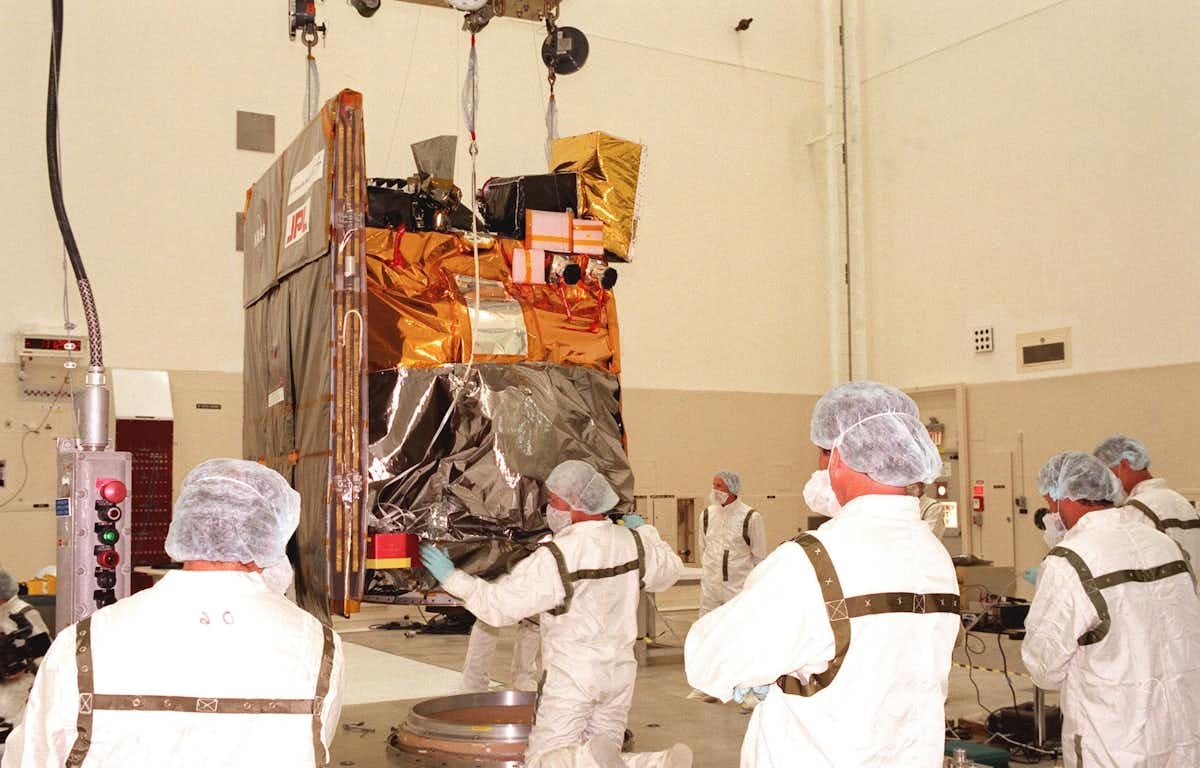
Through a field called geometric topology, mathematicians like me study all possible spaces in all dimensions. Whether trying to design secure sensor networks, mine data or use origami to deploy satellites, the underlying language and ideas are likely to be that of topology.

The shape of the universe

When you look around the universe you live in, it looks like a 3D space, just like the surface of the Earth looks like a 2D space. However, just like the Earth, if you were to look at the universe as a whole, it could be a more complicated space, like a giant 3D version of the 2D beach ball surface or something even more exotic than that.

A doughnut, also called a torus, is a shape that you can move across in two directions, just like the surface of the Earth. YassineMrabet via Wikimedia Commons, CC BY-NC-SA

While you don’t need topology to determine that you are living on something like a giant beach ball, knowing all the possible 2D spaces can be useful. Over a century ago, mathematicians figured out all the possible 2D spaces and many of their properties.

In the past several decades, mathematicians have learned a lot about all of the possible 3D spaces. While we do not have a complete understanding like we do for 2D spaces, we do know a lot. With this knowledge, physicists and astronomers can try to determine what 3D space people actually live in.

While the answer is not completely known, there are many intriguing and surprising possibilities. The options become even more complicated if you consider time as a dimension.

To see how this might work, note that to describe the location of something in space – say a comet – you need four numbers: three to describe its position and one to describe the time it is in that position. These four numbers are what make up a 4D space.

Now, you can consider what 4D spaces are possible and in which of those spaces do you live.

Topology in higher dimensions

At this point, it may seem like there is no reason to consider spaces that have dimensions larger than four, since that is the highest imaginable dimension that might describe our universe. But a branch of physics called string theory suggests that the universe has many more dimensions than four.

There are also practical applications of thinking about higher dimensional spaces, such as robot motion planning. Suppose you are trying to understand the motion of three robots moving around a factory floor in a warehouse. You can put a grid on the floor and describe the position of each robot by their x and y coordinates on the grid. Since each of the three robots requires two coordinates, you will need six numbers to describe all of the possible positions of the robots. You can interpret the possible positions of the robots as a 6D space.

As the number of robots increases, the dimension of the space increases. Factoring in other useful information, such as the locations of obstacles, makes the space even more complicated. In order to study this problem, you need to study high-dimensional spaces.

There are countless other scientific problems where high-dimensional spaces appear, from modeling the motion of planets and spacecraft to trying to understand the “shape” of large datasets.

Tied up in knots

Another type of problem topologists study is how one space can sit inside another.

For example, if you hold a knotted loop of string, then we have a 1D space (the loop of string) inside a 3D space (your room). Such loops are called mathematical knots.

The study of knots first grew out of physics but has become a central area of topology. They are essential to how scientists understand 3D and 4D spaces and have a delightful and subtle structure that researchers are still trying to understand.

Knots are examples of spaces that sit inside other spaces. Jkasd/Wikimedia Commons

In addition, knots have many applications, ranging from string theory in physics to DNA recombination in biology to chirality in chemistry.

What shape do you live on?

Geometric topology is a beautiful and complex subject, and there are still countless exciting questions to answer about spaces.

For example, the smooth 4D Poincaré conjecture asks what the “simplest” closed 4D space is, and the slice-ribbon conjecture aims to understand how knots in 3D spaces relate to surfaces in 4D spaces.

Topology is currently useful in science and engineering. Unraveling more mysteries of spaces in all dimensions will be invaluable to understanding the world in which we live and solving real-world problems.

For more such insights, log into www.international-maths-challenge.com.

*Credit for article given to John Etnyre*


Boys not only perform better in maths, they are also more confident about the subject than girls

Michael Jung/ Shutterstock

There is a persistent gender gap in Australian schools. Boys, on average, outperform girls in maths.

We see this in national tests such as NAPLAN, as well as international assessments.

New Australian Council for Educational Research analysis by my colleague Catherine Underwood shows how boys, on average, are also more confident and positive about maths than girls.

What can parents do to help their children feel more confident about this core subject?

Boys outperform girls in maths

An important measure of students’ maths performance is the OECD’s Programme for International Assessment (PISA) test. Run every three years, it measures 15-year-olds’ ability to apply their maths, science and reading knowledge to real-world situations.

In 2022, 53% of Australian male students achieved the PISA national proficiency standard in maths, compared with 48% of female students. The gender gap on average scores was also greater in Australia than across the OECD.

As part of PISA, students also completed a questionnaire about their attitudes to learning. ACER’s new analysis uses data from the questionnaire to look at Australian students’ confidence in maths and how this differs between girls and boys.

Boys outperformed girls in maths skills in the most recent PISA test. Monkey Business Images/ Shutterstock

Why is confidence so important?

Research suggests students’ confidence has an impact on their academic performance. Researchers can call this “self-efficacy”, or the belief in your ability to successfully perform tasks and solve problems.

Students with high mathematical self-efficacy embrace challenges, use effective problem-solving strategies, and persevere despite difficulties. Those with low self-efficacy may avoid tasks, experience anxiety, and ultimately underperform due to a lack of confidence in their maths abilities.

We can see this in the 2022 PISA results. Girls in the top quarter on the self-rated “self-efficacy index” scored an average of 568 points on the PISA maths performance test, a staggering 147 points higher than the average for girls in the lowest quarter on the index.

For boys, the benefit of confidence was even more pronounced. Those in the top quarter of the index scored 159 points on average higher in maths performance than those in the lowest quarter.

Boys are more confident than girls

The PISA questionnaire asked students how confident they felt about having to do a range of formal and applied maths tasks.

Students showed similar levels of confidence solving formal maths tasks such as equations. But male students, on average, showed they were more confident than female students with applied mathematics tasks such as:

  • finding distances using a map
  • calculating a power consumption rate
  • calculating how much more expensive a computer would be after adding tax
  • calculating how many square metres of tiles are needed to cover a floor.

What about attitude?

The PISA data also shows Australian boys, on average, have more positive attitudes towards maths than girls.

For example, in response to the statement “mathematics is easy for me” only 41% of female students agreed, compared with 55% of male students.

In response to “mathematics is one of my favourite subjects”, 37% of female students agreed, compared with 49% of males.

But in response to “I want to do well in my mathematics class”, 91% of female students agreed, compared to 92% of males.

What can parents do at home to help?

It is troubling that girls, on average, show consistently lower levels of confidence about maths tasks.

This comes on top of other PISA questionnaire results that have shown in general (not just around maths) that a higher proportion of girls than boys say they feel nervous approaching exams.

We want all students to have a positive relationship with maths, where they can appreciate maths skills are important in many aspects of their lives, and they’re willing to have a go to develop them.

Recently, we collaborated with the Victorian Academy of Teaching and Leadership on resources for teachers, students and parents that focus on addressing maths anxiety.

Research shows how we talk about maths at home is important in shaping students’ attitudes and persistence. Parents can help create a positive atmosphere around maths by:

  • dispelling “maths myths”, such as the idea maths ability is fixed and no amount of effort or practise can improve it
  • talking about how making mistakes is a normal part of learning
  • thinking about about how we forgive mistakes in other areas (such as sport, art or science): how can we treat maths mistakes in a similar way?
  • telling your child they have done a good job when they put effort into their maths learning.

Parents can also help their children even if they don’t know the answers to maths problems. It’s perfectly fine to say, “I’m not sure how to do that one but who can we ask for help? Let’s talk to the teacher.”

Modelling a “help-seeking” approach lets children know that it’s OK not to know the answer, the key is to persist and try.

For more such insights, log into www.international-maths-challenge.com.

*Credit for article given to Sarah Buckley*


The butterfly effect: this obscure mathematical concept has become an everyday idea, but do we have it all wrong?

Edward Lorenz’s mathematical weather model showed solutions with a butterfly-like shape. Wikimol

In 1972, the US meteorologist Edward Lorenz asked a now-famous question:

Does the flap of a butterfly’s wings in Brazil set off a tornado in Texas?

Over the next 50 years, the so-called “butterfly effect” captivated the public imagination. It has appeared in movies, books, motivational and inspirational speeches, and even casual conversation.

The image of the tiny flapping butterfly has come to stand for the outsized impact of small actions, or even the inherent unpredictability of life itself. But what was Lorenz – who is now remembered as the founder of the branch of mathematics called chaos theory – really getting at?

A simulation goes wrong

Our story begins in the 1960s, when Lorenz was trying to use early computers to predict the weather. He had built a basic weather simulation that used a simplified model, designed to calculate future weather patterns.

One day, while re-running a simulation, Lorenz decided to save time by restarting the calculations from partway through. He manually inputted the numbers from halfway through a previous printout.

But instead of inputting, let’s say, 0.506127, he entered 0.506 as the starting point of the calculations. He thought the small difference would be insignificant.

He was wrong. As he later told the story:

I started the computer again and went out for a cup of coffee. When I returned about an hour later, after the computer had generated about two months of data, I found that the new solution did not agree with the original one. […] I realized that if the real atmosphere behaved in the same manner as the model, long-range weather prediction would be impossible, since most real weather elements were certainly not measured accurately to three decimal places.

There was no randomness in Lorenz’s equations. The different outcome was caused by the tiny change in the input numbers.

Lorenz realised his weather model – and by extension, the real atmosphere – was extremely sensitive to initial conditions. Even the smallest difference at the start – even something as small as the flap of a butterfly’s wings – could amplify over time and make accurate long-term predictions impossible.

The ‘Lorenz Attractor’ found in models of a chaotic weather system has a characteristic butterfly shape. Milad Haghani, CC BY

Lorenz initially used “the flap of a seagull’s wings” to describe his findings, but switched to “butterfly” after noticing a remarkable feature of the solutions to his equations.

In his weather model, when he plotted the solutions, they formed a swirling, three-dimensional shape that never repeated itself. This shape — called the Lorenz attractor — looked strikingly like a butterfly with two looping wings.

Welcome to chaos

Lorenz’s efforts to understand weather led him to develop chaos theory, which deals with systems that follow fixed rules but behave in ways that seem unpredictable.

These systems are deterministic, which means the outcome is entirely governed by initial conditions. If you know the starting point and the rules of the system, you should be able to predict the future outcome.

There is no randomness involved. For example, a pendulum swinging back and forth is deterministic — it operates based on the laws of physics.

Systems governed by the laws of nature, where human actions don’t play a central role, are often deterministic. In contrast, systems involving humans, such as financial markets, are not typically considered deterministic due to the unpredictable nature of human behaviour.

A chaotic system is a system that is deterministic but nevertheless behaves unpredictably. The unpredictability happens because chaotic systems are extremely sensitive to initial conditions. Even the tiniest differences at the start can grow over time and lead to wildly different outcomes

Chaos is not the same as randomness. In a random system, outcomes have no definitive underlying order. In a chaotic system, however, there is order, but it’s so complex it appears disordered.

A misunderstood meme

Like many scientific ideas in popular culture, the butterfly effect has often been misunderstood and oversimplified.

One common misconception is that the butterfly effect implies every small action leads to massive consequences. In reality, not all systems are chaotic, and for systems that aren’t, small changes usually result in small effects.

Another is that the butterfly effect carries a sense of inevitability, as though every butterfly in the Amazon is triggering tornadoes in Texas with each flap of its wings.

This is not at all correct. It’s simply a metaphor pointing out that small changes in chaotic systems can amplify over time, making long-term outcomes impossible to predict with precision.

Taming butterflies

Systems that are very sensitive to initial conditions are very hard to predict. Weather systems are still tricky, for example

Forecasts have improved a lot since Lorenz’s early efforts, but they are still only reliable for a week or so. After that, small errors or imprecisions in the starting data grow larger and larger, eventually making the forecast inaccurate.

To deal with the butterfly effect, meteorologists use a method called ensemble forecasting. They run many simulations, each starting with slightly different initial conditions.

By comparing the results, they can estimate the range of possible outcomes and their likelihoods. For example, if most simulations predict rain but a few predict sunshine, forecasters can report a high probability of rain.

However, even this approach works only up to a point. As time goes on, the predictions from the models diverge rapidly. Eventually, the differences between the simulations become so large that even their average no longer provides useful information about what will happen on a given day at a given location.

A butterfly effect for the butterfly effect?

The journey of the butterfly effect from a rigorous scientific concept to a widely popular metaphor highlights how ideas can evolve as they move beyond their academic roots.

While this has helped bring attention to a complex scientific concept, it has also led to oversimplifications and misconceptions about what it really means.

Attaching a metaphor to a scientific phenomenon and releasing it into popular culture can lead to its gradual distortion.

Any tiny inaccuracies or imprecision in the initial description can be amplified over time, until the final outcome is a long way from reality. Sound familiar?

For more such insights, log into www.international-maths-challenge.com.

*Credit for article given to Milad Haghani*


‘I was scared’: many student teachers had bad maths experiences at school. Here’s how they can do better

Toey Adante/ Shutterstock

What do you remember about maths at school? Did you whizz through the problems and enjoy getting the answers right? Or did you often feel lost and worried you weren’t keeping up? Perhaps you felt maths wasn’t for you and you stopped doing it altogether.

Maths can generate strong emotions in students. When these emotions are negative, it leads to poor mathematical wellbeing. This means students do not feel good when doing maths and do not function well. They may experience feelings of hopelessness and despair, and view themselves as incapable of learning maths.

Poor mathematical wellbeing, if not addressed, can develop into maths anxiety). This can impact working memory (which we use for calculating and problem-solving) and produce physical symptoms such as increased heart and breathing rates. It can also lead to students avoiding maths subjects, courses and careers.

Research shows students often start primary school enjoying and feeling optimistic about maths. However, these emotions can decline rapidly as students progress through school and can continue into adulthood.

Our new, as-yet-unpublished, research shows how this can be an issue for those studying to become teachers.

Our research

We frequently see students enter our university courses lacking confidence in their maths knowledge and ability to teach the subject. Some students describe it as “maths trauma”.

To better understand this issue, we surveyed 300 students who are studying to be primary teachers. All were enrolled in their first maths education unit.

We asked them to recount a negative and positive experience with maths at school. Many described feelings of shame and hopelessness. These feelings were often attributed to unsupportive teachers and teaching practices when learning maths at school.

As teacher educators, we often see students who do not have confidence to teach maths. Ground Picture/ Shutterstock

‘I felt so much anxiety’

The responses describing unpleasant experiences were highly emotional. The most common emotion experienced was shame (35%), followed by anxiety (27%), anger (18%), hopelessness (12%) and boredom (8%). Students also described feeling stupid, afraid, left behind, panicked, rushed and unsupported.

Being put on the spot in front of their peers and being afraid of providing wrong answers was a significant cause of anxiety:

The teacher had the whole class sitting in a circle and was asking students at random different times tables questions like ‘what is 4 x 8?’ I remember I felt so much anxiety sitting in that circle as I was not confident, especially with my six and eight times tables.

Students recalled how competition between students being publicly “right” or “wrong” featured in their maths lessons. Another student recalled how their teacher held back the whole class until a classmate could perfectly recite a certain times table.

Students also told us about feeling left behind and not being able to catch up.

In around Year 9, I remember doing algebra, and feeling like I didn’t ‘get’ it. I remember the feeling of falling behind. Not nice! The feeling of gentle panic, like you’re trying to hang on and the rope is pulled through your hands.

Students also described the stress of results being made public in front of their classmates. Another respondent told us how the teacher called out NAPLAN maths results from lowest to highest in front of the whole class.

Students often feel more negatively about maths as they progress through school. Juice Verve/Shutterstock

‘I was scared of maths teachers’

In other studies, primary and high school students have said a supportive teacher is one of the most important influences on their mathematical wellbeing.

In our research, many of the students’ descriptions directly mentioned “the teacher”. This further shows how important the teacher/student relationship is and its impact on students’ feelings about maths. As one student told us, they were:

[…] belittled by the teacher and the class [was] asked to tell me the answer to the question that I didn’t know. I felt lost and embarrassed and upset.

Another student told us how they were asked to stay behind after class after others had left because they didn’t understand “wordy maths problems”.

[there were] sighs and huffs from the teacher as it was taking so long to learn. I was scared of maths and maths teachers.

But teachers were also mentioned extensively when students reflected on pleasant experiences. Approximately one third of student responses mentioned teachers who were understanding, kind and supportive:

In Year 8 my teacher for maths made it fun and engaging and made sure to help every student […] The teacher made me feel smart and that if I put my mind to it I could do it.

What can we do differently?

Our research suggests there are four things teachers can do differently when teaching maths to support students’ learning and feelings about maths.

  1. Work with negative emotions: we can support students to tune into negative emotions and use them to their advantage. For example, we can show students how to embrace being confused – this is an opportunity to learn and with the right level of support, overcome the issue. In turn, this teaches students resilience.
  2. Normalise negative emotions: we can invite students to share their emotions with others in the class. Chances are, they will not be the only one feeling worried. This can help students feel supported and show them they are not alone.
  3. Treat mathematical wellbeing as seriously as maths learning: teachers can be patient and supportive and make sure maths lessons are engaging and relevant to students’ lives. When teachers focus on enjoying learning and supporting students’ psychological safety, this encourages risk-taking and makes it harder to develop negative emotions.
  4. Ditch the ‘scary’ methods: avoid teaching approaches that students find unpleasant – such as pitting students against each other or calling on students for an answer in front of their peers. In doing so, teachers can avoid creating more “maths scars” in the next generation of students.

For more such insights, log into www.international-maths-challenge.com.

*Credit for article given to Tracey Muir, Julia Hill,  & Sharyn Livy*


Why are boys outperforming girls in maths?

Vitalii Stock/Shutterstock

A major international test has revealed a concerning gender gap in maths among Australian school students.

In the 2023 Trends in International Mathematics and Science Study (TIMSS), Australia’s boys did much better than girls.

Year 4 boys outperformed girls by the equal highest margin out of 58 countries that did the test. The story is not much better for Year 8 students – Australia had the 12th-largest gender gap of the 42 countries.

This is out of character with other subjects, such as literacy, where the gender gap is either much smaller, or girls outperform boys.

Why is there a gap?

International researchers have been aware of a gender gap in maths for decades and have been trying to understand why and how to fix it .

It has previously been suggested boys are just better at mathematics than girls. However, this has been thoroughly debunked, with many studies finding no statistically significant biological difference between boys and girls in maths ability.

Yet figures consistently show girls are under-represented in the most advanced maths courses at school. For example, for the two most advanced Year 11 and 12 courses in New South Wales, girls are outnumbered by a ratio of roughly two to one.

NSW girls are less likely to study advanced maths subjects in senior high school than boys. Juice Verve/ Shutterstock

A ‘boys’ subject?‘

Studies suggest social factors and individual motivation are playing a part in the maths gender gap.

Research has found stereotyping is a problem, with maths been seen as a “boys’ subject”. These ideas start developing from an early age, even as young as five.

These stereotypes can negatively impact girls’ motivation in maths and their self-efficacy (their perception of how well they can do), which then impacts performance.

Girls are also more likely to develop maths anxiety, which may be due to lacking confidence in their ability.

Another possible reason for this gap is it is not as important for girls themselves to be seen as skilled at maths as it is for boys. This has been linked to differences in subject engagement and subsequent performance.

Given how important mathematical skills are for workplaces today and in the future, we need to change these attitudes.

Girls can start seeing maths as a ‘boys’ subject from early primary school. Monkey Business Images/ Shutterstock

What can we do?

Unfortunately, there are no simple answers. However, we recommend three strategies to help narrow the gap.

  1. Treat boys and girls equally when it comes to maths: there is a noted tendency to expect boys to engage in more challenging maths than girls. If parents and teachers expect less from girls, we are feeding the stereotype that maths is “more suited to boys”. Simply holding beliefs that boys are better at maths can result in spending more time with or giving more attention to boys in maths. It can also be seen in behaviours where we think we are being supportive, such as reassuring a struggling girl, “it’s ok if you’re not great at maths”!
  2. Talk to girls about maths: girls historically report lower confidence in maths when correlated with their actual achievement. This means girls potentially have inaccurate beliefs about their ability. So we need to understand how they feel they are progressing and make sure they understand their genuine progress.
  3. Make use of female maths role models: when girls see themselves represented in maths-intensive careers – such as engineers, actuaries, chemists, economists, data scientists, architects and software developers – they are more likely to see the importance and value of maths. We know this can inspire young people.

For more such insights, log into www.international-maths-challenge.com.

*Credit for article given to Ben Zunica & Bronwyn Reid O’Connor*


The Surprising Connections Between Maths And Poetry

From the Fibonacci sequence to the Bell numbers, there is more overlap between mathematics and poetry than you might think, says Peter Rowlett, who has found his inner poet.

People like to position maths as cold, hard logic, quite distinct from creative pursuits. Actually, maths often involves a great deal of creativity. As mathematician Sofya Kovalevskaya wrote, “It is impossible to be a mathematician without being a poet in soul.” Poetry is often constrained by rules, and these add to, rather than detract from, its creativity.

Rhyming poems generally follow a scheme formed by giving each line a letter, so that lines with matching letters rhyme. This verse from a poem by A. A. Milne uses an ABAB scheme:

What shall I call
My dear little dormouse?
His eyes are small,
But his tail is e-nor-mouse
.

In poetry, as in maths, it is important to understand the rules well enough to know when it is okay to break them. “Enormous” doesn’t rhyme with “dormouse”, but using a nonsense word preserves the rhyme while enhancing the playfulness.

There are lots of rhyme schemes. We can count up all the possibilities for any number of lines using what are known as the Bell numbers. These count the ways of dividing up a set of objects into smaller groupings. Two lines can either rhyme or not, so AA and AB are the only two possibilities. With three lines, we have five: AAA, ABB, ABA, AAB, ABC. With four, there are 15 schemes. And for five lines there are 52 possible rhyme schemes!

Maths is also at play in Sanskrit poetry, in which syllables have different weights. “Laghu” (light) syllables take one unit of metre to pronounce, and “guru” (heavy) syllables take two units. There are two ways to arrange a line of two units: laghu-laghu, or guru. There are three ways for a line of three units: laghu-laghu-laghu; laghu-guru; and guru-laghu. For a line of four units, we can add guru to all the ways to arrange two units or add laghu to all the ways to arrange three units, yielding five possibilities in total. As the number of arrangements for each length is counted by adding those of the previous two, these schemes correspond with Fibonacci numbers.

Not all poetry rhymes, and there are many ways to constrain writing. The haiku is a poem of three lines with five, seven and five syllables, respectively – as seen in an innovative street safety campaign in New York City, above.

Some creative mathematicians have come up with the idea of a π-ku (pi-ku) based on π, which can be approximated as 3.14. This is a three-line poem with three syllables on the first line, one on the second and four on the third. Perhaps you can come up with your own π-ku – here is my attempt, dreamt up in the garden:

White seeds float,
dance,
spinning around
.

For more such insights, log into www.international-maths-challenge.com.

*Credit for article given to Peter Rowlett


Real Equity in Math Education is About More Than Good Grades and Test Scores

Math education outcomes in the United States have been unequal for decades. Learners in the top 10% socioeconomically tend to be about four grade levels ahead of learners in the bottom 10%—a statistic that has remained stubbornly persistent for 50 years.

To advance equity, policymakers and educators often focus on boosting test scores and grades and making advanced courses more widely available. Through this lens, equity means all students earn similar grades and progress to similar levels of math.

With more than three decades of experience as a researcher, math teacher and teacher educator, we advocate for expanding what equity means in mathematics education. We believe policymakers and educators should focus less on test scores and grades and more on developing students’ confidence and ability to use math to make smart personal and professional decisions. This is mathematical power—and true equity.

What is ‘equity’ in math?

To understand the limitations of thinking about equity solely in terms of academic achievements, consider a student whom We interviewed during her freshman year of college.

Jasmine took Algebra 1 in ninth grade, followed by a summer online geometry course. This put her on a pathway to study calculus during her senior year in an AP class in which she earned an A. She graduated high school in the top 20% of her class and went to a highly selective liberal arts college. Now in her first year, she plans to study psychology.

Did Jasmine receive an equitable mathematics education? From an equity-as-achievement perspective, yes. But let’s take a closer look.

Jasmine experienced anxiety in her math classes during her junior and senior years in high school. Despite strong grades, she found herself “in a little bit of a panic” when faced with situations that require mathematical analysis. This included deciding the best loan options.

In college, Jasmine’s major required statistics. Her counsellor and family encouraged her to take calculus over statistics in high school because calculus “looked better” for college applications. She wishes now she had studied statistics as a foundation for her major and for its usefulness outside of school. In her psychology classes, knowledge of statistics helps her better understand the landscape of disorders and to ask questions like, “How does gender impact this disorder?”

These outcomes suggest Jasmine did not receive an equitable mathematics education, because she did not develop mathematical power. Mathematical power is the know-how and confidence to use math to inform decisions and navigate the demands of daily life—whether personal, professional or civic. An equitable education would help her develop the confidence to use mathematics to make decisions in her personal life and realize her professional goals. Jasmine deserved more from her mathematics education.

The prevalence of inequitable math education

Experiences like Jasmine’s are unfortunately common. According to one large-scale study, only 37% of U.S. adults have mathematical skills that are useful for making routine financial and medical decisions.

A National Council on Education and the Economy report found that coursework for nine common majors, including nursing, required relatively few of the mainstream math topics taught in most high schools. A recent study found that teachers and parents perceive math education as “unengaging, outdated and disconnected from the real world.”

Looking at student experiences, national survey results show that large proportions of students experience anxiety about math class, low levels of confidence in math, or both. Students from historically marginalized groups experience this anxiety at higher rates than their peers. This can frustrate their postsecondary pursuits and negatively affect their lives.


How to make math education more equitable

In 2023, We collaborated with other educators from Connecticut’s professional math education associations to author an equity position statement. The position statement, which was endorsed by the Connecticut State Board of Education, outlines three commitments to transform mathematics education.

  1. Foster positive math identities: The first commitment is to foster positive math identities, which includes students’ confidence levels and their beliefs about math and their ability to learn it. Many students have a very negative relationship with mathematics. This commitment is particularly important for students of colour and language learners to counteract the impact of stereotypes about who can be successful in mathematics.

A growing body of material exists to help teachers and schools promote positive math identities. For example, writing a math autobiography can help students see the role of math in their lives. They can also reflect on their identity as a “math person.” Teachers should also acknowledge students’ strengths and encourage them to share their own ideas as a way to empower them.

  1. Modernize math content: The second commitment is to modernize the mathematical content that school districts offer to students. For example, a high school mathematics pathway for students interested in health care professions might include algebra, math for medical professionals and advanced statistics. With these skills, students will be better prepared to calculate drug dosages, communicate results and risk factors to patients, interpret reports and research, and catch potentially life-threatening errors.
  2. Align state policies and requirements:The third commitment is to align state policies and school districts in their definition of mathematical proficiency and the requirements for achieving it. In 2018, for instance, eight states had a high school math graduation requirement insufficient for admission to the public universities in the same state. Other states’ requirements exceed the admission requirements. Aligning state and district definitions of math proficiency clears up confusion for students and eliminates unnecessary barriers.

What’s next?

As long as educators and policymakers focus solely on equalizing test scores and enrolment in advanced courses, we believe true equity will remain elusive. Mathematical power—the ability and confidence to use math to make smart personal and professional decisions—needs to be the goal.

No one adjustment to the U.S. math education system will immediately result in students gaining mathematical power. But by focusing on students’ identities and designing math courses that align with their career and life goals, we believe schools, universities and state leaders can create a more expansive and equitable math education system.

For more insights like this, visit our website at www.international-maths-challenge.com.

Credit of the article given to Megan Staples, The Conversation


Mathematical Method For Spectral Density Estimation Set To Unlock Ocean Mysteries

Researchers at The University of Western Australia’s ARC Industrial Transformation Research Hub for Transforming Energy Infrastructure through Digital Engineering (TIDE) have made a significant mathematical breakthrough that could help transform ocean research and technology.

Research Fellow Dr. Lachlan Astfalck, from UWA’s School of Physics, Mathematics and Computing, and his team developed a new method for spectral density estimation, addressing long-standing biases and paving the way for more accurate oceanographic studies.

The study was published in the journal Biometrika, known for its emphasis on original methodological and theoretical contributions of direct or potential value in applications.

“Understanding the ocean is crucial for numerous fields, including offshore engineering, climate assessment and modeling, renewable technologies, defense and transport,” Dr. Astfalck said.

“Our new method allows researchers and industry professionals to advance ocean technologies with greater confidence and accuracy.”

Spectral density estimation is a mathematical technique used to measure the energy contribution of oscillatory signals, such as waves and currents, by identifying which frequencies carry the most energy.

“Traditionally, Welch’s estimator has been the go-to method for this analysis due to its ease of use and widespread citation, however this method has an inherent risk of bias, which can distort the expected estimates based on the model’s assumption, a problem often overlooked,” Dr. Astfalck said.

The TIDE team developed the debiased Welch estimator, which uses non-parametric statistical learning to remove these biases.

“Our method improves the accuracy and reliability of spectral calculations without requiring specific assumptions about the data’s shape or distribution, which is particularly useful when dealing with complex data that doesn’t follow known analytical patterns, such as internal tides in oceanic shelf regions,” Dr. Astfalck said.

The new method was recently applied in a TIDE research project by Senior Lecturer at UWA’s Oceans Graduate School and TIDE collaborator, Dr. Matt Rayson, to look at complex non-linear ocean processes.

“The ocean is difficult to measure and understand and the work we are doing is all about uncovering some of those mysteries,” Dr. Rayson said.

“The new method means we can better understand ocean processes, climate models, ocean currents and sediment transport, bringing us closer to developing the next generation of numerical ocean models.

For more insights like this, visit our website at www.international-maths-challenge.com.

Credit of the article given to University of Western Australia.


Losing Count: The Mathematical Magic of Counting Curves

How can you figure out which points lie on a certain curve? And how many possible curves do you count by a given number of points? These are the kinds of questions Pim Spelier of the Mathematical Institute studied during his Ph.D. research. Spelier received his doctorate with distinction on June 12.

What does counting curves mean on an average day? “A lot of sitting and gazing,” Spelier replies. “When I’m asked what exactly do, can’t always answer that easily. Usually give the example about the particle traveling through time.”

All possible curves

Imagine a particle moving through space and you follow the path the particle makes through time. That path is a curve, a geometric object. How many possible paths can the particle follow, if we assume certain properties? For example, a straight line can only pass through two points in one way. But how many paths are possible for the particle if we look at more difficult curves? And how do you study that?

By looking at all possible curves at the same time. For example, all possible directions from a given point form with each other a circle, and that is called a modulspace. And that circle is itself a geometric object.

The mathematical magic can happen because this set of all curves itself has geometrical properties, Spelier says, to which you can apply geometrical tricks. Next, you can make that far more complicated with even more complex curves and spaces. So not counting in three but, for example, in eleven dimensions.

Spelier tries to find patterns that always apply to the curves he studies. His approach? Breaking up complicated spaces into small, easy spaces. You can also break curves into partial curves. That way, the spaces in which you’re counting are easier. But the curves sometimes get complicated properties, because you have to be able to glue them back together.

Spelier says, “The goal is to find enough principles to determine the number of curves exactly.”

In addition to curves, Spelier also counted points on curves. He studied the question: how many solutions does a given mathematical equation have?

These are equations that are a bit more complicated than the a2 + b2 = c2 of the Pythagorean theorem. That equation is about the lengths of the sides of a right triangle. If you replace the squares with higher powers, it is more difficult to investigate solutions. Spelier studied solutions in whole numbers, for example, 32 + 42 = 52.

Meanwhile, there is a method to find those solutions. Professor of Mathematics Bas Edixhoven, who died in 2022, and his Ph.D. student Guido Lido developed an alternative approach to the same problem. But to what extent the two methods match and differ was still unclear. During his Ph.D. research, Spelier developed an algorithm to investigate this.

The first person with an answer

Developing that algorithm is necessary to implement the method. If you want to do it by hand, you get pages and pages of equations. Edixhoven’s method uses algebraic geometry. Through clever geometric tricks, you can calculate exactly the whole number points of a given curve. Spelier proved that the Edixhoven-Lido method is better than the old one.

David Holmes, professor of Pure Mathematics and supervisor of Spelier, praises the proof provided. “When you’re the first person to answer a question that everyone in our community wants an answer to, that’s very impressive. Pim proves that these two methods for finding rational points are similar, an issue that really kept mathematicians busy.”

Doing math together

The best part of his Ph.D.? The meetings with his supervisor. After the first year, it was more collaboration than supervision, both for Spelier and Holmes. Spelier says, “Doing math together is still more fun than doing it alone.”

Spelier starts in September as a postdoc in Utrecht and is apparently not yet done with counting. After counting points and curves, he will soon start counting surfaces.

For more insights like this, visit our website at www.international-maths-challenge.com.

Credit of the article given to Leiden University.