Learning Almost Becomes Secondary’: What Happens When K–8 Students Engage with Mathletics

When Grade 5 teacher Jared Bremner joined First Baptist Christian School in the Cayman Islands, Mathletics was already woven into their math curriculum.

Six years later, he can’t imagine teaching without it.

First Baptist’s approach was different from the start: they were intentional about implementation. What started as simply adding another digital resource has become a complete shift in how students experience math from Kindergarten through Grade 8.

Mathletics, our ESSA-certified online math program for ages 5–16, delivers personalized learning through explicit and systematic instruction, engaging activities, gamified challenges and immediate feedback. But at First Baptist, it’s become much more than a supplement: it’s central to how they teach.

Bremner now oversees implementation across the entire school, ensuring every new teacher successfully integrates the program into their lessons.

His personal journey, from newcomer to passionate champion, reflects the school’s own evolution in digital math education.

From ‘just another resource’ to essential instruction

Six years ago, First Baptist had a clear goal: find a math platform with diverse resources that teachers could actually use to improve instruction through technology.

“While it started off as just a resource they wanted to use,” Bremner reflects, “is now an important part of our instruction.” What made the difference? “We find Mathletics to be very encompassing. It’s a very layered product,” Bremner explains, “from working through problem-solving questions to assessment to fun games.”

This comprehensive nature meant teachers weren’t juggling multiple tools: they had everything in one platform. The school committed to systematic implementation and real teacher training, instead of just handing teachers another digital tool and hoping for the best. Their approach? Start with the youngest learners and build up.

Students learn the platform progressively from Kindergarten through Grade 8, teachers get ongoing support (not just a one-time training session) and most importantly, Mathletics becomes woven into daily instruction rather than treated as an add-on.

“We’ve been intentional about using Mathletics,” Bremner explains, “and so from Kindergarten up to Grade 8, we’re really training our children how to understand the platform, how to use it and how they can benefit from the resources.

When learning becomes play (without students realizing it)

Ask Bremner about gamification and he lights up. He’s watched something remarkable happen in his classroom over the years: students so absorbed in math challenges they forget they’re actually learning.

“Making things in a gamified way allows them to enjoy their learning and learning almost becomes secondary,” he shares. “And so, through that gamification, they learn that they can progress, and they can make mistakes, but they can still improve.”

For today’s digital-native students, this isn’t just nice to have – it’s speaking their language.

And nowhere is this more evident than with Live Mathletics, the program’s real-time math competitions where students can compete with peers from around the world.


These live challenges test students’ math fluency skills and reflexes, allowing whole schools, classes and individual learners to go head-to-head.

For Bremner’s class at this international school, it means they’re not just competing with classmates: they’re facing off against students from India, Pakistan, South Africa and Canada.

“[They] find ways of how they can get their answers in quicker and how they can compete with children around the world,” Bremner observes. “And so, it grows a global mindset not just within the classroom but on the platform that we’re using.”

The competitive element has genuinely engaged students. They enjoy customizing their avatars, working to beat their personal bests in timed challenges and tracking their progress against peers worldwide.

The immediate feedback and global competition keep them motivated to practice more, proving that when learning feels like play, students naturally want to keep improving.

The teacher’s game-changer: Data that actually helps

The engagement is just the beginning. For Bremner, the real value comes from how Mathletics helps him meet every student where they are.

Using the platform’s reporting features, Bremner tracks how students perform on activities and quests, gauging their responses against the school’s grading scale. But he doesn’t stop at assessment.

“What we do is build from that,” he explains, “build their understanding and make sure they’re [not just] working on topics being taught in class at that moment… so it’s not just about current learning, it’s about identifying students that need to be challenged and also children that need to be supported.”

This means advanced learners get extension activities that push them beyond the current curriculum, while struggling students receive targeted support exactly where they need it.

The school reinforces this differentiated approach with Mathletics’ printable booklets in their Response to Intervention (RTI) program.

The result? Every student gets what they need (challenge or support) based on real data, not guesswork.

Leadership that values what works

At First Baptist, administrative support comes with accountability. The principal’s approach is clear: she’s committed to providing Mathletics but expects to see it actively used in classrooms.

“She wants to make sure the teachers are intentional in its use,” Bremner explains, “and that it’s not just another resource that we just add to the list.”

This results-focused leadership means the school maintains accountability through:

  • Usage monitoring via administrative accounts
  • Activity tracking to measure engagement levels
  • Regular review of minutes used and activities assigned
  • Data-driven decisions about program effectiveness.

“I have an admin account and I look at how many activities are being assigned and how many minutes are being used,” Bremner shares. “We make sure that it’s actually being used for its true value.”

From one teacher’s journey to school-wide success

When Bremner first arrived at First Baptist, integrating a new platform while adapting to a new country and school felt challenging. Yet his perspective shifted dramatically through experience:

“And over time of using it, I grew to love it!” he reflects.

His transformation, from newcomer to the teacher who now guides colleagues through Mathletics implementation, mirrors First Baptist’s own six-year evolution.

Through Bremner’s experience, we see the key elements that drive success:

  • Comprehensive training that unlocks features teachers didn’t know existed
  • Engaged students participating because they want to, not because they must
  • Meaningful data that informs teaching decisions and student support
  • Committed leadership that backs investment with accountability and clear usage expectations
  • Systematic progression building platform fluency from kindergarten through eighth grade
  • Sustained support offering professional development beyond one-time training sessions.

Today, Bremner monitors usage data and provides the support he once needed himself, embodying the long-term approach First Baptist has built.

“When it comes to Mathletics, because we’ve embedded it within our culture of numeracy in the school, it’s allowed our teachers to feel confident in how they use it and our students to feel comfortable and confident with the platform.”

Bremner’s six-year journey shows exactly how sustainable maths success can happen – one teacher, one classroom, one school at a time!

For more such insights, log into www.international-maths-challenge.com.

*Credit for article given to Kristina Gobetti*


Despite A-level popularity, maths education after 16 is still lacking in England

Ground Picture/Shutterstock

Mathematics at A-level is going from strength to strength. Maths is the most popular subject choice, and further maths, which is a separate A-level course, has seen the most growth in uptake. Despite this, concerns still remain about the mathematical skills of young people who do not choose to study maths after they are 16.

Students in England who have passed GCSE maths at grade four or above, but who are not taking A-level or AS-level maths, are eligible to take a core maths qualification.

Core maths was introduced in 2014-15 to attempt to remedy a lack in mathematics education after 16. But the number of entries remains well short of what they could be. Many students who would benefit from maths after 16 are not taking this subject.

A 2010 report from the Nuffield Foundation found students in the UK lag their peers in other countries in participation in mathematics after the age of 16. Further research from the Royal Society and higher education charity AdvanceHE showed that as a consequence, many were not well prepared for the demands of their university courses or careers. Survey data has also found that over half of UK adults’ maths skills are low.

Many courses at university include mathematical or quantitative elements, but do not require AS or A-level maths for entry. These include psychology, geography, business and management, sociology, health sciences, biology, education and IT. When many students have not studied mathematics since GCSE, this results in a lack of fluency and confidence in using and applying it.

Core maths consolidates and builds on students’ mathematical understanding. The focus is on using and applying mathematics to authentic problems drawn from study, work and life. This includes understanding and using graphs, statistics and tools such as spreadsheets, as well as understanding risk and probability.

Core maths includes topics such as probability. EF Stock/Shutterstock

Take-up remains low despite incentives – schools receive an additional £900 in funding for each student who studies core maths. In 2025, 15,327 students took core maths – a 20% increase on 12,810 entries in 2024, which is very encouraging. However, research from the Royal Society in 2022 found that fewer than 10% of the number of A-level students who were not taking A-level mathematics had taken core maths, which will not have changed significantly even with the current numbers.

Increasing enrolment

There remains strong commitment from the government for increasing participation in mathematics after 16 in England through core maths. Many schools and colleges have embraced the subject, and universities have expressed support too.

However, a real incentive for teenagers to study this subject would be if it was rewarded in entry to university. Universities can allow students entry to a course with lower A-level grade profiles than normally required if they also passed core maths, for instance. But the number of universities making this kind of offer is low.

Schools and colleges need stronger signals from universities to induce them to offer students the opportunity to study for a core maths qualification, and to encourage their students to do so. Shifting today’s landscape to one where the vast majority of learners aged 16 to 19 in England are studying some form of mathematics which is relevant to their current and future interests and needs will require reform.

The Royal Society’s 2024 report on mathematical and data education sets out several reforms necessary to develop the mass mathematical, quantitative and data skills needed for the careers of the future. These include compulsory maths and data education in some form until 18. Extending the take up of core maths would be an excellent way to begin achieving this.

For more such insights, log into www.international-maths-challenge.com.

*Credit for article given to Paul Glaister CBE*


Maths is most popular A-level again – more students should get the opportunity to take their study further

Gorodenkoff/Shutterstock

In 2025, more young people than ever have opened their A-level results to find out how they did in their maths exam. Once again, maths has been the most popular A-level subject, with 112,138 entries in 2025.

This is up by more than 4% compared with 2024. Entries in further maths, an A-level that expands on the maths curriculum, have also risen – an increase of 7% since 2024, with over 19,000 entries this year.

As a professional mathematician this is pleasing news. Some of these students will be happily receiving confirmation of their place to study maths at university.

The joy I experienced when I discovered in my maths degree that many of the subjects I studied at school – chemistry, biology, physics and even music – are woven together by a mathematical fabric, is something I’ve never forgotten.

I’m excited by the idea that many young people are about to experience this for themselves. But I am concerned that fewer students will have the same opportunities in the future, as more maths departments are forced to downsize or close, and as we become more reliant on artificial intelligence.

There are a number of differences between studying maths at university compared with school. While this can be daunting at first, all of these differences underscore just how richly layered, deeply interconnected and vastly applicable maths is.

At university, not only do you learn beautiful formulas and powerful algorithms, but also grapple with why these formulas are true and dissect exactly what these algorithms are doing. This is the idea of the “proof”, which is not explored much at school and is something that can initially take students by surprise.

But proving why formulas are true and why algorithms work is an important and necessary step in being able discover new and exciting applications of the maths you’re studying.

Maths degrees involve finding out why mathematics works the way it does. Gorodenkoff/Shutterstock

A maths degree can lead to careers in finance, data science, AI, cybersecurity, quantum computing, ecology and climate modelling. But more importantly, maths is a beautifully creative subject, one that allows people to be immensely expressive in their scientific and artistic ideas.

A recent and stunning example of this is Hannah Cairo, who at just 17 disproved a 40-year old conjecture.

If there is a message I wish I knew when I started studying university mathematics it is this: maths is not just something to learn, but something to create. I’m continually amazed at how my students find new ways to solve problems that I first encountered over 20 years ago.

Accessiblity of maths degrees

But the question of going on to study maths at university is no longer just a matter of A-level grades. The recent and growing phenomenon of maths deserts – areas of the country where maths degrees are not offered – is making maths degrees less accessible, particularly for students outside of big cities.

Forthcoming research from The Campaign for Mathematical Sciences (CAMS), of which I am a supporter, shows that research-intensive, higher tariff universities – the ones that require higher grades to get in – took 66% of UK maths undergraduates in 2024, up from 56% in 2006.

This puts smaller departments in lower-tariff universities in danger of closure as enrolments drop. The CAMS research forecasts that an additional nine maths departments will have fewer than 50 enrolments in their degrees by 2035.

This cycle will further concentrate maths degrees in high tariff institutions, reinforcing stereotypes such as that only exceptionally gifted people should go on to study maths at university. This could also have severe consequences for teacher recruitment. The CAMS research also found that 25% of maths graduates from lower-tariff universities go into jobs in education, compared to 8% from higher tariff universities.

Maths in the age of AI

The growing capability and sophistication of AI is also putting pressure on maths departments

With Open AI’s claim that their recently released GPT-5 is like having “a team of PhD-level experts in your pocket”, the temptation to overly rely on AI poses further risks to the existence and quality of future maths degrees.

But the process of turning knowledge into wisdom and theory into application comes from the act of doing: doing calculations and forming logical and rigorous arguments. That is the key constituent of thinking clearly and creatively. It ensures students have ownership of their skills, capacities, and the work that they produce.

A data scientist will still require an in-depth working knowledge of the mathematical, algorithmic and statistical theory underpinning data science if they are going to be effective. The same for financial analysts, engineers and computer scientists.

The distinguished mathematician and computer scientist Leslie Lamport said that “coding is to programming what typing is to writing”. Just as you need to have some idea of what you are writing before you type it, you need to have some idea of the (mathematical) algorithm you are creating before you code it.

It is worth remembering that the early pioneers in AI – John McCarthy, Marvin Minsky, Claude Shannon, Alan Turing – all had degrees in mathematics. So we have every reason to expect that future breakthroughs in AI will come from people with mathematics degrees working creatively in interdisciplinary teams.

This is another great feature of maths: its versatility. It’s a subject that doesn’t just train you for a job but enables you to enjoy a rich and fulfilling career – one that can comprise many different jobs, in many different fields, over the course of a lifetime.

For more such insights, log into www.international-maths-challenge.com.

*Credit for article given to Neil Saunders*


Mississippi’s education miracle: A model for global literacy reform

Mississippi’s reforms have led to significant gains in reading and math, despite the state being one of the lowest spenders per pupil in the U.S. Klaus Vedfelt/Getty Images

In a surprising turnaround, Mississippi, once ranked near the bottom of U.S. education standings, has dramatically improved its student literacy rates.

As of 2023, the state ranks among the top 20 for fourth grade reading, a significant leap from its 49th-place ranking in 2013. This transformation was driven by evidence-based policy reforms focused on early literacy and teacher development.

The rest of the country might want to take note.

That’s because Mississippi’s success offers a proven solution to the reading literacy crisis facing many states – a clear road map for closing early literacy gaps and improving reading outcomes nationwide.

As an expert on the economics of education, I believe the learning crisis is not just an educational issue. It’s also economic.

When students struggle, their academic performance declines. And that leads to lower test scores. Research shows that these declining scores are closely linked to reduced economic growth, as a less educated workforce hampers productivity and innovation.

The Mississippi approach

In 2013, Mississippi implemented a multifaceted strategy for enhancing kindergarten to third grade literacy. The Literacy-Based Promotion Act focuses on early literacy and teacher development. It includes teacher training in proven reading instruction methods and teacher coaching.

Relying on federally supported research from the Institute of Education Science, the state invested in phonics, fluency, vocabulary and reading comprehension. The law provided K-3 teachers with training and support to help students master reading by the end of third grade.

It includes provisions for reading coaches, parent communication, individual reading plans and other supportive measures. It also includes targeted support for struggling readers. Students repeat the third grade if they fail to meet reading standards.

The state also aligned its test to the NAEP, or National Assessment of Educational Progress, something which not all states do. Often referred to as “The Nation’s Report Card,” the NAEP is a nationwide assessment that measures student performance in various subjects.

Mississippi 4th graders’ reading improved the most from 2013 to 2022

According to federal data, fourth graders’ reading scores improved by nine points in Mississippi from 2013 to 2022. At the other end of the spectrum, Maryland fourth graders’ reading levels fell by 20 points over the same period.

Mississippi’s reforms have led to significant gains in reading and math, with fourth graders improving on national assessments.

I believe this is extremely important. That’s because early reading is a foundational skill that helps develop the ability to read at grade level by the end of third grade. It also leads to general academic success, graduating from high school prepared for college, and becoming productive adults less likely to fall into poverty.

Research by Noah Spencer, an economics doctoral student at the University of Toronto, shows that the Mississippi law boosted scores.

Students exposed to it from kindergarten to the third grade gained a 0.25 standard deviation improvement in reading scores. That is roughly equivalent to one year of academic progress in reading, according to educational benchmarks. This gain reflects significant strides in students’ literacy development over the course of a school year.

Another study has found an even greater impact attributed to grade retention in the third grade – it led to a huge increase in learning in English Language Arts by the sixth grade.

But the Mississippi law is not just about retention. Spencer found that grade retention explains only about 22% of the treatment effect. The rest is presumably due to the other components of the measure – namely, teacher training and coaching.

Other previous research supports these results across the country.

Adopting an early literacy policy improves elementary students’ reading achievement on important student assessments, with third grade retention and instructional support substantially enhancing English learners’ skills. The policy also increases test scores for students’ younger siblings, although it is not clear why.

Moreover, third grade retention programs immediately boost English Language Arts and math achievements into middle school without disciplinary incidents or negatively impacting student attendance.

These changes were achieved despite Mississippi being one of the lowest spenders per pupil in the U.S., proving that strategic investments in teacher development and early literacy can yield impressive results even with limited resources.

The global learning crisis

Mississippi’s success is timely. Millions of children globally struggle to read by age 10. It’s a crisis that has worsened after the COVID-19 pandemic.

Mississippi’s early literacy interventions show lasting impact and offer a potential solution for other regions facing similar challenges.

In 2024, only 31% of U.S. fourth grade students were proficient or above in reading, according to the NAEP, while 40% were below basic. Reading scores for fourth and eighth graders also dropped by five points compared with 2019, with averages lower than any year since 2005.

In 2013, Mississippi ranked 49th in fourth grade reading scores. Klaus Vedfelt/Getty Images

Mississippi’s literacy program provides a learning gain equal to a year of schooling. The program costs US$15 million annually – 0.2% of the state budget in 2023 – and $32 per student.

The learning gain associated with the Mississippi program is equal to about an extra quarter of a year. Since each year of schooling raises earnings by about 9%, then a quarter-year gain means that Mississippi students benefiting from the program will increase future earnings by 2.25% a year.

Based on typical high school graduate earnings, the average student can expect to earn an extra $1,000 per year for the rest of their life.

That is, for every dollar Mississippi spends, the state gains about $32 in additional lifetime earnings, offering substantial long-term economic benefits compared with the initial cost.

The Mississippi literacy project focuses on teaching at the right level, which focuses on assessing children’s actual learning levels and then tailoring instruction to meet them, rather than strictly following age- or grade-level curriculum.

Teaching at the right level and a scripted lessons plan are among the most effective strategies to address the global learning crisis. After the World Bank reviewed over 150 education programs in 2020, nearly half showed no learning benefit.

I believe Mississippi’s progress, despite being the second-poorest state, can serve as a wake-up call.

For more such insights, log into www.international-maths-challenge.com.

*Credit for article given to Harry Anthony Patrinos*


Is the pope a mathematician? Yes, actually – and his training may help him grapple with the infinite

Ten! Alamy/Insidefoto

Humans are finite creatures. Our brains have a finite number of neurons and we interact with a finite number of people during our finite lifetime. Yet humans have the remarkable ability to conceive of the infinite.

This ability underlies Euclid’s proof that there are infinite prime numbers as well as the belief of billions that their gods are infinite beings, free of mortal constraints.

These ideas will be well known to Pope Leo XIV since before his life in the church, he trained as a mathematician. Leo’s trajectory is probably no coincidence since there is a connection between mathematics and theology.

Infinity is undoubtedly of central importance to both. Virtually all mathematical objects, such as numbers or geometric shapes, form infinite collections. And theologians frequently describe God as a unique, absolutely infinite being.

Despite using the same word, though, there has traditionally been a vast gap between how mathematicians and theologians conceptualise infinity. From antiquity until the 19th century, mathematicians have believed that there are infinitely many numbers, but – in contrast to theologians – firmly rejected the idea of the absolute infinite.

The idea roughly is this: surely, there are infinitely many numbers, since we can always keep counting. But each number itself is finite – there are no infinite numbers. What is rejected is the legitimacy of the collection of all numbers as a closed object in its own right. For the existence of such a collection leads to logical paradoxes.

A paradox of the infinite

The most simple example is a version of Galileo’s paradox and leads to seemingly contradictory statements about the natural numbers 1,2,3….

First, observe that some numbers are even, while others are not. Hence, the numbers – even and odd – must be more numerous than just the even numbers 2,4,6…. And yet, for every number there is exactly one even number. To see this, simply multiply any given number by 2.

But then there cannot be more numbers than there are even numbers. We thus arrive at the contradictory conclusion that numbers are more numerous than the even numbers, while at the same time there are not more numbers than there are even numbers.

Because of such paradoxes, mathematicians rejected actual infinities for millennia. As a result, mathematics was concerned with a much tamer concept of infinity than the absolute one used by theologians. This situation dramatically changed with mathematician Georg Cantor’s introduction of transfinite set theory in the second half of the 19th century.

Georg Cantor, mathematical rebel. Wikipedia

Cantor’s radical idea was to introduce, in a mathematically rigorous way, absolute infinities to the realm of mathematics. This innovation revolutionised the field by delivering a powerful and unifying theory of the infinite. Today, set theory provides the foundations of mathematics, upon which all other subdisciplines are built.

According to Cantor’s theory, two sets – A and B – have the same size if their elements stand in a one-to-one correspondence. This means that each element of A can be related to a unique element of B, and vice versa.

Think of sets of husbands and wives respectively, in a heterosexual, monogamous society. These sets can be seen to have the same size, even though we might not be able to count each husband and wife.

The reason is that the relation of marriage is one-to-one. For each husband there is a unique wife, and conversely, for each wife there is a unique husband.

Using the same idea, we have seen above that in Cantor’s theory, the set of numbers – even and odd – has the same size as the set of even numbers. And so does the set of integers, which includes negative numbers, and the set of rational numbers, which can be written as fractions.

The most striking feature of Cantor’s theory is that not all infinite sets have the same size. In particular, Cantor showed that the set of real numbers, which can be written as infinite decimals, must be strictly larger than the set of integers.

The set of real numbers, in turn, is smaller than even larger infinities, and so on. To measure the size of infinite sets, Cantor introduced so-called transfinite numbers.

The ever-increasing series of transfinite numbers is denoted by Aleph, the first letter of the Hebrew alphabet, whose mystic nature has been explored by philosophers, theologians and poets alike.

Set theory and Pope Leo XIII

For Cantor, a devout Lutheran Christian, the motivation and justification of his theory of absolute infinities was directly inspired by religion. In fact, he was convinced that the transfinite numbers were communicated to him by God. Moreover, Cantor was deeply concerned about the consequences of his theory for Catholic theology.

Pope Leo XIII, Cantor’s contemporary, encouraged theologians to engage with modern science, to show that the conclusions of science were compatible with religious doctrine. In his extensive correspondence with Catholic theologians, Cantor went to great lengths to argue that his theory does not challenge the status of God as the unique actual infinite being.

On the contrary, he understood his transfinite numbers as increasing the extent of God’s nature, as a “pathway to the throne of God”. Cantor even addressed a letter and several notes on this topic to Leo XIII himself.

Pope Leo XIII. Wikipedia/Braun et Compagnie

For Cantor, absolute infinities lie at the intersection of mathematics and theology. It is striking to consider that one of the most fundamental revolutions in the history of mathematics, the introduction of absolute infinities, was so deeply entangled with religious concerns.

Pope Leo XIV has been explicit that Leo XIII was his inspiration for his choice of pontifical name. Perhaps among an infinite number of potential reasons for the choice, this mathematical link was one.

For more such insights, log into www.international-maths-challenge.com.

*Credit for article given to Balthasar Grabmayr*


The Surprising Connections Between Maths And Poetry

From the Fibonacci sequence to the Bell numbers, there is more overlap between mathematics and poetry than you might think, says Peter Rowlett, who has found his inner poet.

People like to position maths as cold, hard logic, quite distinct from creative pursuits. Actually, maths often involves a great deal of creativity. As mathematician Sofya Kovalevskaya wrote, “It is impossible to be a mathematician without being a poet in soul.” Poetry is often constrained by rules, and these add to, rather than detract from, its creativity.

Rhyming poems generally follow a scheme formed by giving each line a letter, so that lines with matching letters rhyme. This verse from a poem by A. A. Milne uses an ABAB scheme:

What shall I call
My dear little dormouse?
His eyes are small,
But his tail is e-nor-mouse
.

In poetry, as in maths, it is important to understand the rules well enough to know when it is okay to break them. “Enormous” doesn’t rhyme with “dormouse”, but using a nonsense word preserves the rhyme while enhancing the playfulness.

There are lots of rhyme schemes. We can count up all the possibilities for any number of lines using what are known as the Bell numbers. These count the ways of dividing up a set of objects into smaller groupings. Two lines can either rhyme or not, so AA and AB are the only two possibilities. With three lines, we have five: AAA, ABB, ABA, AAB, ABC. With four, there are 15 schemes. And for five lines there are 52 possible rhyme schemes!

Maths is also at play in Sanskrit poetry, in which syllables have different weights. “Laghu” (light) syllables take one unit of metre to pronounce, and “guru” (heavy) syllables take two units. There are two ways to arrange a line of two units: laghu-laghu, or guru. There are three ways for a line of three units: laghu-laghu-laghu; laghu-guru; and guru-laghu. For a line of four units, we can add guru to all the ways to arrange two units or add laghu to all the ways to arrange three units, yielding five possibilities in total. As the number of arrangements for each length is counted by adding those of the previous two, these schemes correspond with Fibonacci numbers.

Not all poetry rhymes, and there are many ways to constrain writing. The haiku is a poem of three lines with five, seven and five syllables, respectively – as seen in an innovative street safety campaign in New York City, above.

Some creative mathematicians have come up with the idea of a π-ku (pi-ku) based on π, which can be approximated as 3.14. This is a three-line poem with three syllables on the first line, one on the second and four on the third. Perhaps you can come up with your own π-ku – here is my attempt, dreamt up in the garden:

White seeds float,
dance,
spinning around
.

For more such insights, log into www.international-maths-challenge.com.

*Credit for article given to Peter Rowlett


Is the Universe a Game?

Generations of scientists have compared the universe to a giant, complex game, raising questions about who is doing the playing – and what it would mean to win.

If the universe is a game, then who’s playing it?

The following is an extract from our Lost in Space-Time newsletter. Each month, we hand over the keyboard to a physicist or mathematician to tell you about fascinating ideas from their corner of the universe. You can sign up for Lost in Space-Time for free here.

Is the universe a game? Famed physicist Richard Feynman certainly thought so: “‘The world’ is something like a great chess game being played by the gods, and we are observers of the game.” As we observe, it is our task as scientists to try to work out the rules of the game.

The 17th-century mathematician Gottfried Wilhelm Leibniz also looked on the universe as a game and even funded the foundation of an academy in Berlin dedicated to the study of games: “I strongly approve of the study of games of reason not for their own sake but because they help us to perfect the art of thinking.”

Our species loves playing games, not just as kids but into adulthood. It is believed to have been an important part of evolutionary development – so much so that the cultural theorist Johan Huizinga proposed we should be called Homo ludens, the playing species, rather than Homo sapiens. Some have suggested that once we realised that the universe is controlled by rules, we started developing games as a way to experiment with the consequences of these rules.

Take, for example, one of the very first board games that we created. The Royal Game of Ur dates back to around 2500 BC and was found in the Sumerian city of Ur, part of Mesopotamia. Tetrahedral-shaped dice are used to race five pieces belonging to each player down a shared sequence of 12 squares. One interpretation of the game is that the 12 squares represent the 12 constellations of the zodiac that form a fixed background to the night sky and the five pieces correspond to the five visible planets that the ancients observed moving through the night sky.

But does the universe itself qualify as a game? Defining what actually constitutes a game has been a subject of heated debate. Logician Ludwig Wittgenstein believed that words could not be pinned down by a dictionary definition and only gained their meaning through the way they were used, in a process he called the “language game”. An example of a word that he believed only got its meaning through use rather than definition was “game”. Every time you try to define the word “game”, you wind up including some things that aren’t games and excluding others you meant to include.

Other philosophers have been less defeatist and have tried to identify the qualities that define a game. Everyone, including Wittgenstein, agrees that one common facet of all games is that they are defined by rules. These rules control what you can or can’t do in the game. It is for this reason that as soon as we understood that the universe is controlled by rules that bound its evolution, the idea of the universe as a game took hold.

In his book Man, Play and Games, theorist Roger Caillois proposed five other key traits that define a game: uncertainty, unproductiveness, separateness, imagination and freedom. So how does the universe match up to these other characteristics?

The role of uncertainty is interesting. We enter a game because there is a chance either side will win – if we know in advance how the game will end, it loses all its power. That is why ensuring ongoing uncertainty for as long as possible is a key component in game design.

Polymath Pierre-Simon Laplace famously declared that Isaac Newton’s identification of the laws of motion had removed all uncertainty from the game of the universe: “We may regard the present state of the universe as the effect of its past and the cause of its future. An intellect which at a certain moment would know all forces that set nature in motion, and all positions of all items of which nature is composed, if this intellect were also vast enough to submit these data to analysis, it would embrace in a single formula the movements of the greatest bodies of the universe and those of the tiniest atom; for such an intellect nothing would be uncertain and the future just like the past could be present before its eyes.”

Solved games suffer the same fate. Connect 4 is a solved game in the sense that we now know an algorithm that will always guarantee the first player a win. With perfect play, there is no uncertainty. That is why games of pure strategy sometimes suffer – if one player is much better than their opponent then there is little uncertainty in the outcome. Donald Trump against Garry Kasparov in a game of chess will not be an interesting game.

The revelations of the 20th century, however, have reintroduced the idea of uncertainty back into the rules of the universe. Quantum physics asserts that the outcome of an experiment is not predetermined by its current state. The pieces in the game might head in multiple different directions according to the collapse of the wave function. Despite what Albert Einstein believed, it appears that God is playing a game with dice.

Even if the game were deterministic, the mathematics of chaos theory also implies that players and observers will not be able to know the present state of the game in complete detail and small differences in the current state can result in very different outcomes.

That a game should be unproductive is an interesting quality. If we play a game for money or to teach us something, Caillois believed that the game had become work: a game is “an occasion of pure waste: waste of time, energy, ingenuity, skill”. Unfortunately, unless you believe in some higher power, all evidence points to the ultimate purposelessness of the universe. The universe is not there for a reason. It just is.

The other three qualities that Caillois outlines perhaps apply less to the universe but describe a game as something distinct from the universe, though running parallel to it. A game is separate – it operates outside normal time and space. A game has its own demarcated space in which it is played within a set time limit. It has its own beginning and its own end. A game is a timeout from our universe. It is an escape to a parallel universe.

The fact that a game should have an end is also interesting. There is the concept of an infinite game that philosopher James P. Carse introduced in his book Finite and Infinite Games. You don’t aim to win an infinite game. Winning terminates the game and therefore makes it finite. Instead, the player of the infinite game is tasked with perpetuating the game – making sure it never finishes. Carse concludes his book with the rather cryptic statement, “There is but one infinite game.” One realises that he is referring to the fact that we are all players in the infinite game that is playing out around us, the infinite game that is the universe. Although current physics does posit a final move: the heat death of the universe means that this universe might have an endgame that we can do nothing to avoid.

Caillois’s quality of imagination refers to the idea that games are make-believe. A game consists of creating a second reality that runs in parallel with real life. It is a fictional universe that the players voluntarily summon up independent of the stern reality of the physical universe we are part of.

Finally, Caillois believes that a game demands freedom. Anyone who is forced to play a game is working rather than playing. A game, therefore, connects with another important aspect of human consciousness: our free will.

This raises a question: if the universe is a game, who is it that is playing and what will it mean to win? Are we just pawns in this game rather than players? Some have speculated that our universe is actually a huge simulation. Someone has programmed the rules, input some starting data and has let the simulation run. This is why John Conway’s Game of Life feels closest to the sort of game that the universe might be. In Conway’s game, pixels on an infinite grid are born, live and die according to their environment and the rules of the game. Conway’s success was in creating a set of rules that gave rise to such interesting complexity.

If the universe is a game, then it feels like we too lucked out to find ourselves part of a game that has the perfect balance of simplicity and complexity, chance and strategy, drama and jeopardy to make it interesting. Even when we discover the rules of the game, it promises to be a fascinating match right up to the moment it reaches its endgame.

For more such insights, log into www.international-maths-challenge.com.

*Credit for article given to Marcus Du Sautoy*


Mathematicians Find Odd Shapes That Roll Like A Wheel In Any Dimension

Not content with shapes in two or three dimensions, mathematicians like to explore objects in any number of spatial dimensions. Now they have discovered shapes of constant width in any dimension, which roll like a wheel despite not being round.

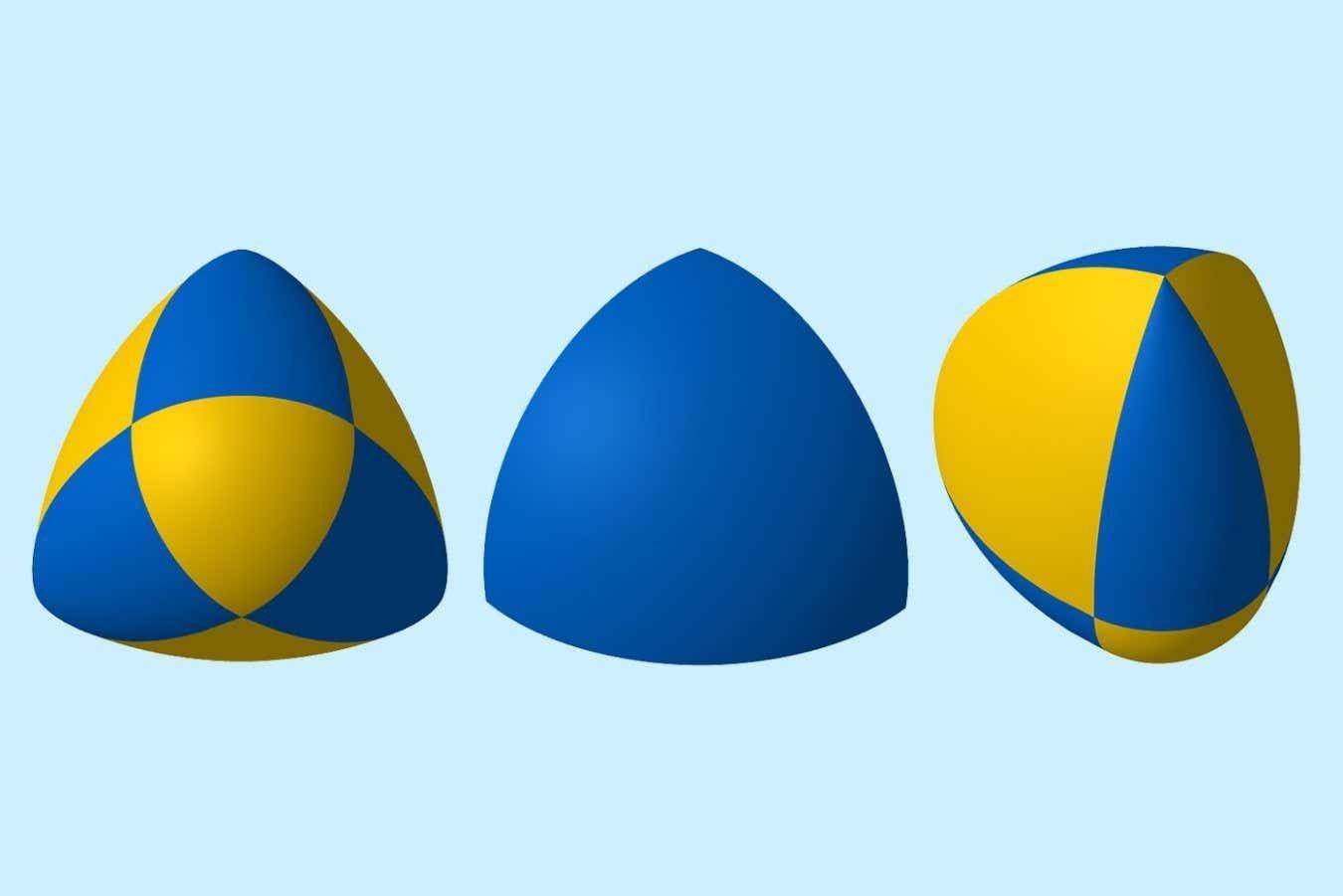
A 3D shape of constant width as seen from three different angles. The middle view resembles a 2D Reuleaux triangle

Mathematicians have reinvented the wheel with the discovery of shapes that can roll smoothly when sandwiched between two surfaces, even in four, five or any higher number of spatial dimensions. The finding answers a question that researchers have been puzzling over for decades.

Such objects are known as shapes of constant width, and the most familiar in two and three dimensions are the circle and the sphere. These aren’t the only such shapes, however. One example is the Reuleaux triangle, which is a triangle with curved edges, while people in the UK are used to handling equilateral curve heptagons, otherwise known as the shape of the 20 and 50 pence coins. In this case, being of constant width allows them to roll inside coin-operated machines and be recognised regardless of their orientation.

Crucially, all of these shapes have a smaller area or volume than a circle or sphere of the equivalent width – but, until now, it wasn’t known if the same could be true in higher dimensions. The question was first posed in 1988 by mathematician Oded Schramm, who asked whether constant-width objects smaller than a higher-dimensional sphere might exist.

While shapes with more than three dimensions are impossible to visualise, mathematicians can define them by extending 2D and 3D shapes in logical ways. For example, just as a circle or a sphere is the set of points that sits at a constant distance from a central point, the same is true in higher dimensions. “Sometimes the most fascinating phenomena are discovered when you look at higher and higher dimensions,” says Gil Kalai at the Hebrew University of Jerusalem in Israel.

Now, Andrii Arman at the University of Manitoba in Canada and his colleagues have answered Schramm’s question and found a set of constant-width shapes, in any dimension, that are indeed smaller than an equivalent dimensional sphere.

Arman and his colleagues had been working on the problem for several years in weekly meetings, trying to come up with a way to construct these shapes before they struck upon a solution. “You could say we exhausted this problem until it gave up,” he says.

The first part of the proof involves considering a sphere with n dimensions and then dividing it into 2n equal parts – so four parts for a circle, eight for a 3D sphere, 16 for a 4D sphere and so on. The researchers then mathematically stretch and squeeze these segments to alter their shape without changing their width. “The recipe is very simple, but we understood that only after all of our elaboration,” says team member Andriy Bondarenko at the Norwegian University of Science and Technology.

The team proved that it is always possible to do this distortion in such a way that you end up with a shape that has a volume at most 0.9n times that of the equivalent dimensional sphere. This means that as you move to higher and higher dimensions, the shape of constant width gets proportionally smaller and smaller compared with the sphere.

Visualising this is difficult, but one trick is to imagine the lower-dimensional silhouette of a higher-dimensional object. When viewed at certain angles, the 3D shape appears as a 2D Reuleaux triangle (see the middle image above). In the same way, the 3D shape can be seen as a “shadow” of the 4D one, and so on.  “The shapes in higher dimensions will be in a certain sense similar, but will grow in complexity as [the] dimension grows,” says Arman.

Having identified these shapes, mathematicians now hope to study them further. “Even with the new result, which takes away some of the mystery about them, they are very mysterious sets in high dimensions,” says Kalai.

For more such insights, log into www.international-maths-challenge.com.

*Credit for article given to Alex Wilkins*


The Central Limit Theorem

The central limit theorem – the idea that plotting statistics for a large enough number of samples from a single population will result in a normal distribution – forms the basis of the majority of the inferential statistics that students learn in advanced school-level maths courses. Because of this, it’s a concept not normally encountered until students are much older. In our work on the Framework, however, we always ask ourselves where the ideas that make up a particular concept begin. And are there things we could do earlier in school that will help support those more advanced concepts further down the educational road?

The central limit theorem is an excellent example of just how powerful this way of thinking can be, as the key ideas on which it is built are encountered by students much earlier, and with a little tweaking, they can support deeper conceptual understanding at all stages.

The key underlying concept is that of a sampling distribution, which is a theoretical distribution that arises from taking a very large number of samples from a single population and calculating a statistic – for example, the mean – for each one. There is an immediate problem encountered by students here which relates to the two possible ways in which a sample can be conceptualised. It is common for students to consider a sample as a “mini-population;” this is often known as an additive conception of samples and comes from the common language use of the word, where a free “sample” from a homogeneous block of cheese is effectively identical to the block from which it came. If students have this conception, then a sampling distribution makes no sense as every sample is functionally identical; furthermore, hypothesis tests are problematic as every random sample is equally valid and should give us a similar estimate of any population parameter.

A multiplicative conception of a sample is, therefore, necessary to understand inferential statistics; in this frame, a sample is viewed as one possible outcome from a set of possible but different outcomes. This conception is more closely related to ideas of probability and, in fact, can be built from some simple ideas of combinatorics. In a very real sense, the sampling distribution is actually the sample space of possible samples of size n from a given population. So, how can we establish a multiplicative view of samples early on so that students who do go on to advanced study do not need to reconceptualise what a sample is in order to avoid misconceptions and access the new mathematics?

One possible approach is to begin by exploring a small data set by considering the following:

“Imagine you want to know something about six people, but you only have time to actually ask four of them. How many different combinations of four people are there?”

There are lots of ways to explore this question that make it more concrete – perhaps by giving a list of names of the people along with some characteristics, such as number of siblings, hair colour, method of travel to school, and so on. Early explorations could focus on simply establishing that there are in fact 15 possible samples of size four through a systematic listing and other potentially more creative representations, but then more detailed questions could be asked that focus on the characteristics of the samples; for example, is it common that three of the people in the sample have blonde hair? Is an even split between blue and brown eyes more or less common? How might these things change if a different population of six people was used?

Additionally, there are opportunities to practise procedures within a more interesting framework; for example, if one of the characteristics was height then students could calculate the mean height for each of their samples – a chance to practise the calculation as part of a meaningful activity – and then examine this set of averages. Are they close to a particular value? What range of values are covered? How are these values clustered? Hey presto – we have our first sampling distribution without having to worry about the messy terminology and formal definitions.

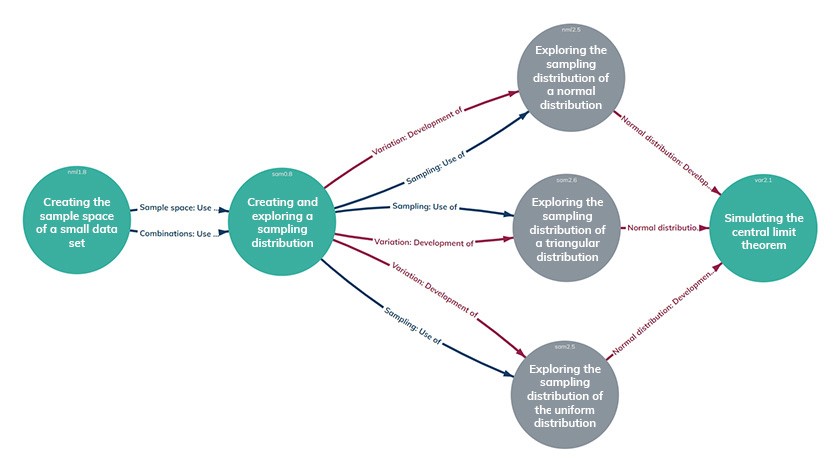
In the Cambridge Mathematics Framework, this approach is structured as exploratory work in which students play with the idea of a small sample as a combinatorics problem in order to motivate further exploration. Following this early work, they eventually created their first sampling distribution for a more realistic population and explored its properties such as shape, spread, proportions, etc. This early work lays the ground to look at sampling from some specific population distributions – uniform, normal, and triangular – to get a sense of how the underlying distribution impacts the sampling distribution. Finally, this is brought together by using technology to simulate the sampling distribution for different empirical data sets using varying sizes of samples in order to establish the concept of the central limit theorem.

While sampling distributions and the central limit theorem may well remain the preserve of more advanced mathematics courses, considering how to establish the multiplicative concept of a sample at the very beginning of students’ work on sampling may well help lay more secure foundations for much of the inferential statistics that comes later, and may even support statistical literacy for those who don’t go on to learn more formal statistical techniques.

For more insights like this, visit our website at www.international-maths-challenge.com.

Credit for the article given to Darren Macey