Tips to Improve Your Child’s Learning Skills

All kids are different and live with different skills and interests. Some kids are good at studies and some at sports, but no one can be good at everything. Many kids are good at mathematics, but many kids find maths a little confusing & challenging. There will be no other option for kids to skip this learning period; every kid has to learn all these subjects. Parents and teachers help their kids or students to learn these subjects with ease but there are a lot of ways by which students can easily enjoy these boring activities and enhance their learning skills.

Some of the ways to improve your child’s learning skills and abilities-

Visual Techniques

It’s a compelling technique to improve your kid’s learning skills. Generally, visual learners learn things by seeing what they are reading or writing. You should also provide your kid with all the tools and resources so they can learn hands-on. According to research, if kids have food like raisins or marshmallows on a daily basis, it can help them easily solve Maths Olympiad problems like addition or subtraction. This technique for addition or subtraction visually can upgrade your child’s understanding of maths skills and allow the child to become engaged in the process.

International Maths Olympiad Registration

Further, you can also register for the maths olympiad to enhance your child’s skills. These maths tests will help the child to build a positive perception regarding different subjects and enable them to think logically and achieve well in different phases of life.

Let them choose

One of the best ways for your kid to get engrossed in their studies is to let them choose their material and resources. They won’t even need to insist when they are already interested. It will be interesting for them, so they will pick up study material and read on their own. If you want your kid to solve IMO sample papers independently, you should first create interest. Allow them to pick books and find stories they can imagine.

Give them a reading book

All the kids need to know how to read, which is necessary for other learning activities. To improve a child’s performance, you should put a reading book in their room or motivate them to read books using the visualization technique. This will encourage them to read and solve IMO sample papers easily.

Create Environment

It’s essential to give them a clean and quiet environment to study so that they can give their complete focus without any distractions. Do they have proper space for books, computers, or laptops? Also, give them the required resources, like school supplies, folders, and International Maths Olympiad sample papers. So they don’t need to get up in the middle of their studies.

Allow them to ask for doubts

Your kid must feel free to ask you anything that they want. They should not hesitate to ask and provide them comfort so they can ask easily. Suppose they have any doubts in a lesson, you will be there and you should always be available for their help. This thing can also assist them to ask in their class without any hesitation.

Studying and preparing for the maths Olympiad will enhance students’ logical reasoning and thinking abilities and make them move toward strong career opportunities. If you are confused about participating in the International Maths Challenge, we are here to guide you at every step of your success. Click here to raise your query.


All You Need To Know About International Maths Olympiad Challenge

The International Math Challenge is administered across the world for students to acquire acknowledgment for their skills in mathematics. The exam is conducted at different grade levels and brings many possibilities for students to gain recognition, rewards, certificates, and even scholarships for further studies. One of the popular Maths challenges that nurture maths intellectuals is the International Math Olympiad. It is a big platform that concedes and rewards math masterminds worldwide. Candidates from more than a hundred countries join the Olympiad challenge every year.

Overview of Maths Olympiad

International Math Challenge is an ambitious exam that evaluates students for their mathematical talents and abilities. The main objective of this test is to inculcate a fierce mindset in students all over the world. Unlike school exams, Maths Olympiad tests are deliberated to unveil the real meaning of maths education. It offers a wider sight of math subjects and their empirical applications. Students who resolve problems intellectually using the acquired skills of math undoubtedly become problem-solvers.

Importance of Math Olympiad

Math Olympiad enhances the mathematical capability and competitive skills and knowledge of students. It allows them to find out their abilities and potential. Participating in such international competitive exams provides a strong fundamental for gaining an overall academic distinction. Students who participate in International Maths Olympiad acquire the confidence to answer difficult and complex questions. This gives them mastery over their competitors. Rewards and acknowledgment gained through the Maths Olympiad exam are highly beneficial in the academic portfolio and career planning of students.

Registration for Maths Olympiad

While many Maths Olympiad tests are held and administered through the school, some let children register individually. To get more information about the registration processes, students can visit our website.

Benefits of the International Maths Olympiad

Maths Olympiad is the type of platform that is excellent for enhancing the abilities and skills of your children. Students who join in Maths Olympiad exam have demonstrated increased marks in academics too. It is like an exam of a student’s mind of earlier learned concepts.

The International Maths Olympiad is an open manifesto for all students to examine their intellectual aptitude and talents. Preparing for the Maths Olympiad test qualifies students to inspect their math abilities against their fellows at school, national, and international standards. It allows students to know where they appear regarding their mathematical skills.

Finally 

Studying and preparing for the maths Olympiad will enhance the logical reasoning and thinking abilities of students and will make them move toward strong career opportunities. If you have any confusion in the process of participating in the International Maths Olympiad Challenge, we are here to guide you at every step of your success. Click here to raise your query.


How To Prepare For International Maths Olympiad?

The IMOC stands for International Mathematical Olympiad Challenge and is a well-renowned world championship mathematics competitive examination. It occurs every year, similar to another competitive exam. You can get ready for the International Maths Olympiad once you get familiar with the mathematical concepts and ideas, get into the mock tests, and try to give as many mock tests as you can.

Here are a few points that will help you prepare for the International Maths Olympiad:

Understand The Syllabus

While beginning to prepare for the International Maths Olympiad exam, it is necessary to introduce yourself to the syllabus. The syllabus for the exam is a bit different from your academic syllabus and you can find out all about it here.

Get The Expert Tutor

As your trainer will play a major part in your learning method, just be sure that you choose someone who is experienced and at par with your ease level. Generally, your school maths trainer can make your competition worthy. If you can’t find an experienced Maths Olympiad trainer near your location, look for the best online tutoring.

Learn Problem-Solving Skills

The IMC problem-solving approach is a one-stop solution for math competition practices and materials, thousands of students have already enrolled in the mission to crack the International Maths Olympiad. We have resources to learn how you can solve difficult types of math problems. Consult with our expert trainers and get a brief idea to use problem-solving skills in the examination.

Practice past papers

We do not wish to tutor your child; their teachers are doing a great job at it. We believe that students should be taught in only one way and not be confused with multiple styles of teaching. So while your child covers conceptual learning of math topics in school, we help you by providing exhaustive and fully solved Test Practice Papers (10 of them). These practice test papers are replicas of the Olympiad. Do not worry about the approach we have in our explanatory solutions. Our subject experts simply explain the basics using logical techniques which helps students to get well acquainted with the topics. Knowledge of these topics will eventually help students to ace their school curriculum as well.

Study Smart

Following your timetable, you also need to focus on sample papers and the previous year’s questions. Schedule mock tests that will let you track your progress report. Practice is the only key to success that will help in developing your skills. However, smart studying is just as essential as studying energetically. Find the sequence in the sample papers and utilize them to your greatest advantage.

Check Your Progress

Revision is an immensely significant part of preparing for the International Maths Olympiad. As you are learning, use note cards for writing down the major points. When you begin with revision, the note cards will let you remember the pointers that you have written down on the cards. The notes are an effective way of recalling what you have learned. Hence, if you are preparing for the International Mathematics Olympiad exam then you should always think that these revisions are the progress standard. If any such topics require you to check those pointers in the notes again and again, then go back to revise and focus on those questions a bit more.

Final Thoughts

The method of IMC preparation and taking part in our examination is a great learning experience apart from the result. This exam assists students to be skilled at school levels and provides them the opportunity to know the structure and timetable of international-level competitive exams. The IMO Challenge helps students throughout the world to determine their strengths and capabilities. 


Mastery Learning Vs Performance-Oriented Learning, and Why Should Teachers Care?

Generally, the occurrence of students asking this question increases with growing age. Primary students know inside out that exams are very important. Brilliant middle school students consider a connection between their test results and semester mark sheets. Ultimately, upon graduation from secondary school, students have comprehended that the totality of their learning has less value than their results in the final exams.

Performance-Oriented Learning

Exam enthusiasm is an indication of performance-oriented learning, and it is intrinsic to our recent education management that needs standards-based reporting of student results. This focuses on performance apart from the method of learning and requests comparison of procurement amongst peers.

The focus for performance-aligned students is showing their capabilities. Fascinatingly, this leads to an affection of fixed mindset characteristics such as the ignorance of challenging tasks because of fear of failure and being intimidated by the success of other students.

Mastery-Oriented Learning

Mastery learning putting down a focus on students developing their competence. Goals are pliably positioned far away from reach, pushing regular growth. The phrase “how can this be even better?” changes the concept of “good enough”. Not to be bewildered with perfectionism, a mastery approach to learning encourages development mindset qualities such as determination, hard work, and facing challenges.

Most forms of mastery learning nowadays can be discovered in the work of Benjamin Bloom in the late 1960s. Bloom saw the important elements of one-to-one teaching that take to effective benefits over group-based classrooms and inspects conveyable instructional plans. Eventually, formative assessment was defined in the circumstances of teaching and learning as a major component for tracking student performance.

So where does mastery learning position in today’s classroom? The idea of formative assessment is frequent, as are posters and discussions encouraging a growth mindset. One significant missing element is making sure that students have a deep knowledge of concepts before moving to the next.

Shifting the Needle

With the growing possibilities offered by Edtech organizations, many are beginning to look to a tech-based solution like International Maths Olympiad Challenge to provide individualized learning possibilities and prepare for the maths Olympiad. The appropriate platform can offer personalized formative assessment and maths learning opportunities.

But we should take a careful viewpoint to utilize technology as a key solution. History shows us that implementing the principles of mastery learning in part restricts potential gains. Despite assessment plans, teachers will also have to promote a mastery-orientated learning approach in their classrooms meticulously. Some strategies are:

  • Giving chances for student agency
  • Encouraging learning from flaws
  • Supporting individual growth with an effective response
  • Overlooking comparing students and track performance

We think teaching students how to learn is far more necessary than teaching them what to learn.


How Teachers Can Help Students Defeat Their Fear of Maths?

Teachers experience many issues in the classroom: an extensive range of aptitudes, deficiency of support or materials, big classroom sizes, time limitations, and more. But possibly one of the strenuous barriers is the fear of mathematics in students. Maths-phobia can simply convert into students betraying anxiety, a lack of approach, and even confidence issues.

A study has found that maths anxiety is connected to inferior maths performance, and can make enlightening the subject a daily pain. So how can teachers guide students to combat their fear of maths? How can they implant excitement in a subject that so many students get frightened of?

Build Confidence

Unsurprisingly, confidence is key in students’ agitation toward the maths subject. Earlier adverse incidents with the subject can take it to a bad and fatalistic attitude. To defeat this, as a teacher you should offer students with daily confidence-building practices that look energizing and entitle all students to perform well in maths subjects and prepare for International Maths Olympiad Challenge. This enhancement in confidence and self-esteem can reduce anxiety and fear, as students feel more and more competent and inspired.

Nourish Students’ Basic Skills

Associated closely with building confidence is bracing students’ basic numerical competency. Providing students chances to practice and upgrade critical skills for quantitative flow is necessary: when students don’t have the fundamental skills at hand, their working capabilities are pushed, which can be both disturbing and discouraging. It would help if you got students to practice mental maths and basic maths skills daily, incorporating them into games, quizzes, maths fun tests, maths Olympiad preparation, and warm-up activities.

Use Step-By-Step Process

There is proof that even intellectual maths students can experience burden and be overwhelmed when there are too many details at once and insufficient time to practice. It’s a better idea to part the resources into small exercises so that the maths olympiad students are able to understand and be adept at one step before continuing to the next.

Develop a Growth Mindset

Studies and publications on ‘growth mindset’ – the trust that our abilities can be advanced– have lightened up the role of student endeavor and self-awareness and acquired a significant foundation in educational practice. Motivating maths students to take challenges and have a growth mindset is inspiring. By offering students maths sample papers that get tough, you can show them they can overcome any obstacle through concentration and regular practice.

Attitude of Teachers

Last but surely not least, a teacher’s approach toward teaching mathematics can greatly impact students’ lives. Just as we request teachers to display a love of reading when it is about literature, we must also uplift maths teachers to exhibit excitement toward maths teaching. Teachers are the main pillars in building a positive and exciting learning atmosphere, such as by introducing maths puzzles and games into simplifications and examples.

Conclusion

By showing excitement and appreciation for mathematics, teachers can also develop a healthy relationship with the students to make them comfortable learning maths. And if teachers aren’t entirely comfortable with students themselves, a better recommendation is to invest in personal development. Learning how to teach maths subjects and connect students in ways that develop understanding capabilities can assist in reducing maths anxiety in both students and teachers.


Five Ways to Reduce Math Anxiety in Kids: What Parents Can Do

Primary school is where it begins. This is when kids normally get introduced to math learning and when math uneasiness takes root repeatedly. Some children find math challenging yet exciting, while some find it extremely strenuous. They might feel distressed about not getting the answers correctly, or not keeping up with their levels of what the trainer or teacher is explaining.  

When kids don’t improve math learning skills at an early age, they tend to grow stress levels while doing math questions. This anxiety develops as they proceed through school and, due to the progressive structure of math, they go down further and further at the back. This generally results in hating the subject. Lack of skills and confidence in maths subjects can lead to self-hesitancy and not only below-par performance in math, but in other subjects as well.

Children who are anxious about math are expected to avoid it, which embellish a further barrier to studying math. Instead of being anxious, students should look for IMO sample papers and practice hard to participate in the International Maths Challenge and gain confidence.

Parents can play a key role in guiding to lessen their kids’ stress levels about math and develop their confidence and belief. It begins with encouraging children to learn and practice math and providing support at home. Moreover, by making Math playful and exciting at home, parents can remove negative discussions about math assignments and assure their kids to adopt a positive approach towards solving it, helping them recover their excitement and interest to learn more and grow their skills.

Some effective ways parents can reduce their kid’s math anxiety

Make math interesting at home by arranging math games and quizzes and engaging your child in math-related works around the house. 

Be up to date on your connection and viewpoint toward math. Did you know that math anxiety can be infectious? The study has shown that parents can transfer their burden and stress about math to their kids, which can lead to bad performance and marks for your kid at school. Remember that you’re not manifesting negative feelings in front of your kid. Try to develop a positive, cool attitude in front of your child. 

Reach out to your kid’s school and meet teachers to discuss how you can help your child’s math learning skills at home. There are many assets out there, including IMO sample papers by International Maths Challenge for kids to help them practice the maths concepts they’re learning at school. Ask the teacher to suggest an excellent productive resource where your kid is at in their learning. A resource that is too tough to understand can create anxiety and more hesitation!

Enhance your math skills before giving attention to your child. Use resources and IMO sample papers and practice doing math questions. Communicate with your child in a comforting, positive way about math and have daily discussions about their recent math challenges and small successes that can take them to greater heights. Help them realize that mistakes are not the end; learning opportunities are limitless.

IMC (International Maths Challenge) offers a curriculum-specific student assessment & practice resource that is created by International Maths Olympiad experts on how your children learn best and efficiently. Don’t get distracted by any usual black-and-white practice books. For more information about the maths practice, visit our website.


Graduate School: Where Grades Don’t Matter

Yesterday I received a disheartening 44/50 on a homework assignment. Okay okay, I know. 88% isn’t bad, but I had turned in my solutions with so much confidence that admittedly, my heart dropped a little (okay, a lot!) when I received the grade. But I quickly had to remind myself, Hey! Grades don’t matter.

The six points were deducted from two problems. (Okay, fine. It was three. But in the third I simply made an air-brained mistake.) In the first, apparently my answer wasn’t explicit enough. How stingy! I thought. Doesn’t our professor know that this is a standard example from the book? I could solve it in my sleep! But after the prof went over his solution in class, I realized that in all my smugness I never actually understood the nuances of the problem. Oops. You bet I’ll be reviewing his solution again. Lesson learned.

In the second, I had written down my solution in the days before and had checked with a classmate and (yes) the internet to see if I was correct. Unfortunately, the odds were against me two-to-one as both sources agreed with each other but not with me. But I just couldn’t see how I could possibly be wrong! Confident that my errors were truths, I submitted my solution anyway, hoping there would be no consequences. But alas, points were taken off.

Honestly though, is a lower grade such a bad thing? I think not. In both cases, I learned exactly where my understanding of the material went awry. And that’s great! It means that my comprehension of the math is clearer now than it was before (and that the chances of passing my third qualifying exam have just increased. Woo!) And that’s precisely why I’m (still, heh…) in school.

So yes, contrary to what the comic above says, grades do exist in grad school, but – and this is what I think the comic is hinting at – they don’t matter. Your thesis committee members aren’t going to say, “Look, your defense was great, but we can’t grant you your PhD. Remember that one homework/midterm/final grade from three years ago?” (They may not use the word “great” either, but that’s another matter.) Of course, we students should still work hard and put in maximum effort! But the emphasis should not be on how well we perform, but rather how much we learn. Focus on the latter and the former will take care of itself. This is true in both graduate school and college, but the lack of emphasis on grades in grad school really brings it home. And personally, I’m very grateful for it because my brain is freed up to focus on other things like, I don’t know, learning math!

So to all my future imperfect homework scores out there: bring it on.

For more such insights, log into www.international-maths-challenge.com.

*Credit for article given to Tai-Danae Bradley*


On Constructing Functions, Part 5

Example 5

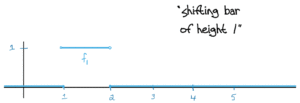
A sequence of functions {fn:R→R}{fn:R→R} which converges to 0 pointwise but does not converge to 0 in L1L1.

This works because: The sequence tends to 0 pointwise since for a fixed x∈Rx∈R, you can always find N∈NN∈N so that fn(x)=0fn(x)=0 for all nn bigger than NN. (Just choose N>xN>x!)

The details: Let x∈Rx∈R and fix ϵ>0ϵ>0 and choose N∈NN∈N so that N>xN>x. Then whenever n>Nn>N, we have |fn(x)−0|=0<ϵ|fn(x)−0|=0<ϵ.

Of course, fn↛0fn↛0 in L1L1 since∫R|fn|=∫(n,n+1)fn=1⋅λ((n,n+1))=1.

For more such insights, log into www.international-maths-challenge.com.

*Credit for article given to Tai-Danae Bradley*


On Constructing Functions, Part 4

This post is the fourth example in an ongoing list of various sequences of functions which converge to different things in different ways.

Also in this series:

Example 1: converges almost everywhere but not in L1L1
Example 2: converges uniformly but not in L1L1
Example 3: converges in L1L1 but not uniformly
Example 5: converges pointwise but not in L1L1
Example 6: converges in L1L1 but does not converge anywhere

Example 4

A sequence of (Lebesgue) integrable functions fn:R→[0,∞)fn:R→[0,∞) so that {fn}{fn} converges to f:R→[0,∞)f:R→[0,∞) uniformly,  yet ff is not (Lebesgue) integrable.

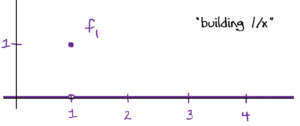
‍Our first observation is that “ff is not (Lebesgue) integrable” can mean one of two things: either ff is not measurable or ∫f=∞∫f=∞. The latter tends to be easier to think about, so we’ll do just that. Now what function do you know of such that when you “sum it up” you get infinity? How about something that behaves like the divergent geometric series? Say, its continuous cousin f(x)=1xf(x)=1x? That should work since we know∫R1x=∫∞11x=∞.∫R1x=∫1∞1x=∞.Now we need to construct a sequence of integrable functions {fn}{fn} whose uniform limit is 1x1x. Let’s think simple: think of drawring the graph of f(x)f(x) one “integral piece” at a time. In other words, define:

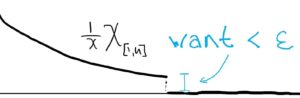
This works because: It makes sense to define the fnfn as  f(x)=1xf(x)=1x “chunk by chunk” since this way the convergence is guaranteed to be uniform. Why? Because how far out we need to go in the sequence so that the difference f(x)−fn(x)f(x)−fn(x) is less than ϵϵ only depends on how small (or large) ϵϵ is. The location of xx doesn’t matter!

Also notice we have to define fn(x)=0fn(x)=0 for all x<1x<1 to avoid the trouble spot ln(0)ln⁡(0) in the integral ∫fn∫fn. This also ensures that the area under each fnfn is finite, guaranteeing integrability.

The details: Each fnfn is integrable since for a fixed nn,∫Rfn=∫n11x=ln(n).∫Rfn=∫1n1x=ln⁡(n).To see fn→ffn→f uniformly, let ϵ>0ϵ>0 and choose NN so that N>1/ϵN>1/ϵ. Let x∈Rx∈R. If x≤1x≤1, any nn will do, so suppose x>1x>1 and let n>Nn>N. If 1<x≤n1<x≤n, then we have |fn(x)−f(x)|=0<ϵ|fn(x)−f(x)|=0<ϵ. And if x>nx>n, then∣∣1xχ[1,∞)(x)−1xχ[1,n](x)∣∣=∣∣1x−0∣∣=1x<1n<1N<ϵ.|1xχ[1,∞)(x)−1xχ[1,n](x)|=|1x−0|=1x<1n<1N<ϵ.

‍For more such insights, log into www.international-maths-challenge.com.

*Credit for article given to Tai-Danae Bradley*


On Constructing Functions, Part 3

This post is the third example in an ongoing list of various sequences of functions which converge to different things in different ways.

‍Example 3

A sequence of continuous functions {fn:R→[0,∞)}{fn:R→[0,∞)} which converges to 0 in the L1L1 norm, but does not converge to 0 uniformly.

There are four criteria we want our functions to satisfy:

  1. First off is the uniform convergence. Observe that “{fn}{fn} does not converge to 0 uniformly” can mean one of three things:
  • converges to 0 pointwise only
  • converges to something other than 0 (pointwise or uniformly)
  • does not converge at all

So it’s up to you to decide which one feels more comfortable to work with. Here we’ll choose the second option.

  1. Next, “{fn}{fn} converges to 0 in the L1L1 norm” means that we want to choose our sequence so that the area under the curve of the fnfn gets smaller and smaller as n→∞n→∞.
  2. Further, we also want the fnfn to be positive (the image of each fnfn must be [0,∞)[0,∞)) (notice this allows us to remove the abosolute value sign in the L1L1 norm: ∫|fn|⇒∫fn∫|fn|⇒∫fn)
  3. Lastly, the functions must be continuous.

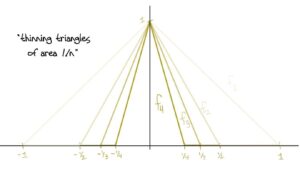
A slick* but very simple solution is a sequence of triangles of decreasing area with height 1!
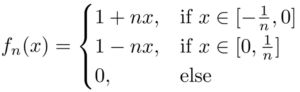
This works because: At x=0x=0, fn(x)=1fn(x)=1 for all nn, so there’s no way it can converge to zero (much less uniformly). In fact we have fn→ffn→f pointwise wheref(x)={1,if x=00otherwise.f(x)={1,if x=00otherwise.The area of each triangle is 1n1n which clearly goes to zero for nn large. Also, it’s clear to see visually that the area is getting smaller. This guarantees fn→0fn→0 in the L1L1 norm. Further, each fnfn is positive since we’ve defined it to equal zero as soon as the edges of the triangle reach the xx-axis. And lastly we have piecewise continuity.

The details: Let ϵ>0ϵ>0 and x∈Rx∈R. If x=0x=0, then fn(x)=1fn(x)=1 for all n and so fn→1fn→1. Otherwise x>0x>0 or x<0x<0 If x>0x>0 and x>1x>1, then fn(x)=0fn(x)=0 for all nn. Otherwise if x∈(0,1]x∈(0,1] choose N>1xN>1x. Then whenever n>Nn>N we have fn(x)=1−nx<1−1xx=0<ϵ.fn(x)=1−nx<1−1xx=0<ϵ. The case when x<0x<0 follows a similar argument.

Lastly fn→0fn→0 in the L1L1 norm since, as we mentioned, the areas are decreasing to 0. Explicitly:  ∫R|fn|=∫0−1n1+nx+∫1n01−nx=2n→0.∫R|fn|=∫−1n01+nx+∫01n1−nx=2n→0.

‍*I can brag because this particular example came from a friend. My own attempt at a solution was not nearly as intuitive.

Constructing the Tensor Product of Modules

The Basic Idea

Today we talk tensor products. Specifically this post covers the construction of the tensor product between two modules over a ring. But before jumping in, I think now’s a good time to ask, “What are tensor products good for?” Here’s a simple example where such a question might arise:

Suppose you have a vector space VV over a field FF. For concreteness, let’s consider the case when VV is the set of all 2×22×2 matrices with entries in RR and let F=RF=R. In this case we know what “FF-scalar multiplication” means: if M∈VM∈V is a matrix and c∈Rc∈R, then the new matrix cMcM makes perfect sense. But what if we want to multiply MM by complex scalars too? How can we make sense of something like (3+4i)M(3+4i)M? That’s precisely what the tensor product is for! We need to create a set of elements of the form(complex number) “times” (matrix)(complex number) “times” (matrix)so that the mathematics still makes sense. With a little massaging, this set will turn out to be C⊗RVC⊗RV.

So in general, if FF is  an arbitrary field and VV an FF-vector space, the tensor product answers the question “How can I define scalar multiplication by some larger field which contains FF?” And of course this holds if we replace the word “field” by “ring” and consider the same scenario with modules.

Now this isn’t the only thing tensor products are good for (far from it!), but I think it’s the most intuitive one since it is readily seen from the definition (which is given below).

So with this motivation in mind, let’s go!

‍From English to Math

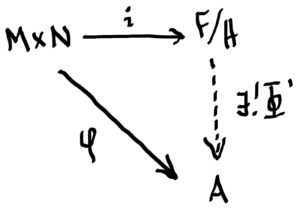
Let RR be a ring with 1 and let MM be a right RR-module and NN a left RR-module and suppose AA is any abelian group. Our goal is to create an abelian group M⊗RNM⊗RN, called the tensor product of MM and NN, such that if there is an RR-balanced map i:M×N→M⊗RNi:M×N→M⊗RN and any RR-balanced map φ:M×N→Aφ:M×N→A, then there is a unique abelian group homomorphism Φ:M⊗RN→AΦ:M⊗RN→A such that φ=Φ∘iφ=Φ∘i, i.e. so the diagram below commutes.
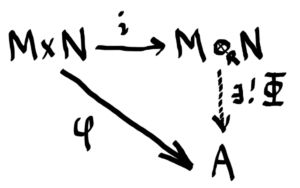
Notice that the statement above has the same flavor as the universal mapping property of free groups!

Definition: Let XX be a set. A group FF is said to be a free group on XX if there is a function i:X→Fi:X→F such that for any group GG and any set map φ:X→Gφ:X→G, there exists a unique group homomorphism Φ:F→GΦ:F→G such that the following diagram commutes: (i.e. φ=Φ∘iφ=Φ∘i)

set map, so in particular we just want our’s to be RR-balanced:
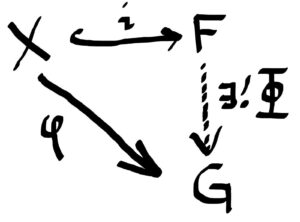
: Let RR be a ring with 1. Let MM be a right RR-module, NN a left RR-module, and AA an abelian group. A map φ:M×N→Rφ:M×N→R is called RR-balanced if for all m,m1,m2∈Mm,m1,m2∈M, all n,n1,n2∈Nn,n1,n2∈N and all r∈Rr∈R,
φ(m1+m2,n)=φ(m1,n)+φ(m2,n)φ(m1+m2,n)=φ(m1,n)+φ(m2,n)φ(m,n1+n2)=φ(m,n1)+φ(m,n2)φ(m,n1+n2)=φ(m,n1)+φ(m,n2)φ(mr,n)=φ(m,rn)φ(mr,n)=φ(m,rn)

By “replacing” F by a certain quotient group F/HF/H! (We’ll define HH precisely below.)
These observations give us a road map to construct the tensor product. And so we begin:

‍Step 1

Let FF be a free abelian group generated by M×NM×N and let AA be an abelian group. Then by definition (of free groups), if φ:M×N→Aφ:M×N→A is any set map, and M×N↪FM×N↪F by inclusion, then there is a unique abelian group homomorphism Φ:F→AΦ:F→A so that the following diagram commutes.
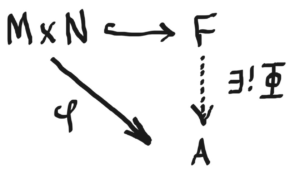
Step 2

that the inclusion map M×N↪FM×N↪F is not RR-balanced! To fix this, we must “modify” the target space FF by replacing it with the quotient F/HF/H where H≤FH≤F is the subgroup of FF generated by elements of the form

(m1+m2,n)−(m1,n)−(m2,n)(m1+m2,n)−(m1,n)−(m2,n)

  • (m,n1+n2)−(m,n1)−(m,n2)(m,n1+n2)−(m,n1)−(m,n2)
  • (mr,n)−(m,rn)(mr,n)−(m,rn)

where m1,m2,m∈Mm1,m2,m∈M, n1,n2,n∈Nn1,n2,n∈N and r∈Rr∈R. Why elements of this form? Because if we define the map i:M×N→F/Hi:M×N→F/H byi(m,n)=(m,n)+H,i(m,n)=(m,n)+H,we’ll see that ii is indeed RR-balanced! Let’s check:
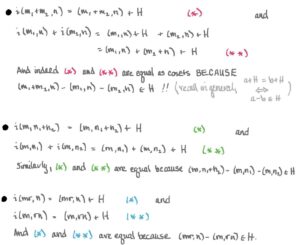
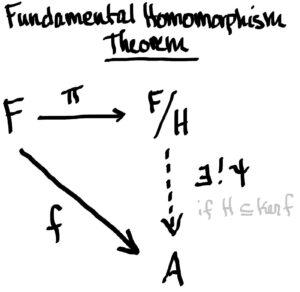
So, are we done now? Can we really just replace FF with F/HF/H and replace the inclusion map with the map ii, and still retain the existence of a unique homomorphism Φ:F/H→AΦ:F/H→A? No! Of course not. F/HF/H is not a free group generated by M×NM×N, so the diagram below is bogus, right?
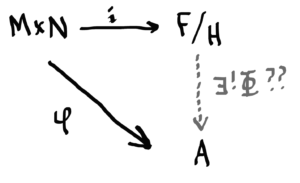
Not totally. We haven’t actually disturbed any structure!
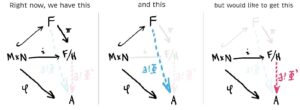
How can we relate the pink and blue lines? We’d really like them to be the same. But we’re in luck because they basically are!

‍Step 3

H⊆ker(f)H⊆ker⁡(f), that is as long as f(h)=0f(h)=0 for all h∈Hh∈H. And notice that this condition, f(H)=0f(H)=0, forces ff to be RR-balanced!

Let’s check:
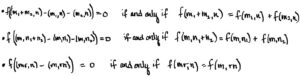
Sooooo… homomorphisms f:F→Af:F→A such that H⊆ker(f)H⊆ker⁡(f) are the same as RR-balanced maps from M×NM×N to AA! (Technically, I should say homomorphisms ff restricted to M×NM×N.) In other words, we have
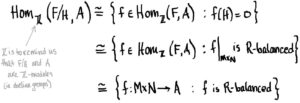
In conclusion, to say “abelian group homomorphisms from F/HF/H to AA are the same as (isomorphic to) RR-balanced maps from M×NM×N to AA” is the simply the hand-wavy way of saying

Whenever i:M×N→Fi:M×N→F is an RR-balanced map and φ:M×N→Aφ:M×N→A is an RR-balanced map where AA is an abelian group, there exists a unique abelian group homomorphism Φ:F/H→AΦ:F/H→A such that the following diagram commutes:
And this is just want we want! The last step is merely the final touch:

‍Step 4

the abelian quotient group F/HF/H to be the tensor product of MM and NN,

whose elements are cosets,
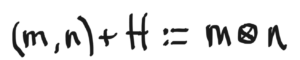
where m⊗nm⊗n for m∈Mm∈M and n∈Nn∈N is referred to as a simple tensor. And there you have it! The tensor product, constructed.

For more such insights, log into www.international-maths-challenge.com.

*Credit for article given to Tai-Danae Bradley*