Triangular Numbers and Euler’s Number Triangle

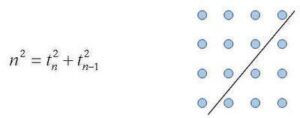
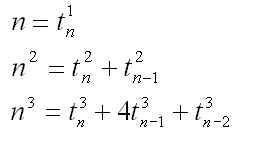
There is a nice identity stating that a square number can be written as the sum of two subsequent triangular numbers.

Here we are writing tdn for the nth triangular of dimension d (d=2 are the flat polygonals, d=3 for they pyramidal polygonals, etc.)

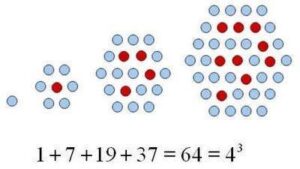
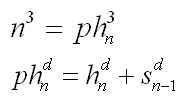
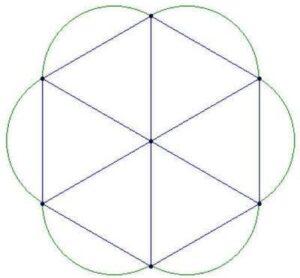
There is also a nice relationship that connects cubes to polygonal numbers. It turns out that a cube of spheres can be unfolded into a packed-hexagonal pyramid. The “packed hexagonals” or “centered hexagonals” are not quite the usual hexagonal numbers – instead these are hexagons of dots with the gaps filled in. The picuture below shows how square numbers fill the gaps of the hexagonals perfectly to form the “packed hexagonals,” and how these in turn can be stacked to form a cube. Here we are using phdn for “packed hexagonals” hdn for hexagonals, sdn for squares, and tdn for triangular numbers.

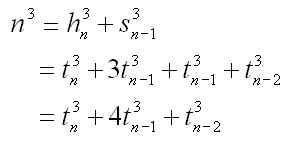
Combining this result with the “triangulation” identities we have:

This gives us three nice identities for powers of n:

It turns out that these identities generalize for other positive integer powers of n. Every nd can be written as a sum of tdi where i ranges from n to n+1−d. (for any i less than 1, these terms are zero)

1.Write out the sequence of nd for at least 2d−2 terms. Take the finite difference of this sequence d−2 times (this reduces the sequence down to “2-dimensional” numbers, allowing us to use the 2-dimensional triangular numbers in our calculations).

2.The first term of the new sequence should be 1. Eliminate the first term by subtracting t2n from this sequence. This means that our sum begins with tdn, with a coefficient of 1. Ensure that the t2n values are subtracted from the corresponding terms of the sequence.

3. Now, the sequence has a new first term which is A. Eliminate this term by subtracting A t2n from the sequence. A is the coefficient of tdn−1.

4. Repeat step 3, eliminating the first term of the sequence each time with a multiple of t2n, which provides the coefficient for the next value of tdi.

5.The process ends when all terms in the nd sequence is eliminated, which happens at the dth step.

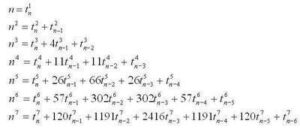
Carrying out this process for a few more powers of n, we end up with:

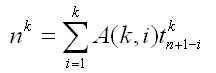
In general, we seem to have:

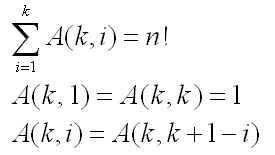
where the coefficients A(i,k) have the nice properties:

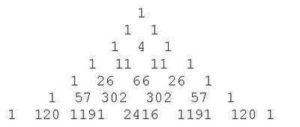
The coefficients are naturally analogous to the binomial coefficients, and can be arranged in a triangle like Pascal’s.

These coefficients are known as Eulerian numbers, and the construction above is known as Euler’s Number Triangle (not to be confused with the geometric construction called the Euler Triangle).

For more such insights, log into www.international-maths-challenge.com.

*Credit for article given to dan.mackinnon*


Window Patterns

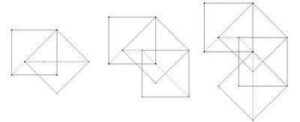
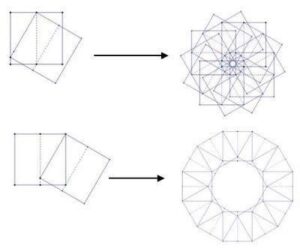
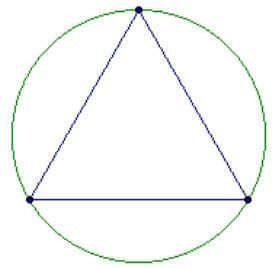
Start with a square piece of paper (like a Post it note), fold and unfold it in half along a mid-line or along a diagonal. Take another identical square, and fold and unfold it the same way. Decide on some way to place the second square on the first, so that the second is somewhat rotated. Use only the edges of the square and the creases that you made to determine the placement. Make your placement precise so that your “rule” can be described exactly in terms of the edges and creases. Repeat this process, placing a third square on top of your second square using exactly the same rule. Repeat until your placing of papers leads you back to the first piece.

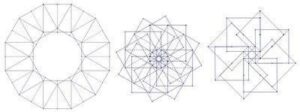
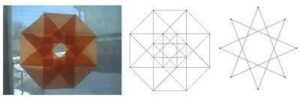
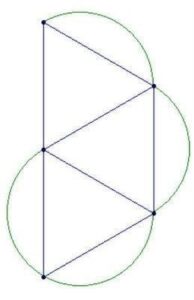
The resulting construction might look something like the one shown on the left below. If you take your papers, set them in place with some careful light gluing, and place them on a window, the sunlight passing through the overlapping papers creates a stained-glass effect that shows a variety of shapes.

This sort of construction is a simplified version of what William Gibbs describes in his book “Window Patterns.” In Gibbs’ treatment, the pattern is partially planned in advance, and then the dimensions of the rectangular pieces of paper that make up the pattern are determined using a little trigonometry. This process can be simplified by starting with a more limited range of options for paper dimension and placement. It turns out that a surprising number of window patterns can be created by only using squares, their mid-lines, and their diagonals, and that these patterns invariably have “special triangles” and related regular polygons and star-polygons embedded within them.

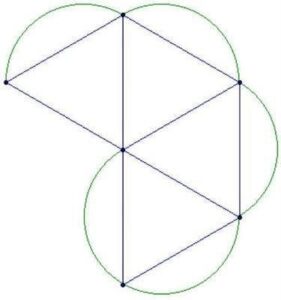
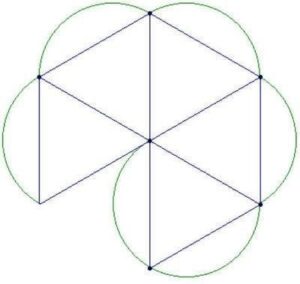
Here are a two more “placement rules” and the patterns that they give rise to.

The diagrams were created using Geometer’s Sketchpad – if you construct the rule using translations applied to a constructed square, you can use the iteration feature to create the final pattern. GSP provides a good environment for planning out the patterns prior to constructing them with paper, and building the plans in GSP is enjoyable and instructive as well.

For more such insights, log into www.international-maths-challenge.com.

*Credit for article given to dan.mackinnon*


Phyllotaxis Spirals 2

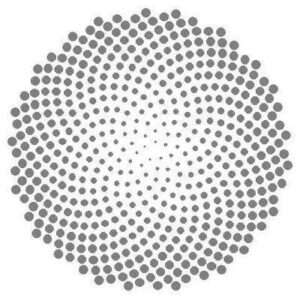
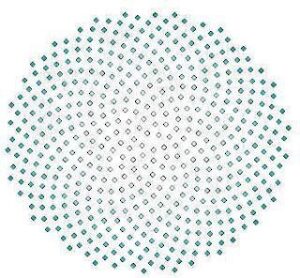
If you have already created the phyllotaxis data in Fathom, or opened the data created in TinkerPlots in Fathom, you can change the display you get when you drag open a collection box. Under the display tab on the Collection Inspector in Fathom you can set the display properties so that cases no longer show up as uniform gold balls. Setting the display attributes to the values below should give you a growing spiral like the one pictured above.

x = 10x+400
y = 10y+400
image = greyCircleIcon
width = sqrt(r*10)
height = sqrt(r*10)
caption=””

Note that the x and y on the right-hand side of the equations above are the x and y attributes that you defined for the data, and the x and y on the left-hand correspond to the position of the icons. You can experiment with other formulas for width and height—using a slider to provide a variable instead of the number “10” gives more flexibility.

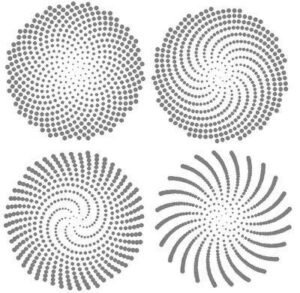
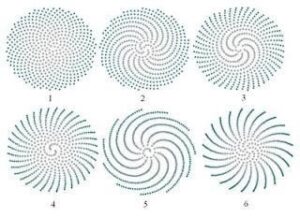
The images below show some of the other spirals you can obtain by varying the angle between the seeds, as mentioned in the previous post.

For more such insights, log into www.international-maths-challenge.com.

*Credit for article given to dan.mackinnon*


Cut-and-Glue Polyhedral Models

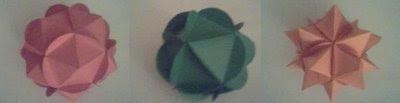
Building polyhedral models is a nice way to explore a lot of significant mathematics. The above models were made by printing patterns onto card-stock, cutting them out, and gluing them together. For these models, only triangular faces were used. These can give you a wide variety of cumulated (or augmented) polyhedra. The triangular faces are circumscribed to provide tabs that you glue together. You can fold and glue the tabs so that they are inside the models, but it is easier to leave them out, and they look nice this way (I think).
1. Decide on a model that you would like to make, and figure out how many faces you will need.
2. Copy and paste the images below into a document or presentation slide (PowerPoint works well) for printing. Choose the right ones for your model, and fit as many as you can on a single sheet.
3. Print out onto card-stock. Most desk ink-jet printers can take card-stock instead of printer-paper.
4. Cut out the units, fold the tabs, and assemble and glue.
Throughout this process, it helps if you have pictures of the polyhedra that you want to construct. Poly is a nice software package for browsing through families of polyhedra.
I’ve found that it works well to bend the tabs using a ruler, that glue-sticks provide the best gluing, and that it helps to hold the model together with binder-clips while assembling.

For more such insights, log into www.international-maths-challenge.com.

*Credit for article given to dan.mackinnon*


Phyllotaxis Spirals


Phyllotaxis is a term used for the patterns that emerge in the growth of plants. Spiral phyllotaxis is observed in the heads of sunflowers, in pine-cones and pineapples, and in a variety of other plants.

Phyllotaxis is a popular topic in mathematics recreation – it’s interesting in its own right and also related to other perennial favourites, Fibonacci numbers and the golden ratio.

The article Modeling Spiral Growth in a GSP Environment describes how to model phyllotaxis-like patterns in GSP. Although GSP works reasonably well, TinkerPlots or Fathom environments seem to be better suited to capturing this particular model – they make the formulas more explicit and easy to manipulate, and they allow for the data generated to be viewed in a variety of ways. The images above were created by porting this model to TinkerPlots.

As the article suggests, experimenting with the the angle between successive seeds allows you to see different resulting patterns – angles that are multiples of rational numbers create patterns of rays while irrational numbers (actually approximate values) give spirals, or spiral/ray combinations (the rays form as the approximation gets more “rational”). A good choice for approximating actual phyllotaxis patterns is to use tau = (1+sqrt(5))/2 in your angle. Here is a listing for the attributes required to generate the pattern in TP or Fathom. The graph/plot is simply the x attribute on the horizontal and the y attribute on the vertical (in TP these need to be fully separated).

n = caseIndex
base_angle = pi*(1+sqrt(5))
r = sqrt(n)
theta = n*base_angle
x = r*cos(theta)
y = r*sin(theta)

The images shown in this post use a collection of 500 cases or “seeds”. The base angle is 2pi*tau, and the actual angle for a given seed is a multiple of this base angle.

The model is nice looking and easy to build, but it models only the end result of the growth process, not the process itself. It winds new seeds around the outer edge based on a pre-determined angle. A better model would be one that mirrors what is understood to be the underlying phonomena – new seeds are added to the center and old seeds are pushed out following a set of rules. Under this dynamic method, the angles and spirals are an emergent aspect of the system, rather than the explicit result. This website describes how such a dynamical system could be modeled.

Although the Fathom/TP model does not model the dynamical system that underlies phyllotaxis, it’s fun to play with in its own right. You can manually alter the base_angle attribute as suggested by the GSP article. If you add a parameter (a slider) to help you vary the angle, you can obtain a whole family of spiral/ray patterns whose properties you could take a closer look at. Different combinations of angles and sliders will give you various levels of control over the image.

For example, change the formula for base_angle to base_angle = pi*(1+sqrt(5))*base, and create a slider “base”. The image below shows the spirals obtained for base = 1…6.

Update: Here is an example of how to draw spirals like this in R.

For more such insights, log into www.international-maths-challenge.com.

*Credit for article given to dan.mackinnon*


Sonobe Phizz Duality

Sonobe and phizz modular origami units are assembled into polyhedral models in similar ways, but the models that they produce are “dual” to each other (vertices in one correspond to faces in the other). Assembling models out of sonobe and phizz units with this duality in mind provides a nice way of exploring duality and the relationships between edges, faces, and vertices.

The sonobe and phizz modules are both examples of edge modules that come together in groups of 3. In both cases, when the units come together in their groups of 3 they meet in a small triangular pyramid. These pyramids in turn come together in clusters of 3 to 6. The essential difference between the phizz and sonobe modules is in how these clusters form. In the phizz, there is a gap between the groups, so the resulting cluster seems to form the edges of a polygon. In the sonobe, the gap between the groups is small, so the cluster seems to form around a point. Consequently, in the phizz, the center of the cluster takes on the role of a polygonal face, while in the sonobe it is takes on the role of a vertex. Meanwhile, the pyramids formed by the groups of three units become raised vertices in the phizz unit, while in the sonobe they become cumulated faces of the resulting polyhedron.

We naturally interpret what phizz modules generate as polyhedral skeletons, while we see the shapes generated by sonobe as cumulated (or augmented) polyhedra. The fact that this different interpretation is based on the size of the gap that forms in the center of the module clusters suggests that seeing an origami model as a particular polyhedron or its dual is, to some extent, a matter of perception and interpretation.

In phizz models, the fact that the modules come together in groups of 3 dictates that the finished models have vertices of degree (or valence) 3, while in the sonobe case, the 3 units come together to make triangular faces. Dual models have the same number of edges, which corresponds to the number of modules required to build the model.

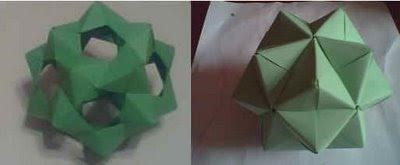
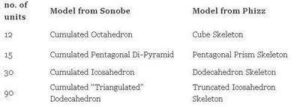
Some of the models that you can build are summarized below. The picture at the top of the post shows the 30-unit phizz dodecahedron and its dual, the 30-unit sonobe icosahedron.

For more such insights, log into www.international-maths-challenge.com.

*Credit for article given to dan.mackinnon*


Sonobe cut-out-module

Although creating origami sonobe units is likely to be considered by most to be an essential part of making sonobe polyhedra, a cut-out version of the sonobe module can be used to help beginners learn how to weave the units together.

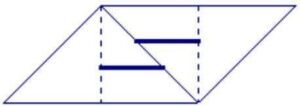
The unit pictured here can be reproduced multiple times in a document (a PowerPoint slide works well, since you don’t have to worry about margins), and printed onto card stock. Printing onto card stock gives a solid unit to work with, while regular paper will likely be too flimsy.

After printing, cut out each unit and cut slits into them along the bold horizontal lines (a utility blade or exacto-knife works well). Depending on whether you want to hide the printing or not, you can mountain-fold the diagonal line and vally-fold the dotted vertical lines, or vice-versa (all modules should be folded the same).

You will need 6 units for a cube, 12 for an “augmented octahedron”, and 30 for an augmented icosahedron. Models can also be assembled from 3 units (a triangular di-pyramid) 9 units (two fused cubes), and other combinations.

The main idea in creating this module was to create a set of reusable units that could be used in professional development workshops for teachers learning modular origami for the first time. After seeing how the units hold together, the next step is to learn how to fold the units from paper.

To construct smaller modules, simply connect less than 5 units around. A 4 unit base will form the pattern for the augmented octahedron (which will take a total of 12 units). A 3 unit base will form the pattern for the cube (which will take a total of 6 units).

For more such insights, log into www.international-maths-challenge.com.

*Credit for article given to dan.mackinnon*


This Turing Machine Should Run Forever Unless Maths is Wrong

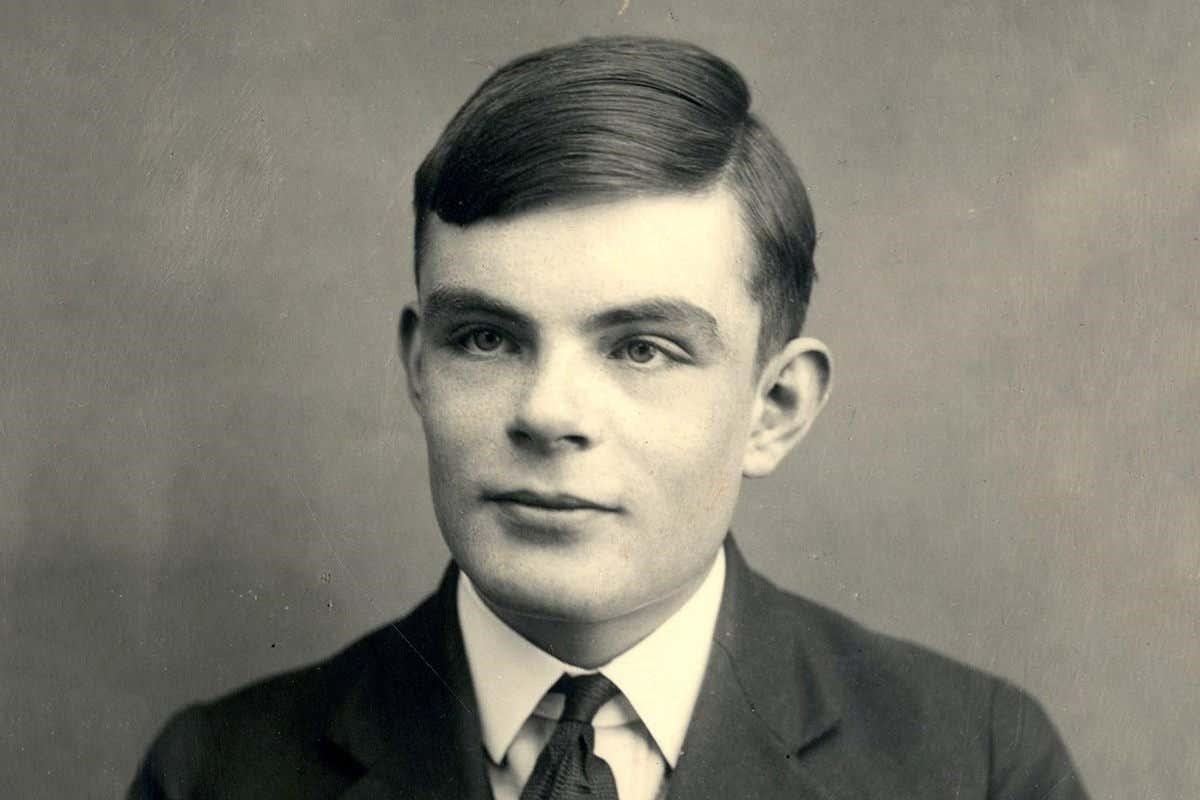
Alan Turing: still casting a long shadow over mathematics

One hundred and fifty years of mathematics will be proved wrong if a new computer program stops running. Thankfully, it’s unlikely to happen, but the code behind it is testing the limits of the mathematical realm.

The program is a simulated Turing machine, a mathematical model of computation created by codebreaker Alan Turing. In 1936, he showed that the actions of any computer algorithm can be mimicked by a simple machine that reads and writes 0s and 1s on an infinitely long tape by working through a set of states, or instructions. The more complex the algorithm, the more states the machine requires.

Now Scott Aaronson and Adam Yedidia of the Massachusetts Institute of Technology have created three Turing machines with behaviour that is entwined in deep questions of mathematics. This includes the proof of the 150-year-old Riemann hypothesis – thought to govern the patterns of prime numbers.

Turing’s machines have long been used to probe such questions. Their origins lie in a series of philosophical revelations that rocked the mathematical world in the 1930s. First, Kurt Gödel proved that some mathematical statements can never be proved true or false – they are undecidable. He essentially created a mathematical version of the sentence “This sentence is false”: a logical brain-twister that contradicts itself.

No proof of everything

Gödel’s assertion has a get-out clause. If you change the base assumptions on which proofs are built – the axioms – you can render a problem decidable. But that will still leave other problems that are undecidable. That means there are no axioms that let you prove everything.

Following Gödel’s arguments, Turing proved that there must be some Turing machines whose behaviour cannot be predicted under the standard axioms – known as Zermelo-Fraenkel set theory with the axiom of choice (C), or more snappily, ZFC – underpinning most of mathematics. But we didn’t know how complex they would have to be.

Now, Yedidia and Aaronson have created a Turing machine with 7918 states that has this property. And they’ve named it “Z”.

“We tried to make it concrete, and say how many states does it take before you get into this abyss of unprovability?” says Aaronson.

The pair simulated Z on a computer, but it is small enough that it could theoretically be built as a physical device, says Terence Tao of the University of California, Los Angeles. “If one were then to turn such a physical machine on, what we believe would happen would be that it would run indefinitely,” he says, assuming you ignore physical wear and tear or energy requirements.

No end in sight

Z is designed to loop through its 7918 instructions forever, but if it did eventually stop, it would prove ZFC inconsistent. Mathematicians wouldn’t be too panicked, though – they could simply shift to a slightly stronger set of axioms. Such axioms already exist, and could be used to prove the behaviour of Z, but there is little to be gained in doing so because there will always be a Turing machine to exceed any axiom.

“One can think of any given axiom system as being like a computer with a certain limited amount of memory or processing power,” says Tao. “One could switch to a computer with even more storage, but no matter how large an amount of storage space the computer has, there will still exist some tasks that are beyond its ability.”

But Aaronson and Yedidia have created two other machines that might give mathematicians more pause. These will stop only if two famous mathematical problems, long believed to be true, are actually false. These are Goldbach’s conjecture, which states that every even whole number greater than 2 is the sum of two prime numbers, and the Riemann hypothesis, which says that all prime numbers follow a certain pattern. The latter forms the basis for parts of modern number theory, and disproving it would be a major, if unlikely, upset.

Practical benefits

Practically, the pair have no intention of running their Turing machines indefinitely in an attempt to prove these problems wrong. It’s not a particularly efficient way to attack that problem, says Lance Fortnow of the Georgia Institute of Technology in Atlanta.

Expressing mathematical problems as Turing machines has a different practical benefit: it helps to work out how complex they are. The Goldbach machine has 4888 states, the Riemann one has 5372, while Z has 7918, suggesting the ZFC problem is the most complex of the three. “That would match most people’s intuitions about these sorts of things,” Aaronson says.

Yedidia has placed his code online, and mathematicians may now compete to reduce the size of these Turing machines, pushing them to the limit. Already a commenter on Aaronson’s SaiBlog claims to have created a 31-state Goldbach machine, although the pair have yet to verify this.

Fortnow says the actual size of the Turing machines are irrelevant. “The paper tells us that we can have very compressed descriptions that already go beyond the power of ZFC, but even if they were more compressed, it wouldn’t give us much pause about the foundations of math,” he says.

But Aaronson says shrinking Z further could say something interesting about the limits of the foundations of maths – something Gödel and Turing are likely to have wanted to know. “They might have said ‘that’s nice, but can you get 800 states? What about 80 states?’” Aaronson says. “I would like to know if there is a 10-state machine whose behaviour is independent of ZFC.”

For more such insights, log into www.international-maths-challenge.com.

*Credit for article given to Jacob Aron*


From English to Math

Let’s lay down some definitions:

  • Let FF be a field and let EE be an extension of FF. An element α∈Eα∈E is algebraicover FF if there is a polynomial f(x)f(x) in F[x]F[x] such that f(α)=0f(α)=0 (i.e. α∈Eα∈E is an algebraic element if it is the root of some polynomial with coefficients in FF).
  • Let FF be a field and let EE be an extension of FF. If K⊂EK⊂E is a subset of EE which contains all elements which are algebraic over FF, then KK is actually a subfieldof EE and an algebraic extension of FF. We call KK the algebraic closure of FF and denote it by ¯¯¯¯FF¯. [1]

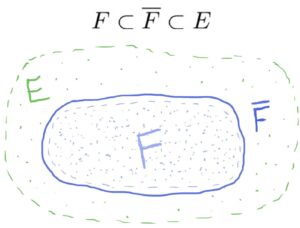
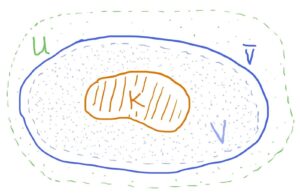
It’s a fact that an algebraic closure ¯¯¯¯FF¯ exists for every field FF (and is actually unique up to isomorphism). So we can draw a containment picture like the one above.

Those familar with some topology and/or analysis will notice that such a “field tower” is suggestive of a vaguely analogous result: given a topological space XX we can always (assuming some conditions about XX, namely it being locally-compact Hausdorff) stick an open set VV and its closure ¯¯¯¯VV¯ between a certain compact set KK and open set UU:  K⊂V⊂¯¯¯¯V⊂U.K⊂V⊂V¯⊂U.

Now, don’t buy too much into the analogy. I only mention this topological result to motivate the fact that the closure of a set and the algebraic closure of a field do indeed convey the same concept: wholeness. It seems then that we can view algebraic elements as the mathematical cousins of limit points of sequences of real numbers. Why? Because, topologically speaking, what is the closure of a set? The collection of limit points of that set, right? So in particular, when we let our topological space be RR, the set of real numbers (with the usual topology) and consider the subset {xn}∞n=1{xn}n=1∞ – some sequence of real numbers,

  • we say x∈Rx∈R is a limit pointof {xn}{xn} if for every ϵ>0ϵ>0 there is an n∈Nn∈N such that |xn−x|<ϵ|xn−x|<ϵ.

Then in light of our comments above, we can make the analogous statement for a subset of polynomials {fn(x)}⊂F[x]⊂E[x]{fn(x)}⊂F[x]⊂E[x]:

  • We say α∈Eα∈E is an algebraic element(over FF) if there is an n∈Nn∈N such that fn(α)=0fn(α)=0**.

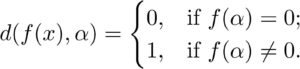
Notice there’s no need for an approximation by ϵϵ in the second bullet. Why? Well, imagine placing a “metric” dd on E[x]E[x] by d:E[x]×E[x]→Ed:E[x]×E[x]→E via***

(So intuitively, f(x)f(x) is far away from αα if αα is not a root, but if αα is a root of f(x)f(x), then f(x)f(x) and αα are just as close as they can be.) In this way, the distance between an algebraic element and its corresponding polynomial is precisely 0. So in this case there’s no need to approximate a distance of zero by an arbitrarily small ϵϵ-ball – we have zero exactly!

And thus we have stumbled upon another insight into one of the main differences between analysis and algebra: you know the adage –

Analysts like inequalies; algebraists like equalities!

Digging Deeper

It would be interesting to see if there’s something in the language of category theory which allows one to see that closure of an algebraic field and closure of a topological set really are the same. Now I don’t know much about categories, but as one of my classmates recently suggested, we might want to look for a functor from the category of fields to the category of topological spaces such that the operation of closure is equivalent in each. In this case, perhaps it’s more appropriate to relate an algebraic closure to the completion of a topological space, as opposed to its closure. Admittedly, I’m not sure about all the details, but I think it’s worth looking into!

Footnotes:

* This is actually a bit deceiving. How we measure “closeness” really depends on the topology of the space we’re working on. For example, we can place the ray topology on RR so that the open sets are intervals of the form (a,∞)(a,∞) for a∈Ra∈R. Then in the strict definition of a limit point we see that -763 is a limit point of the interval (0,1)(0,1) even though it’s “far away”!

** Okay okay… there’s no reason to assume an arbitrary collection of polynomials is countable. I really should write FF for some family of polynomials in which case this statement would read “…if there is some f∈Ff∈F such that f(α)=0f(α)=0.” But bear with me for analogy’s sake.

*** I put “metric” in quotes here because as defined dd is not a metric in the strict sense of the word. Indeed, we don’t have the condition d(f(x),α)=0d(f(x),α)=0 if and only if “f(x)=αf(x)=α” since the latter is like comparing apples and oranges! But it would be interesting to see if we could place looser version of a metric on a polynomial ring. For instance, the way I’ve defined dd here, an open ball centered at αα would correspond to all polynomials in E[x]E[x] which have αα as a root! This idea seems to be related to Hilbert’s Nullstellensatz and the Zariski topology.

For more such insights, log into www.international-maths-challenge.com.

*Credit for article given to Tai-Danae Bradley*


If I had a blank cheque, I’d … turn IBM’s Watson into a maths genius

Grand Challenges in Mathematics.

In his famous 1900 speech The Problems of Mathematics David Hilbert listed 23 problems that set the stage for 20th century mathematics.

It was a speech full of optimism for mathematics in the coming century and Hilbert felt open (or unsolved) problems were a sign of vitality:

“The great importance of definite problems for the progress of mathematical science in general … is undeniable … [for] as long as a branch of knowledge supplies a surplus of such problems, it maintains its vitality … every mathematician certainly shares … the conviction that every mathematical problem is necessarily capable of strict resolution … we hear within ourselves the constant cry: There is the problem, seek the solution. You can find it through pure thought …”

Hilbert’s problems included the continuum hypothesis, the “well-ordering” of the reals, Goldbach’s conjecture, the transcendence of powers of algebraic numbers, the Riemann hypothesis, the extension of Dirichlet’s principle and many more.

Many were solved in subsequent decades, and each time it was a major event for mathematics.

The Riemann hypothesis (which deals with the distribution of prime numbers) remains on a list of seven “third millennium” problems.

For the solution of each millennium problem, the Clay Mathematics Institute offers – in the spirit of the times – a one-million-dollar prize.

This prize has already been awarded and refused by Perelman for resolving the Poincaré conjecture. The solution also merited Science’s Breakthrough of the Year, the first-time mathematics had been so honoured.

Certainly, given unlimited moolah, learned groups could be gathered to attack each problem and assisted in various material ways. But targeted research in mathematics has even less history of success than in the other sciences … which is saying something.

Doron Zeilberger famously said that the Riemann hypothesis is the only piece of mathematics whose proof (i.e. certainty of knowledge) merits $10 billion being spent.

“In 1965 the Russian mathematician Alexander Konrod said ‘Chess is the Drosophila [a type of fruit fly] of artificial intelligence.

“But computer chess has developed as genetics might have if the geneticists had concentrated their efforts, starting in 1910, on breeding racing Drosophila. We would have some science, but mainly we would have very fast fruit flies.”

Unfortunately, the so-called “curse of exponentiality” – whereby the more difficult a problem becomes, the challenge of solving it increases exponentially – pervades all computing, and especially mathematics.

As a result, many problems – such as Ramsey’s Theorem – will likely be impossible to solve by computer brute force, regardless of advances in technology.

Money for nothing

But, of course, I must get to the point. You’re offering me a blank cheque, so what would I do? A holiday in Greece for two? No, not this time. Here’s my manifesto:

Google has transformed mathematical life (as it has with all aspects of life) but is not very good at answering mathematical questions – even if one knows precisely the question to ask and it involves no symbols.

In February, IBM’s Watson computer walloped the best human Jeopardy players in one of the most impressive displays of natural language competence by a machine.

I would pour money into developing an enhanced Watson for mathematics and would acquire the whole corpus of maths for its database.

Maths ages very well and I am certain we would discover a treasure trove. Since it’s hard to tell where maths ends and physics, computer science and other subjects begin, I would be catholic in my acquisitions.

Since I am as rich as Croesus and can buy my way out of trouble, I will not suffer the same court challenges Google Books has faced.

I should also pay to develop a comprehensive computation and publishing system with features that allow one to manipulate mathematics while reading it and which ensures published mathematics is rich and multi-textured, allowing for reading at a variety of levels.

Since I am still in a spending mood, I would endow a mathematical research institute with great collaboration tools for roughly each ten million people on Earth.

Such institutes have greatly enhanced research in the countries that can afford and chose to fund them.

Content with my work, I would then rest.

For more such insights, log into our website https://international-maths-challenge.com

Credit of the article given to Jonathan Borwein (Jon), University of Newcastle