The same but different

Imagine this: On the news this morning you hear a segment about the weather – the maximum temperature tonight is predicted to be -2℃ and this is 10℃ colder than last night!

Question: What was the maximum temperature last night?

Now imagine this: You step into an elevator in a tall building and travel down 10 floors to the car park. When the doors open, you see a sign on the wall saying ‘Level -2’.

Question: If the ground floor was Level 0 , on which level of the building did you enter the elevator?

Next, imagine this: You go to the cinema and spend £10 on a ticket. Later, you check your bank balance and see that it is -£2.

Question: What was your balance before you purchased the ticket?

Finally, imagine this: You sit down in your mathematics class and see the equation 𝑥-10=-2

Question: What is the value of 𝑥?

What do these scenarios have in common?

Perhaps you noticed that they all have the same numerical answer? Maybe you recognised that they are all asking the same numerical question: Which number is 10 more than -2?

We sometimes describe such problems as ‘isomorphic’ – they have the same underlying structure but different surface details. Those surface details often add context to otherwise abstract mathematical problems, and it is common for us as teachers and designers to try to include these contextual or ‘word problems’ in teaching materials. But for what purpose? I suspect the immediate answer that comes to mind is one based on ideas of numeracy or mathematical literacy – ‘because learners need to be able to apply their knowledge to solve problems in the world around them’. Another common answer might be simply ‘because these sorts of questions will come up in the exam’. A perhaps less common answer could be ‘because they help learners to understand a concept’.

But how many students would recognise that the problems posed earlier were in fact isomorphic? Or do they tackle each of these as isolated problems, never noticing the connection between them? Does it matter either way?

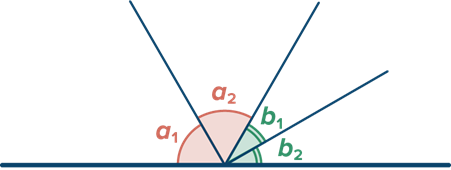
In the two problems below (adapted from those in Greer and Harel, 1998, p. 20), problem 2 is provided by the teacher to help a student who is struggling to solve problem 1.

  1. In the diagram, 𝑎1=𝑎2 and 𝑏1=𝑏 Find the value of 𝑎2+𝑏1

  1. You and your sister had £180 altogether. Your sister gave me half of what she had and you gave me half of what you had. How much money do you have left between you?

Here the teacher is supposedly trying to support the student by providing an isomorphic problem that they might find easier to make sense of. However, Greer and Harel reported that in this case, the learner saw no connection between the two, that is until after they had constructed a solution for problem 1 (which rendered the teachers’ attempt at support somewhat unsuccessful!). And this finding is not unique; it is commonly reported (e.g. Barniol and Zavala, 2010 ; Lin and Singh, 2011) that learners simply do not spontaneously recognise isomorphic problems – that which is an obvious analogy to the teacher (an expert) often remains invisible to the learner (a novice).

I am reminded of a time when my GCSE mathematics class were exploring linear graphs in the context of Celsius and Fahrenheit temperature scales. After some time, a student loudly protested, ‘You haven’t given us enough information – we don’t know this value!’ (referring to the freezing point of water in degrees Celsius). Surprised, I prompted them to think of their science classes, to which they responded, ‘Well in science it’s 0℃. But this isn’t science, it’s maths!’

This interaction has stayed with me for many years. I had made assumptions about the ways in which students implicitly connected their knowledge, that they would automatically recognise where and how knowledge could be transferred from one setting or context to another. But they didn’t, even with something as elementary as the freezing point of water.

So, recognising sameness in context matters – that there are universal facts and knowledge that can be applied to a problem, be it in mathematics, science, geography, or in what we sometimes call ‘the real world’ (that mysterious place outside the classroom). But what about sameness in (mathematical) structure – does it matter if students don’t recognise two problems are isomorphic if they can solve each of them correctly anyway?

Here I ask you to consider the following three problems, this time concerned with combining vectors. Try to reflect on the first mental image that comes to mind in each case; you might like to note or sketch something for one before moving to the next.

Problem A

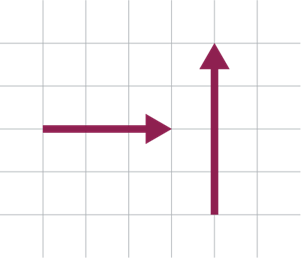
There is a vector of 3 units to the east and another vector of 4 units to the north.

Sketch the two vectors and the vector sum.

Problem B

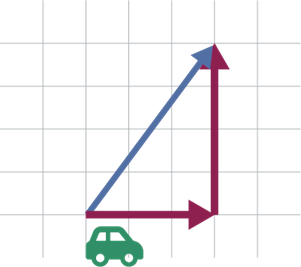
A car travels 3km to the east and then 4km to the north.
Sketch the total displacement vector.

Problem C

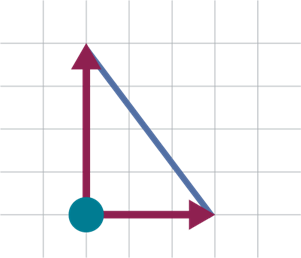
Two forces are exerted on an object. One force is of 3N to the east and another force is of 4N to the north.
Sketch the force vectors and the total force vector exerted on the object.

These problems are also isomorphic and did you notice, the context likely influenced your mental image, your ‘sense’ of the problem and the solution path you might take?

Let’s consider this further. Problem A is the most abstract; it requires us to draw upon our knowledge of mathematical conventions and terminology and procedures associated with adding vectors, and to undertake significant mental manipulation of the two mathematical objects (the individual vector arrows) to form a sum.

Problem B focuses on displacement and brings with it the benefits of intuition around sequential movement. Here it’s much easier to sketch the vector combination correctly and to recognise the effect of total displacement.

Problem C focusses on forces; it requires us to have a sense of what a force is and knowledge of conventions associated with free-body diagrams (most likely from physics classes). In this context, our intuition sometimes leads to initial misconceptions – for example, that the resultant vector will join the individual vectors end-to-end (completing a triangle).

Now, knowing that these problems are isomorphic, did/does any one help you to make (more) sense of another?

I am hoping that the answer is yes! As humans we are excellent at pattern spotting and building analogies and noticing, or imagining, similarities – it’s how we build connections and retrieve memories. Our ability to work flexibly with a mathematical concept is related to exactly this: our capacity to build and tap into that rich network of connected ideas, experiences and problems. But this doesn’t happen spontaneously – it is cultivated over time, an accumulation of experiences and prompts to compare and contrast situations. So, I wonder, how often do we give students time and guidance not to practise solving different, isolated problems but to understand a concept in different ways or contexts, and moreover, how often do we deliberately give students isomorphic problems presented in those different ways?

In the same way that we might support an individual student who is struggling to solve 𝑥-10=-2 by offering them a relatable, analogous scenario or way of thinking about the problem, why not incorporate explicit opportunities for all students to see, compare and even create their own isomorphic problems? Perhaps then they will begin to construct stronger, richer networks of knowledge, or ‘mental libraries’ of contexts and problem types that they can visit when confronted by a new problem or concept, seeking, not an answer, but a sense of the problem and possible paths to a solution.

Let’s finish with a challenge – how many problems can you create that are isomorphic to this?

Solve the equation 10𝑦=2

And how about problems isomorphic to this?

Solve the equation -10𝑦=2

For more such insights, log into www.international-maths-challenge.com.

*Credit for article given to Tabitha Gould*


Game on: The maths and data behind professional League of Legends

Have you heard of esports? If not, then where have you been? Probably outdoors having fun with friends or loved ones … but I’m here to tell you that you’re missing out on the greatest genre of entertainment this side of a digital screen!

Should you be unaware, esports is essentially a computer game that is played in a competitive setting by the best players in the world – usually in front of a crowd. These games are often streamed on platforms such as Twitch or YouTube to millions of fans. Talking of millions, the best players in the world can earn those kinds of figures. Additionally, the esports scene was valued at $1.81 billion in 2024 and is set to reach $5.88 billion by 2030.

While you might have an image of people just sitting at computers messing around, there is in fact a huge amount of variation and flexibility to these games when played at the top level, and a massive infrastructure of people involved. There are the players, the coaches, the managers and even private chefs and personal trainers! Importantly teams also have analysts to track information about their own teams and also about the other teams as well. Each team plays differently, and each player plays differently. Numerous statistics are tracked during games, both in professional games and the general player base. It’s a huge amount of data to work with – and it’s what this blog will primarily focus on.

Now you might be saying, ‘Ray, how on earth are you going to link this to mathematics?’, and I’m here to tell you ‘By a very delicate thread’ – a trait of all my blogs.

But what I’d like you to consider as you read this, is the incredible number of variables that are being presented. Ones that are constantly at play, ones reactive to other choices, variables within variables … a data smorgasbord!

League of Legends

There is a vast array of games which have their competitive scenes, but for this blog I’m going to stick with one called League of Legends – due to my own knowledge, both in terms of playing (9,210 hours as of writing this) and also watching (since the very first season back in 2011).

In short, League of Legends is a multiplayer online battle arena released in 2009. In the main game mode two teams of five battle against each other to destroy their opponent’s ‘Nexus’ (their base). On average a game takes 25–40 minutes.

It’d be easy to think that this is just a simple 5v5 game, so you just jump into a game and get killing. But the game starts before … well, before the game starts.

The game and its variables

Before the game clock can even reach 00:01, champion selection must take place, a process which takes around 5 minutes by itself. This is where each player decides which champion they are playing in the game – a very collaborative process between all the players of the team, and the coaches. The aim is to have a well-rounded team composition built of champions that each offer something different.

In the below sections, variables 1–4 will cover this phase, while 5–7 cover aspects found during actual game play.

While we progress through these variables, I’ll try to inform you of numerical variations that are found within each one. Keep these in mind as you progress through to try and grasp the scale of knowledge required, and the breadth of data analytics required to strategise against your opponents.

Variable 1: The champions

There are currently 171 unique champions to choose from, and each one has their own abilities; each champion has four abilities as standard, though a select few have a couple more or a couple less. Each champion then has their own values for stats which encompass things such as health, attack speed, armour, magic resist, attack range, etc. Additionally, each champion has a unique passive effect that provides a continued effect throughout the game.For instance, a simple passive might be ‘hit the same champion 3 times within X seconds to cause more damage’.

Champions are generally grouped into six categories:

  • Marksmen buy items which improve their auto attack damage (a basic attack).
  • Supports focus on items that improve their health and defences to be a frontline (someone who positions closest to the enemy team during fights in order to protect teammates and to create and engage fights), or items which help them to heal, shield, or defend others.
  • Fighters look to buy items which help them do damage, but also to keep themselves healthy by healing themselves for a % of damage caused (for example). They tend to spend a lot of the game fighting solo against another solo opponent.
  • Mages build items that improve their ability power, so their abilities do more damage.
  • Assassins use items that help them kill squishy (vulnerable) champions quickly, known for producing quick burst damage.
  • Tanks build items that give them massive improvements to health and defences.

They can then be grouped further by their effectiveness during the periods of the game:

  • Early game: Strong during the early period, known as the ‘laning phase’, where there is fighting in small skirmishes, generally in equal numbers.
  • Mid game: Period where teams start fighting for early objectives on the map; the start of grouping up as groups of 4 or 5.
  • Late game: This is where most champions are now at or close to max level with their core items, and there are full-on 5v5 team fights.

The developer of League of Legends, Riot Games, works constantly to try and balance champions so all are viable. Taking into consideration the data from professional and general games, they adjust them to try and encourage an average 50% win rate for each. However, this doesn’t mean all champions are good against each other. For instance, Champion A might be strong against Champion B, but they get stomped by Champion C, and Champion C gets destroyed by Champion B. This comes into play later in the pick and ban phase, variable 3.

Additionally, champion popularity is also taken into account when considering balance changes. Win rates can be tied to champion usage and the skill of those playing; for instance, a champion might have a low win rate, but mainly due to being highly played by users who (quite frankly) are terrible.

Variables to note

  • 171 champions
  • 5 abilities (includes passive and ignores non-standard)
  • 10 stat ranges per champion
  • 6 champion categories

Variable 2: The map and player roles

The map the game is played on is square, and is split into 3 main lanes: Top, Mid and Bot. It is split diagonally (top left to bottom right) by the River – with the rest of the space in-between the lanes being the Jungle. The half of the square below and to the left of the River is the Blue team’s side, and the half above and to the right of the River is the Red team’s side.

In a normal game, side selection is random, whereas in the professional scene the team with the highest seed coming into the game generally gets to choose which side they are.
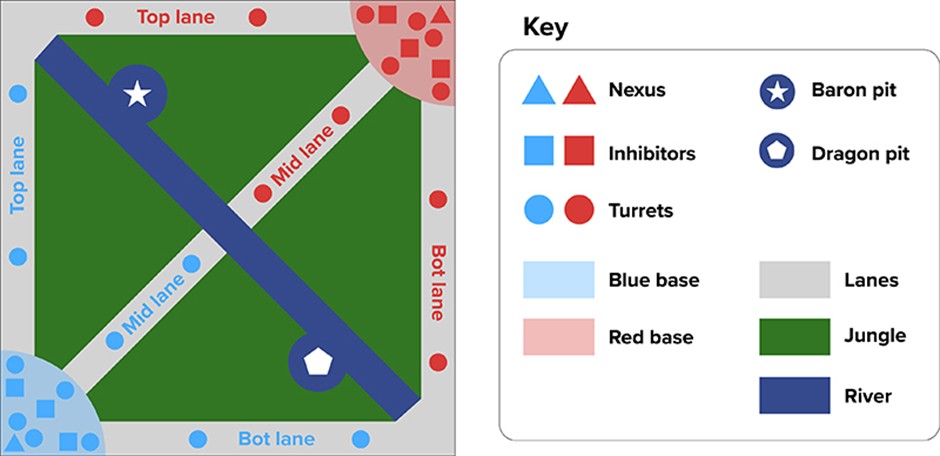
Figure 1. Summoner’s Rift, the map on which a standard game of League of Legends is played. Image adapted under Creative Commons License CC BY-SA 3.0.

The five players per team are distributed into the following positions:

  • Top laner
  • Jungler
  • Mid laner
  • Bot laner
  • Support (who spends most of their time with the bot laner, but can roam to assist the other roles)

Champions tend to excel when played in a certain role, however you can technically play everyone everywhere, though you might get flamed (insulted, harassed, etc.) or called a griefer (someone purposely playing the game in a negative way).

In the professional game, each player is an expert in their role, and how it should be played, along with the champions that are suited to that lane. For the sake of simplicity, we’ll divide the total champion numbers by 5 to say that means each player is an expert in 34.2 champions. I refuse to round up or down.

While you might think, ‘Well that map sounds equal and balanced’, it turns out, you are super wrong, and you should feel bad. In the professional scene, Blue side generally has a win rate between 51–52%, although in last year’s tournament, Worlds 2024, the Blue win rate sky rocketed to 60% during the early stages! In the previous Worlds tournament, it was nearly 80%!

The map is mostly a flipped reflection, i.e. Team 1 top jungle matches Team 2 bottom jungle. While this seems fair, it does actually give blue slide a few advantages, such as easier access to the Baron Pit (the Baron is explained later) but generally it is also just a more natural way to play – going bottom left, to top right. Top right to bottom left makes for a more awkward process, especially when the game’s interface is mostly along the bottom edge covering a good portion of visibility.

Variables to note

  • 2 sides
  • 3 lanes + jungle
  • 5 roles

Variable 3: The pick and ban phase

In the competitive scene, the order players choose a champion is very specific – and also involves banning champions out, which means both teams can’t play that champion. This is a good way to remove champions who perhaps are:

  • too strong, so better if no-one plays it;
  • a strong champion that someone on your team doesn’t play, so better to remove it; or
  • is played by someone on the opposite team as an OTP (one trick pony), or the opponent is known for being able to affect the game strongly on that champion.

The order starts with the first ban phase:

  • Blue Ban 1
    Red Ban 1
    Blue Ban 2
    Red Ban 2
    Blue Ban 3
    Red Ban 3

Then the first pick phase:

  • Blue Pick 1
    Red Pick 1
    Red Pick 2
    Blue Pick 2
    Blue Pick 3
    Red Pick 3

Followed by the second ban phase:

  • Red Ban 4
    Blue Ban 4
    Red Ban 5
    Blue Ban 5

And finally, the second pick phase:

  • Red Pick 4
    Blue Pick 4
    Blue Pick 5
    Red Pick 5
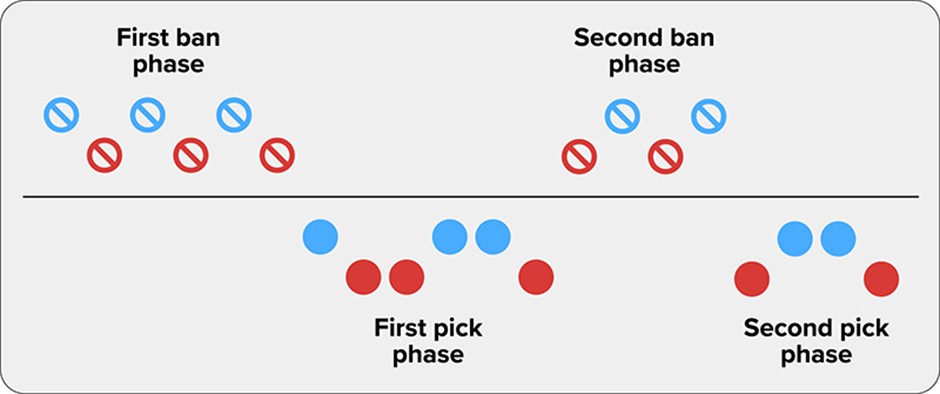
Figure 2. The pick/ban order during champion selection. Image adapted under Creative Commons License CC BY-SA 3.0.

As you can see the pick orders are staggered; this is to try and ensure teams don’t become too unbalanced. Blue team get the opportunity to choose the strongest champion left in the pool; however Red team then gets to pick the next two. Depending on the meta (Most Effective Tactics Available), a team might prefer to be on blue or red side, i.e. if there is a singular strong champion who usually gets past the ban phase, you might want to ensure the chance to have them, thus pick Blue. Or if there is a range of strong picks, especially a pairing which works really well – you’d choose Red. As mentioned in Variable 2, Blue win rate is generally an advantage – one factor is due to a few champions who are very strong right now (meta picks), so Blue side tends to ban most of these out in the hope of being able to pick a remaining one.

The pick and ban structure also allows certain strategies.

Counter picking

In the pick phase, there is a tactic known as counter picking. Essentially, some champions are strong against certain other champions – or in turn weak against others. Therefore, you try to choose champions who are strong against the ones your opponents have chosen. The staggered order helps to ensure the team who picks second doesn’t get all the counter picks. The next strategy is also used to help with this …

Flex picking

As mentioned previously, while champions tend to excel in one role there are some which are strong in multiple roles, or at least capable enough to hold their own in them. Sometimes it becomes an advantage to choose one of these flex picks, rather than a strong meta champion in order to avoid being counter picked. You then get to decide when to reveal where this champion will go. It has been a strong tactic in the past to choose three flex picks in the first pick phase in order to really stump the opposing team. However, the negative of this tactic is that it requires multiple players to be competent at playing these champions.

Role banning

For example, if you are playing Blue side, and your Top Laner has already chosen their champion in the first pick phase, but the Red side’s Top Laner hasn’t chosen theirs, then you might choose to prioritise banning champions often played in Top during your second ban phase, to reduce the pool of viable Top Laners.

At the end of this, you’ll have two teams each with five champions. But it’s not just about choosing five strong champions and calling it a day: it’s about composition1 as well, ensuring that your team of five don’t all have the same strength, but instead work together2 to create a strong team. A team of five Mages, for example, wouldn’t work against a properly composed and balanced team which includes a Tank, Support and a Marksman. There is a bit of flexibility in how creative a team can be, but sticking to a well-rounded formula tends to lead to success.

So, is it game time yet? No, don’t be silly.

Variables to note

  • LOTS! Let’s just throw a non-numerical value here … X

Variable 4: Runes, shards and summoner spells

In short, runes are extra effects you can assign to your champion; this is done during the Pick and Ban phase before the game starts.

Runes are split into 5 different categories, which are made from 4 different tier levels, the final tier being an ultimate rune.

  • You have a primary category, where you can choose one from each tier – so 4 in total.
  • You then have a secondary category, where you choose one from 3 tiers (no ultimate) – so 3 in total.

In total, there are 63 different runes – which all do different things!

Shards are another system, but much simpler. Three categories, each with 3 different options to choose from, which give you extra stats in areas such as health, cooldown reduction, adaptive power (which, depending on your champion, is either attack damage or ability power), etc.

Then there are summoner spells. These are extra skills players can take to help them perform. There are 9 different spells to choose from (although one is only for the Jungler as it helps them kill Jungle creeps) and each player can only have two.

Variables to note

  • 5 rune categories with 63 runes in total, from which players can choose 7: 4 from their primary category and 3 from their secondary category
  • 3 rune shard categories with 9 rune shards in total
  • 9 summoner spells with a choice of 2 for each player

Lovely… so now the match can actually start. Yes!

And now we can go ‘no brain mode’ and enjoy the game right? Nein.

Variable 5: Items

In the game one of the main priorities is to earn gold, in order to buy items. This can be done in numerous ways, but the main ones are:

  • Killing enemy champions
  • Killing enemy minions, which are NPCs (non-playable characters) that march down the lanes
  • Killing jungle minions (also NPCs)
  • Taking turrets (fortifications which protect the lanes, each team has 3 per lane)

At the start of the game each player has 500 gold from which to buy a starter item. There are approximately 8 different starter items, each has its own stats and they are in certain cases special effects.

In the early game players buy item components; there are approximately 15 Basic Items which can make 48 Epic Items. These also have their own stats and in certain cases special effects.

And yep, that’s right – Basic and Epic item components can then be combined to create completed items classed as Legendary. There are about 103 of these, and by the end game each champion should have 5 of these. You can’t have the same item on a champion more than once, and some completed Items make it impossible to buy some others (if they are for a similar purpose, for instance).

All done? You know better than that.

Each champion also buys a pair of boots – which start as a basic pair, which are then upgraded to one of 7 variations.

Ok so now we…. Nope still not done, be quiet.

There’s a champion in the game called Ornn, who has a passive which allows him to upgrade a single item for each of his allies. There are 28 of those.

AND then there’s… why? Why are there all these items?

Well as you can imagine, each item has a different purpose. Some just purely boost damage, whether that’s attack damage, or ability power. Some improve your defences, things like health, armour or magic resist while some help you apply better shields or healing to your allies. Which ones you buy depends on the champion you play, AND which champions you are playing against. But also, players will have their own favourites of items they prefer to use – even if the statistics say not to, alas you can’t remove the human ego out of the equation!

Variables to note

  • 6 item slots available for each champion
  • 100+ Legendary items (plus Ornn variables if he’s selected as a champion)

Variable 6: Objectives

As mentioned previously – the aim of the game is to destroy your opponent’s Nexus. However, that is the final objective. To get there, you need to do objectives. Some are required; some are additional to help boost your chances of winning.

The main objectives are:

  • Turrets: Each lane has 3 turrets. To get to the Nexus you need to at least destroy all 3 in a single lane. However, destroying more is beneficial for getting gold and improving your map state (i.e. having control of an area).
  • Inhibitor: After destroying the 3rd turret in one lane, you have access to the opponent’s inhibitor for that lane. Destroying this allows your lane to spawn stronger minions.

Additional objectives which help your chances are:

  • Dragons: Dragons spawn during the game; they can be four different types. The first two will be random types, but the following dragons will all be the same type and eventually become the ‘Soul’. The souls of the different types of dragon (Ocean, Cloud, Hextech and Infernal) offer different benefits. Whichever team gets four dragon kills (of any type combination) in total gets a dragon’s soul which offers a strong passive for the rest of the game. Oh, and depending on which dragon’s soul it is also changes the map in different ways.
  • Grubs: Once per game, three small grub monsters spawn at the same time. Killing these will give a buff (enhancement) to your team which helps with the destruction of turrets.
  • Herald: Herald is a large monster that spawns a while after the grubs, and removes the grubs if they’ve not been taken by this point. Should your team kill it, you can spawn it as an ally to help you easily destroy turrets.
  • Baron: Baron spawns 25 minutes into the game. Should your team kill it, it gives each player alive at the time a temporary power boost, and the ability to power up your lane minions, to help you destroy turrets.
  • Elder Dragon: After four dragons have been killed, the next dragon to spawn is Elder Dragon. Should your team kill this, it gives you a temporary power that will execute your opponents should you take them down to 20% health. This is a late game buff to help your team end the game.

The final objective:

  • Nexus: Each team has a Nexus. Destroying your opponent’s Nexus ends the game in victory.

Variables to note

  • Which dragon becomes soul, and which team gets it
  • Which team gets grubs and how many
  • Which team gets Herald
  • Which team gets Barons or Elder Dragons

Variable 7: The game’s end(?)

It’s worth briefly mentioning, that while games in the main seasons usually comprise single games, in competitive tournaments (like the prementioned Worlds) there are also matches with best of three games, and best of five games. So, all of this happens over and over again! Additionally in subsequent games, the choice of side selection is decided by whichever team lost the previous game which means strategies change each time!

A recent introduction to the league is also ‘Fearless Draft’. In this system, during matches which span multiple games, whichever champions are played in Game 1, for instance, can’t be played in the later games. This creates a whole new dynamic and forces players to improve their pool of champions even further – along with making viewing more exciting and varied.

Variables to note

  • You win or you lose
  • Side selection for subsequent games

Disclaimer

There are further variables which could be discussed too, but the ones above are perhaps the most crucial to the standard gameplay.

The data

So here we are, at the crux of it all. Seven main variables, each with their own array of potential options, values and outcomes to take into consideration. It’s a swirling storm of statistics, strategy, psychology, and probability – like designing the world’s most complex game of rock, paper, scissors, but with 171 hands and a shifting rulebook.

Something that should be as simple as ‘win or lose’ is instead a story of data, and the integration of that data with player experience and knowledge to forge a path towards victory.

What fascinates me most is not just the numbers, but how those involved interpret them, bend them, and sometimes defy them, as with all sports – sometimes the better team, playing on the blue side and ahead for most the game, can lose. The data might suggest one path to victory, but the human element of intuition, creativity and stubbornness can rewrite the script entirely.

If you’re a mathematician, a gamer, or just someone curious about how numbers shape the world, I hope this blog has offered a glimpse into the beautiful chaos of esports. And maybe, just maybe, next time you hear someone mention League of Legends, you’ll see more than just a game – you’ll see a living, breathing equation in motion.

For more such insights, log into www.international-maths-challenge.com.

*Credit for article given to Ray Knight*


Questioning the answer rather than answering the question

“Are we at the top?” might not sound like such an unusual question to hear from a child when you’re out and about, but as I cycled past a family and their dog in the park the other morning, I was intrigued by how the adult being questioned was going to answer. Anyway, as is so often the case when I hear snippets of conversation on the move, I thought that it would at best interrupt the flow of conversation, and at worst be considered rude, to stop and listen in, so I kept pedalling.

I’d like to pause briefly in my tale and invite you to think about the situations that could have prompted this question, given the location… (if you’re like me, you might make list, but otherwise just cast your mind around a park environment and consider the options). Maybe the pronoun ‘we’ ruled out trees or playground equipment from your musings, unless you see more families climbing things together than I do, but if not then you might have considered those alongside a hill, perhaps? In fact, they and I were on a bridge, and so the next questions I’d like to pose to you are how many different types of bridge have you come across and how many of those have what you would consider to be a ‘top’?

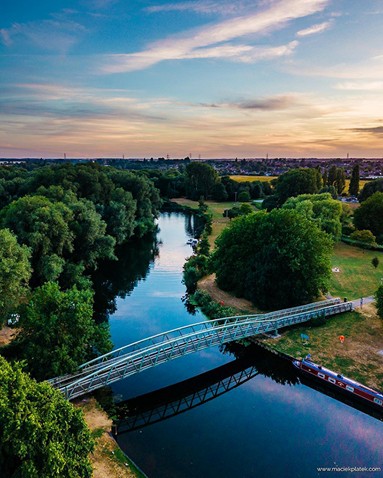
I thought about this before drawing some pictures (as a student of mine is fond of pointing out, “You love a sketch, Miss!”) and then decided to look up how many different types of bridge there are. Having found various internet sources that gave names to shapes I partially recognised, I couldn’t decide which of those types best described the bridge in question. I shared a photograph of ‘my’ bridge and pictures of the seven main structural types that I’d found on the internet, with a civil engineer I know, as I wasn’t sure which was the closest match or which particular elements were the most important in classifying it; for example, when identifying a triangle, most people first think of the property of having three sides, but to be certain a shape is a triangle, it’s also important that these sides are straight and that they form a closed shape. I wanted to know which properties give each bridge type its name and how to therefore classify one which didn’t exactly match any of the seven types I’d found described. Their answer was that ‘my’ bridge (shown below if you click on ‘Show / Hide photo’) is a double truss bridge, which I had assumed from the pictures I’d seen meant that the main span was flat. On further investigation, my assumption turned out to be wrong, so what my legs had told me, which was that more effort was increasingly required to ride across the bridge, up to a point, and then I could freewheel down the other side, must mean that there was a top, highest point or ‘apex’ (since we’re talking about the highest point of a geometric shape).

© Maciek Platek 2018.

I decided to ask AI for definitions of ‘top’, and this prompted me to realise other uses too. Below are some examples from our combined lists:

  • The highest point or uppermost part of something (top of a mountain, building, or tree)
  • The surface of an object (the top of the cube)
  • Added to an existing word to modify the meaning (tabletop or countertop)
  • The lid or cover of a container
  • A position (“Put the lettuce on top of the cheese in the sandwich”)
  • The highest position in a particular rank or chart (“The Top of the Pops”)
  • A particular section of a data set (“The top 1% of…”)
  • A piece of clothing worn on the upper part of the body
  • A spinning toy that balances on a point at its base
  • Peak performance state (being at the top of your game)
  • Maximum volume or intensity (singing at the top of your lungs)

The versatility of the word is much wider than I’d first thought, and the context is often vital in understanding the concept being conveyed.

Back then to the question I overheard and the many answers it had made me consider: I went in search of photographs of the bridge to see if I could locate the ‘top’ via symmetry, both of the surface being walked/biked on, but also the visible highest point of the bridge (presumably at some unreachable point on the structure above us); I wondered if could locate the point at which I started to freewheel as the middle of the bridge, and therefore the highest I was going to get above the river on my bike. All these explorations generated joyful and interesting questions for me, arguably more so than if I’d overheard whatever response/answer was given in the moment. So as a colleague of mine often said, “Perhaps our role (as teachers) is to question answers, rather than answer questions”.

I leave you with “Do things with ‘tops’ always necessarily have ‘bottoms’?” and challenge you and your learners to think of as many examples and non-examples as you can!

For more such insights, log into www.international-maths-challenge.com.

*Credit for article given to Fran Watson*


Mathematics is SUBLIME!

What is the value of learning mathematics now that artificial intelligence (AI) can solve almost all the questions we throw at it? Will AI change the way we think of mathematics and the way we teach and learn it? Will learning mathematics even remain relevant in 10 years from now, in an age when AI will surely play a key role? These are all valid questions, regardless of whether one is a mathematician or an educator or not. Finding definite answers to such questions is a key challenge in times like these; governed by uncertainty, by the fact that many questions have no clear answers, and that most answers are questionable. It is challenging yet exciting at the same time though, just like mathematics! It is now that our human intelligence and character need to be fully activated to ensure we proceed confidently, and try to find answers that allow us to prosper as a civilisation. So, I cannot answer these big questions on behalf of everyone, but what I can and will do here is share my personal thoughts on mathematics in the age of AI, as a mathematician, an educator, and a human.

First, mathematics is here to stay, no matter how AI proliferates. Not necessarily as it is now, not necessarily as an independent subject, not necessarily in its current shape and form, but as something to be embraced and experienced, and as something to be learned as the Greek origins of the word imply. How will it be learned though? Not necessarily the same way as now, not necessarily in classrooms, not only through textbooks and assessments, and probably not just facilitated by a human. I am convinced that teaching and learning in general will change in theory and practice, sooner or later, as a result of AI and all the emerging technologies, all the new discoveries in various fields, and our own evolving understanding of the concepts of teaching and learning. A change in education models will surely accompany this, whether we are in favor of it or not. I am also certain that if we manage to perceive AI and technology as catalysts and not threats, and if we truly believe in our human intelligence and resilience and our ability to adapt while protecting our human characteristics, we can then conceive new resilient learning and education models, mostly human-led and AI- and technology-powered as a starting point, that take us to new levels of innovation, efficiency and progress.

Will mathematics remain relevant? Yes. Always. But again, what do we mean by mathematics and relevance here? Mathematics is not just a book or an assessment. It is more than a grade or a degree. Mathematics is relevant for how sublime it is, and we need to accentuate that. What do I mean by sublime? First, from a philosophical and aesthetic perspective, mathematics induces awe and exceeds the realm of senses; its infinite horizons and abstract beauty align with the scale and magnificence the word induces among philosophers, from Burke and the vastness beyond comprehension to Kant and triumph of reason. This somehow resonates with Kurt Gödel who said: “Either mathematics is too big for the human mind or the human mind is more than a machine.”1 For me personally, mathematics is SUBLIME in the way it embodies seven aspects: it is stimulating, ubiquitous, borderless, limitless, intriguing, monumental, and enduring. How, you ask?

Stimulating: Mathematics is not just memorising and applying formulas, sketching a graph, solving an equation, or finding the area of a 2D-shape, and we need to ensure it is not perceived as such. Nothing activates critical thinking, reasoning and problem-solving skills like mathematics. It pushes us to think about everything we deal with in real life from finances and measurements to more impalpable topics like the origin of the universe and the future of human intelligence, and even infinity and beyond. But not just that, mathematics teaches us to persevere while remaining patient, and to dream big while remaining humble. Maryam Mirzakhani was spot-on when she declared that “the beauty of mathematics only shows itself to more patient followers”.2 What is more humbling than the ‘simple’ prime numbers that still offer the most complex and challenging uncharted ramifications. Patience, and maybe AI, can help us explore these!

Ubiquitous: Mathematics is not just a ‘subject’ or a ‘course’ to be taught at school. While it has been tagged as such by many for a long time, for structural and practical reasons mainly, it might be time we rethink that. Purists may say that keeping it “independent” is an explicit acknowledgement of its importance, but is it? Maybe education systems should rethink how subjects are packaged and how content is delivered. Mathematics can (should?) be the element that beats the long-standing stagnation in the existing education models, which traditionally segregate subjects, with the help of new technologies, drawing upon how mathematics beats within so many other subjects that rely on mathematical concepts and reasoning to survive. Who said mathematics and computer science are totally independent, for example? Same for mathematics and physics or mathematics and medical sciences. Is teaching mathematics in context nowadays better or worse for learners? Joseph Fourier said: “Mathematics compares the most diverse phenomena and discovers the secret analogies that unite them”.3 What if mathematics gets taught, at least partially, in that way; following a unifying approach?

Borderless: Mathematics is not to be confined in curricula and textbooks; it is not to be framed as a collection of topics and domains or a list of theorems and formulas. It is and should be free to roam, as Georg Cantor wanted it to be when he said “the essence of mathematics lies precisely in its freedom”.4 One of the beautiful things about technology, and mainly AI, when used carefully, is that it allows us to break human-made borders between education resources and brings almost everything to our fingertips: we can now access real-time data related to a medical condition for use in a statistics course; we can create a mathematical model for climate change based on relevant and recent information; we can visualise and touch 3D graphs and interact with all sorts of holograms; we can juggle equations and play with charts in various ways; and much more. When all of this is available, why stick to the book and the blackboard? Technology allows us to amplify how free-spirited mathematics can and should be. After all, mathematics is not just something we learn: it is something we live, and that should be at the core of how mathematics is experienced.

Limitless: Mathematics is not a finite set of components. It never ceases to amaze us day after day, and this will be the case for an infinite amount of time! Speaking of infinity, who can think of different ‘sizes’ of infinity but a mathematician? That being said, new technologies should be seen and used as tools in support of this journey of ours to ensure more brains are triggered, more mysteries are unraveled, more conjectures are proven, and even new domains and fields are created and explored, just like with DeepMind. After all, keep in mind that there are still many unsolved problems in mathematics that require deep thinking and much perseverance, so why not let AI help us tackle these quests while we move on to think of new mounts to climb? Andrew Wiles once said: “The definition of a good mathematical problem is the mathematics it generates rather than the problem itself.”5 Mathematics builds on itself, and the more we discover the more there will be left to uncover.

Intriguing: Mathematics is not boring and should not be so. It never ceases to push intelligence, human or artificial, to the limit, as it tackles a combination of structured and irregular numbers and objects, as it deals with systematic and chaotic systems and models, and as it includes logical and counterintuitive theorems and results. How fascinating to study a Koch snowflake, with its infinite length enclosing a finite area? How captivating to learn about Gabriel’s horn, with its infinite surface area and finite volume? This is the never-ending generosity of mathematics, always breaking the norms of reason and common sense, while being the guardian of logic! Mathematics is that magical mixture of certainty and conjectures: a special key that opens the most basic locks and the most challenging ones at once; it helps you add two digits and has the power to reveal the mysteries of the universe. But while this is so, we should not forget that there is still a stigma associated with mathematics for many, from numeracy to advanced level topics, and the fact that it is not presented and delivered as fun, attractive, and useful for all, adds to this stigma. We need to keep that gripping aspect of mathematics alive and to eliminate the stigma, and technology can assist with that.

Monumental: Mathematics is not just a supporting actor in a play led by other ‘fields’. Mathematics always had a tremendous role to play in humanity’s flourishing, and this has been the case to a massive extent from the beginning of times. Imagine a world without ‘0’, without ‘pi’, without ‘x’, without ‘i’, without ‘e’! All tiny on paper but huge in impact on human civilisation, and not only theoretically or in closed labs. Mathematics, whether explicitly or implicitly, even makes our world more beautiful to look at and live in; imagine architecture without the golden ratio, or nature without fractals and the Fibonacci sequence. This impact of mathematics will be further amplified with AI and new technologies; new discoveries, new proofs, new unexplored areas. But maybe it is time we rebrand mathematics to highlight its role and impact even more? If you ask a student nowadays if they prefer taking a course titled “Linear Algebra and Statistics” or one titled “Machine Learning and AI”, I believe I know what most of them would choose (someone to do a survey?), because mathematics is not marketed as a key component to all the transformations we are now witnessing in technology, nor to so many discoveries. Maybe the status of mathematics and its stardom is not debatable among scholars, but that is not necessarily the case in society or among students; this should change.

Enduring: Mathematics is not confined in an era or a timeline. It keeps on giving and history provides numerous examples of this. Mathematics evolves and expands, but it never stops being vital. Mathematics is always there, with its facts guiding how everything works whether we feel it or not, whether we know they are facts or not. As Erwin Schrödinger eloquently put it: “A mathematical truth is timeless, it does not come into being when we discover it”.6 Mathematics has always been a companion and a guide to discoveries and progress; from Thales, Euclid, and Hypatia; to Al Khawarizmi, Al-Battani and Al-Kashi; to Euler, Gauss, and Germain; to Ramanujan, Turing, and Mandelbrot; the list is long. Mathematics will remain alive as long as humanity exists, and beyond. It will remain relevant as long as we have problems to solve, patterns and relationships to understand, and things to measure and compare. Mathematics will remain a core element of this universe as long as curiosity is burning.

So, with or without AI, or maybe because of it, it is time to highlight how SUBLIME mathematics is! What do you say?

For more such insights, log into www.international-maths-challenge.com.

*Credit for article given to Rachad Zaki*