A New Study Shows Little Kids Who Count On Their Fingers Do Better At Maths

Sydney Bourne/ AAP

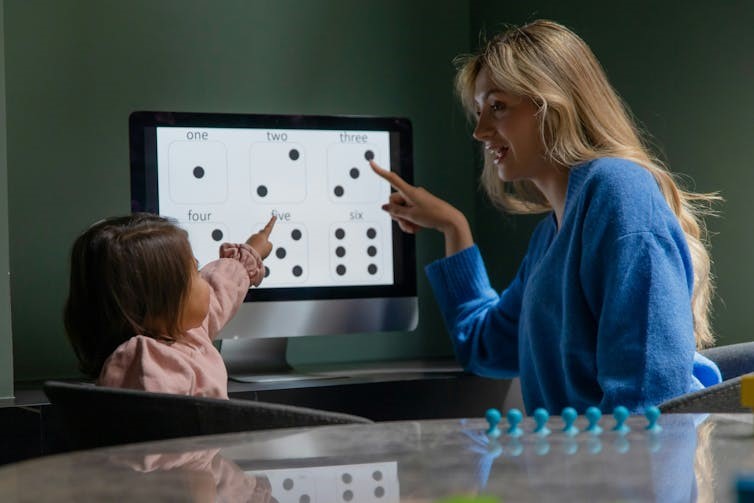
If you ask a small child a simple maths question, such as 4+2, they may count on their fingers to work it out.

Should we encourage young children to do this? This seemingly simple question is surprisingly complex to answer.

Some teachers and parents might say, yes, it seems to help young children learn about numbers. Others might discourage finger counting, arguing it might slow the development of mental strategies.

A new Swiss study, released on Friday, shows kids who use finger counting from a young age perform better at addition than those who do not.

What does the research say?

There is a rich debate among researchers about the value of kids using their fingers to count.

Education psychologists say finger counting helps children think through strategies without overloading their working memory (how our brains hold pieces of information for short time while we work something out), until more abstract strategies are mastered.

Researchers in embodied cognition (learning through actions) argue associating fingers and numbers is “doing what comes naturally” and so, should be encouraged. Neuroscientists might also note similar parts of your brain activate when you move your fingers and think about numbers, which helps memory.

Several previous classroom studies have shown children who use finger strategies to solve maths questions perform better than children who do not, until around seven when the opposite becomes true.

So, before age seven, finger-counters are better. After seven, non-finger-counters are better.

Why does this happen? What does this mean for mathematics education? This has been a point of debate for several years.

A new study followed 200 kids

A new University of Lausane study has taken an important step in settling this debate.

The researchers say previous studies have left us with two possible explanations for the apparent change in the benefits of finger counting at about seven.

One interpretation is finger strategies become inefficient when maths questions become more complex (for example 13 + 9 is harder than 1 + 3), so children who use finger strategies don’t perform as well.

The other possibility is the children who are not using finger strategies at seven (and performing better than those who do) were previously finger-users, who have transitioned to more advanced mental strategies.

To untangle these contrasting explanations, the researchers followed almost 200 children from age 4.5 to 7.5 and assessed their addition skills and finger use every six months.

Notably, they tracked if and when the children started and stopped using their fingers. So, at each assessment point, it was noted whether children were non-finger users, new finger-users (newly started), continuing finger-users, or ex-finger users (had stopped).

What did the study find?

The study found that by 6.5 years most of the non-finger users were indeed ex-finger users. These ex-finger users were also the highest performers in the addition questions and were still improving a year later. The significance of this finding is that in previous studies, these high performing children had only been identified as non-finger users, not as former users of finger-based strategies.

In the new Swiss study, only 12 children never used their fingers over the years, and they were the lowest performing group.

Additionally, the study showed the “late starters” with finger-counting strategies, who were still using finger strategies at the age of 6.5 to 7.5 years, did not perform as well as the ex-finger users.

What does this mean?

The findings from this unique longitudinal study are powerful. It seems reasonable to conclude both teachers and parents should encourage finger counting development from preschool through the first couple of years of school.

However, the Swiss study focused on predominantly white European children from middle to high socioeconomic backgrounds. Would we find such clear outcomes in the average multicultural public school in Australia? We suspect that we might.

Our own 2025 study found a wide variety of finger counting methods in such schools, but when teachers paid attention to the development of finger counting strategies it supported children’s number skills.

What can parents do?

Parents can show preschoolers how they can use their fingers to represent numbers, such as holding up three fingers and saying “three”.

Help them practice counting from one to ten, matching one finger at a time. Once they get started, the rest should come naturally. There is no need to discourage finger counting at any time. Children naturally stop using their fingers when they no longer need them.

For more such insights, log into www.international-maths-challenge.com.

*Credit for article given to Jennifer Way & Katherin Cartwright*


How number systems shape our thinking and what it means for learning, language and culture

Despite using numerical bases on a daily basis, few of us have reflected on the nature of these cognitive tools. (Getty Images/Unsplash+)

Most of us have little trouble working out how many millilitres are in 2.4 litres of water (it’s 2,400). But the same can’t be said when we’re asked how many minutes are in 2.4 hours (it’s 144).

That’s because the Indo-Arabic numerals we often use to represent numbers are base-10, while the system we often use to measure time is base-60.

Expressing time in decimal notation leads to an interaction between these two bases, which can have implications at both the cognitive and cultural level.

Such base interactions and their consequences are among the important topics covered in a new issue of the Philosophical Transactions of the Royal Society journal, which I co-edited with colleagues Andrea Bender (University of Bergen), Mary Walworth (French National Centre for Scientific Research) and Simon J. Greenhill (University of Auckland).

The themed issue brings together work from anthropology, linguistics, philosophy and psychology to examine how humans conceptualize numbers and the numeral systems we build around them.

What are bases, and why do they matter?

Despite using numeral bases on a daily basis, few of us have reflected on the nature of these cognitive tools. As I explain in my contribution to the issue, bases are special numbers in the numeral systems we use.

Because our memories aren’t unlimited, we can’t represent each number with its own unique label. Instead, we use a small set of numerals to build larger ones, like “three hundred forty-two.”

The degree to which numeral systems transparently reflect their bases has all sorts of implications. (Pablo Merchán Montes/Unsplash+)

That’s why most numeral systems are structured around a compositional anchor — a special number with a name that serves as a building block to form names for other numbers. Bases are anchors that exploit powers of a special number to form complex numerical expressions.

The English language, for example, uses a decimal system, meaning it uses the powers of 10 to compose numerals. So we compose “three hundred and forty-two” using three times the second power of 10 (100), four times the first power of 10 (10) and two times the zeroth power of 10 (one).

This base structure allows us to represent numbers of all sizes without overloading our cognitive resources.

Languages affect how we count

Despite the abstract nature of numbers, the degree to which numeral systems transparently reflect their bases has very concrete implications — and not just when we tell time. Languages with less transparent rules will take longer to learn, longer to process and can lead to more calculation and dictation errors.

Take French numerals, for example. While languages like French, English and Mandarin all share the same base of 10, most dialects of French have what could politely be called a quirky way of representing numbers in the 70-99 range.

Seventy is soixante-dix in French, meaning “six times 10 plus 10,” while 80 uses 20 as an anchor and becomes quatre-vingts, meaning “four twenties” (or “four twenty,” depending on the context). And 90 is quatre vingt dix, meaning “four twenty ten.”

French is far from being alone in being quirky with its numerals. In German, numbers from 13 to 99 are expressed with the ones before the tens, but numbers over 100 switch back to saying the largest unit first.

Even in English, the fact that “twelve” is said instead of “ten two” hides the decimal rules at play. Such irregularities spread far beyond languages.

How bases shape learning and thought

Base-related oddities are spread out across the globe and have very real implications for how easily children learn what numbers are and how they interact with objects such as blocks, and for how efficiently adults manipulate notations.

For example, one study found that lack of base transparency slows down the acquisition of some numerical abilities in children, while another found similar negative effects on how quickly they learn how to count.

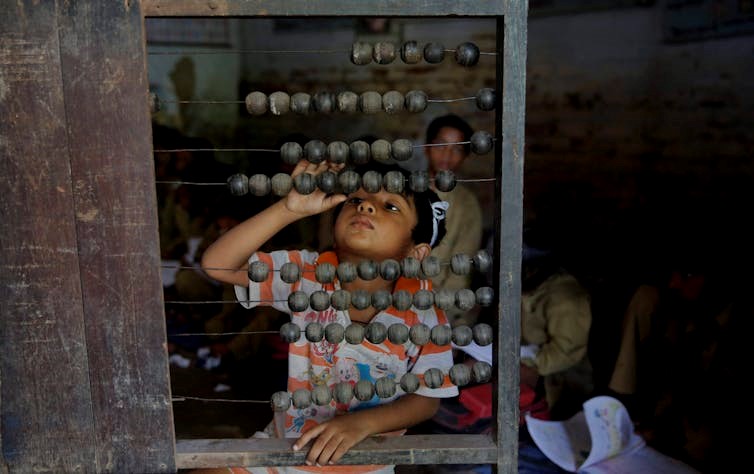
A young boy learns counting on an abacus at a school in Allahabad, India, in 2015. (AP Photo/Rajesh Kumar Singh)

Another study found that children from base-transparent languages were quicker to use large blocks worth 10 units to represent larger numbers (for example, expressing 32 using three large blocs and two small ones) than children with base-related irregularities.

While Mandarin’s perfectly transparent decimal structure can simplify learning, a new research method suggests that children may find it easier to learn what numbers are if they are exposed to systems with compositional anchors that are smaller than 10.

In general, how we represent bases has very concrete cognitive implications, including how easily we can learn number systems and which types of systems will tend to be used in which contexts.

Technicians lower the Mars Climate Orbiter onto its work stand in the Spacecraft Assembly and Encapsulation Facility-2 in 1998. (NASA)

At a cultural level, base representation influences our ability to collaborate with scientists across disciplines and across cultures. This was starkly illustrated by the infamous Mars Climate Orbiter incident, when a mix-up between metric and imperial units caused a $327 million spacecraft to crash into Mars in 1999.

Why understanding bases matters

Numeracy — the ability to understand and use numbers — is a crucial part of our modern lives. It has implications for our quality of life and for our ability to make informed decisions in domains like health and finances.

For example, being more familiar with numbers will influence how easily we can choose between retirement plans, how we consider trade-offs between side-effects and benefits when choosing between medications or how well we understand how probabilities apply to our investments.

And yet many struggle to learn what numbers are, with millions suffering from math anxiety. Developing better methods for helping people learn how to manipulate numbers can therefore help millions of people improve their lives.

Research on the cognitive and cultural implications of bases collected in the Philosophical Transactions of the Royal Society journal can help make progress towards our understanding of how we think about numbers, marking an important step towards making numbers more accessible to everyone.

For more such insights, log into www.international-maths-challenge.com.

*Credit for article given to Jean-Charles Pelland*


A rushed new maths curriculum doesn’t add up. The right answer is more time

Getty Images

If the recent news of a new mathematics and statistics curriculum for years 0–10 felt familiar, that’s because it was.

In term four last year, the Ministry of Education released a previous new maths (and English) curriculum for Years 0–8, to be implemented from term one this year.

Schools must use the latest new curriculum from term one next year. This will be the third curriculum for primary and intermediate schools in less than three years.

Despite claims that the most recent curriculum is only an “update”, the changes are bigger than teachers might have expected.

The new curriculum is more difficult and more full. There is now a longer list of maths procedures and vocabulary to be memorised at each year of school.

For example, year 3 children should learn there are 366 days in a leap year and that leap years happen every four years. Year 5 students should know what acute, obtuse and reflex angles are.

Some concepts have been moved into earlier years. Year 6 children will learn calculations with rational numbers (such as “75% is 24, find the whole amount”), whereas previously this would have been taught at year 8. (If you’re wondering, the whole amount is 32.)

Cubes and cube roots have been moved a year earlier. A lot of statistics, a traditional area of strength for New Zealand in international tests, has been stripped out.

Much of the “effective maths teaching” material about clearly explaining concepts and planning for challenging problem solving has been removed. Also gone are the “teaching considerations” that helped guide teachers on appropriate ways to teach the content.

The maths children should learn was previously broken up into what they needed to “understand, know and do” – the UKD model. But this has changed to “knowledge” and “practices”.

In short, there are new things to teach, things to teach in different years, and the whole curriculum is harder and structured differently. It is effectively a new curriculum.

Not just a document

Most teachers now have about eight school weeks to plan for the changes, alongside teaching, planning, marking, reporting, pastoral support and extracurricular activities.

For busy schools heading into the end of the school year, the timeline is unrealistic, some say a “nightmare”.

For secondary teachers, who will be making changes in years 9 and 10, this is the first major curriculum change since 2007.

Primary and intermediate teachers, who have worked hard this year getting up to speed with a new curriculum that will soon expire, might legitimately ask why they bothered.

A curriculum change is a big deal in a school, something that normally happens once in a decade or more. A curriculum is not just a document, it is used every day for planning, teaching and assessment. Any change requires more lead time than this.


When England launched a new National Curriculum in 2013, teachers had it 12 months ahead of implementation. Singapore, a country whose education system Education Minister Erica Stanford paints as exemplary, gave teachers two years to prepare for the secondary maths curriculum change in 2020.

Expecting teachers to prepare for major curriculum changes in eight weeks is not only unnecessarily rushed and stressful – it is also a risk to children’s learning.

Time to slow down

Term one next year also marks the implementation of the new “student monitoring, assessment and reporting tool” (SMART) which teachers have not yet seen.

Children in Years 3–10 will take maths tests twice a year and will be described as emerging, developing, consolidating, proficient or exceeding. Children in the top three categories (during the year) or top two categories (at the end of year) are “on track”.

For the rest, the curriculum says “teachers will need to adjust classroom practice, develop individualised responses, or trigger additional learning support”.

The original curriculum rewrite shifted the goalposts – only 22% of year 8 students would be at the “expectation” level, compared with 42% previously – and this curriculum shifts those goalposts further.

The inevitably poorer results from testing against a more challenging curriculum risk damaging children’s self confidence, disappointing parents and placing blame on teachers.

Test results may improve in later years, compared to those produced in the first year of assessment against a harder curriculum that will take time to embed. But that will not necessarily be evidence the change was justified.

Pausing this latest curriculum change for at least 12 months would give time for adequate consultation and preparation. That would be more consistent with the change processes of education systems internationally.

According to a recent report from the Education Review Office, teachers have mostly demonstrated professionalism in their conscientious adoption of the previous curriculum.

In our view, the most recent changes will severely test that goodwill.

For more such insights, log into www.international-maths-challenge.com.

*Credit for article given to David Pomeroy & Lisa Darragh*


How Do We Get More Year 12s Doing Maths?

Black ice/ Pexels , CC BY

Mathematics has been the broccoli of school subjects for generations of Australian teenagers.

Often pushed aside, dreaded, or even feared, nearly one third of students opt out of any senior maths courses.

This has serious implications for Australia’s future. As an Australian Academy of Science report warned on Thursday, we need people with maths skills to support a whole range of careers in science. This includes agricultural science, artificial intelligence, data science, biotechnology and climate science.

The skills we gain during school mathematics – problem-solving, pattern-finding, reasoning logically, and computational thinking – are essential to the work of many STEM careers.

The challenge is turning maths from broccoli to the ingredient every student wants on their plate for their future. So, what can we do?

What has been happening with high school maths?

Across Australia, there has been a decline in students studying maths in years 11 and 12 since the 1990s. Today, only 8.4% of Australian high school students study the most difficult level of maths.

There are diverse reasons explaining why students opt out of maths during school.

Many students struggle to see the relevance of the maths they are learning for their future. Others have low self-confidence and avoid maths, believing they are not capable. An increasing range of senior subjects has also led to students being drawn to more enticing alternatives.

What can parents do?

Research shows parents’ attitudes towards maths can predict the attitudes their children will have towards the subject.

This means we need to be careful as parents. If we have negative attitudes towards maths due to our own anxieties or past struggles, this can affect our children’s attitudes and performance too.

Instead, parents should try to focus on the positive aspects of maths.

For example, this is a subject where you learn about the mechanics of the world, rather than a subject to be endured before moving to the “fun” stuff. Maths can come alive once we notice how we use it in sports, art, cooking, travel, money management and games.

Parents can also be curious co-learners with their children – we never need to have all the answers ourselves. But showing interest, having a growth mindset (a belief you can improve your abilities through effort), and asking questions can support students’ positive attitudes and performance in maths.

You can also talk to your child about why mastering maths is central to a wide range of occupations, from coding to trades, retail, nursing, animation and architecture.

What should schools do?

Research suggests 20% of 15-year-old boys and 33% of 15-year-old girls do not think maths will be relevant to their future.

So we need a new approach to careers advice in schools. Students need adequate support from informed adults to make accurate judgements about career pathways – emphasising how maths can help.

On top of this, schools could consider the ways in which mathematics is celebrated and promoted in schools. While music, drama, and sport days are regular features of the school calendar, maths is rarely included. Exciting maths competitions and maths days are prime opportunities to show students how important maths is in our world.

What about teachers?

Some of us may remember maths lessons as rather dry with a focus on lots of questions and whether something was “wrong” or “right”.

So teachers who make maths engaging for students and maximise opportunities for success are crucial.

This involves making abstract mathematics real (how does this concept apply to something physical in the real world?).

Teachers should also provide step-by-step support to students (what educators call “scaffolding”), so young people experience a sense of achievement and success with maths. Success builds motivation, creating an upward spiral of positive maths experiences.

What can governments do?

The alarm bells over maths participation have been raised for 30 years, with government funding supporting research into this phenomenon.

Despite this, the declines persist, and gender gaps in maths have widened, with more boys doing maths and more boys achieving higher marks.

So while governments should continue to support research into this matter, they should prioritise translating it into practical strategies for schools and teachers.

Some evidence-based approaches include:

high-expectation teaching, where teachers set ambitious goals, create supportive classrooms, and believe all students can achieve

relevance interventions, where teachers show students the practical implications of their learning

mindset interventions, which help students believe in their abilities.

Getting kids back into maths

Maths participation is both a national concern and something we should all be personally attuned to.

The lifestyles of future generations will be dependent on our capacity to be STEM innovators.

At an individual level, when students opt-out of mathematics, they are potentially closing many doors in their lives and career.

For more such insights, log into www.international-maths-challenge.com.

*Credit for article given to Bronwyn Reid O’Connor & Ben Zunica*