
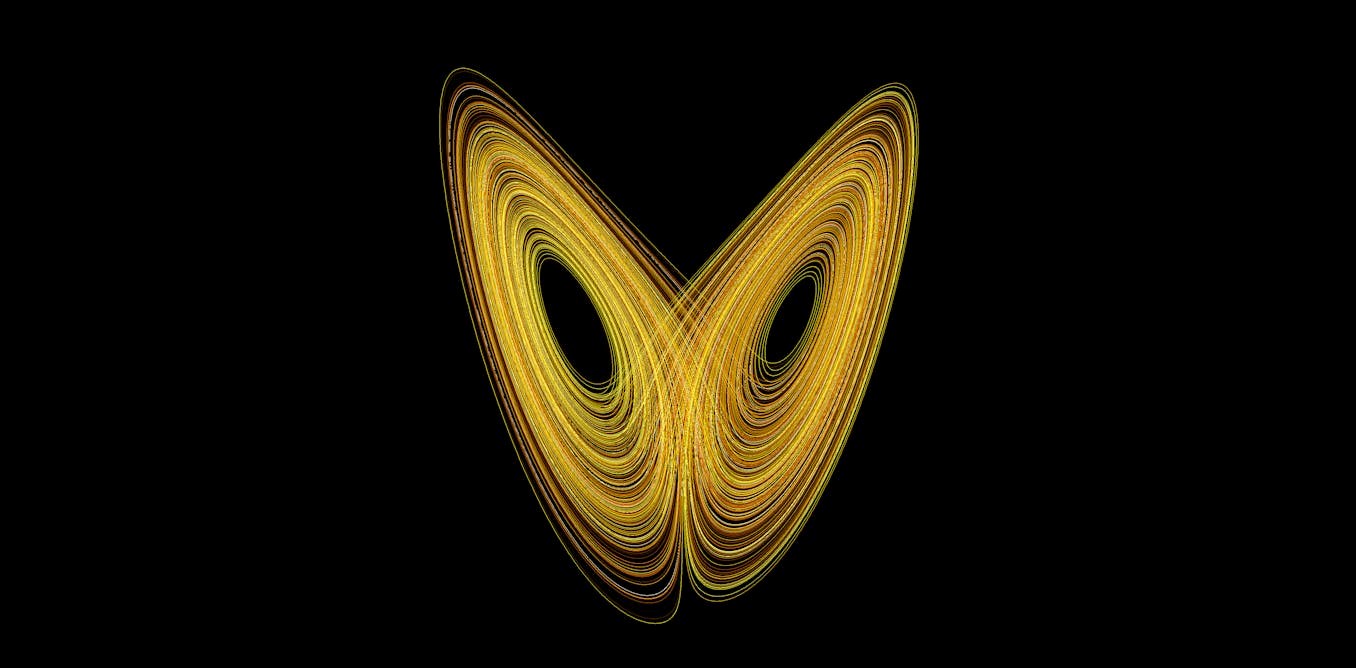
Edward Lorenz’s mathematical weather model showed solutions with a butterfly-like shape. Wikimol
In 1972, the US meteorologist Edward Lorenz asked a now-famous question:
Does the flap of a butterfly’s wings in Brazil set off a tornado in Texas?
Over the next 50 years, the so-called “butterfly effect” captivated the public imagination. It has appeared in movies, books, motivational and inspirational speeches, and even casual conversation.
The image of the tiny flapping butterfly has come to stand for the outsized impact of small actions, or even the inherent unpredictability of life itself. But what was Lorenz – who is now remembered as the founder of the branch of mathematics called chaos theory – really getting at?
A simulation goes wrong
Our story begins in the 1960s, when Lorenz was trying to use early computers to predict the weather. He had built a basic weather simulation that used a simplified model, designed to calculate future weather patterns.
One day, while re-running a simulation, Lorenz decided to save time by restarting the calculations from partway through. He manually inputted the numbers from halfway through a previous printout.
But instead of inputting, let’s say, 0.506127, he entered 0.506 as the starting point of the calculations. He thought the small difference would be insignificant.
He was wrong. As he later told the story:
I started the computer again and went out for a cup of coffee. When I returned about an hour later, after the computer had generated about two months of data, I found that the new solution did not agree with the original one. […] I realized that if the real atmosphere behaved in the same manner as the model, long-range weather prediction would be impossible, since most real weather elements were certainly not measured accurately to three decimal places.
There was no randomness in Lorenz’s equations. The different outcome was caused by the tiny change in the input numbers.
Lorenz realised his weather model – and by extension, the real atmosphere – was extremely sensitive to initial conditions. Even the smallest difference at the start – even something as small as the flap of a butterfly’s wings – could amplify over time and make accurate long-term predictions impossible.

The ‘Lorenz Attractor’ found in models of a chaotic weather system has a characteristic butterfly shape. Milad Haghani, CC BY
Lorenz initially used “the flap of a seagull’s wings” to describe his findings, but switched to “butterfly” after noticing a remarkable feature of the solutions to his equations.
In his weather model, when he plotted the solutions, they formed a swirling, three-dimensional shape that never repeated itself. This shape — called the Lorenz attractor — looked strikingly like a butterfly with two looping wings.
Welcome to chaos
Lorenz’s efforts to understand weather led him to develop chaos theory, which deals with systems that follow fixed rules but behave in ways that seem unpredictable.
These systems are deterministic, which means the outcome is entirely governed by initial conditions. If you know the starting point and the rules of the system, you should be able to predict the future outcome.
There is no randomness involved. For example, a pendulum swinging back and forth is deterministic — it operates based on the laws of physics.
Systems governed by the laws of nature, where human actions don’t play a central role, are often deterministic. In contrast, systems involving humans, such as financial markets, are not typically considered deterministic due to the unpredictable nature of human behaviour.
A chaotic system is a system that is deterministic but nevertheless behaves unpredictably. The unpredictability happens because chaotic systems are extremely sensitive to initial conditions. Even the tiniest differences at the start can grow over time and lead to wildly different outcomes
Chaos is not the same as randomness. In a random system, outcomes have no definitive underlying order. In a chaotic system, however, there is order, but it’s so complex it appears disordered.
A misunderstood meme
Like many scientific ideas in popular culture, the butterfly effect has often been misunderstood and oversimplified.
One common misconception is that the butterfly effect implies every small action leads to massive consequences. In reality, not all systems are chaotic, and for systems that aren’t, small changes usually result in small effects.
Another is that the butterfly effect carries a sense of inevitability, as though every butterfly in the Amazon is triggering tornadoes in Texas with each flap of its wings.
This is not at all correct. It’s simply a metaphor pointing out that small changes in chaotic systems can amplify over time, making long-term outcomes impossible to predict with precision.
Taming butterflies
Systems that are very sensitive to initial conditions are very hard to predict. Weather systems are still tricky, for example
Forecasts have improved a lot since Lorenz’s early efforts, but they are still only reliable for a week or so. After that, small errors or imprecisions in the starting data grow larger and larger, eventually making the forecast inaccurate.
To deal with the butterfly effect, meteorologists use a method called ensemble forecasting. They run many simulations, each starting with slightly different initial conditions.
By comparing the results, they can estimate the range of possible outcomes and their likelihoods. For example, if most simulations predict rain but a few predict sunshine, forecasters can report a high probability of rain.
However, even this approach works only up to a point. As time goes on, the predictions from the models diverge rapidly. Eventually, the differences between the simulations become so large that even their average no longer provides useful information about what will happen on a given day at a given location.
A butterfly effect for the butterfly effect?
The journey of the butterfly effect from a rigorous scientific concept to a widely popular metaphor highlights how ideas can evolve as they move beyond their academic roots.
While this has helped bring attention to a complex scientific concept, it has also led to oversimplifications and misconceptions about what it really means.
Attaching a metaphor to a scientific phenomenon and releasing it into popular culture can lead to its gradual distortion.
Any tiny inaccuracies or imprecision in the initial description can be amplified over time, until the final outcome is a long way from reality. Sound familiar?
For more such insights, log into www.international-maths-challenge.com.
*Credit for article given to Milad Haghani*