
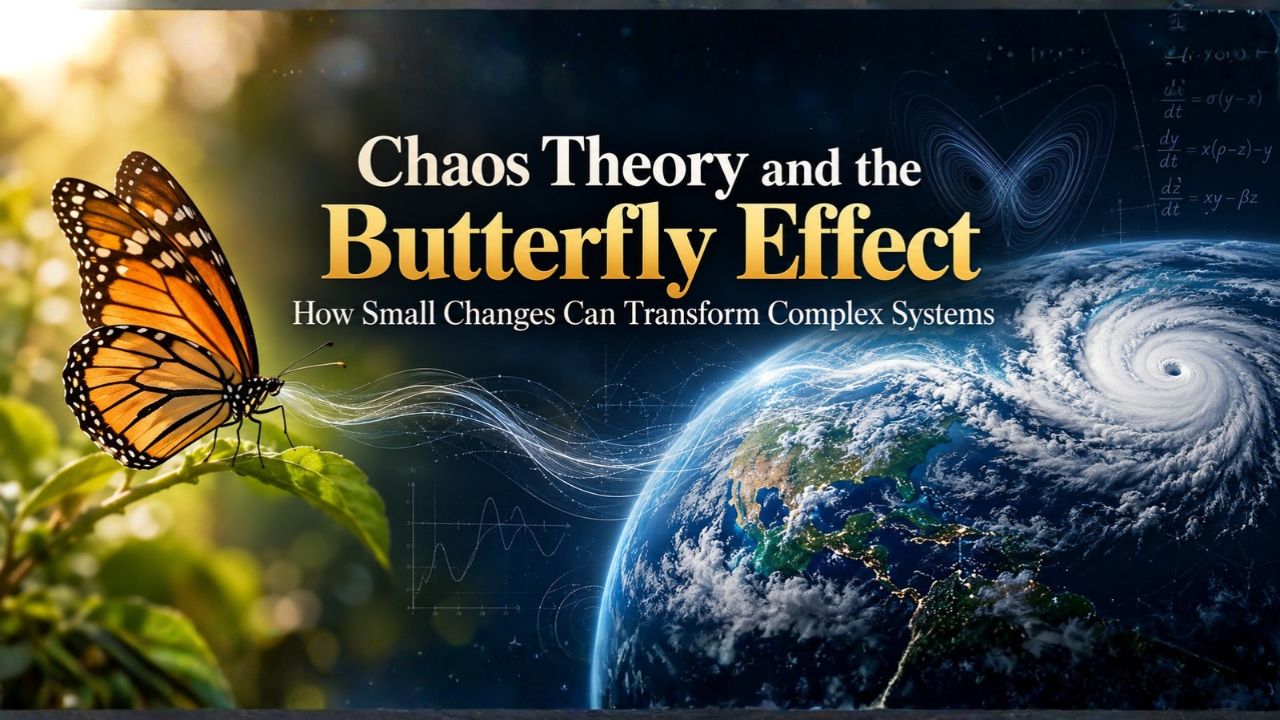
Have you ever wondered how a tiny change in the weather, a small decision, or a slight movement can lead to a completely different outcome? Mathematics offers a fascinating explanation through Chaos Theory and the Butterfly Effect — concepts that reveal how small changes can influence complex systems in surprising ways.
What Is Chaos Theory?
Chaos Theory is a branch of mathematics that studies systems that are highly sensitive to their initial conditions. These systems may follow precise mathematical rules, yet their long-term behaviour can be extremely difficult to predict.
Examples include weather patterns, ocean currents, population growth, and the movement of planets under certain conditions.
The interesting part is that chaotic systems are not necessarily random. They can follow mathematical laws while producing outcomes that appear unpredictable.
Understanding the Butterfly Effect
The Butterfly Effect is one of the best-known ideas in Chaos Theory. It suggests that a very small difference in the starting conditions of a system can eventually lead to a significantly different outcome.
The concept became widely known through meteorologist and mathematician Edward Lorenz, who studied mathematical models of weather in the 1960s.
Lorenz discovered that even tiny differences in the initial values of his calculations could produce dramatically different weather predictions over time.
The butterfly is a metaphor for this sensitivity. It does not mean that one butterfly literally creates a hurricane, but that small disturbances can influence complex systems in ways that are difficult to predict.
How Does Mathematics Explain Chaos?
A famous mathematical model associated with Chaos Theory is the Lorenz system, which uses three differential equations to describe simplified atmospheric motion.
Its behaviour demonstrates how two systems starting with nearly identical conditions can gradually follow very different paths.
In mathematical terms, this is called sensitive dependence on initial conditions. Even when the governing equations remain unchanged, small differences in starting values can grow over time.
This is why weather forecasts become less reliable the further into the future they attempt to predict.
Where Do We See the Butterfly Effect in Real Life?
-
Weather forecasting: Tiny differences in temperature, pressure, and wind can influence future weather patterns.
-
Nature and ecosystems: A small change in one species’ population can affect food chains and the balance of an entire ecosystem.
-
Human decisions: A seemingly minor choice can lead to unexpected opportunities or different life outcomes.
-
Technology and traffic: Small disruptions in traffic flow can sometimes develop into major congestion across a road network.
These examples show how interconnected systems can amplify small changes, although not every small event produces a major consequence.
Why Is Chaos Theory Important?
Chaos Theory helps mathematicians and scientists understand the limits of prediction. It encourages researchers to study how systems behave, how sensitive they are to changing conditions, and which outcomes may be difficult to forecast.
Rather than assuming that every complex system can be predicted perfectly, Chaos Theory teaches us to recognise uncertainty and the importance of initial conditions.
Conclusion
The Butterfly Effect reveals a remarkable truth about mathematics: small changes can sometimes lead to enormous consequences. From weather systems to ecosystems, Chaos Theory helps explain why complex systems can behave in unexpected ways, even when they follow mathematical rules.
Continue exploring fascinating mathematical ideas with more articles on International Maths Challenge.