Every four years, the mathematics world holds its breath. The International Congress of Mathematicians gathers the brightest minds on the planet, and the International Mathematical Union announces the awards that define a generation of mathematical achievement. On 23 July 2026, at the ICM in Philadelphia — the first held in the United States since 1986 — four remarkable individuals were awarded the Fields Medal, widely described as the Nobel Prize of mathematics.
The Fields Medal has a history as rich as the mathematics it celebrates. First awarded in 1936, it was the vision of John Charles Fields, a Canadian mathematician who wanted to create an award that would both recognise outstanding work already done and encourage future achievement. Unlike the Nobel Prize, which can be awarded to scientists of any age, the Fields Medal comes with a strict upper age limit of 40. This is deliberate. The award is designed not just to honour what has been accomplished but to signal what is still to come — to tell the world that this person is worth watching.
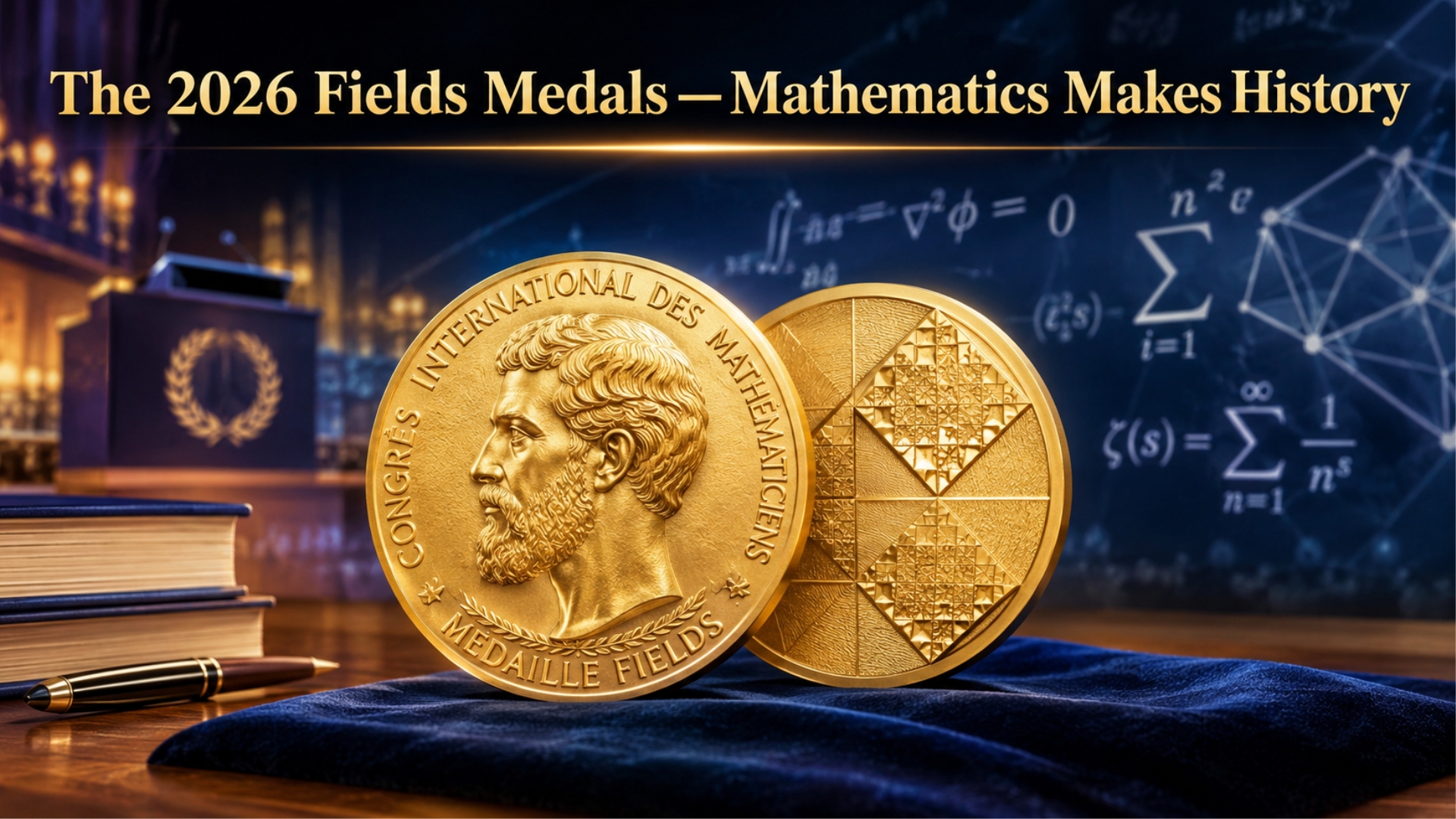
Each winner receives CAD 15,000 and a gold medal bearing the image of the Greek mathematician Archimedes. The prize money is modest by the standards of other major awards. What the medal confers is something far more valuable than money — it is the recognition of peers, the weight of history and membership in one of the smallest and most distinguished clubs in human intellectual life.
This year’s prizes went to four of the world’s top mathematicians: Yu Deng of the University of Chicago, John Pardon of Stony Brook University in New York, Jacob Tsimerman of the University of Toronto, and Hong Wang of New York University and France’s Institut des Hautes Études Scientifiques. The IMU president Hiraku Nakajima praised their depth, originality and vitality in contemporary mathematics.
Hong Wang — The History Maker
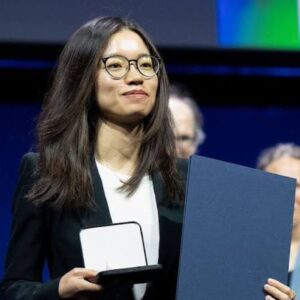
Of the four winners, it is Hong Wang whose story has captured the world’s imagination most powerfully. Wang is the third woman ever to win the Fields Medal in the 90 years since the award was established. The first was Iranian mathematician Maryam Mirzakhani in 2014, followed by Ukrainian mathematician Maryna Viazovska in 2022. No woman received the award at all in the nearly 80 years before Mirzakhani’s win. That statistic alone tells a story about the historical barriers women have faced in mathematics — and Wang’s win is another step, however overdue, toward dismantling them.
Wang, 35, was born in Guilin, China, and is now a professor at New York University as well as a researcher at the Institut des Hautes Études Scientifiques in France. Her award was for work on the Kakeya conjecture, a deceptively simple-sounding problem that had defeated mathematicians for roughly 50 years. The conjecture asks how little space is needed to rotate a needle in three-dimensional space so that it points in every possible direction. It sounds almost like a puzzle from a school textbook — and yet the mathematics required to answer it reaches into some of the deepest and most sophisticated corners of geometry and analysis.
In February 2025, Wang and her collaborator Joshua Zahl presented a 127-page proof of the long-standing conjecture. The duo had been checking their work for months and had sent it to select colleagues for review before finally mustering the courage to post it publicly. Wang worried less that the arguments were flawed than that they might be imperfectly expressed and therefore unclear.
That attention to clarity and precision is characteristic of Wang’s approach to mathematics. She has spoken openly about working harder than she feels she needs to, about the self-doubt that accompanies even the most celebrated careers in mathematics, and about the satisfaction of solving problems that others have given up on. Her story is a reminder that mathematical genius is not a thunderbolt — it is the product of sustained effort, intellectual courage and an unwillingness to accept that something cannot be done.
Yu Deng — Bridging the Microscopic and the Macroscopic
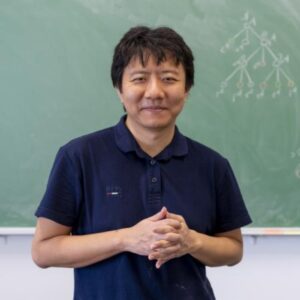
Yu Deng, a professor at the University of Chicago, received his medal for work that sits at the boundary between mathematics and physics. Specifically he was recognised for connecting microscopic and macroscopic descriptions of gases — for building mathematical bridges between the behaviour of individual molecules and the large-scale behaviour of fluids and gases that we observe in the physical world.
Yu Deng and Hong Wang are only the second and third Chinese nationals to have earned a Fields Medal, after Shing-Tung Yau who won his in 1982. That two Chinese-born mathematicians won in the same year, after a gap of more than four decades, is a remarkable moment. It reflects both the extraordinary depth of mathematical talent emerging from China and the increasingly global character of the discipline.
Deng’s work helped resolve a longstanding conceptual puzzle in physics. Microscopic physics — the behaviour of individual particles — works just as well when time is reversed. If you filmed two molecules bouncing off each other and played it backwards you would not be able to tell the difference. But when many molecules form a fluid, they behave in a clearly irreversible way — heat flows from hot to cold, never the reverse, without any external interference. Deng’s mathematics helps explain how irreversibility emerges from a world of reversible interactions. It is the kind of question that sits at the deepest level of our understanding of the physical universe.
John Pardon — Solving Topology’s Hardest Problems
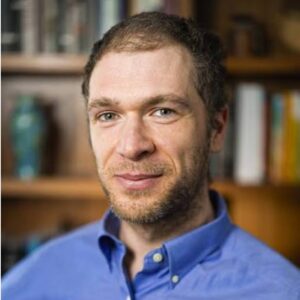
John Pardon of Stony Brook University in New York was honoured for work in topology and geometry — two of the oldest and richest branches of mathematics. Topology is concerned with properties of shapes that remain unchanged when those shapes are continuously stretched, bent or deformed without tearing. In topology, a coffee cup and a donut are mathematically identical because one can be smoothly transformed into the other. It is a field that sounds abstract but underpins significant parts of modern physics, robotics and data science.
Pardon has spent his career tackling problems in topology and geometry that had resisted solution despite decades of effort by the best minds in the field. His methods are characterised by a willingness to combine ideas from different areas of mathematics in unexpected ways — a quality he shares with several of this year’s other honourees. His work has not only solved specific problems but opened up new lines of inquiry that will keep mathematicians busy for years.
Jacob Tsimerman — New Tools for Ancient Puzzles

Jacob Tsimerman of the University of Toronto works at the intersection of number theory and algebraic geometry — two fields that have been in increasingly deep conversation over the last century. Number theory is among the oldest branches of mathematics, concerned with the properties of whole numbers and the patterns hidden within them. Algebraic geometry translates geometric questions into algebraic language and vice versa, creating a powerful two-way dictionary between shape and equation.
Tsimerman’s contribution has been to develop new technical tools in this space that have allowed mathematicians to make progress on problems that had previously seemed completely out of reach. His methods combine deep ideas from several different areas of mathematics in ways that were not obvious to anyone before him. In the world of mathematics, this kind of bridge-building is often the most valuable contribution of all — not just solving one problem but creating the machinery that allows many others to be solved.
The Bigger Picture
The 2026 Fields Medal class is striking not just for the brilliance of the individual mathematics but for what it represents collectively. A Chinese-born woman solving a 50-year-old geometry problem. Two Chinese-born winners for the first time in four decades. An American solving topology’s hardest problems. A Canadian building new roads through algebraic geometry. Four people from four different corners of the mathematical world, united by the same relentless curiosity and the same willingness to spend years on problems that might defeat them.
Mathematics has always been one of the few truly universal languages. This year’s medalists are a powerful reminder of why. The discipline does not care about borders, backgrounds or biography. It cares only about ideas — and whether they are true.
The 2026 Abacus Medal and the full ICM prize ceremony — coming soon.
For more blog updates, keep following International Maths Challenge.