A 125-year-old challenge by David Hilbert — to mathematically unify the laws of physics — just got a major breakthrough.
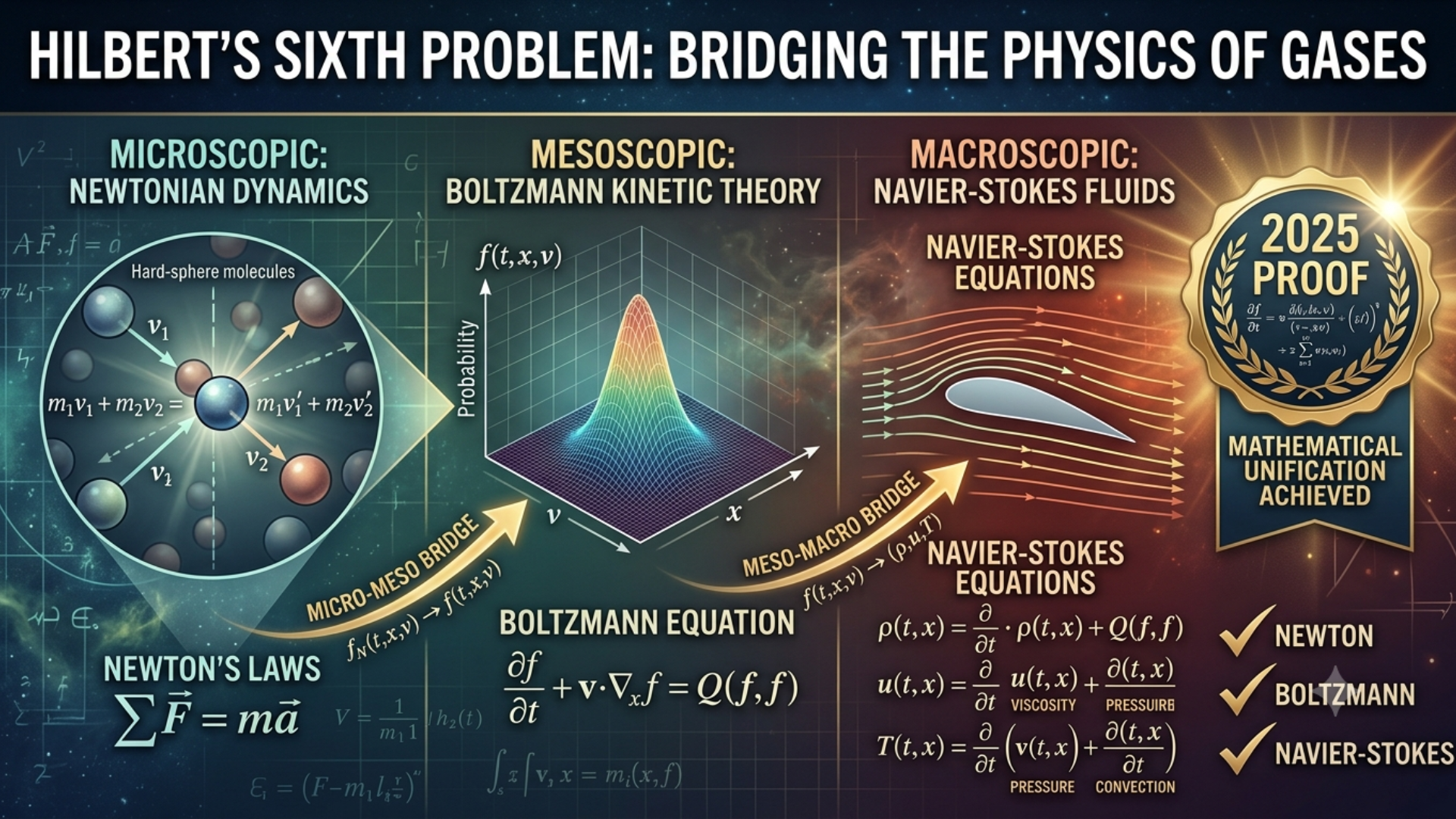
Three levels of gas physics — Newton (microscopic), Boltzmann (mesoscopic), and Navier-Stokes (macroscopic) — bridged in a 2025 proof.
In 1900, the German mathematician David Hilbert set mathematics a challenge that has defined a century of research. He published a list of 23 unsolved problems — a kind of to-do list for the twentieth century and beyond. His sixth problem was among the boldest: can the laws of physics, which physicists derive from observation and intuition, be derived from pure mathematical axioms, the way theorems are proved from first principles?
One specific version of this challenge concerns the behaviour of gases. Physicists describe gas at three different scales: at the microscopic level, they use Newton’s laws of motion to track individual molecules; at the mesoscopic level (vast numbers of molecules but not yet a bulk fluid), they use the Boltzmann equation; and at the macroscopic level (a room full of air), they use the Navier-Stokes equations of fluid dynamics. All three describe the same physical reality, but they are not mathematically unified. Nobody had been able to rigorously derive one from another, from first principles, without patching in extra assumptions.
The 2025 breakthrough
In 2025, a trio of mathematicians — Yu Deng (University of Chicago), Zaher Hani (University of Michigan), and Xiao Ma — published a landmark proof connecting these three levels of description. Their work shows, rigorously and for the first time, how the microscopic Newtonian world of individual gas molecules transitions continuously into the Boltzmann equation and then into the macroscopic Navier-Stokes equations. No extra assumptions. No mathematical hand-waving.
“It reshapes our understanding of the natural world — not just solving a century-old problem, but providing a new mathematical foundation for the physics of fluids.” — Quanta Magazine, 2025
The proof is a tour de force of modern analysis, drawing on techniques from probability theory, kinetic theory, and partial differential equations. Quanta Magazine named it one of the top three mathematical breakthroughs of 2025, alongside the Kakeya conjecture and new results on hyperbolic surfaces.
Why it matters
The practical implications are significant. The Navier-Stokes equations underpin everything from weather forecasting and aircraft design to the modelling of ocean currents. Having a mathematically rigorous derivation of these equations from first principles does not change the equations themselves — but it gives physicists and mathematicians a far deeper understanding of when and why these equations can be trusted, and where their limits lie. It is the difference between knowing a recipe works and understanding the chemistry behind why it works.
Sources & Further Reading
Deng, Y., Hani, Z. & Ma, X. (2025). Full derivation of the Euler and Navier-Stokes equations from classical mechanics. Preprint.
Quanta Magazine (2025). The Biggest Breakthroughs in Mathematics: 2025. quantamagazine.org
GIGAZINE (2025). What are the three biggest breakthroughs in mathematics in 2025? gigazine.net
Scientific American (2025). The Top 10 Math Discoveries of 2025. scientificamerican.com